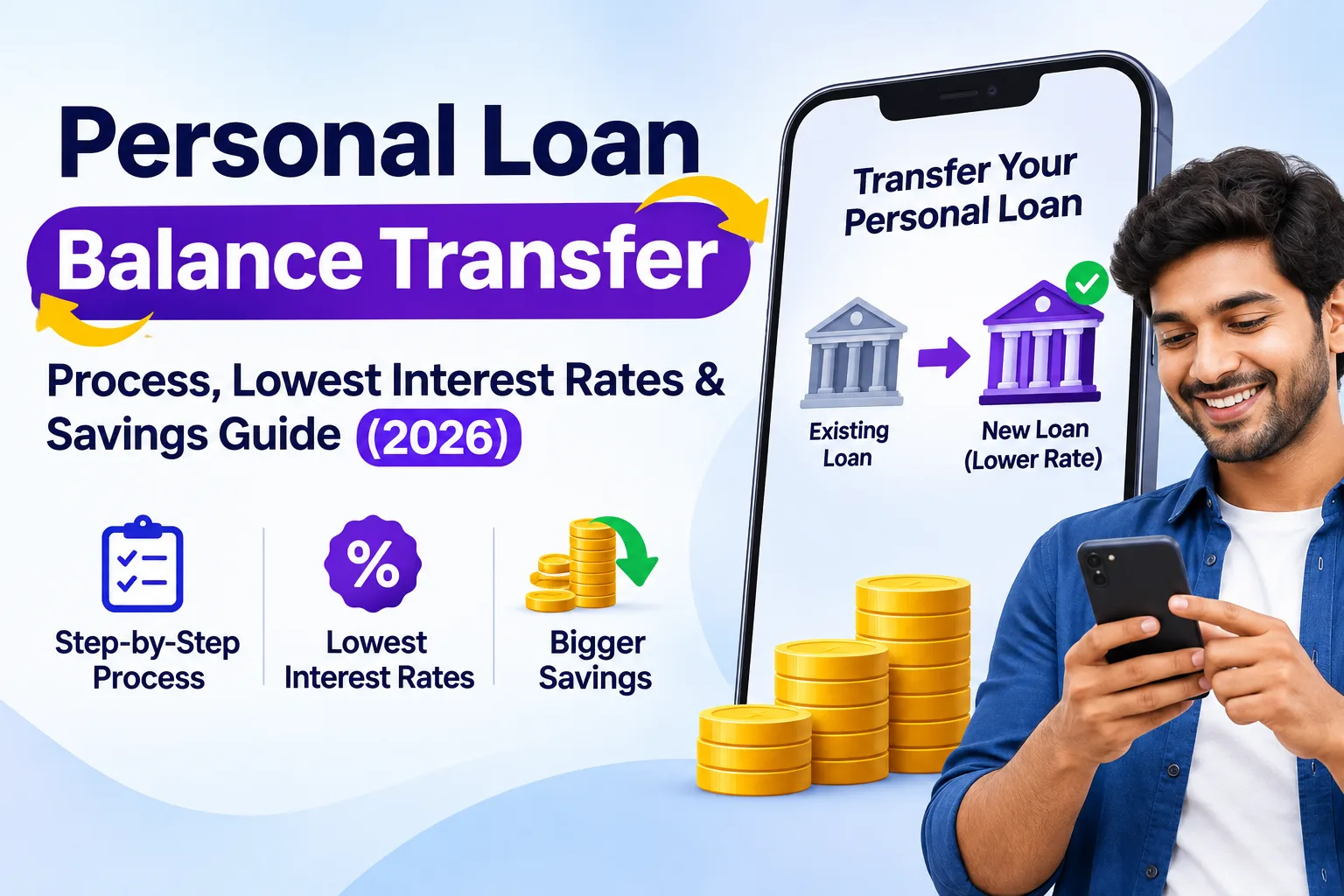


A personal loan balance transfer is a debt refinancing facility that lets you move your unpaid personal loan principal from your existing lender to a new bank or Non-Banking Financial Company (NBFC) at a lower interest rate or better repayment terms. In India, borrowers typically use a balance transfer loan when their CIBIL score improves or market lending rates drop after taking an expensive initial loan. However, a personal loan balance transfer only saves money if the interest reduction outweighs the new lender’s processing fees and any foreclosure penalty charged by your current lender. At Pocketly, while we focus on transparent short-term digital personal loans from ₹1,000 to ₹50,000 rather than multi-lakh balance transfers, we help you evaluate every switching cost clearly before you refinance.
Quick Answer: Personal Loan Balance Transfer at a Glance
|
Parameter |
How It Works for Indian Borrowers |
|
What Is Balance Transfer Loan |
Moving an active, unpaid personal loan from Lender A to Lender B for lower interest or better tenure terms. |
|
Ideal Timing to Switch |
Within the first half of your loan tenure (at least 12+ months remaining) when interest outgo is highest. |
|
Typical Credit Score Needed |
Usually 720–750+ CIBIL score with 6–12 consecutive on-time EMIs for the personal loan balance transfer lowest interest rate. |
|
Switching Costs to Check |
New processing fee (typically 0.5%–2% + 18% GST) plus existing lender’s foreclosure charge (0%–5% on fixed-rate loans). |
|
RBI Rule Update (2026) |
Under RBI’s Pre-payment Charges Directions (effective Jan 1, 2026), floating-rate individual non-business loans carry zero foreclosure penalty; fixed-rate personal loans may still carry agreed exit fees. |
|
Alternative for Small Shortfalls |
For urgent ₹1,000–₹50,000 cash gaps, explore our paperless digital loans underwritten by Speel Finance Company Private Limited. |
What Is a Balance Transfer Loan?
Understanding what is balance transfer loan mechanics comes down to replacing expensive existing debt with cheaper credit. When you initiate a personal loan balance transfer, your new lender pays off the remaining principal directly to your old bank or NBFC. Your old loan account closes, and you begin paying fresh monthly Equated Monthly Instalments (EMIs) to the new lender under a revised interest rate and tenure.
Borrowers generally opt for a balance transfer loan for three reasons:
-
Lower Interest Outgo: Shifting from a 16%–20% p.a. loan to an 11%–13% p.a. offer reduces overall interest paid.
-
Lower Monthly EMI: A reduced interest rate—or a slightly extended tenure—lowers monthly cash outflow and improves your Fixed Obligation to Income Ratio (FOIR).
-
Top-Up Liquidity: Many banks offer an optional top-up personal loan alongside a personal loan balance transfer, letting you borrow extra funds at the lower refinancing rate without applying separately.
Before deciding whether to refinance or clear debt early, check your potential savings on our loan balance transfer calculator and verify early exit charges with our loan foreclosure calculator.
How Does the Personal Loan Balance Transfer Process Work?
The personal loan balance transfer process involves coordination between you, your existing lender, and the incoming lender. Under the Reserve Bank of India (RBI) Digital Lending Directions and the RBI (Pre-payment Charges on Loans) Directions, 2025 (effective for loans sanctioned or renewed from January 1, 2026), regulated lenders must disclose all transfer costs and foreclosure rules upfront in a Key Fact Statement (KFS).
Follow this step-by-step personal loan balance transfer process:
-
Calculate Net Savings First: Check your remaining principal, remaining tenure, and existing interest rate. Run these numbers through our loan comparison calculator alongside our personal loan EMI calculator to verify that total interest saved exceeds switching fees.
-
Request Foreclosure Documents from Current Lender: Apply for a Foreclosure Letter (Statement of Account) and a No Objection Certificate (NOC) conditional quote showing the exact payoff figure as of a specific settlement date.
-
Compare Offers for the Personal Loan Balance Transfer Lowest Interest Rate: Compare KFS quotes across banks and NBFCs, checking the Annual Percentage Rate (APR) rather than just headline rates.
-
Submit Application & KYC: Submit your PAN card, Aadhaar verification, bank statements, income proof, and existing loan statement to the new lender.
-
Loan Closure & Disbursal: Once approved, the new lender issues a demand draft or NEFT/RTGS transfer directly to your old lender to close the existing loan.
-
Collect Final NOC & Start New EMIs: Confirm your old loan status shows "Closed" with your previous lender, download your final NOC, and activate your new e-NACH or UPI auto-debit mandate. For details on automated repayments, read our guide on UPI mandate explained.
Eligibility Criteria & Documents Required for a Balance Transfer Loan
Because a personal loan balance transfer is unsecured, lenders screen applicants carefully before offering their personal loan balance transfer lowest interest rate tiers:
-
Credit Bureau Track Record: Most banks expect a CIBIL score of 720–750+ and at least 6 to 12 consecutive on-time EMI repayments on the existing loan.
-
Minimum Outstanding Principal & Tenure: Banks generally require a minimum remaining balance (often ₹50,000 or higher) and at least 12 months of remaining tenure.
-
Stable Income & Safe FOIR: Lenders check that your total monthly EMIs—including the new balance transfer loan—stay within 40% to 50% of your net monthly income. You can check your ratio on our FOIR calculator.
-
Standard KYC & Loan Proofs: Valid PAN card, Aadhaar-based address proof, last 3–6 months’ bank statements, salary slips or ITR/business financials, and the existing lender’s loan account statement and foreclosure quote.
Costs, Interest Rates & Illustrative Balance Transfer Calculation
Securing the personal loan balance transfer lowest interest rate does not automatically guarantee savings if upfront fees are steep. Always check four cost components:
-
New Lender Processing Fee: Usually 0.5% to 2% of the transferred principal plus 18% GST (some lenders offer flat promotional fees).
-
Existing Lender Foreclosure Penalty: Under RBI rules effective January 1, 2026, regulated entities cannot levy prepayment penalties on floating-rate loans granted to individuals for non-business purposes. However, most personal loans in India are fixed-rate loans, where lenders may still charge 2% to 5% + GST as disclosed in your original loan agreement.
-
Stamp Duty & Documentation Fees: Applicable state stamp duty on the fresh loan agreement.
-
APR vs. Nominal Rate: Always compare the KFS Annual Percentage Rate, and check whether your quote uses a reducing balance or flat rate using our flat vs reducing rate calculator.
Illustrative Worked Example: ₹4,00,000 Personal Loan Balance Transfer
Disclaimer: The numbers below are purely illustrative for educational understanding and do not represent Pocketly product pricing.
|
Loan Parameter |
Existing Loan (Lender A) |
Refinanced Balance Transfer Loan (Lender B) |
|
Outstanding Principal |
₹4,00,000 |
₹4,00,000 |
|
Remaining Tenure |
36 Months (3 Years) |
36 Months (3 Years) |
|
Applicable Interest Rate |
16.00% p.a. (Reducing) |
11.50% p.a. (Reducing) |
|
Monthly EMI |
₹14,063 |
₹13,190 |
|
Total Remaining Interest |
₹1,06,268 |
₹74,840 |
|
Switching Costs (1% Processing + GST) |
— |
₹4,720 (assuming zero foreclosure fee) |
|
Net Lifetime Savings |
— |
₹26,708 net savings |
If Lender A charges a 3% foreclosure penalty (₹12,000 + ₹2,160 GST = ₹14,160), net savings drop to ₹12,548. If only 10 months remained on the loan, switching costs would exceed the interest saved—making the personal loan balance transfer unviable.
How Pocketly Supports Short-Term Liquidity Without Multi-Year Lock-Ins
A traditional personal loan balance transfer is built for multi-lakh bank loans with 2 to 5 years of remaining tenure. It requires foreclosure letters, inter-bank settlements, and several days of verification.
If you do not hold a multi-lakh loan—or you simply need a quick, transparent cash bridge of ₹1,000 to ₹50,000 for urgent bills, rent gaps, or medical expenses without falling into high-APR credit card rollovers—we offer 100% digital micro-credit tailored to your income profile:
-
For Salaried Professionals: Smooth out month-end shortfalls before payday with our personal loan for salaried option.
-
For Self-Employed Earners & Freelancers: Manage delayed client invoices or working capital gaps through our personal loan for self employed tier.
-
For Students & Non-Salaried Earners: If you earn via stipends, gigs, or regular allowances without corporate payslips, explore our personal loan for non salaried pathway—no prior CIBIL score is mandatory to apply with us.
All loans facilitated on Pocketly are sanctioned and disbursed by our RBI-registered NBFC partner, Speel Finance Company Private Limited, with tenures from 61 days to 9 months, monthly interest of 2% to 3% (reducing balance), processing fees of 0% to 7.5% plus 18% GST (APR 30% to 121%), and upfront Key Fact Statement disclosures in line with our responsible lending standards. Note that while completing our paperless KYC takes just a few minutes—often searched as an instant personal loan online in 2 minutes—final approval and bank disbursal depend on real-time KYC validation and underwriting checks.
What Should You Check & Common Mistakes to Avoid Before Applying
Before submitting a balance transfer loan application, avoid these common pitfalls:
-
Transferring Late in the Tenure: Under reducing-balance amortisation, you pay most of your interest in the first half of the loan. Refinancing in the final 6 to 12 months rarely recovers processing fees.
-
Extending Tenure Without Checking Total Interest: Stretching a 24-month remaining loan into 48 months lowers your monthly EMI, but can increase your total interest outgo despite a lower rate.
-
Overlooking Foreclosure & GST Charges: Always confirm whether your existing personal loan is fixed-rate or floating-rate and factor 18% GST into every fee calculation.
-
Applying Simultaneously Across Multiple Lenders: Submitting multiple personal loan balance transfer applications triggers hard CIBIL inquiries that can temporarily lower your score. Check your borrowing capacity safely first using our personal loan eligibility calculator.
-
Turning to Unverified Loan Apps for EMI Repayments: Never borrow from unlicensed 7-day apps to pay existing EMIs. Read our guide on 7 days loan vs 30 days loan and review what to do if you cannot pay a loan EMI to protect your credit profile.
Final Takeaway: Calculate Net Savings Before You Switch
A personal loan balance transfer works best when you are early in your repayment schedule, hold a strong credit score, and confirm that total interest savings exceed processing fees and foreclosure charges. Always review your Key Fact Statement carefully before signing any refinancing contract.
And whenever you need transparent, small-ticket digital credit from ₹1,000 to ₹50,000 without multi-year lock-ins, we are here to help:
-
👉 Calculate Your Net Savings on Our Loan Balance Transfer Calculator
-
👉 Plan Monthly Repayments with Our Personal Loan EMI Calculator
Also Read: Latest Guides & News on Pocketly
-
What Is a Personal Loan? Meaning, How It Works & Borrowing Guide
-
Education Loans Hit ₹2.5 Lakh Crore in 2026: CIBIL Report News
Frequently Asked Questions (FAQs)
1. What is a personal loan balance transfer and how does it work?
A personal loan balance transfer is the process of shifting your unpaid personal loan principal from your existing bank or NBFC to a new lender offering a lower interest rate or better repayment terms. Your new lender pays off your old loan directly, and you repay the transferred balance through new monthly EMIs.
2. What is balance transfer loan eligibility in India?
Understanding what is balance transfer loan eligibility starts with your repayment record: most banks require a CIBIL score of 720–750+, at least 6 to 12 consecutive on-time EMIs paid to your current lender, regular income, and at least 12 months of remaining tenure.
3. How can I get the personal loan balance transfer lowest interest rate?
To qualify for the personal loan balance transfer lowest interest rate, maintain a CIBIL score above 750, keep your FOIR below 40%–50%, ensure zero recent missed EMIs, and compare Key Fact Statements across multiple regulated banks before applying.
4. How long does the personal loan balance transfer process take?
The personal loan balance transfer process typically takes 3 to 7 working days, as it requires obtaining a foreclosure quote from your existing lender, completing KYC and income verification with the new lender, and settling the payoff amount via NEFT/RTGS or demand draft.
5. Are there foreclosure charges on a personal loan balance transfer in 2026?
Under RBI’s Pre-payment Charges Directions effective January 1, 2026, lenders cannot levy prepayment charges on floating-rate loans granted to individuals for non-business purposes. However, most personal loans are fixed-rate loans, which may still carry a 2% to 5% foreclosure charge as stated in your loan agreement.
6. Can I get a top-up loan during a personal loan balance transfer?
Yes, many banks and NBFCs allow eligible borrowers to apply for an additional top-up amount alongside a balance transfer loan, subject to income eligibility and credit underwriting.
7. Does Pocketly offer a personal loan balance transfer or short-term personal loans?
At Pocketly, we do not offer multi-lakh bank balance transfers; instead, we facilitate 100% digital personal loans from ₹1,000 to ₹50,000 (61 days to 9 months tenure) through our RBI-registered NBFC partner, Speel Finance Company Private Limited, for urgent short-term cash needs.
8. Can I get an instant personal loan online in 2 minutes with Pocketly?
Completing our digital onboarding and paperless Video KYC takes only a few minutes on your smartphone, often searched as an instant personal loan online in 2 minutes. However, final approval and bank transfer depend on real-time KYC validation and automated underwriting checks.
9. Which Pocketly loan options are available for salaried, self-employed, and non-salaried borrowers?
If you earn a monthly salary, explore our personal loan for salaried option; if you are self-employed or freelance, check our personal loan for self employed tier; and if you earn via stipends or gigs without payslips, explore our personal loan for non salaried category.
10. What should I check when comparing options for the best loan app in India?
When evaluating options to find the best loan app in India for your needs, verify the underlying RBI-registered NBFC or bank, inspect the Key Fact Statement (KFS) for total APR and fees, confirm data-security standards, and ensure repayments fit comfortably within your budget.