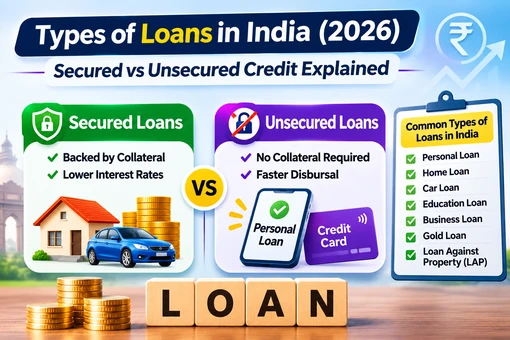


Understanding the types of loans available in India helps you pick credit that matches your goal, repayment ability, and timeline without paying unnecessary interest. Broadly, Indian banks and Reserve Bank of India (RBI)-registered Non-Banking Financial Companies (NBFCs) classify loans into two main categories secured loans (backed by collateral such as property, gold, or a vehicle) and unsecured loans (approved without physical security, such as personal loans and education loans under specified limits). However, eligibility, interest rates, and sanctioned amounts always depend on lender underwriting and KYC verification. At Pocketly, we facilitate 100% digital unsecured personal loans from ₹1,000 to ₹50,000 through our RBI-registered NBFC partner, Speel Finance Company Private Limited.
Quick Answer: Types of Loans in India
When borrowers ask how many types of loan products exist in India, the simplest way to compare them is by collateral requirement, typical use case, and repayment window:
|
Loan Category |
Collateral Needed? |
Common Examples in India |
Typical Repayment Window |
Best Suited For |
|
Unsecured Personal Loans |
No |
Digital micro-loans, salary advances, retail personal loans |
61 days to 5 years (61 days–9 months on Pocketly) |
Urgent medical bills, rent, travel, exam fees, month-end cash gaps |
|
Secured Home Loans |
Yes (Property) |
Home purchase, home construction, plot + construction |
Up to 20–30 years |
Long-term residential property buying |
|
Secured Auto / Two-Wheeler Loans |
Yes (Vehicle) |
New car loan, used car loan, bike/scooter loan |
1 to 7 years |
Commuting or family vehicle purchases |
|
Secured Gold Loans |
Yes (Gold jewellery/coins) |
Overdraft against gold, bullet-repayment gold loan |
3 months to 3 years |
Short-term liquidity against household gold |
|
Education Loans |
Collateral-free up to specified bank limits; secured above |
Domestic degree loans, overseas study loans |
5 to 15 years (often with moratorium) |
Higher education tuition and living expenses |
|
Business & MSME Loans |
Both secured & unsecured |
Working capital loans, term loans, merchant cash advances |
6 months to 10 years |
Inventory, equipment, and business cash flow |
How Many Types of Loan Categories Exist in India?
If you are wondering how many types of loan options Indian lenders offer, financial institutions group credit across three practical lenses: security (collateral), purpose (end-use), and repayment structure (tenure).
1. Classification by Security: Secured vs. Unsecured Loans
-
Secured Loans: You pledge an asset such as a house, commercial property, vehicle, gold ornaments, or fixed deposit as security. Because the lender holds a legal claim over the asset until full repayment, secured loans usually carry lower interest rates and longer tenures.
-
Unsecured Loans: You do not pledge physical collateral or arrange a third-party asset guarantee. Lenders assess your identity, banking cash flow, and repayment capacity instead. Our types of personal loans guide explains how unsecured personal credit works across everyday Indian needs.
2. Classification by Repayment Structure: Term Loans vs. Credit Lines
-
Term Loans: You receive a fixed lump sum upfront and repay principal plus interest through scheduled Equated Monthly Instalments (EMIs) over a fixed period. You can explore tenure-based structures in our breakdown of different types of term loan options.
-
Revolving Credit Lines & Overdrafts: You are approved for a maximum credit limit and pay interest only on the amount you withdraw and use. For deeper banking distinctions, read our guide on types of loans and advances in banking.
Different Types of Loans in India by Purpose
Comparing the different types of loans by end-use prevents you from taking a high-cost short-term loan for a multi-year asset or locking into a multi-year bank loan when you only need ₹10,000 until payday.
1. Personal Loans (Short-Term & Retail)
A personal loan is an unsecured facility with flexible end-use for legitimate personal expenses. Traditional banks offer larger retail personal loans (often ₹50,000 to ₹40,00,000 over 1 to 5 years) to borrowers with high credit scores and formal salary slips. For smaller, immediate needs, digital micro loans bridge short-term gaps without collateral.
At Pocketly, we facilitate personal loans from ₹1,000 to ₹50,000 with repayment tenures from 61 days to 9 months, underwritten and disbursed by Speel Finance Company Private Limited (an RBI-registered NBFC). Before choosing an amount, test your monthly outgo on our personal loan EMI calculator.
2. Home Loans
Home loans are long-term secured loans used to buy a ready flat, build a house, or renovate an existing residence. Under RBI guidelines, banks link floating-rate retail home loans to an external benchmark such as the RBI Policy Repo Rate (which stands at 5.50% following the October 2026 Monetary Policy Committee review). You can estimate long-term housing instalments using our home loan EMI calculator.
3. Car and Two-Wheeler Loans
Auto loans finance new or pre-owned cars and two-wheelers, with the vehicle hypothecated to the lender until the final EMI is cleared. Lenders typically fund 75% to 90% of the vehicle's on-road or ex-showroom value depending on your credit profile. Check monthly vehicle instalments beforehand with our car loan EMI calculator.
4. Gold Loans
Gold loans allow households to unlock liquidity by pledging gold jewellery (generally 18 to 22 karats) with a bank or gold-loan NBFC. According to RBI guidelines, Loan-to-Value (LTV) norms govern the maximum credit sanctioned against pledged gold value, and jewellery is returned once principal and interest are repaid.
5. Education Loans
Education loans cover college tuition, hostel fees, books, and travel for approved courses in India or abroad. Many banks offer collateral-free student loans up to ₹4 lakh to ₹7.5 lakh (often with a co-borrower), while larger overseas education loans require tangible security.
6. Business and Working Capital Loans
From shopkeepers managing seasonal stock to freelancers upgrading work equipment, business loans support commercial operations. Depending on turnover and GST filings, entrepreneurs can apply for unsecured business loans, MSME term loans, or collateral-backed Loans Against Property (LAP).
How Different Types of Loans Work Under RBI Rules
Whether you apply at a commercial bank or through a digital lending platform, regulated types of loans in India follow strict consumer protection standards laid down by the Reserve Bank of India (RBI):
-
Mandatory KYC Verification: Lenders verify your identity and address using official documents such as your PAN card and Aadhaar-based authentication before sanctioning credit.
-
Creditworthiness & Debt-Ratio Check: Lenders review your income continuity, existing EMIs, and credit bureau records (such as CIBIL or Experian). You can check your existing debt burden on our FOIR calculator.
-
Key Fact Statement (KFS) Disclosure: Under RBI's Digital Lending Directions, regulated lenders must provide a standardized Key Fact Statement before you sign the loan contract. The KFS clearly states the Annual Percentage Rate (APR), processing fees, GST, net disbursal amount, repayment schedule, and cooling-off period.
-
Direct Account Disbursal & Repayment: Approved funds are transferred straight from the regulated lender's account to your bank account via IMPS, NEFT, or RTGS, and repaid through scheduled EMIs or UPI/NACH auto-debits.
Who Is Eligible & What Documents Are Needed?
Eligibility criteria vary across the types of loans in India. Secured loans focus heavily on asset valuation and long-term income stability, whereas traditional bank personal loans often require a 700–750+ CIBIL score and formal corporate salary slips.
At Pocketly, we keep our eligibility criteria accessible for young Indian earners:
-
Residency & Age: You must be an Indian resident aged between 18 and 40 years.
-
Regular Cash Inflow: A verifiable monthly income source from full-time employment, freelancing, small business receipts, or a regular student allowance.
-
Credit History Flexibility: A prior CIBIL score is not mandatory to apply with us. First-jobbers with thin credit files are evaluated on current banking cash flows and KYC verification.
-
Active Savings Account: A domestic bank account in your own name enabled for digital banking.
Documents Required on Pocketly (100% Paperless):
-
Valid PAN card details for identity verification.
-
Aadhaar-based digital address verification.
-
A smartphone camera for a brief in-app Video KYC.
-
Active Indian savings bank account details and verified mobile number/email ID.
You can check your safe borrowing range before applying using our personal loan eligibility calculator.
Tailored Pocketly Loan Options for Your Income Profile
Because young Indians earn across diverse work structures, we offer dedicated personal loan pathways tailored to your cash flow:
-
Salaried Professionals: If an urgent medical bill, rent payment, or utility expense arrives before payday, explore our personal loan for salaried applicants for short-term liquidity from ₹1,000 to ₹50,000.
-
Self-Employed & Freelancers: If delayed client invoices create a temporary cash gap, our personal loan for self employed option helps you manage expenses without branch paperwork.
-
Non-Salaried Earners & Students: If you receive stipends, gig payouts, or regular allowances without corporate payslips, check our personal loan for non salaried category.
Costs, Interest Rates & Illustrative EMI Example
Before choosing among the types of loans, always compare the all-inclusive Annual Percentage Rate (APR) rather than looking only at headline monthly or annual interest percentages. You can also compare interest calculation methods using our flat vs reducing rate calculator.
Under our published responsible lending standards, here are our verified product parameters:
-
Loan Amount: ₹1,000 to ₹50,000 (subject to eligibility and underwriting).
-
Repayment Tenure: 61 days to 9 months.
-
Interest Rate: 2% to 3% per month.
-
Processing Fee: 0% to 9.4% of the loan amount (inclusive of applicable 18% GST).
-
Annual Percentage Rate (APR): 30% to 121% (capped at 99.73% per annum across core personal micro-products).
-
Foreclosure Charge: 2.5% on the outstanding principal balance if you settle early. Check potential early-closure savings on our loan foreclosure calculator.
Illustrative Repayment Breakdown (₹5,000 Personal Loan)
|
Loan Parameter |
Illustrative Breakdown |
|
Sanctioned Principal |
₹5,000.00 |
|
Repayment Tenure |
90 Days (3 Months) |
|
Annualized Interest Rate |
36% p.a. (3% per month) |
|
Processing Fee + 18% GST |
₹425.00 |
|
Net Amount Disbursed |
₹4,575.00 |
|
Total Interest Payable |
₹302.96 |
|
Estimated Monthly EMI |
Approx. ₹1,767.65 per month |
|
Total Repayment Amount |
₹5,302.96 |
|
Representative APR |
93.15% p.a. |
Disclaimer: The figures above are purely illustrative. Your actual loan limit, interest rate, processing fee, and repayment schedule depend on individual underwriting and appear on your Key Fact Statement (KFS).
What Should You Check Before Applying? (And Common Mistakes to Avoid)
When comparing lenders or searching for the best loan app in India for your specific needs verify the regulated NBFC or bank partner, APR, processing fees, repayment tenure, Key Fact Statement, and total repayment obligation before accepting an offer.
Common Borrowing Mistakes to Avoid:
-
Using Unregulated 7-Day Loan Apps: Predatory apps outside RBI oversight trap borrowers in ultra-short repayment cycles with steep hidden deductions. Review our guide on 7 days loan vs 30 days loan and our updated list of loan apps banned in India to stay safe.
-
Submitting Multiple Applications at Once: Applying across several lenders simultaneously creates multiple hard credit inquiries, which can lower your credit score.
-
Ignoring Monthly Budget Caps: Keep total monthly EMIs well below 40% to 50% of your net income. You can plan your monthly spending buckets with our 50 30 20 rule calculator.
-
Missing EMI Due Dates: Late payments trigger penal charges and hurt your credit bureau profile. Read our guide on what happens if you miss a loan EMI so you know how to manage repayment stress early.
Final Takeaway: Choose the Right Type of Loan for Your Needs
Matching your borrowing goal to the right credit category among the types of loans in India protects your savings and keeps your monthly EMIs manageable. Use secured loans for long-term assets like homes or vehicles, and choose transparent, regulated personal credit for short-term liquidity gaps always reviewing your Key Fact Statement and total repayment obligation before signing.
Also Read: Latest Guides & News on Pocketly
-
List of Loan Apps Banned in India (2019–2026) & Complaint Guide
-
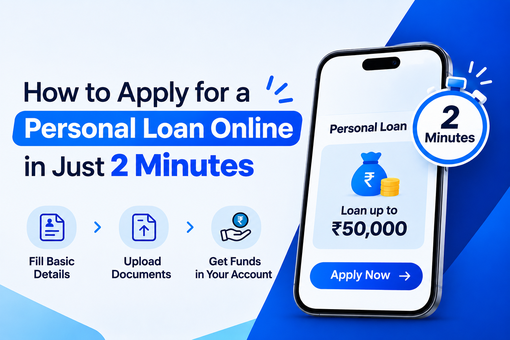
How to Apply for a Personal Loan: A Simple Step-by-Step Guide
-
RBI Proposes Stop Switch & Trusted Person for Bank Fraud (Nov 2026)
Frequently Asked Questions (FAQs)
1. How many types of loan options are broadly available in India?
Broadly, the types of loans in India fall into two primary categories: secured loans (such as home loans, car loans, and gold loans backed by collateral) and unsecured loans (such as personal loans and collateral-free education loans approved on income and KYC checks).
2. Which type of loan is best for urgent personal expenses without collateral?
An unsecured personal loan is designed for urgent personal expenses because it requires no property, gold, or guarantor. At Pocketly, eligible borrowers can apply digitally for personal loans from ₹1,000 to ₹50,000 through our RBI-registered NBFC partner, Speel Finance Company Private Limited, subject to verification and underwriting.
3. Can I get an instant personal loan online in 2 minutes?
While completing our smartphone registration and paperless KYC takes only a few minutes, an instant personal loan online in 2 minutes refers to fast digital onboarding rather than guaranteed approval or guaranteed two-minute disbursal. Final sanction and bank transfer depend on real-time KYC validation and underwriting checks.
4. What are the different types of loans offered on Pocketly?
At Pocketly, we offer unsecured digital personal loans tailored to three borrower profiles: our personal loan for salaried applicants, our personal loan for self employed professionals, and our personal loan for non salaried earners and students, subject to eligibility criteria.
5. What documents do I need to apply for a personal loan with Pocketly?
Our application journey is 100% digital. You need your valid PAN card details, Aadhaar-based digital address verification, an active Indian savings bank account, and a smartphone camera to complete a quick in-app Video KYC.
6. Do I need a CIBIL score to apply for a personal loan with Pocketly?
No, a prior CIBIL score is not mandatory to apply with us. If you are a first-jobber or young earner with no credit history, our underwriting evaluates your current monthly cash inflow and digital KYC credentials.
7. How can I calculate my monthly EMI before choosing among types of loans in India?
You can estimate your exact monthly instalment and total interest payable before applying by entering your desired loan amount and tenure into our free personal loan EMI calculator.
8. What should I check when comparing options for the best loan app in India?
If you are comparing platforms to find the best loan app in India for your needs, verify that the app is backed by an RBI-registered bank or NBFC, displays a Key Fact Statement (KFS) with full APR upfront, and clearly discloses processing fees and repayment tenures.