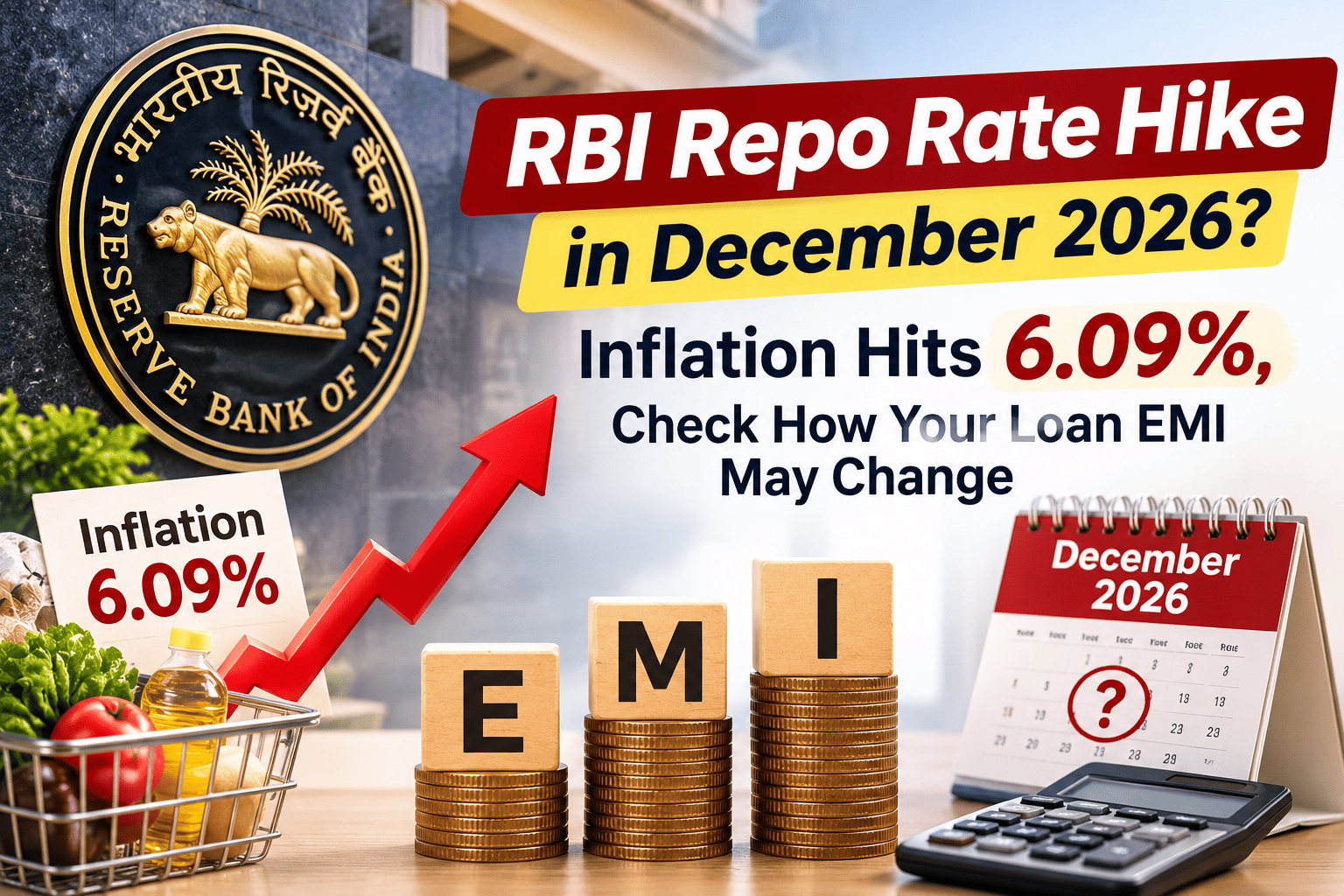


RBI Repo Rate News, 13 November 2026: The Reserve Bank of India (RBI) could increase its repo rate by another 25 basis points during the December 2026 Monetary Policy Committee (MPC) meeting after India's retail inflation climbed to 6.09% in October.
According to official data released by the Ministry of Statistics and Programme Implementation (MoSPI) on 12 November 2026, retail inflation increased from 5.54% in September to 6.09% in October, exceeding the RBI's upper tolerance limit of 6%.
The latest figures have strengthened economists' expectations of another interest rate increase.
SBI Research has revised its December rate-hike forecast from 50 basis points to 25 basis points, while economists cited in a Moneycontrol report published on 13 November also anticipate further monetary tightening.
Will personal loan and home loan EMIs increase?
If the RBI raises its policy rate and lenders pass the increase to borrowers, some floating-rate loans could become more expensive. However, a December repo rate hike has not yet been announced, and existing fixed-rate loans generally remain unaffected.
RBI Repo Rate December 2026: Latest Updates
|
Particulars |
Latest information |
|
Current RBI repo rate |
5.50% |
|
Last RBI repo rate hike |
7 October 2026 |
|
October rate increase |
25 basis points |
|
October 2026 CPI inflation |
6.09% |
|
September 2026 CPI inflation |
5.54% |
|
October food inflation |
8.94% |
|
Next RBI MPC meeting |
2–4 December 2026 |
|
December rate-hike forecast |
25 basis points |
|
Possible repo rate after a 25-bps hike |
5.75% |
|
Official December RBI decision |
Not yet announced |
Source: RBI October 2026 MPC statement, MoSPI CPI release dated 12 November and economist forecasts published on 13 November 2026.
Why Is RBI Expected to Increase the Repo Rate in December 2026?
The possibility of another RBI interest rate hike has increased because consumer inflation has moved above the central bank's tolerance ceiling.
The RBI's inflation framework has a medium-term target of 4%, with a tolerance band of 2% to 6%.
Inflation above this range can influence monetary policy because persistent price increases reduce purchasing power and raise household expenses.
October 2026 inflation rises to 6.09%
India's latest inflation report shows increasing pressure on consumer prices.
|
Inflation indicator |
September 2026 |
October 2026 |
|
Overall CPI inflation |
5.54% |
6.09% |
|
Food inflation |
7.74% |
8.94% |
|
Rural inflation |
6.08% |
6.63% |
|
Urban inflation |
4.88% |
5.41% |
October figures are provisional. September figures are final, according to the 12 November government release.
Food inflation was a major contributor to the increase. Rising food prices can affect monthly spending on groceries, vegetables and household essentials.
For borrowers already managing rent, utility bills and loan repayments, higher living costs can reduce the money available for savings.
Pocketly's guide on how to manage monthly expenses explains ways to organise essential spending, bills and existing EMIs.
What does higher inflation mean for RBI policy?
The RBI uses the repo rate as one of its principal monetary policy instruments.
When inflation remains elevated, increasing the repo rate can help moderate borrowing demand and inflationary pressures over time.
However, higher interest rates can also increase borrowing costs and influence economic activity.
The MPC must consider inflation, economic growth, liquidity and wider financial conditions before deciding whether to raise rates or maintain the existing level.
A single inflation reading does not automatically trigger a repo rate increase.
SBI Research Expects a 25-Basis-Point Repo Rate Hike in December
SBI Research revised its forecast on 12 November 2026, reducing the expected December increase from 50 basis points to 25 basis points.
The research report cited improving external conditions, foreign investment inflows and easing pressure on the Indian rupee.
It also indicated that inflation could remain above 6% in November before moderating later.
Moneycontrol reported on 13 November that at least six economists anticipated a December rate increase of 25 basis points. Their forecasts reflect concerns about persistent inflation.
What are economists predicting?
|
Source |
December 2026 expectation |
|
SBI Research |
25-bps rate increase |
|
Crisil economist cited by Moneycontrol |
25-bps increase |
|
Emkay Global Financial Services |
25-bps increase in December, with additional tightening forecast later |
|
RBI |
No December decision announced |
These are forecasts, not official commitments by the RBI.
Some economists expect rate increases to continue into 2027, while others believe improving external conditions could limit the extent of further tightening.
The actual decision will be announced following the December MPC review.
What Is the Current RBI Repo Rate in November 2026?
The current RBI policy repo rate is 5.50% as of 13 November 2026.
The RBI increased the rate from 5.25% to 5.50% on 7 October 2026.
The Monetary Policy Committee also changed its stance from neutral to calibrated tightening.
|
RBI policy indicator |
Before October hike |
Current rate |
|
Repo rate |
5.25% |
5.50% |
|
Standing Deposit Facility rate |
5.00% |
5.25% |
|
Marginal Standing Facility rate |
5.50% |
5.75% |
|
Bank Rate |
5.50% |
5.75% |
The October policy decision was confirmed. The possible December increase remains a forecast.
For details about the previous decision, read Pocketly's RBI repo rate hike October 2026 report.
Will Personal Loan EMIs Increase After the December RBI Repo Rate Hike?
Personal loan EMIs could increase for borrowers whose loans have floating interest rates and whose lenders revise those rates.
However, the impact depends on the loan agreement.
1. Existing fixed-rate personal loans
Borrowers with fixed-rate personal loans generally continue paying their agreed instalments.
A change in the RBI repo rate does not automatically alter an existing fixed-rate loan's interest rate.
2. Existing floating-rate personal loans
Floating-rate loans are more sensitive to benchmark interest rate movements.
If the applicable lending benchmark increases, the lender may revise the EMI, repayment tenure or both according to the agreement and RBI requirements.
3. New personal loan applications
Borrowers applying for new loans may encounter revised interest rates if lenders adjust their pricing.
However, rates also depend on income, creditworthiness, repayment capacity, loan amount and lender policies.
Readers can understand these costs through Pocketly's guide on EMI, interest rates and loan fees.
EMI Calculation: How Much Could a 25-Basis-Point Rate Hike Cost?
A 25-basis-point increase equals a 0.25-percentage-point increase in an annual interest rate.
For example, a loan carrying 12% annual interest would move to 12.25% if the lender passed through the entire increase.
The following calculations illustrate the potential impact.
|
Loan balance |
Remaining tenure |
EMI before increase |
EMI after 0.25% increase |
Approximate monthly increase |
|
₹1,00,000 at 12% |
2 years |
₹4,707 |
₹4,719 |
₹12 |
|
₹5,00,000 at 11% |
5 years |
₹10,871 |
₹10,934 |
₹62–₹63 |
|
₹30,00,000 at 8.5% |
20 years |
₹26,035 |
₹26,511 |
₹477 |
Illustrative calculations use monthly reducing-balance interest, unchanged remaining tenure and full transmission of a 25-basis-point increase. They exclude fees and other charges.
For a ₹30 lakh home loan with 20 years remaining, this scenario would increase the EMI by approximately ₹477 per month and the total remaining interest by around ₹1.14 lakh if the revised rate remained unchanged throughout that period.
Actual results may differ because lenders can revise rates at different intervals.
Borrowers can use Pocketly's Personal Loan EMI Calculator or free loan EMI calculator to compare repayment scenarios.
Will Home Loan and Car Loan Interest Rates Increase?
Home loans linked to external benchmarks, including the RBI repo rate, may experience changes when their lending benchmarks reset.
Older loans linked to benchmarks such as MCLR can respond differently because their rates are revised according to the lender's applicable reset schedule.
Car loans and other retail loans may also be affected, depending on whether their interest rates are fixed or floating.
The possible impact can be understood through the following comparison.
|
Loan type |
Possible impact of a rate hike |
|
Fixed-rate personal loan |
Existing contractual rate generally unchanged |
|
Floating-rate personal loan |
EMI or tenure may increase |
|
Repo-linked home loan |
Rate may increase at the applicable reset |
|
MCLR-linked home loan |
Depends on MCLR revision and reset date |
|
Fixed-rate vehicle loan |
Usually unaffected during the fixed-rate period |
|
New loan applications |
Pricing may change according to lender policy |
A repo rate increase does not mean that every bank must immediately increase every lending rate.
What Rights Do Borrowers Have if Their Floating-Rate EMI Increases?
The RBI has issued instructions governing interest-rate resets on equated-instalment-based personal loans.
Under the applicable framework, regulated lenders must communicate the possible impact of floating-rate changes and provide relevant information about revised repayment terms.
Borrowers must also be offered applicable choices concerning EMI increases, repayment tenure and prepayment.
A switch from floating to fixed interest may be available where the lender provides that option under its approved policy.
Before accepting a revised repayment schedule, borrowers should ask their lender for a statement showing the remaining principal, applicable interest rate, number of instalments and total repayment obligation.
For a step-by-step calculation, see Pocketly's article on how to calculate EMI for a personal loan.
What Should Borrowers Do Before the December RBI MPC Meeting?
Borrowers do not need to make immediate changes based on forecasts alone.
However, the possibility of higher borrowing costs makes repayment planning useful.
-
Check your loan type. Confirm whether the interest rate is fixed, floating or linked to a specific benchmark.
-
Review the reset date. Floating-rate loans may respond to benchmark changes at different times.
-
Estimate higher EMIs. Test an increase of 0.25 to 0.50 percentage points as a planning scenario.
-
Review monthly expenses. Account for housing, groceries, transport, insurance and existing repayments.
-
Consider prepayment carefully. Compare potential interest savings with applicable charges and emergency savings needs.
Pocketly's 50/30/20 budgeting guide can help borrowers allocate income between essential expenses, discretionary spending and savings.
If an EMI increase would create repayment difficulties, borrowers should contact their lender before missing a scheduled instalment.
How Could an RBI Repo Rate Increase Affect NBFCs and Digital Lending Apps?
Non-banking financial companies (NBFCs) can face higher funding costs when borrowing rates increase.
Their lending rates may respond differently depending on funding arrangements, existing loan contracts and business conditions.
For digital lending platforms, an RBI repo rate hike does not automatically change all consumer loan products.
Pocketly provides access to personal loans ranging from ₹1,000 to ₹50,000 through Speel Finance Company Private Limited, an RBI-registered NBFC.
For eligible borrowers considering short-term personal finance, the important figures are the applicable interest rate, Annual Percentage Rate (APR), processing fees, repayment tenure and total repayment obligation.
Borrowers can review Pocketly's personal loan information and the lender's Key Facts Statement before accepting a loan.
Taking another loan solely to meet increasing EMIs may create additional repayment pressure, especially when the new credit carries higher borrowing costs.
When Is the Next RBI MPC Meeting in December 2026?
The Reserve Bank of India's next Monetary Policy Committee meeting is scheduled for 2–4 December 2026.
The policy decision is expected on 4 December 2026.
The committee will consider inflation, economic growth, credit conditions, global developments and financial stability before deciding the appropriate interest rate.
Three broad outcomes are possible:
|
December policy scenario |
Repo rate |
Potential borrower implication |
|
RBI keeps rate unchanged |
5.50% |
No new repo-rate increase |
|
RBI raises rate by 25 bps |
5.75% |
Some floating-rate borrowing costs could rise |
|
RBI raises rate by 50 bps |
6.00% |
Potentially larger increase in affected loan costs |
These are illustrative policy scenarios. None represents an announced December decision.
Conclusion
The possibility of an RBI repo rate hike in December 2026 has increased following India's October inflation reading of 6.09%.
SBI Research and several economists now expect a 25-basis-point increase, which could take the current repo rate from 5.50% to 5.75%.
However, the RBI has not confirmed any further rate increase.
For borrowers, the immediate priority is to understand existing loan terms, assess whether the interest rate is fixed or floating, and estimate the potential impact of higher borrowing costs.
For more updates on RBI monetary policy, loan interest rates and responsible borrowing, visit Pocketly and explore the latest financial news.
Frequently Asked Questions
1. Will RBI increase the repo rate in December 2026?
Several economists expect a 25-basis-point increase, but the RBI has not announced its December decision. The MPC meeting is scheduled for 2–4 December 2026.
2. What is the current RBI repo rate today?
As of 13 November 2026, the RBI repo rate is 5.50%, following the increase announced on 7 October 2026.
3. Why is RBI expected to increase interest rates?
October retail inflation rose to 6.09%, above the RBI's 6% upper tolerance limit. Persistent inflation has increased expectations of further monetary tightening.
4. Will personal loan EMIs increase in December 2026?
Only borrowers whose loan terms and lender rate revisions lead to an increase may see their EMI or tenure change. Existing fixed-rate personal loans generally remain unaffected.
5. How much will EMI increase after a 25-bps hike?
The amount depends on outstanding principal, interest rate and remaining tenure. For an illustrative ₹5 lakh loan over five years, a full 25-bps increase could raise the EMI by approximately ₹62 per month.
6. Will fixed-rate home loans be affected?
An existing home loan with a fixed contractual rate generally does not change because of an RBI repo rate increase during its fixed-rate period.
7. Will RBI cut interest rates in December 2026?
A rate cut is currently considered unlikely by economists cited in the latest reports, but the RBI has not announced the December outcome.
8. What is the expected RBI repo rate after December 2026?
If the RBI increases the current rate by 25 basis points, the repo rate would become 5.75%. This remains conditional on the MPC's decision.
9. Can NBFC personal loan rates increase?
Yes. NBFCs may revise rates on new lending or eligible floating-rate contracts when funding costs change. Any adjustment depends on lender policy and loan terms.
10. What should borrowers check before taking a loan?
Borrowers should compare interest rates, APR, processing fees, repayment tenure, total repayment, the Key Facts Statement and their ability to repay.
Sources and References
-
Reserve Bank of India – October 2026 Monetary Policy Statement, 7 October 2026.
-
Ministry of Statistics and Programme Implementation – October CPI Data, 12 November 2026.
-
Moneycontrol – Economists Expect 25-bps December Rate Hike, 13 November 2026.
-
Financial Express – SBI Research Revises December Rate Forecast, 13 November 2026.
-
RBI – Reset of Floating Interest Rate on EMI-Based Personal Loans, updated 1 October 2025.