

50/30/20 Rule: A Smarter Way to Manage Your Salary in 2027
It's the 25th of the month. You go to your bank app, look at your account, and you realize you don't have half of your salary in there.You log into your banking app, check your account and realize that you don't have half your salary in there.
Not purchased a lot of expensive items. Just rent, food, grocery, some online orders and all the required monthly bills. But the only thing that's left to save is little.
This happens to lots of individuals, particularly when they begin making money. It can be an exciting time to receive a salary, but it can also be challenging to manage.
That's where the 50/30/20 rule comes in handy.
It's easy to follow without a high income or complicated spreadsheet. This way, your money has a goal before it's spent whether you make ₹20,000, ₹30,000 or ₹50,000 per month.
What Is the 50/30/20 Rule?
The 50/30/20 rule is a budgeting method that divides your monthly take-home salary into three parts: 50% for essential expenses, 30% for personal wants and 20% for savings and additional debt repayment.
The idea is to balance today's expenses with tomorrow's financial needs.
|
Budget category |
Percentage |
What it covers |
|
Needs |
50% |
Rent, groceries, bills and essential EMIs |
|
Wants |
30% |
Shopping, restaurants, entertainment and travel |
|
Savings |
20% |
Emergency fund, investments and extra loan repayments |
These percentages are guidelines. You can adjust them when your expenses or income change.
How Does the 50/30/20 Rule Work?
Imagine you've just joined your first company in Bengaluru. Your monthly take-home salary is ₹30,000.
You want to enjoy your weekends, pay your bills and still save something.
Here's how you could divide your money.
1. Use 50% of Your Salary for Needs
Half of your salary goes towards expenses you cannot easily avoid.
For a ₹30,000 salary, that's ₹15,000.
Your monthly needs might include:
-
Room rent: ₹7,000
-
Groceries: ₹3,000
-
Electricity and mobile bills: ₹1,000
-
Office transportation: ₹2,000
-
Medical and other essentials: ₹2,000
Total: ₹15,000.
If you already have a personal loan, its required EMI should also be included in your essential expenses.
One mistake people make is treating every regular payment as a necessity. A streaming subscription may be paid monthly, but that doesn't make it essential.
2. Keep 30% for Things You Enjoy
You work hard for your money. There's nothing wrong with spending some of it on yourself.
Under the 50/30/20 rule, you can set aside ₹9,000 from a ₹30,000 salary for wants.
This could cover eating out, shopping, movies, subscriptions or occasional trips.
The problem starts when these expenses happen without a limit.
A ₹250 food order may seem small. Order ten times, and you've spent ₹2,500. Add weekend outings and online shopping, and your budget can disappear faster than expected.
You don't have to stop enjoying life. Just decide how much you're comfortable spending before the month begins.
3. Save the Remaining 20%
This is the money you're keeping for your future.
From a ₹30,000 salary, your 20% allocation would be ₹6,000.
You could divide it like this:
|
Savings goal |
Monthly amount |
|
Emergency fund |
₹3,000 |
|
Long-term investments |
₹2,000 |
|
Extra loan repayment |
₹1,000 |
|
Total |
₹6,000 |
If you don't have any loans, the additional ₹1,000 can go towards savings.
And if you're just starting out, consider building an emergency fund before investing heavily in risky assets.
50/30/20 Rule Calculator: How Much Should You Save?
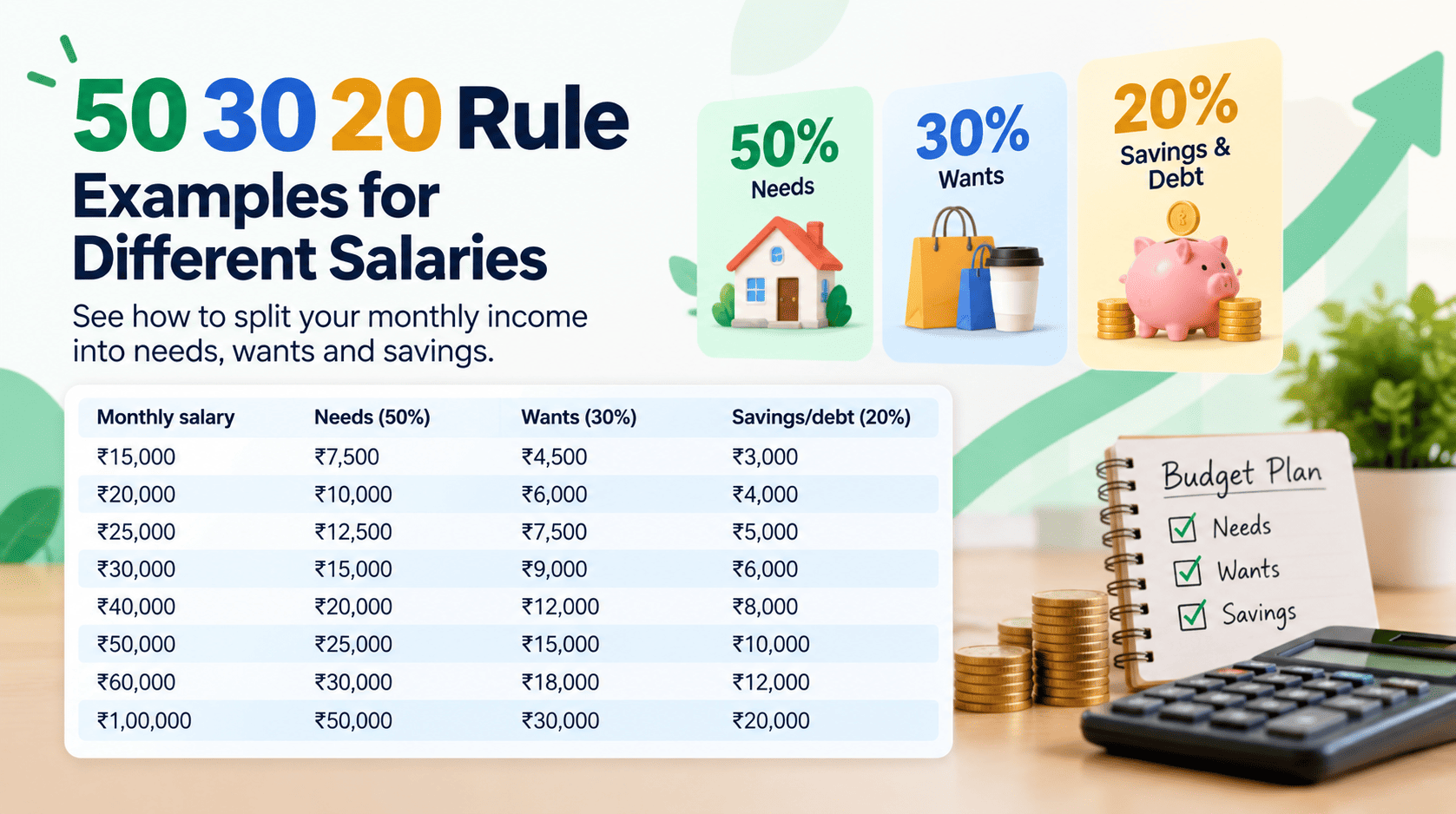
You can calculate your monthly budget using three simple formulas.
Needs = Monthly take-home salary × 50 ÷ 100
Wants = Monthly take-home salary × 30 ÷ 100
Savings = Monthly take-home salary × 20 ÷ 100
For example, someone earning ₹40,000 can allocate ₹20,000 to needs, ₹12,000 to wants and ₹8,000 to savings.
Here's a quick reference table.
|
Monthly salary |
Needs (50%) |
Wants (30%) |
Savings (20%) |
|
₹20,000 |
₹10,000 |
₹6,000 |
₹4,000 |
|
₹25,000 |
₹12,500 |
₹7,500 |
₹5,000 |
|
₹30,000 |
₹15,000 |
₹9,000 |
₹6,000 |
|
₹40,000 |
₹20,000 |
₹12,000 |
₹8,000 |
|
₹50,000 |
₹25,000 |
₹15,000 |
₹10,000 |
|
₹1,00,000 |
₹50,000 |
₹30,000 |
₹20,000 |
Use your take-home salary, not your CTC. The money available after salary deductions is what matters for your monthly budget.
What If the 50/30/20 Rule Doesn't Fit Your Salary?
Here's something worth understanding: the rule doesn't work perfectly for everyone.
Say you're earning ₹22,000 in Mumbai. Your rent is ₹9,000, and groceries, transport and bills cost another ₹5,000.
Your essential expenses are already ₹14,000, which is more than 60% of your income.
Trying to keep needs below 50% might be unrealistic.
Instead, you could temporarily follow a 60/20/20 budget.
|
Category |
Standard rule |
Adjusted rule |
|
Needs |
50% |
60% |
|
Wants |
30% |
20% |
|
Savings |
20% |
20% |
The important thing is to find a budget you can actually follow.
Even saving ₹1,000 regularly is better than planning to save ₹5,000 and giving up after two months.
How Can Freelancers and Self-Employed People Use This Rule?
If you're a freelancer, your income might change every month.
You could earn ₹45,000 in January and only ₹25,000 in February.
Building your lifestyle around your highest-paying month can create problems when work slows down.
A better approach is to look at your earnings over the past six months and choose a conservative monthly budget.
Set aside money for business expenses and applicable taxes first. Then apply the 50/30/20 rule to the amount available for personal use.
During good months, save the extra income instead of increasing your spending immediately.
Can the 50/30/20 Rule Help You Avoid Unnecessary Loans?
Yes. One benefit of budgeting is that you can prepare for expenses before they become emergencies.
Imagine your phone stops working a week before payday. You need ₹8,000 for a replacement or repair, but your bank balance is low.
If you've built an emergency fund, you may be able to manage the expense without borrowing.
But what if you're still building your savings?
Start by checking whether the expense can wait or whether a cheaper option is available. If borrowing becomes necessary, compare the total repayment amount and make sure it fits your next few months' budget.
Pocketly: A Digital Personal Loan Option for Unexpected Expenses
Pocketly offers eligible applicants instant personal loan options ranging from ₹1,000 to ₹50,000 through a 100% digital application process.
Pocketly's website advertises loan approval within seven minutes and states that a CIBIL score is not required to apply. Actual approval and disbursal depend on eligibility, verification and the lender's decision.
With more than 10 million users reported in its published materials, Pocketly is designed for young Indians, including first-jobbers, salaried professionals and eligible self-employed applicants.
Before applying, review the interest rate, APR, processing fee and repayment schedule. Borrow only what you need and can comfortably repay.
Explore Instant Personal Loans on Pocketly
Five Budgeting Mistakes That Can Drain Your Salary
1. Saving whatever remains at month-end
Usually, very little remains. Move your planned savings into a separate account soon after receiving your salary.
2. Forgetting small daily expenses
Tea, snacks, auto rides and food deliveries can quietly add up. Check your UPI transaction history once a week.
3. Ignoring existing loan repayments
Your EMI is a commitment, not optional spending. Include it before setting your shopping or entertainment budget.
4. Using credit for unnecessary purchases
A discount isn't really saving you money if you end up paying interest or late fees.
5. Expecting your budget to be perfect
Some months will cost more than others. Review what happened and adjust next month's spending instead of abandoning your plan.
Final Thoughts
Your salary doesn't have to be huge for you to start managing it well.
Try the 50/30/20 rule for one month. Look at your actual expenses, decide where you can cut back and set aside an amount you can manage.
You might not get the percentages right immediately. That's fine. What matters is knowing where your money goes and having a plan for what comes next.
And when an essential expense cannot wait, you can explore Pocketly's personal loan options, compare the borrowing costs and choose responsibly.
Frequently Asked Questions
What is the 50 30 20 rule of money?
It is a method of dividing take-home income into 50% for needs, 30% for wants and 20% for savings and additional debt repayment.
What is the 50/30/20 rule for a ₹30,000 salary?
You can allocate ₹15,000 to needs, ₹9,000 to wants and ₹6,000 to savings and additional debt repayment.
How do I calculate the 50/30/20 rule?
Multiply your take-home salary by 0.50, 0.30 and 0.20 to find the amount for each category.
Is the 50/30/20 rule good for students?
Yes. Students earning through internships or part-time work can use it to manage their income and start saving.
Can I follow the 50/30/20 rule with a ₹20,000 salary?
Yes, although you may need to adjust the percentages if rent and other essential expenses take up more than half your salary.
Does the 50/30/20 rule include EMIs?
Yes. Required loan EMIs count as needs. Additional payments towards clearing debt can come from the 20% allocation.
What is the difference between the 50/30/20 and 50/20/30 rules?
There is no difference in the percentages. The order of wants and savings is simply reversed.
How much should I save from a ₹50,000 salary?
Under this rule, you would allocate ₹10,000 monthly towards savings and additional debt repayment.
Is the 50/30/20 rule suitable for freelancers?
Yes. Freelancers can use a conservative income estimate and adjust their budget when earnings change.
Should I invest the entire 20%?
Not necessarily. If you don't have emergency savings or have expensive debt, those may deserve attention before additional investing.