

What Are EMI, Tenure, Interest and Processing Fees? A Complete Personal Loan Guide
Taking a personal loan can feel simple: choose an amount, complete KYC, get approval and repay it later. Before taking any kind of loan, four terms can make a huge difference in the EMI, interest, loan tenure and processing fee that you end up paying for the loan.
A student with an unforeseen expense, a first-jobber waiting for his payday, a freelancer with sporadic earnings, or a salary earner with an emergency, can get an idea of the loan costs and avoid making a costly loan mistake.
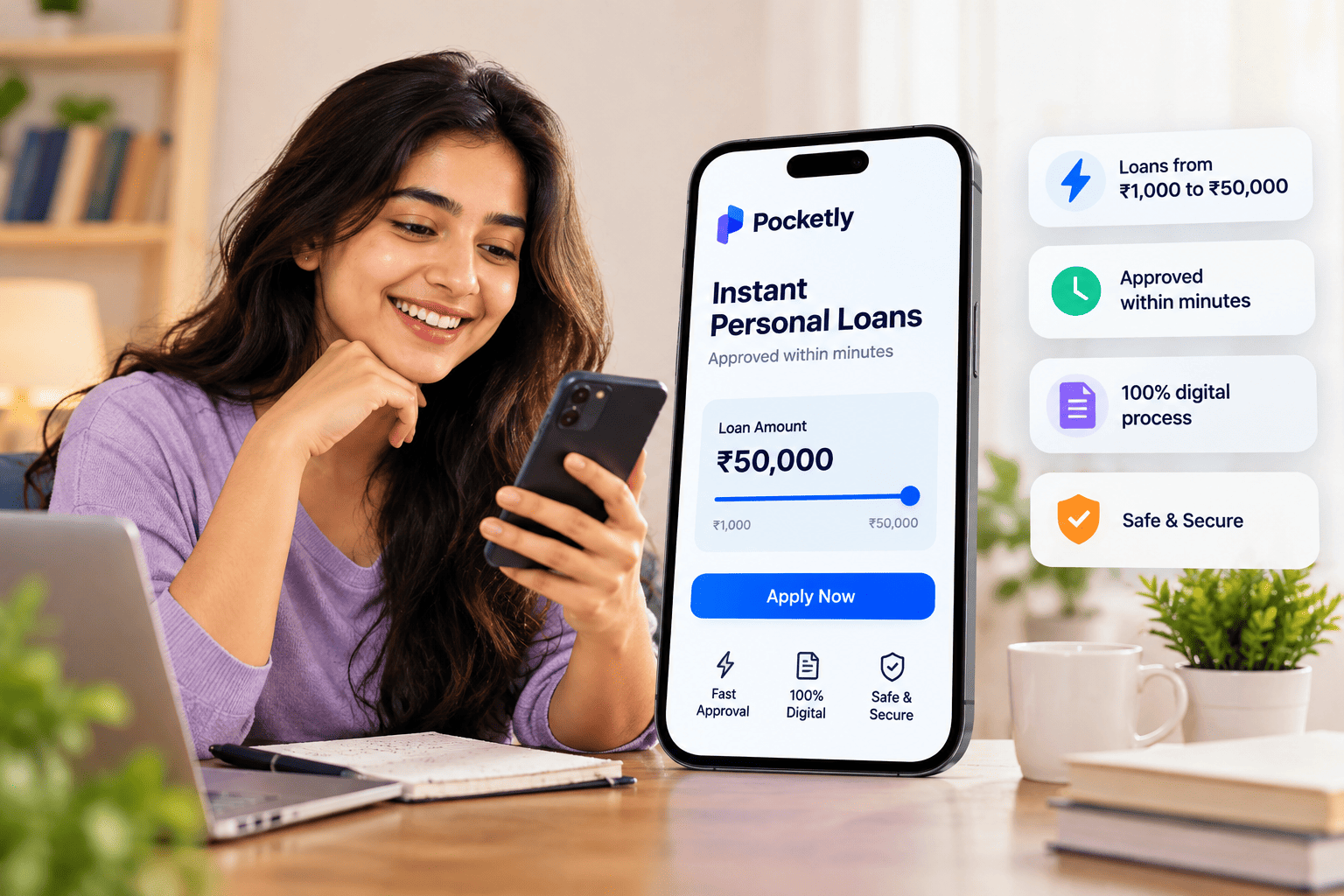
We at Pocketly feel that borrowers should be aware of the cost of credit before taking it. Pocketly offers a digital personal loan experience that allows borrowers to avail loans up to ₹50,000 with various repayment timelines and get information on the loan costs upfront.
Let's take apart each of the key terms in simple terms.
Quick Answer
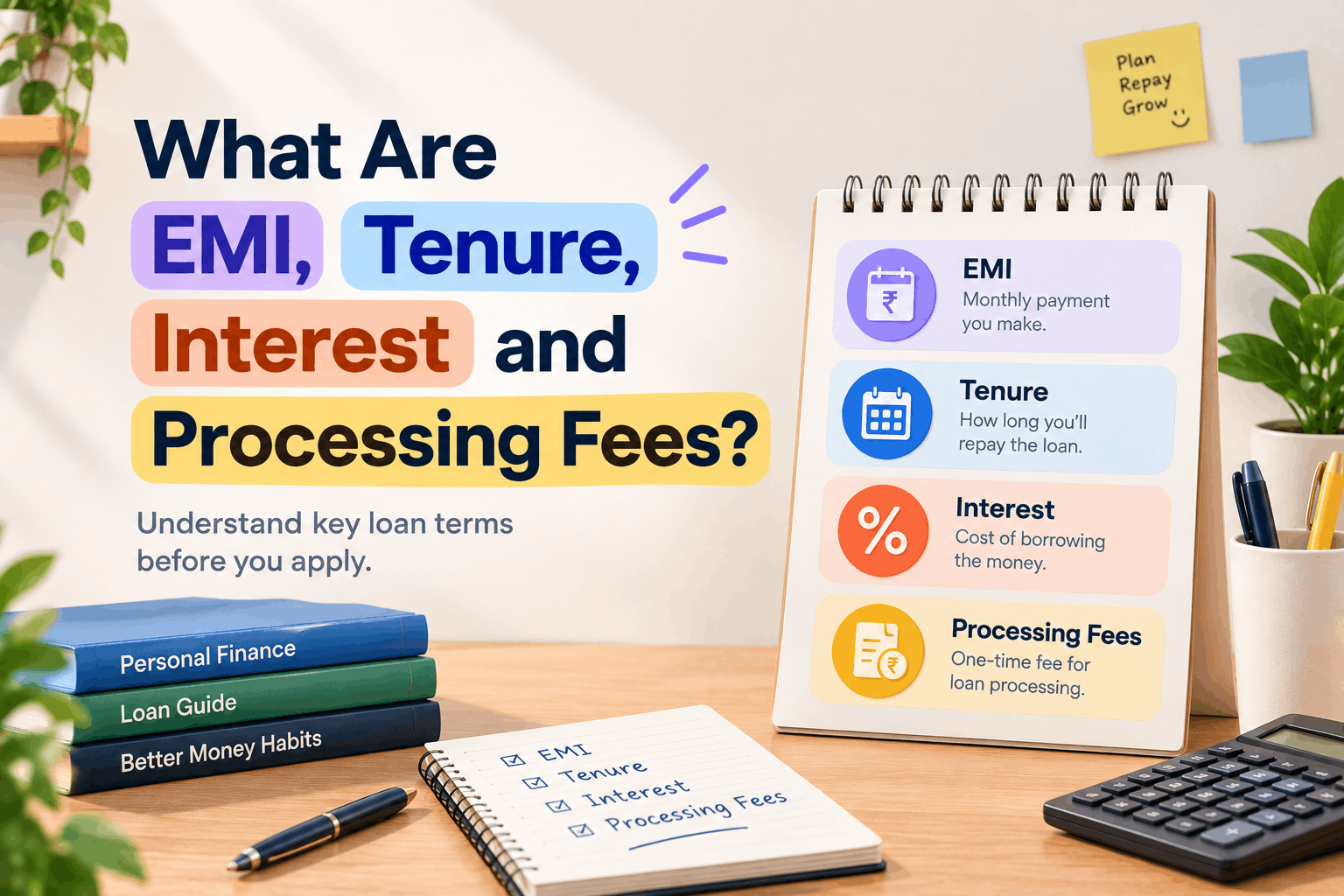
EMI is the amount you repay periodically toward your loan. Loan interest is the cost charged for borrowing money. Loan tenure is the period available to repay the loan. A processing fee is a charge associated with processing the loan. Together, these determine your repayment obligation and the overall cost of a personal loan.
Download Pocketly & Get Started With Your Loan
EMI, Interest, Tenure and Processing Fee at a Glance
|
Term |
Simple Meaning |
Why It Matters |
|
Loan EMI |
Periodic repayment amount |
Determines repayment burden |
|
Loan Interest |
Cost of borrowing |
Increases total repayment |
|
Loan Tenure |
Repayment period |
Influences repayment size and total cost |
|
Processing Fee |
Loan processing charge |
Adds to borrowing cost |
|
APR |
Annualised overall cost measure |
Helps compare loan offers |
What Is Loan EMI?
EMI means Equated Monthly Instalment.
It is the amount a borrower pays at scheduled intervals toward repayment of a loan.
For many loans, the repayment consists of:
-
Principal
-
Interest
-
Applicable charges, where relevant
The exact repayment structure depends on the loan product and its terms.
Why is loan EMI important?
Before taking a loan, you should know:
-
How much you need to repay.
-
When the repayment is due.
-
How long you will make repayments.
-
How much the loan costs overall.
A common mistake is to choose a loan simply because the EMI looks small.
A lower EMI does not automatically mean a cheaper loan.
A longer tenure can reduce the periodic repayment while potentially increasing the total interest paid over time.
What Is Loan Interest?
Loan interest is the cost of borrowing money from a lender.
For example, if you borrow ₹10,000, the amount you eventually repay can be higher because interest is charged according to the applicable loan terms.
Loan interest rates can be expressed as:
-
Monthly interest rate
-
Annual interest rate
-
APR
Pocketly's interest rate range of 2% to 3% per month and an APR range of 30%–121%. The applicable rate depends on the individual loan offer and assessment.
Interest rate vs APR
These aren't necessarily the same thing.
Interest rate: The rate charged for borrowing.
APR: A broader annualised representation of the cost of credit, incorporating applicable charges according to the relevant framework.
When comparing personal loans, looking beyond the headline interest rate can give you a better understanding of the actual cost.
What Is Loan Tenure?
Loan tenure is the period over which you repay your loan.
For example, a loan could have a tenure of:
-
61 days
-
90 days
-
3 months
-
6 months
-
9 months
Pocketly's repayment periods from 61 days to 9 months.
Short loan tenure vs long loan tenure
|
Factor |
Short Tenure |
Long Tenure |
|
Repayment period |
Shorter |
Longer |
|
Periodic payment |
Usually higher |
Usually lower |
|
Interest period |
Shorter |
Longer |
|
Repayment pressure |
Higher |
Lower |
|
Total cost |
Can be lower |
Can be higher |
Which loan tenure should you choose?
Don't automatically choose the shortest or longest tenure.
Instead, consider:
-
Your monthly income
-
Essential expenses
-
Existing EMIs
-
Emergency savings
-
Expected cash flow
-
Total repayment amount
Choose a repayment schedule that you can realistically maintain.
What Is a Loan Processing Fee?
One of the most searched questions by borrowers is:
What is the processing fee in loan?
A loan processing fee is a charge associated with processing a loan application.
Depending on the lender and product, processing may involve activities such as:
-
Application processing
-
Verification
-
Documentation
-
Credit assessment
-
Operational processing
Pocketly’s processing fee of 0% to 7.5% of the loan amount, plus GST as applicable. The applicable fee should be checked in the specific loan offer before accepting it.
Processing fee vs processing charges
You may see both terms used online:
-
Processing fee
-
Processing charge
-
Loan processing fee
-
Personal loan processing fee
-
Processing charges for personal loan
In everyday borrowing discussions, these terms generally refer to charges associated with processing the loan application. However, borrowers should always rely on the lender's actual disclosure and loan documents for the applicable amount.
How EMI, Interest, Tenure and Processing Fee Work Together
These four terms should never be evaluated separately.
Consider an illustrative loan:
Loan amount: ₹5,000
Annual interest rate: 36%
Tenure: 90 days
Using a simple-interest illustration:
Interest = ₹5,000 × 36% × 90 ÷ 365
Interest ≈ ₹443.84
Therefore:
|
Component |
Amount |
|
Principal |
₹5,000 |
|
Illustrative interest |
₹443.84 |
|
Principal + interest |
₹5,443.84 |
|
Processing fee |
As applicable |
|
GST |
As applicable |
Pocketly's published representative example uses ₹5,000, a 90-day tenure and 36% annual interest and notes that applicable processing fees and GST can be extra.
This is an illustration, not a guarantee of an individual borrower's repayment amount.
What Are Personal Loan Charges?
Interest isn't necessarily the only number you need to examine.
Depending on the loan product, borrowers should check for:
-
Processing fee
-
Applicable GST
-
Penal charges
-
Foreclosure charges
-
Prepayment-related charges, where applicable
-
Other disclosed charges
Pocketly currently lists foreclosure charges of 2.5% of principal outstanding. Always check your specific loan agreement and applicable terms before making an early repayment.
Your personal loan cost checklist
Before accepting a loan, check:
-
Loan amount
-
Interest rate
-
APR
-
Tenure
-
EMI/repayment amount
-
Processing fee
-
Applicable taxes
-
Foreclosure terms
-
Penal charges
-
Total repayment amount
Why APR Matters When Comparing Personal Loans
Suppose two lenders advertise different loan interest rates.
It may be tempting to select the lender showing the lowest rate.
But that's not enough.
You should compare the overall cost of credit, including applicable fees and charges.
APR can help borrowers make a more meaningful comparison.
Think of it this way:
Interest rate = one important cost
APR = broader picture of the annualised cost
This is especially important for digital lending, where borrowers should have clear information about the cost of credit before accepting a loan.
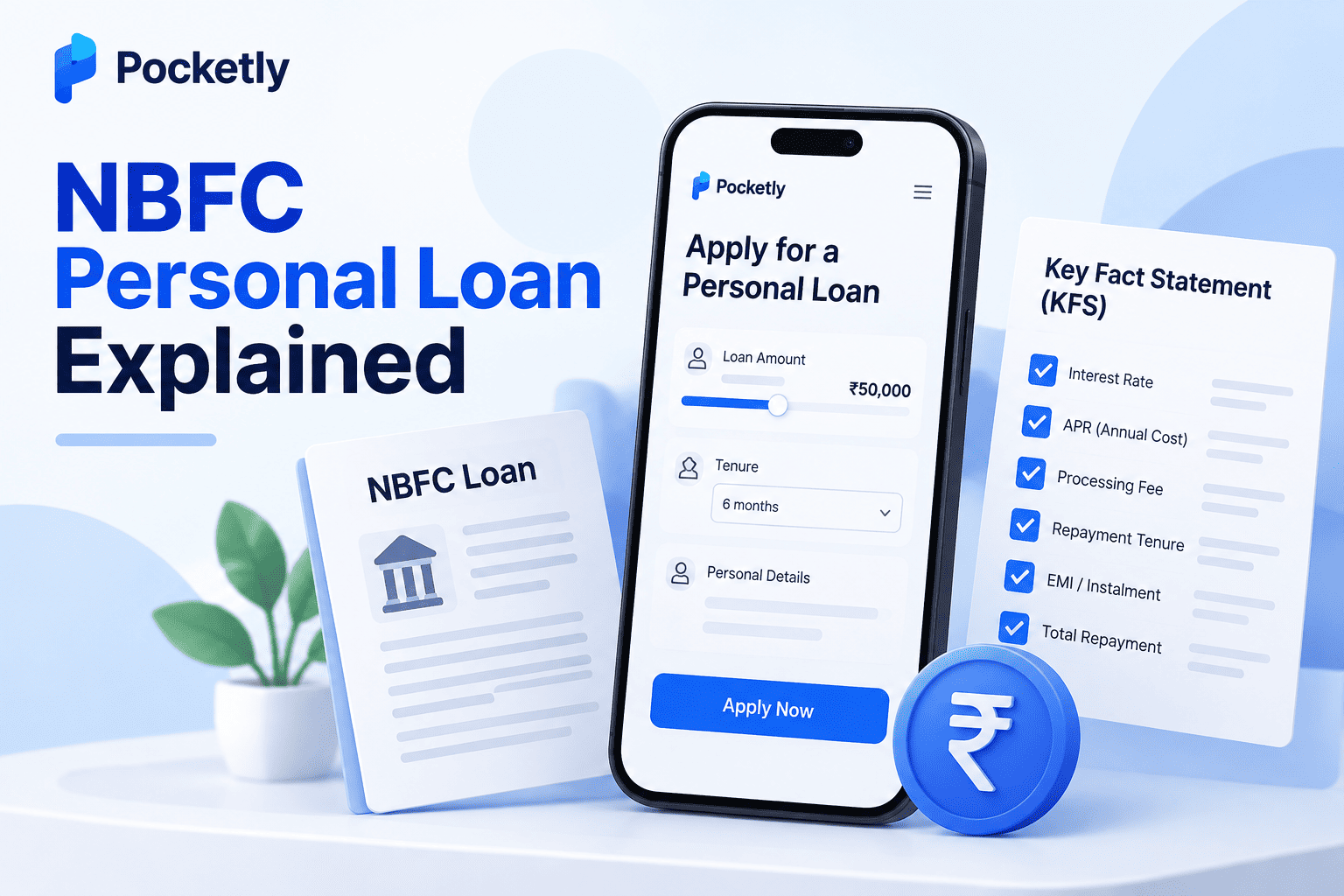
What Is a Key Facts Statement (KFS)?
A Key Facts Statement (KFS) provides important information about applicable loan terms and costs in a standardised format.
Before accepting a digital loan, borrowers should carefully review the information provided in the KFS.
Look for:
-
Loan amount
-
Tenure
-
Interest rate
-
APR
-
Repayment schedule
-
Applicable fees
-
Other important terms
Expert borrowing rule
Don't treat the KFS as paperwork. Treat it as the price tag of your loan.
7 Mistakes Borrowers Should Avoid
1. Choosing only by EMI
A low EMI may come with a longer repayment period.
2. Ignoring processing fees
A small percentage can still affect the overall cost.
3. Borrowing the maximum amount
If you need ₹8,000, don't automatically borrow ₹30,000 simply because you're eligible.
4. Ignoring APR
Interest rate alone doesn't always tell the complete cost story.
5. Not reading repayment dates
Missing repayment dates can create additional financial pressure.
6. Taking multiple loans simultaneously
Multiple repayment obligations can quickly become difficult to manage.
7. Borrowing without a repayment plan
Before applying, know exactly how you intend to repay.
A Simple 5-Step Personal Loan Decision Process
Step 1: Calculate your actual requirement
Ask yourself:
“How much do I really need?”
Not:
“How much can I get?”
Step 2: Check your repayment capacity
Review:
-
Monthly income
-
Rent
-
Food
-
Bills
-
Existing EMIs
-
Essential expenses
Step 3: Compare loan costs
Check:
-
Interest rate
-
APR
-
Processing fee
-
Tenure
-
Total repayment
Step 4: Read the documents
Review the KFS and loan agreement carefully.
Step 5: Borrow responsibly
Only accept a loan when you understand the repayment obligation.
Pocketly: Instant Personal Loans With a 100% Digital Journey
When an unexpected expense arrives, traditional borrowing can sometimes mean lengthy paperwork and waiting.
Pocketly is built around a digital borrowing experience for young India, including eligible students, first-jobbers, freelancers, salaried professionals and other borrowers with a monthly source of income.
Pocketly offers:
-
Personal loans up to ₹50,000
-
100% digital loan journey
-
Flexible repayment periods
-
Fast loan processing
-
Minimum KYC
-
Secure online payments
-
No CIBIL score requirement in Pocketly
-
Loan approval on a request in a maximum of 7 minutes, subject to eligibility and assessment
Pocketly - instant personal loan is operated by Speel Finance Company Private Ltd., an RBI-registered NBFC, and that it follows applicable RBI fair-practice requirements.
The platform reports 20M+ users, 1.3 crore+ loans disbursed and ₹3,500 crore+ amount disbursed in its current website material.
Why borrowers choose Pocketly
|
Pocketly Feature |
Benefit |
|
Up to ₹50,000 |
Useful for smaller financial requirements |
|
100% digital |
Apply online without traditional branch queues |
|
Flexible repayment |
Select from available repayment options |
|
Fast processing |
Designed for time-sensitive borrowing |
|
Minimum KYC |
Simplified digital onboarding |
|
Transparent loan information |
Review applicable costs before accepting |
Need a personal loan for an unexpected expense? Check your eligibility with Pocketly and review the complete loan offer, including the applicable interest, tenure, processing fee, APR and repayment obligation, before accepting.
Loan EMI, Interest and Processing Fee: Quick Comparison
|
If you are asking... |
The answer is... |
|
What is EMI? |
Your scheduled loan repayment amount |
|
What is loan interest? |
The cost of borrowing |
|
What is loan tenure? |
The repayment period |
|
What is the processing fee? |
A charge associated with loan processing |
|
What is APR? |
A broader annualised cost measure |
|
What is KFS? |
A statement containing key loan facts |
|
What should I compare? |
APR, fees, tenure and total repayment |
FAQ
What is EMI in a personal loan?
EMI is the periodic amount paid toward repayment of a personal loan, generally consisting of principal and interest according to the loan structure.
What is loan tenure?
Loan tenure is the period during which the borrower repays the loan.
What is loan interest rate?
It is the rate charged by the lender for providing borrowed funds.
What is a personal loan processing fee?
It is a charge associated with processing a personal loan application. The amount varies by lender and product.
Are processing fees included in EMI?
Not necessarily. Processing fees may be separate from repayment installments. Check the specific KFS and loan agreement.
Is a lower EMI always better?
No. A lower EMI can result from a longer tenure. Always compare total repayment and overall loan costs.
What should I check before taking a personal loan?
Check the interest rate, APR, tenure, repayment amount, processing fee, applicable taxes, other charges and total repayment obligation.
Can I get an instant personal loan without a CIBIL score?
Some lenders use eligibility and underwriting criteria beyond a traditional CIBIL-score requirement. In Pocketly CIBIL score is not required for its loan application, while approval remains subject to eligibility and assessment.
How can I reduce the cost of borrowing?
Borrow only what you need, choose an appropriate repayment period, compare the complete cost and make repayments on time.
Is an instant loan cheaper?
Not necessarily. “Instant” generally describes the speed of the application or disbursal process, not the cost of borrowing.