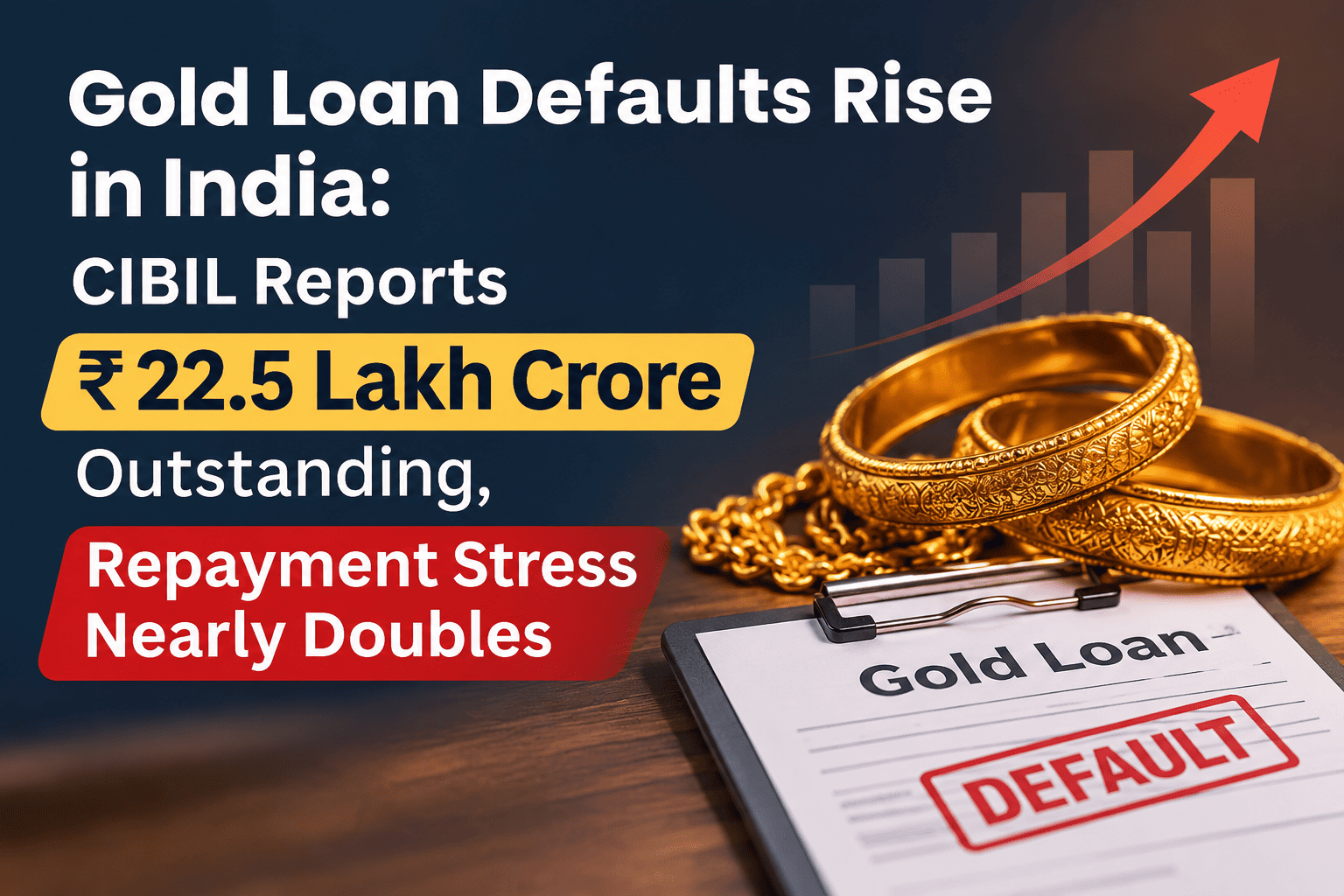


Gold loan defaults in India have become a concern after a new TransUnion CIBIL report revealed that repayment stress nearly doubled between March and August 2026. Outstanding gold loans reached a record ₹22.5 lakh crore, almost three times the amount recorded in August 2023.
According to the report Lending Unlocked: Gold Loans, released on November 5, the share of gold loan balances overdue by more than 90 days increased from approximately 0.16% in March 2026 to 0.30% in August 2026.
The latest CIBIL gold loan report also revealed that India now has 5.5 crore active gold loan borrowers, representing approximately 21% of the country's credit-active population.
While the gold loan default rate remains relatively low, borrowers taking multiple loans and those with previous repayment difficulties face higher risks.
The findings were reported on November 6 by the Times of India and other financial publications. They raise questions about gold loan repayment, credit scores and the growing use of gold-backed borrowing in India.
Gold Loan Defaults in India 2026: Key Highlights
The November 2026 TransUnion CIBIL report provides updated information on gold loan outstanding balances, loan defaults and borrower behaviour.
|
Gold loan indicator |
Latest CIBIL data |
|
Total outstanding gold loans |
₹22.5 lakh crore |
|
Reporting period |
August 2026 |
|
Gold loan portfolio in August 2023 |
Approximately ₹7.5 lakh crore |
|
Active gold loan borrowers |
5.5 crore |
|
Share of credit-active consumers |
21% |
|
Average outstanding balance per borrower |
₹4.1 lakh |
|
Gold loan delinquency rate, March 2026 |
Approximately 0.16% |
|
Gold loan delinquency rate, August 2026 |
0.30% |
|
Delinquency among borrowers with 4+ gold loan accounts |
0.45% |
|
Gold loans originated in April–June 2026 |
Approximately 3.7 crore |
|
Gold loan sanction value in April–June 2026 |
₹8.2 lakh crore |
|
Year-on-year change in loan origination volume |
Down 15% |
|
Year-on-year change in sanctioned value |
Up 12% |
|
Growth in originations above ₹2.5 lakh |
19% |
|
Share of women in gold loan originations |
41% |
|
Year-on-year growth in Gen Z gold loan borrowers |
19% |
Source: TransUnion CIBIL, Lending Unlocked: Gold Loans, November 2026, and reporting by Business Standard and The Economic Times.
Gold Loan Default Rate Nearly Doubles in Five Months
One of the most significant findings in the CIBIL report is the increase in seriously overdue gold loans.
The delinquency rate, measured using balances overdue by more than 90 days, increased from approximately 0.16% in March to 0.30% in August 2026.
This represents an increase of 0.14 percentage points, or approximately 87.5% relative to March.
Gold loan default rate: March vs August 2026
|
Period |
90+ days overdue rate |
Interpretation |
|
March 2026 |
0.16% |
Lower repayment stress |
|
August 2026 |
0.30% |
Higher repayment stress |
|
Five-month change |
+0.14 percentage points |
Nearly 88% relative increase |
The increase deserves attention, but it should be interpreted correctly.
A 0.30% delinquency rate does not mean 30% of borrowers have defaulted. It means that approximately 0.30% of the outstanding portfolio balance was overdue beyond the specified period.
The rate also remained below its year-earlier level, according to Business Standard. Therefore, the latest figures indicate a short-term increase in repayment stress rather than an uninterrupted deterioration throughout the year.
What happens when a gold loan becomes overdue?
Gold loan repayment problems can have consequences beyond additional interest and penalties.
Depending on the loan agreement and regulatory requirements, prolonged non-payment can lead to recovery proceedings and, potentially, the sale of pledged gold.
Missed repayments reported to credit bureaus may also affect future borrowing.
Borrowers can read Pocketly's guide to understanding overdue loan payments and their consequences.
For a detailed explanation of serious overdue accounts, see what happens when a loan becomes an NPA.
India's Gold Loan Outstanding Reaches ₹22.5 Lakh Crore
India's gold loan market has expanded substantially since 2023.
TransUnion CIBIL reported that outstanding gold loan balances rose from approximately ₹7.5 lakh crore in August 2023 to ₹22.5 lakh crore in August 2026.
That represents an increase of approximately 200% over three years.
Gold loan market growth in India
|
Indicator |
August 2023 |
August 2026 |
|
Outstanding gold loans |
₹7.5 lakh crore |
₹22.5 lakh crore |
|
Portfolio growth |
Base period |
Approximately 3 times |
|
Average outstanding balance per borrower |
Lower than 2026 |
₹4.1 lakh |
|
Active borrowers in August 2026 |
— |
5.5 crore |
The CIBIL report indicates that higher loan amounts and repeat borrowing have contributed to the expansion.
Rising gold prices have also played a role because borrowers may qualify for larger loans against eligible pledged gold, subject to valuation and lending requirements.
However, the report does not establish that higher gold prices alone caused the increase in borrowing.
For borrowers comparing repayment options, Pocketly offers a free gold loan EMI calculator to estimate monthly payments, interest and repayment amounts.
Why Are Gold Loan Defaults Increasing in India?
The latest CIBIL findings identify several borrower characteristics associated with greater repayment risk.
1. Borrowers taking multiple gold loans
Multiple borrowing is a major concern.
According to CIBIL, borrowers with four or more gold loan accounts accounted for approximately 27% of outstanding gold loan balances.
Their delinquency rate reached 0.45%, compared with the overall portfolio rate of 0.30%.
This means the group's delinquency rate was 1.5 times the overall rate.
Managing multiple loans becomes difficult when several repayment obligations fall due within a short period.
For anyone facing that situation, Pocketly explains how to manage multiple loans in India without losing track of repayment commitments.
2. Previous missed payments
The CIBIL study also identified previous repayment difficulties as a predictor of future loan stress.
Borrowers who had missed more than one payment during the preceding six months were three times more likely to become delinquent on a credit obligation during the following six months.
This does not mean every borrower with a missed EMI will default. It indicates a higher observed risk within the population studied.
Understanding the consequences of a personal loan EMI bounce can help borrowers recognise problems before an overdue balance increases.
3. Higher outstanding debt
CIBIL found that borrowers with non-mortgage outstanding balances of ₹5 lakh or more had a higher risk of subsequent delinquency.
Borrowers who also held business-oriented loans showed elevated risk.
Existing debt obligations can affect a borrower's capacity to repay additional credit, regardless of the value of the pledged gold.
For consumers concerned about repeated borrowing, Pocketly's guide explains what a debt trap is and how to avoid it.
4. Larger loan amounts
Gold loans above ₹2.5 lakh recorded 19% year-on-year growth in origination volume during the April–June 2026 quarter.
Larger loans can increase the total repayment obligation.
However, the report does not establish that larger gold loans are inherently more likely to default. In fact, borrowers with sanctioned gold loans of ₹10 lakh or more recorded a delinquency rate of approximately 0.20%.
The report points to repayment history, existing debt and the number of loans as relevant risk indicators, rather than loan amount alone.
Gold Loan Borrowing Rises Among Young Indians
Another finding from the CIBIL gold loan report concerns younger borrowers.
Gen Z accounted for approximately one in five gold loan originations.
The number of Gen Z gold loan borrowers increased 19% year-on-year, the highest growth among the age groups examined.
Women accounted for 41% of gold loan originations, compared with 40% previously.
Two-thirds of gold loan originations came from semi-urban and rural markets.
Who is borrowing gold loans in India?
|
Borrower segment |
CIBIL finding |
|
Gen Z |
Approximately 20% of gold loan originations |
|
Gen Z borrower growth |
19% year-on-year |
|
Women |
41% of originations |
|
Semi-urban and rural markets |
Approximately two-thirds of originations |
|
Borrowers with previous gold loan history |
Approximately 67% |
Gold-backed borrowing is available to people who own eligible gold, but applicants should evaluate repayment costs before pledging jewellery.
Younger borrowers considering other options may benefit from understanding the difference between secured and unsecured loans.
CIBIL Report Reveals Repeat Gold Borrowing Trend
The November report also examined borrowers who returned for another gold loan.
Among the lower-risk borrowers studied, approximately one in two originated another gold loan within 12 months.
This suggests that repeat borrowing accounts for a meaningful part of the gold loan market.
However, taking a second gold loan does not automatically indicate financial difficulty. Some borrowers may repay their previous loans regularly and continue using gold-backed credit when required.
The study also found that 42% of borrowers with prior credit stress were current on all active credit obligations 12 months after taking a gold loan.
TransUnion CIBIL explicitly cautioned that this observation does not prove the gold loan caused the improvement.
Borrowers should therefore assess their repayment capacity individually instead of assuming that another loan will resolve existing financial difficulties.
Can Gold Loan Defaults Affect Your CIBIL Score?
Yes. Missed gold loan repayments can negatively affect a borrower's CIBIL score if the overdue payments are reported to credit bureaus.
Gold loans are secured by collateral, but repayment history remains relevant to credit assessment.
A lender evaluating a future personal loan, credit card or other borrowing application may consider the applicant's previous repayment behaviour.
How repayment delays affect borrowers
|
Repayment status |
Possible impact |
|
Payment completed on time |
Supports a positive repayment record |
|
Payment missed by a few days |
Applicable late charges may arise |
|
Payment overdue for 30 days |
Reported delinquency may affect the credit profile |
|
Payment overdue for 60 days |
More serious repayment concern |
|
Payment overdue beyond 90 days |
Greater default and recovery risk |
|
Overdue balance cleared |
Account can become current, but previous delays may remain in credit history |
The exact effect on a CIBIL score depends on the borrower's complete credit profile and how the lender reports repayment information.
A borrower who wants to understand credit-report terminology can read Pocketly's guide to DPD, STD, DBT and LSS in CIBIL reports.
If repayment information is incorrect, the borrower should approach the lender and dispute inaccurate information through the appropriate credit bureau process.
Pocketly also explains how overdue payment records affect CIBIL scores.
Gold Loan vs Personal Loan: Which Is Better in 2026?
The rising gold loan outstanding balance has brought renewed attention to the differences between gold loans and unsecured personal loans.
Both can provide access to funds, but their eligibility requirements, collateral arrangements and borrowing costs differ.
|
Feature |
Gold loan |
Personal loan |
|
Loan category |
Secured |
Generally unsecured |
|
Collateral |
Eligible gold jewellery or other permitted gold assets |
Usually not required |
|
Loan amount |
Depends partly on gold valuation |
Depends on lender eligibility assessment |
|
Credit assessment |
Varies by lender |
Varies by lender |
|
Interest rate |
Depends on lender and product |
Depends on lender and product |
|
Processing fees |
May apply |
May apply |
|
Repayment tenure |
Depends on product terms |
Depends on product terms |
|
Main asset-related risk |
Pledged gold may be sold following default and applicable procedures |
No pledged gold is at risk |
|
Credit-score impact |
Missed payments may affect credit history |
Missed payments may affect credit history |
Which option should borrowers consider?
A gold loan may suit someone who owns eligible gold and can repay within the agreed tenure.
An unsecured personal loan may suit someone who does not want to pledge an asset and qualifies under the lender's eligibility criteria.
Neither option is universally cheaper.
Before deciding, borrowers should compare the Annual Percentage Rate (APR), processing charges, total repayment amount and consequences of late payment.
Pocketly provides a personal loan EMI calculator for estimating repayment under different loan amounts and tenures.
Borrowers can also review EMI, interest rates and loan fees explained before accepting any loan agreement.
What Should Existing Gold Loan Borrowers Do?
The latest gold loan news does not mean borrowers need to close their loans immediately.
However, those with upcoming repayments should check whether they can meet the agreed schedule.
A few practical steps can help.
-
Check the next repayment date. Review the lender's statement, applicable interest and outstanding principal.
-
Review every existing loan. Include personal loans, credit cards and business loans when calculating total repayments.
-
Contact the lender early. If repayment difficulties are expected, ask about available arrangements before the account becomes seriously overdue.
-
Understand collateral-related consequences. Review the gold loan agreement for recovery and auction provisions.
-
Check your credit report. Verify whether payments and outstanding balances have been reported accurately.
-
Consider permitted part-payments. If the loan agreement allows them, additional payments may reduce the outstanding principal or interest burden.
-
Avoid unnecessary new borrowing. Taking another expensive loan to repay an existing one may increase future repayment pressure.
Pocketly's guides to part-payment of loans and loan foreclosure and early closure explain how these options work.
Need a Small Personal Loan? Explore Pocketly
The latest CIBIL report highlights why loan eligibility and repayment planning deserve attention before borrowing.
For eligible borrowers who need smaller amounts for personal expenses, Pocketly provides a digital personal loan application option without requiring gold or property as collateral.
Through Pocketly, eligible applicants can explore loans ranging from ₹1,000 to ₹50,000.
Pocketly personal loan details
|
Feature |
Pocketly |
|
Loan amount |
₹1,000–₹50,000 |
|
Application |
Online |
|
Collateral |
Not required |
|
KYC |
Digital verification |
|
Repayment tenure |
61 days to 9 months, depending on offer |
|
Loan provider |
Speel Finance Company Private Limited |
|
Lending entity status |
RBI-registered NBFC |
|
Loan approval |
Subject to eligibility and assessment |
|
Disbursal |
Direct to bank account after approval |
Pocketly states that an established CIBIL score is not required to submit an application. However, borrowers must still satisfy the applicable eligibility, verification and underwriting requirements.
Anyone comparing a gold loan with a small unsecured loan can explore Pocketly's NBFC personal loan options.
For smaller eligible expenses, users can also review the Pocketly instant pocket loan app.
Before borrowing: Check the Key Facts Statement, APR, applicable fees, repayment tenure and total repayment obligation. Taking another loan solely to clear an existing overdue account can increase financial pressure.
Gold Loan News 2026: What Happens Next?
The November 2026 CIBIL report highlights two developments in India's gold loan market.
First, outstanding balances have expanded considerably since 2023, with larger loan amounts and repeat borrowing contributing to growth.
Second, the share of seriously overdue gold loan balances increased between March and August 2026, particularly among borrowers with multiple accounts and previous repayment difficulties.
Despite this recent increase, the overall delinquency rate remains relatively low and below its year-earlier level.
Financial institutions will need to evaluate borrower repayment capacity alongside the value of pledged gold.
For borrowers, the findings reinforce the need to compare loan costs, understand overdue-payment consequences and avoid taking on repayment obligations that exceed their budgets.
Conclusion
India's gold loan market reached ₹22.5 lakh crore in outstanding balances by August 2026, according to TransUnion CIBIL. Over the five months from March to August, the rate of gold loan balances overdue beyond 90 days increased from approximately 0.16% to 0.30%.
The findings highlight repayment risks among borrowers managing several loans or carrying a history of missed payments.
Existing borrowers should review their outstanding amounts, repayment dates and loan agreements before taking additional credit.
For individuals considering an unsecured personal loan for an eligible expense, Pocketly's online personal loan application provides access to amounts of up to ₹50,000, subject to eligibility and lender approval.
Compare the total cost, understand the repayment terms and borrow only what your income can support.
Frequently Asked Questions
1. Are gold loan defaults increasing in India in 2026?
Yes. TransUnion CIBIL reported that the share of gold loan balances overdue by more than 90 days increased from approximately 0.16% in March 2026 to 0.30% in August 2026. However, the rate remained below its year-earlier level.
2. What is the latest gold loan outstanding amount in India?
According to TransUnion CIBIL's November 2026 report, outstanding gold loan balances reached ₹22.5 lakh crore in August 2026, nearly three times the amount recorded in August 2023.
3. What is the gold loan default rate in India in 2026?
The latest reported 90-plus-day gold loan delinquency rate was 0.30% as of August 2026. This figure measures seriously overdue portfolio balances and should not be interpreted as the percentage of borrowers who defaulted.
4. How many people have gold loans in India?
TransUnion CIBIL reported approximately 5.5 crore active gold loan borrowers as of August 2026, representing 21% of India's credit-active consumers.
5. What happens if I cannot repay my gold loan?
The lender may apply contractual charges and initiate recovery procedures. Continued non-payment can put the pledged gold at risk of auction or sale, subject to applicable rules and contractual requirements. Reported missed payments may also affect your credit history.
6. Does a gold loan affect CIBIL score?
Yes. Gold loans can be reflected in credit reports, and reported repayment delays can negatively affect a borrower's credit profile. The impact depends on repayment history and other credit information.
7. Can I get a personal loan after a gold loan default?
You may apply, but approval depends on the lender's eligibility and underwriting assessment. An unresolved default can make approval more difficult.
Learn more about personal loan eligibility with a low credit score.
8. Is a gold loan better than a personal loan?
The better option depends on the required amount, interest rate, fees, collateral requirements and repayment capacity. A gold loan requires pledged collateral, while an unsecured personal loan generally does not.
9. Why are gold loan amounts increasing in India?
TransUnion CIBIL identified larger loan sizes and repeat borrowing as contributors to portfolio growth. Gold prices and credit demand may also influence borrowing amounts, although the report does not establish a single cause.
10. Can I apply for a Pocketly loan without pledging gold?
Yes. Pocketly provides unsecured personal loan applications for eligible individuals. Its published loan range is ₹1,000 to ₹50,000, subject to approval and the available offer.
11. How can I improve my CIBIL score after missing a loan payment?
Clear outstanding dues, maintain timely repayments, avoid unnecessary credit applications and check your credit report for errors. Improvement depends on your complete credit history.
Read Pocketly's guide on how to build and improve your credit score.
12. When was the latest TransUnion CIBIL gold loan report released?
The report Lending Unlocked: Gold Loans, November 2026 was released on November 5, 2026. Its findings were reported in financial news on November 5 and November 6.
Sources and references
-
TransUnion CIBIL: Lending Unlocked Gold Loans, November 2026 — Primary report.
-
TransUnion CIBIL Newsroom, November 5, 2026 — Official announcement and borrower data.
-
Times of India, November 6, 2026 — Gold loan default rate coverage.
-
Business Standard, November 5, 2026 — Gold loan delinquency, portfolio and borrower-risk findings.
-
Economic Times, November 5, 2026 — Historical comparison of gold loan delinquencies.