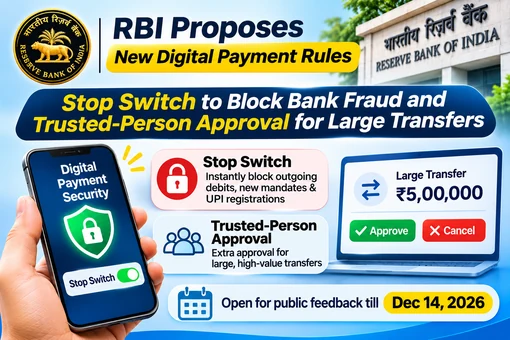


The Reserve Bank of India (RBI) has proposed a suite of customer-controlled anti-fraud safeguards including an emergency RBI Stop Switch to immediately halt outgoing account debits and an optional RBI trusted person approval mechanism for high-value transfers under draft amendment directions released on November 23, 2026.
Published for public consultation until December 14, 2026, the proposals appear in the draft Reserve Bank of India (Commercial Banks – Responsible Business Conduct) Fifth Amendment Directions, 2026 alongside parallel draft directions for Small Finance Banks, Payments Banks, Regional Rural Banks, Local Area Banks, and Co-operative Banks. If finalised without delay, the RBI new rules 2026 framework sets a proposed implementation date of January 1, 2027 for expanded bank negligence provisions and July 1, 2027 for customer-controlled preventive safeguards, unless individual banks roll them out earlier.
For Indian borrowers, salaried professionals, students, and freelancers, these RBI new rules Stop Switch & Trusted Person proposals aim to stop unauthorized account drains in real time while leaving existing Equated Monthly Instalments (EMIs), standing instructions, and incoming salary or loan credits uninterrupted.
What Happened?
On November 23, 2026, the Reserve Bank of India (RBI) issued draft directions proposing an RBI Stop Switch to block future customer-initiated outgoing debits immediately, a voluntary RBI trusted person mechanism to authenticate large digital transfers within one hour, default-off digital channels for new bank accounts, and stricter bank liability norms for bank fraud prevention.
What Did the RBI Announce in Its Draft Digital Payment Rules?
The central bank’s November 23, 2026 draft directions introduce five structural changes to RBI digital payment rules across India's banking system:
-
Emergency RBI Stop Switch (Paragraph 76FF): Banks must offer a one-action RBI Stop Switch across mobile banking, net banking, ATMs, branches, and phone banking. Activating it immediately blocks all future customer-initiated outward debits, new payment mandates, fresh standing instructions, and Unified Payments Interface (UPI) registration on new third-party apps.
-
Voluntary Trusted Person Mechanism (Paragraphs 76FQ–76FZ): Any adult bank account holder can voluntarily nominate an adult RBI trusted person with explicit consent from both parties and a 24-hour activation cooling period to approve transfers exceeding a customer-set threshold. The trusted approver gets zero account access, bears no financial liability, and must approve the transaction within one hour or it is automatically rejected.
-
Default-Off Digital Channels at Onboarding (Paragraph 76FK): When a customer opens a new bank account, all digital payment channels must remain disabled by default until the customer gives explicit consent and completes multi-factor authentication. Newly issued physical and virtual cards will initially work only at domestic contact-based ATMs and Point-of-Sale (PoS) terminals.
-
Granular Channel, Card & Beneficiary Caps: Customers will be able to switch individual payment channels on or off, schedule daily time windows when channels stay disabled, set per-transaction and daily caps per beneficiary, and control domestic, international, ATM, PoS, online, and contactless card limits separately.
-
Expanded Bank Negligence & Liability (Effective Proposed Date: January 1, 2027): Building on the RBI’s June 2026 customer-liability amendments, banks face explicit negligence liability if fraud results from system malfunctions, bank-side breaches, employee/vendor collusion, failure to send alerts, lack of 24x7 fraud reporting channels, or failure to honour customer-set limits and RBI new rules Stop Switch & Trusted Person controls.
Note that the RBI dropped an earlier April 2026 discussion-paper idea that would have imposed a mandatory one-hour latency delay on all large transfers, opting instead for customizable customer controls.
What Is Excluded from the Stop Switch and Trusted Person Mechanism?
Understanding what the RBI Stop Switch and RBI trusted person approval do not block prevents accidental payment disruptions:
-
Incoming Credits Continue: Activating the RBI Stop Switch does not freeze your bank account. Salary credits, client payouts, tax refunds, and approved loan disbursals continue entering your account normally.
-
Existing EMIs & Auto-Debits Stay Active: Existing recurring mandates including NACH auto-debits, e-mandates, standing instructions for personal loan EMIs, and bank-initiated charges or lien recoveries remain outside the Stop Switch’s scope so your credit score is not harmed by accidental EMI bounces.
-
Transactions Excluded from Trusted-Person Approval: According to Paragraph 76FQ of the RBI draft directions, the RBI trusted person second-factor check does not apply to UPI payments linked to the account, merchant payments (across any channel), or existing recurring mandates.
Earlier Banking Controls vs. RBI November 2026 Draft Proposals
|
Area |
Earlier / Current Situation |
New Proposed Development (Nov 23, 2026 Draft) |
What It Means for Borrowers & Account Holders |
|
Emergency Fraud Freeze |
Users must block cards, net banking, and UPI separately or request a full account freeze. |
Single RBI Stop Switch blocks all future customer-initiated outward debits immediately. |
Stops scammers from draining funds across multiple channels while keeping incoming credits open. |
|
High-Value Transfer Check |
Relies solely on the account holder’s OTP/biometric authentication; earlier April 2026 paper floated a 1-hour blanket delay. |
Optional RBI trusted person approval within 1 hour for transfers above a self-set limit (excludes UPI, merchant & recurring payments). |
Adds a human safety net against vishing and digital-arrest scams without slowing routine UPI spends. |
|
New Account Digital Access |
Digital channels and online card features are often active soon after onboarding. |
All digital channels disabled by default at onboarding; new cards restricted to domestic contact ATM/PoS initially. |
Prevents fraudsters from exploiting newly opened accounts before the customer sets security preferences. |
|
Spending & Time Limits |
Mostly governed by bank-wide or NPCI default ceilings. |
Customer-set per-transaction, per-beneficiary, daily channel limits, and scheduled off-hours windows. |
Lets users lock digital transfers overnight or cap daily transfers to specific recipients. |
|
Re-enabling Blocked Channels |
Standard password/OTP reset workflows vary across banks. |
Strict re-authentication plus a mandatory risk-based cooling period before lifting the Stop Switch. |
Prevents fraudsters from immediately turning payment rails back on after a user triggers a block. |
When Will the RBI New Rules 2026 Take Effect?
These safeguards are currently draft proposals, not yet active rules at commercial banks. Here is the timeline outlined in the Reserve Bank of India’s November 23, 2026 release:
-
Public Comment Deadline: December 14, 2026 (open to banks, fintech stakeholders, and consumers).
-
Proposed Start of Bank Negligence Rules: January 1, 2027 (aligned with the RBI’s June 2026 unauthorized electronic banking transaction liability updates).
-
Proposed Start of Stop Switch & Trusted Person Controls: July 1, 2027, though individual commercial banks may implement the facilities earlier once final directions are notified.
What This Means for Borrowers
For retail borrowers managing personal loans, credit cards, or digital credit lines, this RBI latest news update improves bank fraud prevention without changing core lending economics:
-
Interest Rates & EMIs: Unchanged. The November 23 draft addresses electronic banking conduct and RBI digital payment rules, not the Repo Rate or NBFC/bank lending rates. Your ongoing personal loan EMI stays exactly the same.
-
Loan Repayment & NACH Mandates: Protected. Because existing NACH and e-mandates are excluded from the RBI Stop Switch, triggering an emergency fraud block will not block scheduled loan instalments helping you avoid late fees or CIBIL drops explained in Pocketly’s guide on what happens when an EMI is missed or paid late.
-
Loan Disbursals & Digital Lending: Safer. Incoming credits remain unaffected when a Stop Switch is active, while stricter authentication and bank-side security checks reinforce the consumer protections under the digital lending platforms in India framework.
-
Borrowing Cost, Eligibility & Processing Fees: Unchanged. Credit underwriting, documentation, and processing fees are unaffected by these account-level payment controls.
Hypothetical Example: How the Stop Switch and Trusted Person Rules Work Together
Consider an illustrative scenario involving a ₹50,000 personal loan and everyday banking safety:
-
Scenario A (Stopping a Phishing Scam): Suppose a borrower receives a sanctioned ₹50,000 personal loan into their savings account and later clicks a spoofed KYC link. Suspecting credential theft, they activate the RBI Stop Switch. Outgoing NEFT/IMPS transfers and new UPI app registrations are blocked immediately, while their scheduled monthly loan EMI auto-debit continues uninterrupted.
-
Scenario B (Blocking a Coerced Transfer): Suppose a salaried professional sets a ₹25,000 threshold under the RBI trusted person feature, naming a spouse or parent. If a scammer pressures the user into initiating a ₹45,000 RTGS/NEFT transfer, the bank alerts the trusted approver. If the trusted person rejects it or does not approve within one hour the transfer is automatically cancelled.
(Note: The figures above are illustrative examples based on the RBI’s November 23, 2026 draft framework and do not represent Pocketly’s specific loan pricing or approval terms.)
What Borrowers Should Check Before Taking a Personal Loan
While stronger RBI digital payment rules protect your bank balance from unauthorized debits, smart borrowing starts with verifying your lender and repayment capacity before applying:
-
RBI-Registered Lending Entity: Confirm the app or lender is backed by an active RBI-registered bank or NBFC review Pocketly’s coverage of RBI cancelling 49 NBFC licences and identifying fake loan apps to spot red flags early.
-
Key Fact Statement (KFS) & APR: Inspect the mandatory KFS upfront to verify the all-inclusive Annual Percentage Rate (APR), processing charges, tenure, late-payment penalties, and total repayment amount.
-
Monthly EMI & Income Ratio: Check your monthly instalment in advance using a Personal Loan EMI Calculator and measure your debt-to-income obligations with a FOIR Calculator so repayments remain comfortable.
-
Borrower Rights & Recovery Rules: Understand fair collection boundaries by reading Pocketly’s breakdown of RBI guidelines for loan recovery in India.
For eligible salaried professionals, students, freelancers, and self-employed earners seeking transparent, short-term credit, Pocketly operates as a 100% digital lending platform managed by Speel Finance Company Private Limited (an RBI-registered NBFC), offering personal loans from ₹1,000 to ₹50,000 with paperless KYC and upfront KFS disclosures. Borrowers can explore dedicated options including a personal loan for salaried individuals, a personal loan for self employed earners, or a loan for non salaried applicants under published responsible lending practices.
What Should Borrowers and Bank Customers Do Now?
Because the RBI new rules Stop Switch & Trusted Person guidelines are in the draft consultation phase until December 14, 2026, customers do not need to visit a bank branch today. Until banks roll out the new controls (targeted for July 1, 2027), use existing mobile-banking card/channel toggles, avoid sharing OTPs or PINs, verify lenders against the RBI directory, and report suspected cyber fraud immediately on helpline 1930 or cybercrime.gov.in.
Key Takeaways
-
Draft Rules Released Nov 23, 2026: The Reserve Bank of India (RBI) issued draft Responsible Business Conduct Fifth Amendment Directions proposing an emergency RBI Stop Switch and voluntary RBI trusted person approval for large digital transfers.
-
How the Stop Switch Works: Once triggered, it immediately blocks all future customer-initiated outward debits, new mandates, and new UPI app registrations while keeping incoming credits and existing loan EMI auto-debits active.
-
How Trusted-Person Approval Works: Available voluntarily to all adult account holders (with a 24-hour activation cooling period), the nominated adult has one hour to approve transfers above a self-set limit; UPI, merchant, and recurring payments are excluded.
-
Default-Off New Accounts: Newly opened bank accounts must keep digital payment channels disabled by default until explicit customer consent and authentication.
-
Implementation Timeline: Public comments close on December 14, 2026; bank negligence provisions are proposed for January 1, 2027, and customer-controlled bank fraud prevention tools for July 1, 2027.
Need Transparent, Small-Ticket Digital Credit Without Hidden Surprises?
Whether you are covering an unexpected household expense, managing freelance cash flow, or bridging a month-end shortfall, Pocketly offers eligible Indian borrowers unsecured personal loans from ₹1,000 to ₹50,000 through a 100% paperless KYC journey backed by RBI-registered NBFC Speel Finance Company Private Limited with upfront Key Fact Statement (KFS) disclosures.
-
Explore Pocketly Personal Loans to check your eligibility online.
-
Estimate Your Monthly EMI before applying to plan comfortable repayments.
FAQs
1. What is the RBI Stop Switch proposed in November 2026?
The RBI Stop Switch is a proposed emergency banking feature under the RBI’s November 23, 2026 draft directions that lets customers immediately block all future customer-initiated outgoing debits, new payment mandates, and new UPI app registrations from their bank account with a single action.
2. Does activating the RBI Stop Switch stop my loan EMI or salary credit?
No. According to the RBI’s draft directions, activating the RBI Stop Switch does not block incoming credits such as salary or loan disbursals, nor does it stop existing recurring mandates, NACH auto-debits for loan EMIs, or bank-initiated charges.
3. How does the RBI trusted person approval rule work?
Under the voluntary Trusted Person Mechanism (TPM), an account holder can nominate an adult RBI trusted person (after mutual consent and a 24-hour cooling period) to approve transfers above a chosen limit. If the trusted approver does not approve within one hour, the transaction is cancelled.
4. Does the trusted person rule apply to UPI or merchant payments?
No. Paragraph 76FQ of the RBI’s November 23, 2026 draft directions explicitly excludes UPI payments linked to the account, merchant payments across any channel, and existing recurring mandates (standing instructions, e-mandates, or NACH) from RBI trusted person authentication.
5. When will the RBI new rules 2026 Stop Switch and Trusted Person features start?
The guidelines are currently draft proposals open for public feedback until December 14, 2026. Once finalised, expanded bank negligence rules are proposed to start on January 1, 2027, and customer-controlled RBI digital payment rules are proposed for July 1, 2027.
6. Will these new RBI digital payment rules change personal loan interest rates?
No. The draft directions govern electronic banking fraud prevention, customer channel controls, and bank liability. They do not change the RBI Repo Rate, NBFC lending rates, personal loan processing fees, or existing EMI schedules.
Sources
-
Reserve Bank of India (RBI) Draft Directions (November 23, 2026): Draft – Reserve Bank of India (Commercial Banks – Responsible Business Conduct) Fifth Amendment Directions, 2026 (Paragraphs 76FB–76FZE: Preventive Safeguards for Electronic Banking Transactions, Stop Switch, and Trusted Person Mechanism). https://www.rbi.org.in/scripts/bs_viewcontent.aspx?Id=5221
-
Reserve Bank of India (RBI) Connect 2 Regulate Portal (November 23/24, 2026): Public Consultation Notice on Draft Responsible Business Conduct Fifth Amendment Directions, 2026 (Commercial Banks, SFBs, Payments Banks, RRBs, LABs, and Co-operative Banks). https://m.rbi.org.in/scripts/Bs_Connect2RegulateDetails.aspx?prid=512
-
Mint / HT Digital Streams (November 23, 2026): "RBI proposes new rules to protect bank accounts from fraud: Here's how Stop Switch and trusted person approval work." https://www.livemint.com/money/personal-finance/rbi-proposes-new-rules-to-protect-bank-accounts-from-fraud-heres-how-stop-switch-and-trusted-person-approval-work-11795441662320.html
-
The Times of India (November 24, 2026): "RBI proposes trusted approver, stop switch to curb digital fraud." https://timesofindia.indiatimes.com/business/india-business/rbi-proposes-trusted-approver-stop-switch-to-curb-digital-fraud/articleshow/136116676.cms