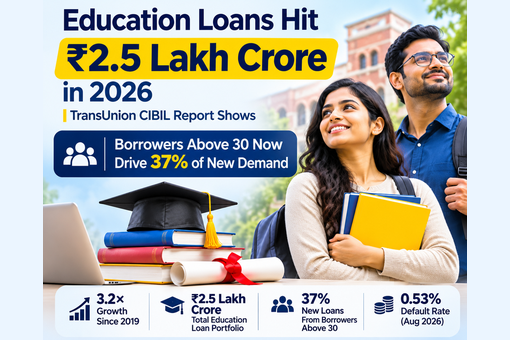


Total outstanding balances across education loans India 2026 reached ₹2.5 lakh crore as of August 2026, expanding 3.2 times since August 2019, according to the latest education loan news published in TransUnion CIBIL's November 2026 report, Lending Unlocked: Education Loans.
Released on November 16, 2026, and highlighted in financial industry coverage on November 23, 2026, the education loan CIBIL report reveals a major demographic shift in how Indians finance learning. Solo borrowers aged above 30 now account for 37% of new education loan originations in the first half of 2026 (H1 2026), jumping sharply from just 6% in 2019 rising from roughly 6,000 borrowers in 2019 to 1.5 lakh borrowers in 2026.
For everyday Indian borrowers including salaried professionals, mid-career workers, students, and freelancers this education loan news signals two parallel realities: NBFC education loans have expanded rapid access to sub-₹1 lakh upskilling credit, while disciplined education loan repayment remains critical as live loan accounts reach 29.1 lakh nationwide.
What Happened?
TransUnion CIBIL's Lending Unlocked: Education Loans report (November 2026) confirmed that India's outstanding student loan India portfolio touched ₹2.5 lakh crore by August 2026, with balance-level delinquencies (90–179 days past due) remaining low at 0.53%. Crucially, borrowers older than 30 now represent 37% of fresh originations, largely driven by short-term professional upskilling and NBFC education loans.
Why Are More Indians Above 30 Taking Education Loans in 2026?
Traditional student loan India portfolios once revolved almost exclusively around 18-to-24-year-olds entering undergraduate or postgraduate degrees with parental co-borrowers. According to the education loan CIBIL report, three structural shifts explain why solo borrowers above 30 are reshaping education loans India 2026:
-
Rapid Mid-Career Upskilling & AI Certification Demand: Working professionals in technology, analytics, finance, and management are enrolling in executive programs, Artificial Intelligence (AI) bootcamps, and digital certifications to protect their earning power. TransUnion CIBIL notes that 64% of loans originated by solo borrowers aged above 30 carry a sanction amount of ₹1 lakh or less.
-
Boom in Micro-Ticket E-Learning Finance: Across all age groups, loans of ₹1 lakh or below accounted for 42% of all new education loan originations in H1 2026 (up 33 percentage points since 2019). Even more striking, the sub-₹25,000 loan segment recorded 34% year-on-year volume growth, pulling the overall average ticket size down from a peak of ₹14.3 lakh in 2023 to ₹7.5 lakh in H1 2026.
-
Digital Underwriting by Non-Banking Lenders: Public sector banks historically dominated large collateralized overseas loans, whereas NBFC education loans and fintech-enabled lenders now underwrite smaller, fast-turnaround skill courses using digital KYC and cash-flow checks. To see how digital rails enable faster credit checks, read Pocketly's breakdown of how India's digital public infrastructure is changing financial services.
2019 vs. 2026: How India's Education Loan Landscape Changed
The following comparison summarizes verified metrics from TransUnion CIBIL's November 2026 education loan CIBIL report:
|
Market Indicator |
2019 Baseline |
2026 Reality (TransUnion CIBIL) |
What It Means for Borrowers |
|
Total Outstanding Balances |
Indexed at 100 (~₹0.78 lakh cr) |
₹2.5 lakh crore (3.2x growth) |
Credit access for both higher degrees and skill courses has expanded sharply. |
|
Active (Live) Loan Accounts |
~20.8 lakh accounts |
29.1 lakh live accounts (1.4x) |
More households and working professionals actively service education EMIs. |
|
Solo Borrowers Aged Above 30 |
6% of originations (6,000 borrowers) |
37% of originations (1.5 lakh borrowers) |
Mid-career professionals increasingly borrow independently without co-applicants. |
|
Sub-₹1 Lakh Loan Share |
9% of originations |
42% of H1 2026 originations |
Short-term certifications and online courses are widely financed via small loans. |
|
Average Loan Ticket Size |
Peaked at ₹14.3 lakh (2023) |
₹7.5 lakh in H1 2026 |
High-volume micro-loans balance out high-value overseas university loans. |
|
90+ DPD Delinquency Rate |
Higher post-pandemic stress |
0.53% (as of August 2026) |
Overall education loan repayment discipline remains healthy across bureaus. |
Regional & Borrower Breakdown: Who Is Borrowing in 2026?
According to this latest education loan news, borrowing patterns vary sharply across states and household structures:
-
Volume vs. Value Leaders: Maharashtra leads India in total education loan origination volumes due to strong demand for domestic and skill-based courses, while Telangana, Andhra Pradesh, and Gujarat contribute disproportionately to total rupee value because of larger-ticket overseas university loans.
-
Three Distinct Borrower Archetypes: TransUnion CIBIL classifies 2026 applicants into Traditional Students (solo borrowers aged 30 or below, representing 22% of originations), Career Upskillers (solo borrowers aged above 30, at 37%), and Co-Borrower Supported Loans (joint loans involving a parent or guardian above 30, accounting for 41% of H1 2026 originations).
-
Active Credit Monitoring: Roughly 39% of active education loan borrowers monitored their credit scores with TransUnion CIBIL between August 2025 and August 2026 reflecting higher awareness of how timely education loan repayment supports future home, auto, or personal credit eligibility.
What This Means for Borrowers
Whether you are a 33-year-old professional financing a data-science certification or a recent graduate managing existing dues, this education loan news carries practical implications across key borrowing factors:
-
Interest Rates & Regulatory Rules (Unchanged): TransUnion CIBIL is a credit information company, not a regulator; its November 2026 report introduces no new Reserve Bank of India (RBI) rules or automatic interest rate changes. Under existing RBI guidelines, public sector banks generally offer collateral-free education loans up to ₹4 lakh (and up to ₹7.5 lakh under the Credit Guarantee Fund Scheme for Education Loans, CGFSEL), while NBFC education loans price rates based on borrower creditworthiness, course type, and tenure.
-
Eligibility & Documentation: Solo borrowers above 30 with steady salary inflows or verifiable freelance income rarely need a parent as co-applicant for sub-₹1 lakh upskilling courses, though lenders still verify PAN, Aadhaar KYC, and existing debt obligations.
-
EMI & Total Repayment Cost: Short-term upskilling loans often carry 6-to-24-month tenures with immediate monthly instalments rather than multi-year study moratoriums. Before committing, test how a new instalment affects your monthly cash flow using Pocketly's personal loan EMI calculator and check your debt-to-income comfort on our FOIR calculator.
-
Credit Score Impact: Every education loan or upskilling EMI is reported to credit bureaus. Missing an instalment hurts your CIBIL profile learn how delays affect your bureau record in our guide on what happens when an EMI is missed or paid late.
Hypothetical Repayment Example: ₹50,000 Upskilling Loan vs. Short-Term Cash Needs
To understand education loan repayment math clearly, consider an illustrative example (for educational explanation only; not representative of any specific lender's guaranteed pricing):
-
Suppose a 32-year-old working professional borrows ₹50,000 for a 6-month executive certification at an illustrative reducing interest rate of 24% per annum (2% per month) over a 6-month tenure.
-
The approximate monthly EMI works out to ₹8,926, resulting in total interest of roughly ₹3,556 and total principal-plus-interest repayment of ₹53,556 (excluding any applicable upfront processing fee and 18% GST).
-
If the borrower stretches the same ₹50,000 across 12 months at the same rate, the monthly EMI drops to roughly ₹4,728, but total interest rises to ₹6,736. Comparing flat versus reducing interest structures beforehand on a flat vs reducing rate calculator prevents hidden cost surprises.
What Borrowers Should Check Before Taking Any Loan in 2026
Before signing any digital credit agreement whether for an executive course, exam fees, laptop purchase, or urgent household expense verify these essentials:
-
Regulated Lending Partner: Confirm that the platform partners with an RBI-registered bank or NBFC and follows responsible lending practices.
-
Key Fact Statement (KFS): Under RBI Digital Lending Directions, lenders must provide a standardized KFS showing the all-inclusive Annual Percentage Rate (APR), processing charges, 18% GST, and total repayment amount before disbursal.
-
Repayment Tenure & Prepayment Terms: Match your tenure to your monthly budget using a 50 30 20 rule calculator, and check whether early closure charges apply.
When professionals or students face smaller, immediate gaps such as exam registration fees, certification deposits, or month-end living expenses Pocketly provides transparent, 100% digital personal credit from ₹1,000 to ₹50,000 facilitated through our RBI-registered NBFC partner, Speel Finance Company Private Limited, subject to digital KYC and underwriting criteria. Depending on your income profile, you can explore a personal loan for salaried professionals before payday, a personal loan for self employed freelancers managing irregular client payouts, or a loan for non salaried students and gig workers.
Key Takeaways
-
₹2.5 Lakh Crore Milestone: Latest education loan news from TransUnion CIBIL shows India's outstanding education loan balances reached ₹2.5 lakh crore in August 2026, growing 3.2x since August 2019.
-
30+ Borrowers Surge to 37%: Solo borrowers older than 30 now account for 37% of new originations in H1 2026 (up from 6% in 2019), with 64% borrowing ₹1 lakh or less for career upskilling.
-
Small-Ticket Boom Lowers Ticket Size: Loans under ₹1 lakh made up 42% of H1 2026 originations and sub-₹25,000 loans grew 34% YoY, reducing the average ticket size from ₹14.3 lakh (2023) to ₹7.5 lakh.
-
NBFCs Expand Access: NBFC education loans and digital lenders are driving smaller-ticket skill financing, while private and public banks compete on larger domestic and overseas degrees.
-
Strong Repayment Health: Across 29.1 lakh active accounts, 90+ days past due delinquencies stood at a low 0.53%, underscoring disciplined education loan repayment across India.
Need Fast, Transparent Funds for Upskilling Fees or Month-End Expenses?
Whether you are paying for an urgent certification deposit, exam registration, or unexpected monthly bills, explore paperless digital personal credit from ₹1,000 to ₹50,000 on Pocketly facilitated through RBI-registered NBFC Speel Finance Company Private Limited with upfront Key Fact Statement disclosures and flexible EMIs.Check Your Eligibility on Pocketly Today
FAQs
1. What is the latest education loan news in India in 2026?
According to TransUnion CIBIL's November 2026 Lending Unlocked: Education Loans report, India's total outstanding education loan balances hit ₹2.5 lakh crore as of August 2026 a 3.2x increase since 2019 while borrowers above 30 now represent 37% of all new loan originations.
2. Why are more Indians above 30 taking education loans?
Working professionals above 30 are increasingly borrowing independently to fund short-term executive certifications, AI and tech upskilling courses, and career-transition programs. Roughly 64% of loans taken by solo borrowers over 30 are for ₹1 lakh or less.
3. How are NBFC education loans changing the student loan market?
While traditional public sector banks focus heavily on higher-value collateralized loans for domestic and foreign degrees, NBFC education loans have expanded access to fast, smaller-ticket credit (under ₹1 lakh and sub-₹25,000) for e-learning and vocational skill programs.
4. What is the current default rate on education loans in India?
TransUnion CIBIL data shows balance-level delinquency (loans overdue by 90 to 179 days) stood at just 0.53% as of August 2026 across 29.1 lakh live education loan accounts, reflecting healthy education loan repayment behavior.
5. Does taking a small education or upskilling loan affect my CIBIL score?
Yes. Regulated banks and NBFCs report every education and personal loan to credit bureaus. Paying your monthly EMIs on time strengthens your CIBIL score, whereas delayed payments or defaults reduce your score and limit future borrowing options.
6. Can I use a small personal loan for short-term exam fees or certification costs?
Yes, if you need ₹1,000 to ₹50,000 for immediate exam fees, course deposits, or study essentials without lengthy institutional tie-ups, regulated digital personal loans such as those facilitated on Pocketly offer structured 61-day to 9-month EMIs subject to KYC and eligibility checks.
Sources
-
TransUnion CIBIL: Lending Unlocked: Education Loans – November 2026 (Published November 16, 2026). https://www.transunioncibil.com/lp/lending-unlocked-education-loans-nov-2026
-
TransUnion CIBIL Newsroom: "Education Loans Triple Since 2019 – More Than One Third of Borrowers Older Than 30" (Published November 16–17, 2026). https://newsroom.transunioncibil.com/education-loans-triple-since-2019--more-than-one-third-of-borrowers-older-than-30/
-
The Economic Times (ET Wealth): "Outstanding education loans hit Rs 2.5 trillion in 2026: Why more borrowers over 30 are taking loans" (Published November 23, 2026). https://economictimes.indiatimes.com/wealth/borrow/outstanding-education-loans-hit-rs-2-5-trillion-in-2026-why-more-borrowers-over-30-are-taking-loans/articleshow/136044967.cms
-
Reserve Bank of India (RBI): Frequently Asked Questions on Educational Loans & Master Direction on Digital Lending (Regulatory Framework Reference). https://www.rbi.org.in/