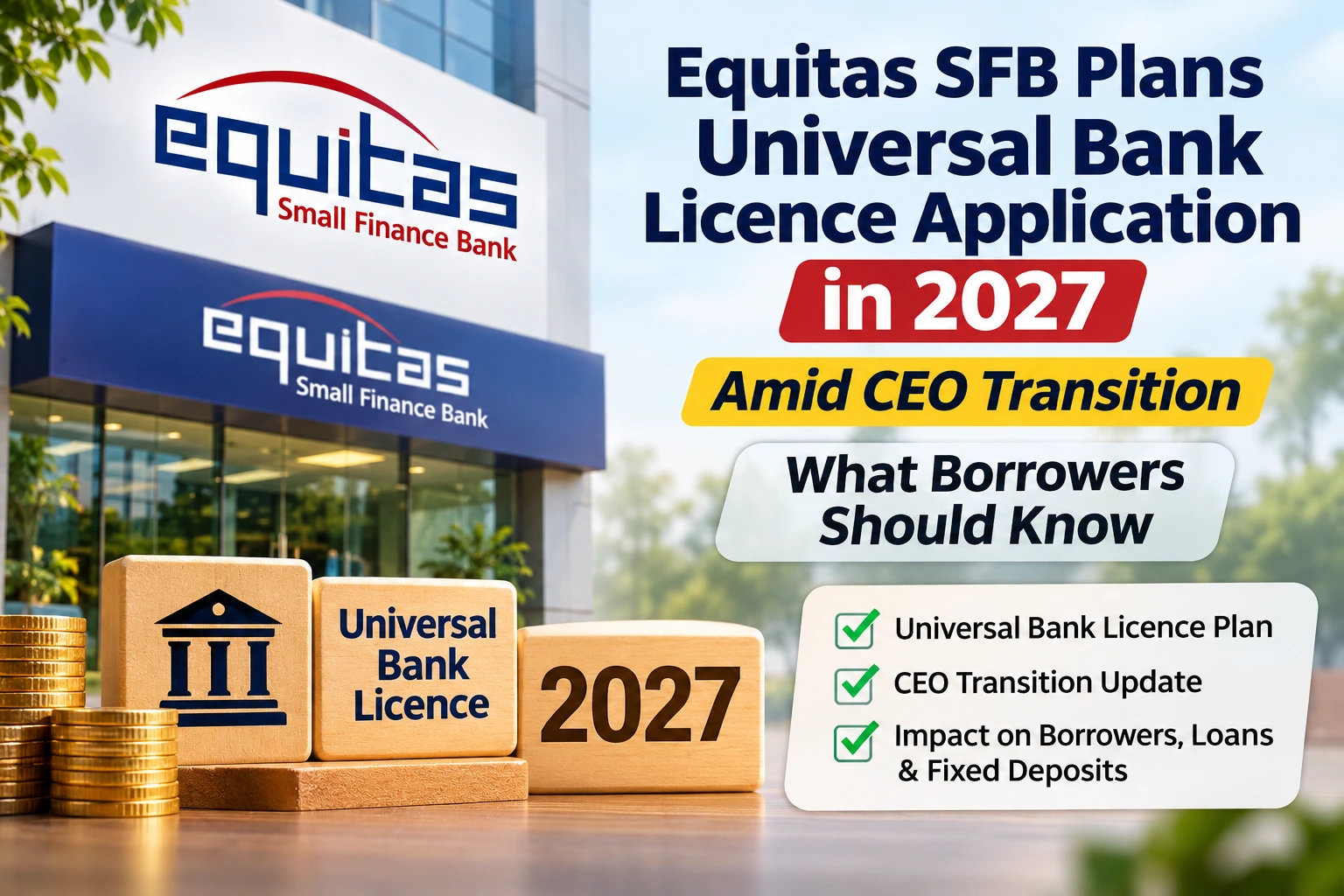


Equitas Small Finance Bank plans to submit its formal application to the Reserve Bank of India (RBI) for an Equitas universal bank licence in the 2027 calendar year , interim Managing Director and Chief Executive Officer Balaji Nuthalapadi confirmed on Wednesday, November 18, 2026, in an interview with Press Trust of India (PTI).
While the ongoing leadership transition following founder-CEO P.N. Vasudevan’s exit could push the filing back by a few months, management stated that Equitas Small Finance Bank already satisfies the central bank's eligibility parameters by a wide margin. For Indian borrowers, salaried workers, and small business owners tracking small finance bank news , this planned upgrade signals wider future loan products and potentially lower long-term funding costs though existing loan contracts, interest rates, and Equated Monthly Instalments (EMIs) remain unchanged today.
What Happened?
On November 18, 2026, interim CEO Balaji Nuthalapadi announced that Equitas Small Finance Bank will apply for an RBI banking licence to become a full universal bank in 2027. Although appointing a permanent CEO may delay the application by a few months, day-to-day lending, deposit collection, and customer operations continue uninterrupted.
Why Is Equitas Small Finance Bank Applying in 2027?
Latest Equitas Bank news centers on balancing two parallel priorities: completing a smooth executive succession and preparing for a structural regulatory upgrade.
-
Executive Succession After Founder-CEO Exit: Nuthalapadi was appointed interim CEO for three months after founder-CEO P.N. Vasudevan stepped down amid conflict-of-interest concerns regarding a non-bank lender promoted by his daughter. The board of Equitas Small Finance Bank will submit two candidate names to the Reserve Bank of India within the prescribed three-month window to finalize a permanent successor.
-
Calibrated Timeline for Equitas Bank 2027: Management noted that while the leadership transition may defer the formal application by a few months into Equitas Bank 2027 , the lender’s five-year growth roadmap remains intact. Nuthalapadi added that RBI officials have acknowledged the bank’s institutional governance systems during recent interactions.
-
Strong Q3 Operational Momentum: Despite mild drought stress in parts of Karnataka and Maharashtra which represent roughly 3% of the bank's total asset book Equitas Small Finance Bank aims to exceed its third-quarter asset disbursement and deposit-raising targets, even if full-year FY27 Return on Assets (RoA) lands marginally below its 1.5% goal.
What Are the RBI Rules for Converting a Small Finance Bank into a Universal Bank?
Under the Reserve Bank of India’s circular on Voluntary Transition of Small Finance Banks to Universal Banks (issued April 26, 2024, and consolidated in the 2025 licensing directions), a Small Finance Bank cannot upgrade automatically. It must apply formally and pass regulatory scrutiny against strict quantitative benchmarks:
-
Minimum Track Record & Listing: Scheduled commercial bank status with a satisfactory operational record of at least five years, plus equity shares listed on a recognised stock exchange ( Equitas Small Finance Bank is listed on both BSE and NSE).
-
Capital & Profitability Thresholds: Minimum audited net worth of ₹1,000 crore at the end of the previous quarter, continuous compliance with the 15% Capital to Risk-weighted Assets Ratio (CRAR), and net profits in each of the preceding two financial years.
-
Asset Quality Caps: Gross Non-Performing Assets (GNPA) of 3% or less and Net Non-Performing Assets (NNPA) of 1% or less over the last two financial years.
-
Portfolio Diversification: The RBI gives explicit preference to Small Finance Banks with a diversified loan book rather than heavy concentration in unsecured microfinance.
Note that an application in Equitas Bank 2027 is a corporate intent not a confirmed approval. Only after the RBI grants "in-principle" clearance and final licence approval (similar to the path followed by AU Small Finance Bank, which received in-principle approval in August 2025) does an SFB officially transition.
Small Finance Bank vs. Universal Bank: What Changes for Customers?
|
Area |
Current Status (Small Finance Bank) |
Proposed Status (Universal Bank in 2027+) |
What It Means for Borrowers & Savers |
|
Regulatory Identity |
Operates under differentiated SFB licensing rules with "Small Finance Bank" in its name. |
Full-service commercial bank under Section 22(1) of the Banking Regulation Act, 1949. |
Removes the "small finance" tag, boosting institutional trust and corporate salary account adoption. |
|
Priority Sector Lending (PSL) |
Required to direct 60% of Adjusted Net Bank Credit (ANBC) to priority sectors. |
Standard universal bank PSL requirement drops to 40% of ANBC. |
Gives the bank greater flexibility to expand mainstream retail, housing, and corporate lending. |
|
Ticket-Size Restrictions |
At least 50% of the loan portfolio must consist of loans up to ₹25 lakh. |
No mandatory small-ticket cap; unrestricted commercial and retail loan sizing. |
Enables larger business loans, working capital limits, and mid-to-large personal credit lines. |
|
Cost of Funds & Deposits |
Typically pays higher savings/FD rates to attract retail deposits against bigger banks. |
Broader access to low-cost Current Account Savings Account (CASA) deposits. |
Lower funding costs over time can help the lender offer more competitive loan interest rates. |
What Does This Mean for Borrowers?
Whenever major small finance bank news surfaces, retail borrowers and depositors often wonder if their active accounts or credit lines will be disrupted. Here is how the planned Equitas universal bank licence affects and does not affect everyday users:
-
Existing Loans & EMIs (No Immediate Change): Your current personal loan, vehicle loan, small business loan, or housing loan agreement with Equitas Small Finance Bank remains valid under its original terms. Monthly EMI dates, repayment schedules, and sanctioned interest rates do not change simply because the bank plans to apply for an RBI banking licence in 2027.
-
Future Borrowing Costs & Product Range: Once a lender transitions to a universal bank, access to cheaper retail and corporate deposits generally reduces its cost of funds. Over the medium term, this can translate into more competitive interest rates and new products such as full-suite credit cards, wealth management, and higher-ticket personal or MSME loans.
-
Eligibility & Documentation: While universal banks cater to larger corporate and salaried segments, Equitas has built its core franchise around small business loans and mass-market retail borrowers. Digital KYC, PAN-Aadhaar verification, and cash-flow underwriting remain central to retail loan approvals.
-
Deposit Insurance Protection: Customer savings and fixed deposits continue to be protected up to ₹5,00,000 per depositor under the Deposit Insurance and Credit Guarantee Corporation (DICGC), an RBI subsidiary, both before and after any licence upgrade.
For deeper context on how non-bank and bank funding costs shape retail credit pricing across India, read Pocketly’s coverage on NBFCs facing rising funding costs despite strong loan growth in FY27 and the RBI's ₹1 lakh crore liquidity injection.
Hypothetical Example: How Funding Costs Affect a Borrower’s Monthly EMI
To understand why an Equitas universal bank licence matters to future borrowers, consider an illustrative calculation: If a borrower takes a ₹50,000 personal loan for a 6-month tenure:
-
Scenario A (Higher Funding Cost Environment Illustrative 24% p.a. Reducing Rate): The estimated monthly EMI is approximately ₹8,926 , with total interest payable of roughly ₹3,558 (excluding applicable processing fees and GST).
-
Scenario B (Lower Universal Bank Funding Cost Illustrative 16% p.a. Reducing Rate): The estimated monthly EMI drops to around ₹8,727 , reducing total interest payable to roughly ₹2,360 saving the borrower nearly ₹1,200 over six months.
(Note: The ₹50,000 loan scenarios above are educational illustrations to show how interest rate differences impact repayment costs. They do not represent actual pricing from Equitas Small Finance Bank or Pocketly.)
What Borrowers Should Check Before Taking a Personal Loan
Whether you borrow from a commercial bank, a transitioning small finance bank, or a digital lending app, verifying key loan terms before signing protects you from unexpected charges:
-
Lender Registration & Licensing: Confirm that your lender is either an RBI-scheduled bank or a platform partnering with an active RBI-registered Non-Banking Financial Company (NBFC). Review Pocketly's guide on how digital lending platforms work in India to understand the regulated entity structure.
-
Key Fact Statement (KFS): Under RBI Digital Lending Directions, every regulated lender must share an upfront KFS listing the exact Annual Percentage Rate (APR), processing charges, net disbursed amount, and total repayment obligation.
-
Monthly EMI & Debt-to-Income Ratio: Check that your new instalment fits safely within your monthly budget using a Personal Loan EMI Calculator and verify your overall debt obligations with a FOIR Calculator.
-
Interest Calculation Method & Late Penalties: Compare interest structures with a Flat vs Reducing Rate Calculator and understand what happens if a loan EMI is missed or paid late so your credit score stays protected.
For salaried professionals, students, first-jobbers, freelancers, and self-employed individuals who need fast, transparent, small-ticket credit without lengthy bank branch visits, Pocketly offers digital personal loans from ₹1,000 to ₹50,000. All loans on Pocketly are underwritten and disbursed directly into your bank account by RBI-registered NBFC partner Speel Finance Company Private Limited following a 100% paperless KYC workflow. Borrowers can explore dedicated options including a personal loan for salaried applicants, a personal loan for self employed professionals, or a loan for non salaried earners while adhering to transparent responsible lending practices.
Outlook for Equitas Bank 2027
Latest Equitas Bank news confirms that while an executive leadership transition is underway, the lender's long-term ambition to secure an Equitas universal bank licence remains firmly intact for Equitas Bank 2027 . Once a permanent CEO takes charge and the formal application reaches the Reserve Bank of India, regulatory approval will determine when Equitas Small Finance Bank officially enters India's universal banking league.
10. Key Takeaways
-
2027 Application Target: Interim CEO Balaji Nuthalapadi confirmed on November 18, 2026, that Equitas Small Finance Bank plans to apply to the RBI for a universal bank licence in 2027.
-
Leadership Transition Factor: Following founder-CEO P.N. Vasudevan's exit, the bank will submit two permanent CEO candidates to the RBI within three months, which may shift the licence filing by a few months.
-
Strict RBI Criteria: Under RBI guidelines, an SFB upgrading to a universal bank must hold a ₹1,000 crore minimum net worth, 5+ years of listed track record, 15% CRAR, two years of net profits, and GNPA/NNPA below 3% and 1%.
-
No Disruption to Current Customers: Existing loans, EMIs, savings accounts, and ₹5 lakh DICGC deposit insurance remain completely unaffected during the transition.
-
Long-Term Borrower Upside: Universal bank status removes the 60% PSL and ₹25 lakh ticket-size caps while lowering deposit funding costs over time.
Need Fast, Transparent Personal Credit Without Branch Delays?
Whether you are managing an unexpected bill, bridging freelance cash flow, or handling month-end expenses, Pocketly provides eligible Indian borrowers with digital personal loans from ₹1,000 to ₹50,000 backed by RBI-registered NBFC partner Speel Finance Company Private Limited , with 100% paperless KYC and upfront Key Fact Statement disclosures.
-
Explore Pocketly Personal Loans to check your eligibility online.
-
Estimate Your Monthly EMI before you borrow to plan stress-free repayments.
FAQs
1. When will Equitas Small Finance Bank apply for a universal bank licence?
According to interim CEO Balaji Nuthalapadi on November 18, 2026, Equitas Small Finance Bank plans to submit its formal application for a universal bank licence to the Reserve Bank of India (RBI) in the 2027 calendar year, following the appointment of a permanent Managing Director and CEO.
2. Why was Equitas Small Finance Bank's universal bank application delayed?
The planned application was pushed back by a few months due to an ongoing executive transition after founder-CEO P.N. Vasudevan resigned amid conflict-of-interest concerns involving an NBFC promoted by his daughter. Management stated the bank wants a permanent CEO in place before filing with the RBI.
3. Has the RBI already approved Equitas Small Finance Bank as a universal bank?
No. As of November 19, 2026, Equitas Small Finance Bank has only announced its intent to apply in 2027. Securing an RBI banking licence requires formal submission, regulatory due diligence, "in-principle" approval, and final licensing clearance from the Reserve Bank of India.
4. What are the RBI eligibility rules for a Small Finance Bank to become a universal bank?
Under the RBI's April 2024 circular, an SFB must have scheduled status with at least five years of satisfactory performance, listed shares, a minimum net worth of ₹1,000 crore, 15% CRAR, net profits in the last two financial years, GNPA of 3% or less, and NNPA of 1% or less.
5. Will my existing loan or EMI with Equitas Small Finance Bank change?
No. Existing personal loans, vehicle loans, business loans, and savings accounts remain governed by your original signed contract. Applying for or transitioning to a universal bank licence does not alter your current EMI schedule or interest rate.
6. How does a universal bank licence benefit borrowers in the future?
Universal banks face lower Priority Sector Lending quotas (40% vs. 60% for SFBs), face no mandate to keep 50% of loans under ₹25 lakh, and attract lower-cost retail and corporate deposits which can lead to broader credit products and more competitive interest rates over time.
Sources
-
Press Trust of India (PTI) / The Economic Times (November 18, 2026): "Equitas SFB to apply for universal banking licence next year, leadership transition may delay move." https://economictimes.indiatimes.com/industry/banking/finance/banking/equitas-sfb-plans-universal-banking-license-application-despite-leadership-transition-challenges/articleshow/135966812.cms
-
ETBFSI / The Economic Times (November 19, 2026): "Equitas SFB to exceed growth targets in Q3, apply for universal bank licence in 2027." https://bfsi.economictimes.indiatimes.com/articles/equitas-sfb-to-exceed-growth-targets-in-q3-apply-for-universal-bank-licence-in-2027/135975494
-
Reserve Bank of India (RBI) Notification (April 26, 2024): "Voluntary transition of Small Finance Banks to Universal Banks" (RBI/2024-25/28 | DOR.LIC.REC.20/16.13.218/2024-25). https://www.rbi.org.in/Scripts/NotificationUser.aspx?Id=12676&Mode=0
-
Reserve Bank of India (RBI) Master Direction (November 28, 2025): "Reserve Bank of India (Universal Banks – Licensing) Guidelines, 2025." https://m.rbi.org.in/scripts/BS_ViewMasDirections.aspx?id=13168
-
Reserve Bank of India (RBI) Press Release (August 7, 2025): "RBI grants 'In-principle' Approval to AU Small Finance Bank Limited for transition into a Universal Bank." https://www.rbi.org.in/Scripts/BS_PressReleaseDisplay.aspx?prid=60977