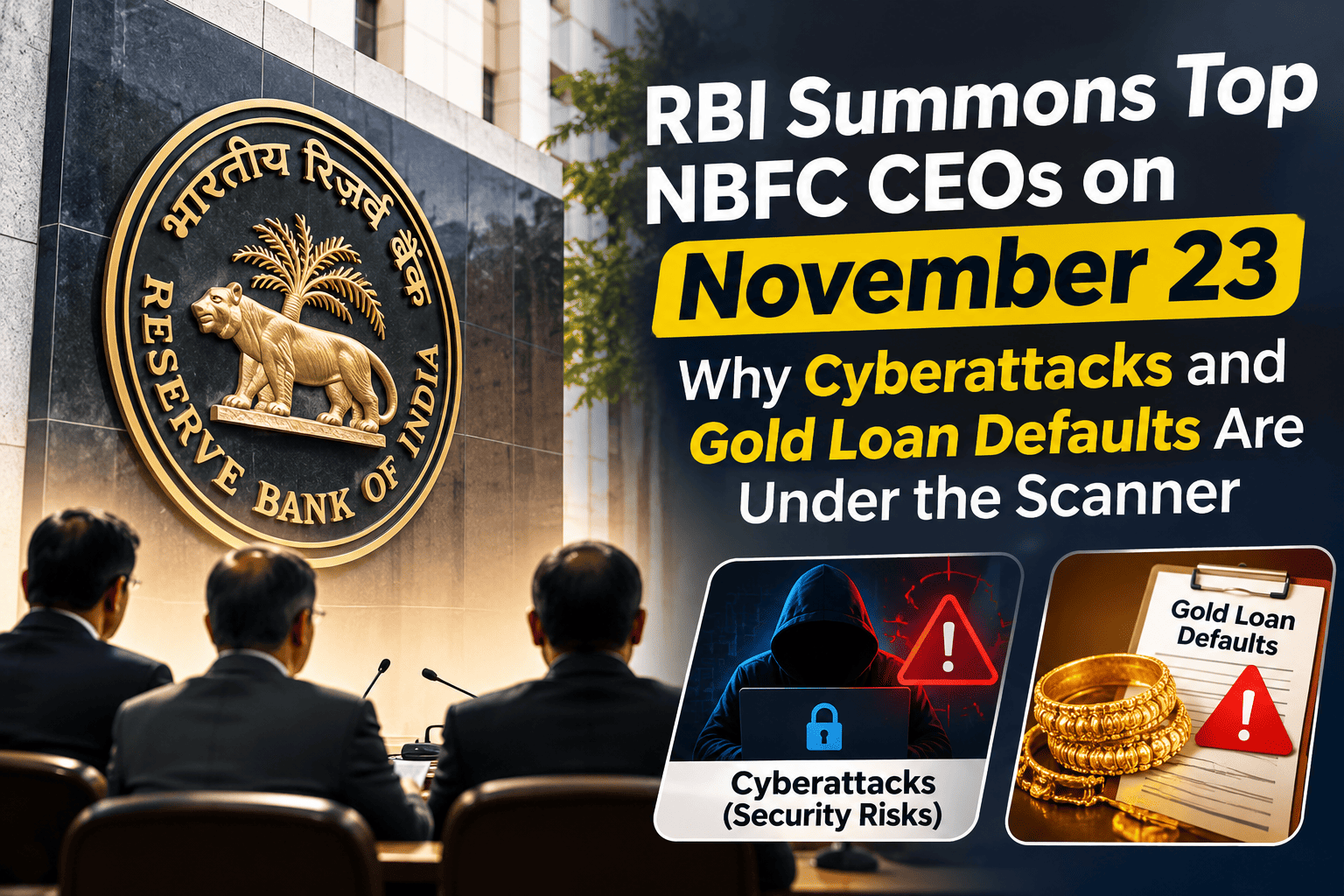


The Reserve Bank of India (RBI) has convened a meeting with Chief Executive Officers (CEOs) of leading Non-Banking Financial Companies (NBFCs) on November 23, 2026, where rising cyberattack threats, increasing gold loan defaults, and agrarian stress from weak monsoons are expected to dominate discussions, according to a report by The Economic Times published on November 20, 2026.
Chaired by RBI Governor Sanjay Malhotra alongside the central bank's four deputy governors, this periodic RBI NBFC meeting marks the first such formal sector-wide CEO interaction since January 2026. While the RBI has not issued an official public press release detailing a binding policy agenda ahead of the interaction, this RBI latest news update arrives immediately after two major regulatory and market developments: heightened central bank scrutiny over third-party Application Programming Interface (API) cyber intrusions and a nearly twofold jump in overdue gold loan defaults between March and August 2026.
For everyday Indian borrowers including salaried professionals, students, freelancers, and small business owners this NBFC news today does not immediately alter existing personal loan interest rates or Equated Monthly Instalments (EMIs). However, it signals stricter lender verification checks, tighter gold loan renewal rules, and stronger digital payment safeguards across regulated lending apps.
What Happened?
The Reserve Bank of India (RBI) has called CEOs of top-tier NBFCs for an RBI NBFC meeting on November 23, 2026, led by Governor Sanjay Malhotra. Media reports citing industry sources indicate that discussions will focus on escalating financial sector cyber risks, rising gold loan defaults, and rural repayment stress caused by uneven monsoons.
Why Is the November 23 RBI NBFC Meeting Newsworthy?
Periodic supervisory engagements allow the central bank to review sector vulnerabilities directly with top executives before deciding whether fresh regulatory interventions are necessary. Note the distinction between confirmed regulatory rules already in force and expected discussion points reported by financial media ahead of the November 23 session:
-
Reported Meeting Focus (Media Reporting): According to The Economic Times (November 20, 2026), RBI leadership typically delivers opening remarks on systemic risks before inviting NBFC CEOs to share operational feedback. Three themes are expected to lead the November 23 RBI NBFC meeting: supply-chain cyber vulnerabilities, rising delinquencies in gold-backed loans, and monsoon-linked repayment pressure in agrarian states.
-
Surge in Gold Loan Delinquencies (TransUnion CIBIL Data): Industry data from TransUnion CIBIL's November 2026 report (Lending Unlocked: Gold Loans) shows that while total outstanding gold loans tripled over three years to reach a record ₹22.5 lakh crore by August 2026, non-performing assets (NPAs, or loans overdue by more than 90 days) rose from 0.16% at the end of March 2026 to 0.30% by August 2026. CIBIL data also flagged repeat borrowing stress, with roughly 27% of borrowers holding four or more active gold loans a trend detailed in Pocketly's coverage of gold loan defaults rising in India.
-
Recent Cyber Incidents & API Scrutiny (Regulatory Context): Across October and November 2026, Indian financial institutions faced heightened cyber threats, including a reported $2 million unauthorised fund diversion across two Mumbai-based NBFCs via compromised disbursement APIs and a State Bank of India (SBI) disclosure involving 3,897 customer Personally Identifiable Information (PII) records found on the dark web. Following alerts from the Indian Computer Emergency Response Team (CERT-In), the RBI has stepped up advisories urging lenders to enforce RBI cybersecurity guidelines and independently verify every API payment instruction rather than relying blindly on third-party partner systems.
What Existing RBI Cybersecurity Guidelines and RBI Gold Loan Rules Already Apply?
Even before the November 23 RBI NBFC meeting takes place, NBFCs are bound by two comprehensive regulatory frameworks introduced by the Reserve Bank of India in 2026:
-
RBI Cybersecurity & Technology Resilience Directions (July 31, 2026): Formally titled the Reserve Bank of India (Non-Banking Financial Companies – Cybersecurity, Technology: Risk, Resilience and Assurance Framework) Directions, 2026 (Master Direction RBI/DoS/2026-27/461), these RBI cybersecurity guidelines apply across Base, Middle, Upper, and Top Layer NBFCs. They mandate board-approved cyber risk governance, third-party vendor security audits, encryption controls, and immediate incident reporting.
-
RBI Lending Against Gold and Silver Collateral Directions (Effective April 1, 2026): Under updated RBI gold loan rules, the central bank replaced flat Loan-to-Value (LTV) ceilings with tiered caps up to 85% for loans up to ₹2.5 lakh, 80% for loans between ₹2.5 lakh and ₹5 lakh, and 75% above ₹5 lakh. The rules also cap bullet-repayment consumption loans at 12 months, require purity valuation based on 22-karat standards, restrict total pledged gold ornaments to 1 kilogram per borrower, and mandate returning pledged gold within 7 working days of full repayment (with a ₹5,000-per-day penalty on lenders for delays).
Confirmed Rules vs. Expected November 23 Discussion Points
|
Focus Area |
Confirmed Regulatory Position (As of Nov 20, 2026) |
Expected Discussion at Nov 23 RBI NBFC Meeting |
What It Means for Everyday Borrowers |
|
Cybersecurity & API Controls |
Bound by July 31, 2026 RBI cybersecurity guidelines (Master Direction 461) and CERT-In reporting norms. |
Independent verification of third-party loan disbursement APIs and supply-chain cyber resilience. |
Safer digital loan disbursals, stricter KYC/bank-account matching, and stronger data protection. |
|
Gold Loan LTV & Renewals |
RBI gold loan rules (effective April 1, 2026) enforce tiered 75%–85% LTV caps and a 12-month bullet tenure limit. |
Rising gold loan defaults (up from 0.16% to 0.30%), repeat pledging, and auction pressures if gold prices dip. |
Lenders may scrutinize repeat gold loan renewals more closely and strictly enforce LTV margins. |
|
Agrarian & Rural Credit |
Standard RBI asset classification and Fair Practices Code norms remain active. |
Potential repayment stress in rural and semi-urban portfolios hit by uneven monsoon rainfall. |
Rural and self-employed borrowers may face closer cash-flow assessments during new loan underwriting. |
|
Retail Personal Loan Rates |
No new Repo Rate or pricing circular issued ahead of the meeting. |
Operational risk and portfolio health review; not a Monetary Policy Committee (MPC) rate-setting meet. |
Existing personal loan EMIs and bank/NBFC benchmark rates do not change automatically on Nov 23. |
What This Means for Borrowers
Following any major RBI latest news headline, borrowers naturally ask whether their active loans, credit scores, or approval chances will change overnight. Here is how this NBFC news today affects key borrowing factors:
-
Interest Rates & Monthly EMIs: Unchanged. The November 23 RBI NBFC meeting is a supervisory interaction, not a Monetary Policy Committee (MPC) meeting. Your ongoing personal loan, home loan, or auto loan EMI does not increase because of this meeting.
-
Gold Loan Renewals & Top-Ups: Potentially Stricter. Because gold loan defaults have nearly doubled in percentage terms and RBI gold loan rules require lenders to monitor LTV ratios throughout the loan tenure (calculating maturity interest within LTV limits at renewal), borrowers with multiple gold loans should expect tighter scrutiny before rolling over bullet loans.
-
Digital Loan Approvals & Disbursement Checks: More Thorough. Under RBI cybersecurity guidelines, NBFCs and digital lending platforms are tightening API validation to ensure sanctioned funds move exclusively to the verified borrower's own bank account. You may notice extra penny-drop or bank-account name-matching steps during onboarding.
-
Consumer Protection & Data Safety: Strengthened. Regulatory pressure on third-party vendor security means compliant lenders must keep customer KYC data encrypted and refrain from accessing personal phone contacts or media files.
Hypothetical Example: Why LTV and Repayment Planning Matter
Consider a simple illustrative example to understand why regulators watch both gold loan defaults and borrower repayment capacity:
-
Illustrative Gold Loan LTV Scenario: Suppose a borrower pledges 22-karat gold jewellery valued at ₹2,00,000 under current RBI gold loan rules. At the maximum 85% LTV slab (applicable to loans up to ₹2.5 lakh), the maximum permissible loan is ₹1,70,000. If gold market prices fall by 10% during the tenure reducing collateral value to ₹1,80,000 the effective LTV rises to roughly 94.4%, breaching the 85% regulatory ceiling and requiring the borrower to either pay down principal or pledge additional collateral to avoid auction risk.
-
Illustrative Unsecured Micro-Loan Scenario: By contrast, if a borrower takes a ₹50,000 personal loan for short-term liquidity without pledging family jewellery, there is no gold price volatility or collateral auction risk, provided the monthly instalment fits comfortably within their net income. (Note: Both scenarios are illustrative educational examples and do not represent Pocketly's specific loan pricing or approval terms.)
What Borrowers Should Check Before Taking a Personal Loan
Whether you are comparing gold-backed credit or small-ticket digital credit amid evolving NBFC news today, check these essentials before signing any loan agreement:
-
Active RBI-Registered Lender: Confirm the platform is backed by an active, licensed bank or NBFC on the official RBI directory avoiding unverified apps or barred entities highlighted in Pocketly's report on the RBI cancelling 49 NBFC licences.
-
Upfront Key Fact Statement (KFS): Under RBI Digital Lending Directions, verify your Annual Percentage Rate (APR), processing fee, applicable GST, and total repayment amount in the KFS before accepting funds.
-
Monthly EMI & Debt Ratio: Preview your exact monthly outflow with a Personal Loan EMI Calculator and ensure your total EMIs stay within safe limits using a FOIR Calculator so you never face the penalties outlined in Pocketly's guide on what happens when an EMI is missed or paid late.
-
Data Security & Direct Disbursal: Ensure the lender follows strict RBI cybersecurity guidelines and transfers funds directly into your verified bank account.
For salaried professionals, students, freelancers, and self-employed earners seeking transparent, collateral-free short-term credit, Pocketly operates as the digital lending platform of Speel Finance Company Private Limited (CIN: U65920MH1995PTC090558) an active, RBI-registered NBFC maintaining ISO 27001:2023 information security standards. Eligible applicants can explore personal loans from ₹1,000 to ₹50,000 with paperless KYC and upfront KFS disclosures, including tailored options for a personal loan for salaried professionals, a personal loan for self employed individuals, and a loan for non salaried earners under published responsible lending practices.
Conclusion: What to Watch After November 23
The upcoming RBI NBFC meeting on November 23, 2026, underscores the central bank's proactive focus on curbing cyber vulnerabilities and monitoring gold loan defaults before localized stress turns systemic. While no new rules take effect until the Reserve Bank of India issues a formal circular, borrowers should stay vigilant against phishing scams, review their KFS carefully, and borrow strictly within their monthly repayment capacity.
Key Takeaways
-
Meeting Date & Leadership: The Reserve Bank of India (RBI) is scheduled to hold an RBI NBFC meeting with top NBFC CEOs on November 23, 2026, expected to be chaired by Governor Sanjay Malhotra alongside all four deputy governors.
-
Three Core Talking Points: Media reports indicate discussions will center on rising cyber risks (especially third-party API vulnerabilities), increasing gold loan defaults, and agrarian repayment stress from weak monsoons.
-
Gold Loan Stress Data: TransUnion CIBIL data shows gold loan NPAs rose from 0.16% in March 2026 to 0.30% in August 2026 as total outstanding gold loans hit ₹22.5 lakh crore, with 27% of borrowers holding four or more gold loans.
-
Active 2026 Regulatory Guardrails: NBFCs already operate under the July 31, 2026 RBI cybersecurity guidelines (Master Direction 461) and the April 1, 2026 RBI gold loan rules (75%–85% tiered LTV caps).
-
No Immediate EMI Hike: The November 23 interaction is a supervisory review, not an interest-rate decision, meaning existing retail personal loan EMIs remain unchanged.
Need Transparent, Collateral-Free Short-Term Credit Without Pledging Family Gold?
Whether you are managing an unexpected bill or a month-end cash gap, choose a regulated digital lending experience backed by an active RBI-registered NBFC (Speel Finance Company Private Limited) and ISO 27001:2023 security standards.
-
Check Your Eligibility on Pocketly for personal loans from ₹1,000 to ₹50,000 with 100% paperless KYC and upfront Key Fact Statement disclosures.
-
Calculate Your Monthly EMI First using Pocketly's free Personal Loan EMI Calculator before you apply.
FAQs
1. What is the RBI NBFC meeting on November 23, 2026, about?
According to financial media reports, the RBI NBFC meeting on November 23, 2026, is a periodic supervisory interaction between RBI top leadership and CEOs of leading NBFCs. Discussions are expected to focus on rising cyberattack risks, API security, increasing gold loan defaults, and monsoon-related rural credit stress.
2. Why are gold loan defaults under RBI scrutiny in 2026?
Data from TransUnion CIBIL shows that while outstanding gold loans reached ₹22.5 lakh crore in August 2026, loans overdue by over 90 days nearly doubled from 0.16% in March 2026 to 0.30% in August 2026. Repeat borrowing with 27% of borrowers holding four or more active gold loans has raised repayment risk concerns.
3. What are the current RBI gold loan rules for borrowers?
Under RBI gold loan rules effective April 1, 2026, lenders must follow tiered Loan-to-Value (LTV) ceilings: up to 85% for loans up to ₹2.5 lakh, 80% for loans between ₹2.5 lakh and ₹5 lakh, and 75% above ₹5 lakh. Lenders must also return pledged gold within 7 working days of full repayment or pay ₹5,000 per day in delay compensation.
4. How do RBI cybersecurity guidelines protect digital loan borrowers?
Under the RBI's July 31, 2026 RBI cybersecurity guidelines for NBFCs and recent API security advisories, lenders must enforce strict third-party vendor audits, verify beneficiary bank details independently before disbursing funds, and protect customer KYC data against unauthorized access or dark web leaks.
5. Will my personal loan EMI or interest rate change after the November 23 RBI meeting?
No. The November 23 RBI NBFC meeting is an operational and risk-review session with NBFC CEOs, not a Monetary Policy Committee (MPC) interest-rate meeting. Your existing personal loan interest rate, tenure, and monthly EMI schedule will not change automatically because of this meeting.
6. How can I verify if a digital loan app is backed by a compliant RBI-registered NBFC?
Check the app's disclosures and Key Fact Statement (KFS) for the exact legal name and Corporate Identification Number (CIN) of its RBI-registered NBFC or banking partner. For instance, Pocketly is operated by Speel Finance Company Private Limited (CIN: U65920MH1995PTC090558), an active RBI-registered NBFC.
Sources
-
The Economic Times / ET Bureau (November 20, 2026): "Cyber risks, gold loans may be top talking points at RBI meet" https://m.economictimes.com/industry/banking/finance/cyber-risks-gold-loans-may-be-top-talking-points-at-rbi-meet/amp_articleshow/136004138.cms
-
Reserve Bank of India (RBI) Master Direction (July 31, 2026): Reserve Bank of India (Non-Banking Financial Companies – Cybersecurity, Technology: Risk, Resilience and Assurance Framework) Directions, 2026 (RBI/DoS/2026-27/461) https://www.rbi.org.in/Scripts/NotificationUser.aspx?Id=13592&Mode=0
-
Reserve Bank of India (RBI) Notification (Effective April 1, 2026): Reserve Bank of India (Lending Against Gold and Silver Collateral) Directions https://www.rbi.org.in/Scripts/NotificationUser.aspx?Id=12859
-
Business Standard (November 18, 2026): "RBI asks lenders to tighten API security amid rising cyberattack risks" https://www.business-standard.com/industry/banking/rbi-asks-lenders-to-tighten-api-security-amid-rising-cyberattack-risks-126111801271_1.html
-
The Times of India / TransUnion CIBIL Report Coverage (November 6, 2026): "Gold loan defaults see almost 2x rise in 5 months" (Citing TransUnion CIBIL's Lending Unlocked: Gold Loans report) https://timesofindia.indiatimes.com/business/india-business/gold-loan-defaults-see-almost-2x-rise-in-5-months/articleshow/135590513.cms