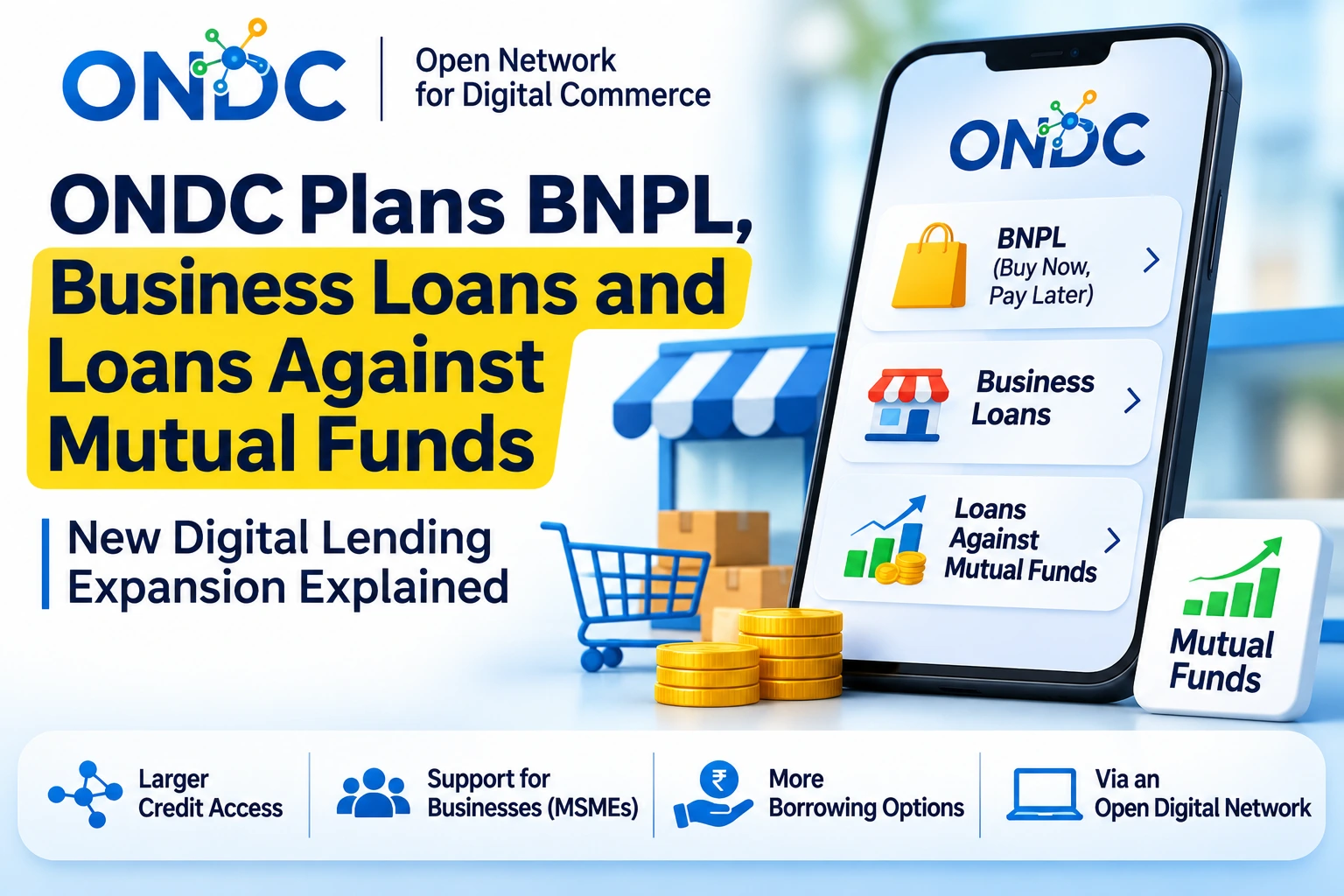


The Open Network for Digital Commerce (ONDC) is expanding its financial services infrastructure to introduce Buy Now, Pay Later (BNPL), purchase finance, credit cards, loans against mutual funds, and expanded ONDC business loans, according to Chief Business Officer (Financial Services) Hrushikesh Mehta in an interview with ETBFSI published on November 17, 2026. With 11 to 12 lenders already live on the open protocol and another 10 to 12 lenders in the onboarding pipeline, ONDC loans are set to move beyond basic unsecured personal credit into embedded checkout financing and asset-backed retail borrowing.
For Indian borrowers—including salaried professionals, students, freelancers, and small business owners—this expansion signals broader lender competition across multiple consumer-facing applications rather than locking applicants into a single proprietary ONDC loan app. However, because ONDC operates as an open technology network rather than a direct lender, interest rates, approval rules, and repayment terms continue to be governed by individual Reserve Bank of India (RBI)-regulated banks and Non-Banking Financial Companies (NBFCs).
What Happened?
ONDC confirmed on November 17, 2026, via statements from CBO Hrushikesh Mehta to ETBFSI, that its financial services vertical is broadening ONDC digital lending to include ONDC BNPL (purchase finance), credit cards, loans against mutual funds, and small business credit. Around 11 to 12 lenders are currently active on the network, with 10 to 12 additional financial institutions in the pipeline.
Why Is ONDC Expanding Into BNPL, Business Loans, and Loans Against Mutual Funds?
ONDC initiated its financial services rail to unbundle credit distribution in the same way it unbundled e-commerce and logistics. Instead of every bank or NBFC building separate technical integrations with dozens of consumer apps, ONDC digital lending provides standardized APIs based on the Beckn protocol so any compliant buyer application can connect borrowers with multiple regulated lenders.
According to ONDC’s quarterly newsletter (ONDC Pulse FY26-27 Q2, released in November 2026), the network already recorded 10,500 disbursed loans in the second quarter of FY27, with more than 50% sourced from lenders serving new-to-credit and thin-file borrowers. The same quarterly update noted that 30 asset management companies (AMCs) and 126 distributors are live on ONDC’s mutual fund rail, while credit cards went live with HDFC Bank as issuer and Bajaj Markets as distributor. Building loans against mutual funds and ONDC BNPL directly on top of these existing commerce and investment rails is the next operational step.
How Do the New ONDC Loans Work Across Each Category?
Unlike a single standalone ONDC loan app, borrowers access ONDC loans through any ONDC-integrated buyer application—such as banking apps, fintech platforms, or merchant checkout interfaces. Once a borrower consents to share KYC and financial data (often via the RBI-regulated Account Aggregator framework), multiple participating lenders can return credit offers in real time.
-
ONDC BNPL and Purchase Finance: Designed for checkout and point-of-sale transactions across ONDC retail and B2B networks, ONDC BNPL lets eligible shoppers and retailers split purchases into short-term instalments directly at checkout without relying on a single marketplace’s captive credit partner.
-
ONDC Business Loans: Tailored for Micro, Small, and Medium Enterprises (MSMEs) and digital sellers, ONDC business loans use standardized Goods and Services Tax (GST) invoices, order fulfillment history, and cash-flow data to underwrite collateral-free working capital and invoice financing.
-
Loans Against Mutual Funds: Allowing retail investors to pledge eligible equity or debt mutual fund units digitally through lien-marking without redeeming their investments, loans against mutual funds provide secured overdraft or term liquidity while keeping long-term SIPs intact.
-
Personal Loans and Credit Cards: Existing personal credit lines and newly launched co-branded or network-distributed credit cards continue to serve everyday retail borrowers seeking unsecured digital credit.
ONDC Digital Lending: Earlier Situation vs. New Expansion
|
Area |
Earlier Situation on ONDC |
New Expansion Plan (November 2026) |
What It Means for Borrowers |
|
Core Credit Products |
Primarily basic unsecured personal loans and early GST-based MSME pilots |
Addition of ONDC BNPL (purchase finance), loans against mutual funds, credit cards, and scaled ONDC business loans |
Borrowers can match specific needs—checkout EMIs, working capital, or mutual fund overdrafts—on one open protocol. |
|
Lender Participation |
Limited pilot cohort of early-adopter NBFCs and banks |
11–12 active lenders live, with 10–12 additional lenders in the onboarding pipeline |
Greater lender competition lets applicants compare multiple regulated offers inside a single ONDC loan app interface. |
|
Underwriting & Data Rails |
Heavy reliance on traditional bureau scores for early pilots |
Integration of Account Aggregator cash flows, ONDC merchant ledger data, and digital mutual fund lien-marking |
Thin-file users, MSMEs, and mutual fund investors gain alternative pathways to qualify for credit. |
|
Regulatory Oversight |
Governed by RBI Digital Lending Directions on participating lenders |
Remains governed by RBI Digital Lending Directions and SEBI lien rules (for mutual fund pledges) |
ONDC stays a technology protocol; actual loans are sanctioned only by RBI-regulated banks and NBFCs. |
What Does This Mean for Borrowers?
For everyday Indian borrowers, understanding how ONDC digital lending affects borrowing costs, eligibility, and consumer protection helps separate confirmed network capabilities from future rollout timelines:
-
Borrowing Costs and Interest Rates: ONDC does not fix interest rates or waive processing charges. Each bank or NBFC participating in ONDC loans sets its own Annual Percentage Rate (APR) based on borrower risk profile, product type, and RBI benchmark rates. Secured loans against mutual funds generally carry lower interest rates than unsecured personal loans or ONDC BNPL facilities because mutual fund units act as collateral.
-
Eligibility and Documentation: First-jobbers, freelancers, and small merchants often struggle with physical paperwork at traditional banks. Through ONDC digital lending, applicants complete paperless PAN and Aadhaar KYC and share bank statements digitally, though final credit approval still depends on each lender's underwriting policy.
-
Credit Score Impact: Every loan or ONDC BNPL facility sanctioned through a regulated lender on the network is reported to credit bureaus such as CIBIL, Experian, Equifax, and CRIF High Mark. Timely EMI payments help build a positive credit history, while missed instalments lower credit scores and attract penal charges—a risk explained in Pocketly’s guide on what happens when an EMI is missed or paid late.
-
Consumer Protection and Transparency: Under the Reserve Bank of India’s Digital Lending Directions, every lender offering ONDC loans must issue a standardized Key Fact Statement (KFS) upfront, transfer funds directly into the borrower’s verified bank account, and provide a mandatory cooling-off period.
Hypothetical Example: Comparing an Unsecured Micro-Loan vs. a Loan Against Mutual Funds
To see how product choice changes monthly outgo, consider a hypothetical borrower who needs ₹50,000 for an urgent expense over a 6-month repayment window:
-
Scenario A — Unsecured Short-Term Digital Loan: If a borrower takes an unsecured ₹50,000 personal loan at an illustrative interest rate of 24% per annum (2% per month) on a reducing balance for 6 months, the estimated monthly EMI is approximately ₹8,926, resulting in total interest of about ₹3,558 (excluding applicable processing fees and GST).
-
Scenario B — Secured Loan Against Mutual Funds: If the same borrower holds ₹1,00,000 in eligible equity mutual funds and pledges units for a ₹50,000 facility at an illustrative secured rate of 11% per annum for 6 months, the estimated monthly EMI drops to roughly ₹8,603, with total interest of around ₹1,616, while the underlying mutual fund units remain invested.
(Note: The figures above are illustrative educational examples to explain how unsecured and secured credit structures differ. Actual interest rates, Loan-to-Value ratios, and fees vary by lender and do not represent Pocketly’s specific loan pricing.)
What Borrowers Should Check Before Using Any Digital Loan App
Whether you apply through an ONDC loan app, a bank portal, or a standalone fintech platform, reviewing key terms before accepting funds prevents unexpected debt stress. Understanding how India’s Digital Public Infrastructure is changing financial services is helpful, yet every borrower should verify five core checkpoints:
-
Regulated Lender Identity: Confirm that the actual loan is sanctioned by an RBI-registered NBFC or scheduled commercial bank rather than an unregulated software intermediary.
-
Key Fact Statement (KFS) & APR: Inspect the KFS for the exact Annual Percentage Rate (APR), processing fee, GST, and net disbursement amount before digitally signing.
-
Monthly EMI Affordability: Estimate your monthly commitment in advance using a Personal Loan EMI Calculator and ensure your total monthly debt obligations stay manageable with a FOIR Calculator.
-
Interest Rate Structure: Compare reducing-balance rates against flat rates using a Flat vs Reducing Rate Calculator so you know the true borrowing cost.
-
Repayment Tenure & Penalties: Check whether the tenure aligns with your salary or invoice cycle, and avoid short-term predatory traps highlighted in Pocketly’s breakdown of 7 days loan vs 30 days loan charges.
For borrowers who need small-ticket, short-term personal credit right away without pledging mutual funds or waiting for new network rollouts, Pocketly provides a transparent digital borrowing option. Owned and operated by Speel Finance Company Private Limited (CIN: U65920MH1995PTC090558), an RBI-registered NBFC, Pocketly offers eligible Indian users personal loans from ₹1,000 to ₹50,000 through a 100% paperless KYC journey with upfront KFS disclosures. Depending on your income profile, you can explore dedicated options including a personal loan for salaried individuals, a personal loan for self employed professionals, or a loan for non salaried earners, all governed by Pocketly’s published responsible lending standards.
Conclusion
ONDC’s plan to roll out ONDC BNPL, ONDC business loans, credit cards, and loans against mutual funds—backed by 11 to 12 active lenders and another 10 to 12 in the pipeline—marks a significant expansion in India’s open credit ecosystem. While ONDC loans and ONDC digital lending will give consumers and MSMEs wider lender choice across compliant apps, smart borrowing still starts with verifying RBI-registered lenders, reading your Key Fact Statement, and matching your loan tenure to your real monthly cash flow.
Key Takeaways
-
New Product Pipeline: ONDC CBO Hrushikesh Mehta confirmed on November 17, 2026, that ONDC is expanding financial services to include ONDC BNPL (purchase finance), credit cards, loans against mutual funds, and ONDC business loans.
-
Growing Lender Network: 11 to 12 banks and NBFCs are currently active on ONDC’s lending rails, with 10 to 12 additional lenders in the onboarding pipeline.
-
Q2 FY27 Traction: According to ONDC Pulse FY26-27 Q2, the network facilitated 10,500 loans in Q2, with over half going to new-to-credit and thin-file borrowers.
-
Open Protocol, Regulated Lenders: ONDC is a non-lending technology network; all credit underwriting, interest rates, and RBI Digital Lending compliance remain with the participating RBI-registered banks and NBFCs.
-
Borrower Best Practice: Always check the Key Fact Statement (KFS), verify the regulated lender name, and calculate your EMI before accepting any digital credit offer.
Need Transparent, Small-Ticket Digital Credit Today?
Whether you are managing an unexpected household bill, bridging freelance cash flow, or handling month-end expenses, Pocketly offers eligible Indian borrowers unsecured personal loans from ₹1,000 to ₹50,000 through a 100% digital KYC process—underwritten and disbursed directly by RBI-registered NBFC Speel Finance Company Private Limited.
FAQs
1. What new loan products is ONDC launching in its digital lending expansion?
According to ONDC CBO Hrushikesh Mehta on November 17, 2026, ONDC is expanding its financial services portfolio to add Buy Now, Pay Later (ONDC BNPL / purchase finance), credit cards, loans against mutual funds, and expanded ONDC business loans alongside existing personal loan offerings.
2. Is ONDC a bank or an NBFC that lends money directly?
No. ONDC is a Section 8 non-profit open network protocol initiated by the Department for Promotion of Industry and Internal Trade (DPIIT). It connects buyer apps with RBI-registered banks and NBFCs that actually underwrite, sanction, and disburse ONDC loans.
3. How many lenders are currently active on ONDC digital lending?
As of November 2026, 11 to 12 regulated lenders are active on ONDC’s financial services network, while another 10 to 12 banks and NBFCs are in the technical integration pipeline to offer ONDC digital lending products.
4. How do loans against mutual funds work on ONDC?
Loans against mutual funds allow investors to pledge eligible equity or debt mutual fund units digitally through lien-marking via an ONDC-integrated buyer app. Borrowers receive a secured credit line or loan without selling their mutual fund holdings, subject to lender Loan-to-Value (LTV) limits and terms.
5. Are ONDC loans regulated by the Reserve Bank of India (RBI)?
Yes. While ONDC provides the open network rails, every bank and NBFC offering ONDC loans or ONDC BNPL must comply with the RBI’s Master Direction on Digital Lending, including mandatory Key Fact Statements (KFS), direct bank-to-bank disbursal, and transparent APR disclosures.
6. Can new-to-credit borrowers apply for digital loans on ONDC or fintech apps?
Yes. Over 50% of the 10,500 loans disbursed on ONDC in Q2 FY27 went to thin-file or new-to-credit borrowers using digital cash-flow underwriting. Similarly, regulated digital lending platforms like Pocketly evaluate eligible applicants aged 18 to 40 using paperless PAN, Aadhaar, and Video KYC without requiring a prior CIBIL score.
Sources
-
ETBFSI / The Economic Times (November 17, 2026): "BNPL, Credit Cards & Loans: What Is ONDC Launching Next? | Hrushikesh Mehta" & Fintech Coverage ("With 11–12 lenders already active on its network and another 10–12 in the pipeline, ONDC is expanding its financial services offerings, including purchase finance, credit cards and loans against mutual funds, says CBO Hrushikesh Mehta"). — https://bfsi.economictimes.indiatimes.com/tag/fintech | https://www.youtube.com/watch?v=tGu1EzDUTgQ
-
Open Network for Digital Commerce (ONDC) (November 2026): Quarterly Newsletter — ONDC Pulse FY26-27 Q2 (Financial Services metrics: 10.5K loans disbursed, >50% new-to-credit/thin-file share, 30 AMCs and 126 distributors live, Credit Cards live with HDFC Bank and Bajaj Markets). — https://ondc.org/public/assets/newsletters/ondc-pulse-2026-27-q2.pdf
-
Press Information Bureau (PIB), Government of India (June 27, 2026): "The Digital India" (ONDC network milestone metrics). — https://www.pib.gov.in/PressReleaseDetail.aspx?PRID=2278422®=1&lang=1
-
Reserve Bank of India (RBI): Master Direction – Reserve Bank of India (Digital Lending) Directions (Guidelines on Regulated Entities, Key Fact Statements, APR, and Direct Disbursal). — https://www.rbi.org.in/