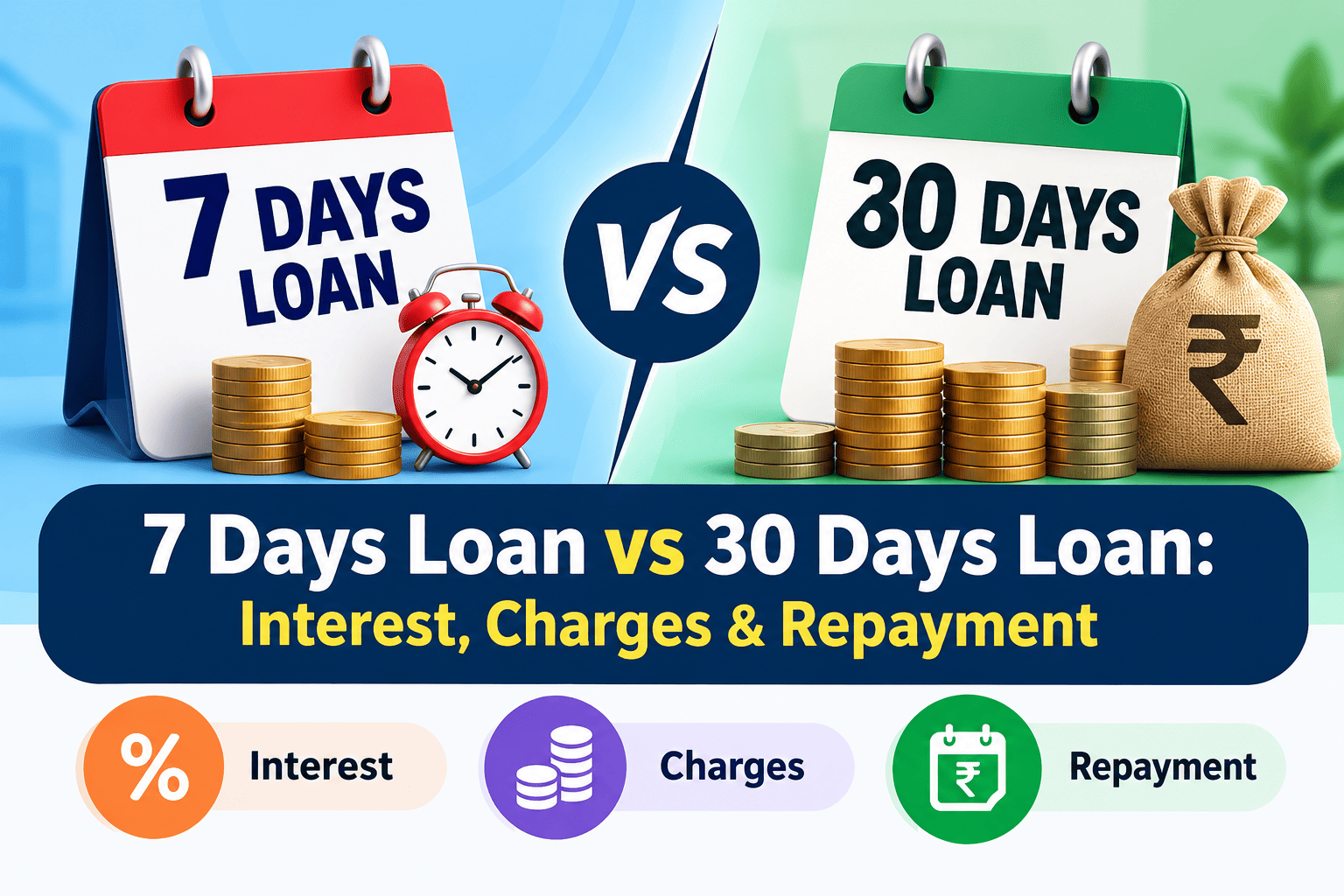


A 7-day loan gives you one week to repay the borrowed amount. A 30-day loan allows approximately one month. The shorter tenure generally results in less interest when both loans have the same annual rate, but processing fees can change the comparison.
Suppose you need ₹5,000 and your salary arrives after 20 days. A seven-day repayment deadline would arrive before payday. A 30-day loan may fit your income schedule better, even if the interest is higher.
Also Read:7 Days Loan App in India: Instant Approval, List & Download Guide 2026
7 Days Loan vs 30 Days Loan: Comparison
|
Feature |
7 Days Loan |
30 Days Loan |
|
Loan tenure |
7 days |
30 days |
|
Repayment deadline |
Within a week |
After approximately one month |
|
Interest |
Depends on rate and calculation |
Depends on rate and calculation |
|
Processing fee |
May apply |
May apply |
|
Repayment structure |
According to agreement |
According to agreement |
|
Suitable for |
Borrowers with funds available within a week |
Borrowers expecting funds later in the month |
|
Main drawback |
Earlier repayment deadline |
Potentially higher interest |
Four details to compare before borrowing:
-
APR: The annualised borrowing cost disclosed by the lender.
-
Net disbursement: The amount credited after any permitted upfront deductions.
-
Total payable: Principal, interest and applicable charges.
-
Due date: The date by which repayment must be completed.
A lower interest amount does not automatically mean the loan is affordable. The repayment date must also work with your budget.
7 Days Loan Interest Rate and Other Charges
There is no universal 7 days loan interest rate in India. Lenders determine pricing based on their products and assessment of the applicant.
Charges to check:
|
Charge |
What It Means |
|
Interest |
Amount charged for borrowing |
|
Processing fee |
Charge for processing the application or loan |
|
GST |
Tax on applicable service fees |
|
Late-payment charges |
Contractual charges for overdue repayment |
|
Other disclosed fees |
Charges specified in the loan terms |
Why processing fees deserve attention
Consider a ₹5,000 loan with a ₹150 processing fee:
-
Processing fee: ₹150.
-
GST at 18% on the fee: ₹27.
-
Combined fee and tax: ₹177.
-
Fee and tax as a percentage of principal: 3.54%.
If the lender deducts ₹177 before disbursement, you receive ₹4,823 rather than ₹5,000.
Check the Key Facts Statement for:
-
APR and interest calculation method.
-
Processing fee and applicable taxes.
-
Net disbursal amount.
-
Repayment schedule.
-
Charges for late repayment.
₹5,000 Loan: 7 Days vs 30 Days Cost Example
The following calculation uses hypothetical terms to show how tenure affects interest.
Assumptions:
-
Loan amount: ₹5,000.
-
Annual simple interest rate: 24%.
-
Processing fee: ₹150.
-
GST on processing fee: ₹27.
-
No additional charges.
Interest formula:
Interest = Principal × Annual Rate × Days ÷ 365
|
Particulars |
7 Days Loan |
30 Days Loan |
|
Principal |
₹5,000 |
₹5,000 |
|
Interest |
₹23.01 |
₹98.63 |
|
Processing fee |
₹150 |
₹150 |
|
GST |
₹27 |
₹27 |
|
Total borrowing cost |
₹200.01 |
₹275.63 |
|
Total amount payable |
₹5,200.01 |
₹5,275.63 |
What changes between the two loans?
-
Interest difference: ₹75.62.
-
Additional repayment time: 23 days.
-
Processing fee difference: None in this example.
-
Total cost difference: ₹75.62.
Important calculation detail: The table treats fees and taxes as amounts payable in addition to principal and interest. If ₹177 is deducted upfront instead, the borrower receives ₹4,823 and the later repayment amount would be ₹5,023.01 for seven days or ₹5,098.63 for 30 days, assuming no other charges. The total economic cost remains the same.
These figures do not represent actual Pocketly rates or loan offers.
Loan Repayment: Due Dates, Payment Methods and Delays
7 days loan repayment requires paying the outstanding amount by the date specified in the agreement.
Before the due date:
-
Check the exact repayment amount.
-
Arrange funds in advance.
-
Use the lender's authorised payment channel.
-
Save the transaction confirmation.
-
Verify that the payment has been credited to the loan account.
Possible payment methods:
-
UPI.
-
Bank transfer.
-
Authorised auto-debit.
-
Other lender-supported channels.
What happens if repayment is late?
-
Contractual late-payment charges may apply.
-
The amount outstanding may increase.
-
Reported overdue payments may affect credit history.
-
The lender may contact you about the unpaid balance.
If you cannot repay on time, contact the lender promptly to discuss available arrangements. Do not assume that a repayment extension is automatic.
Which Repayment Period Fits Your Income?
The appropriate tenure depends on when you receive money and how much remains after regular expenses.
|
Borrower |
Repayment Consideration |
|
Salaried employee |
Salary date and existing EMIs |
|
Freelancer |
Confirmed client payment dates |
|
Self-employed borrower |
Business receipts and operating expenses |
|
Student |
Reliable income and eligibility |
|
First-jobber |
First salary and essential expenses |
|
Gig worker |
Variability in weekly earnings |
Example 1: Freelancer in Bengaluru
-
Laptop repair cost: ₹4,000.
-
Client invoice: ₹12,000.
-
Expected payment: Within five days.
-
Proposed loan tenure: Seven days.
A delayed client payment could make repayment difficult. The borrower should have another reliable source of funds before accepting the loan.
Example 2: Salaried employee in Chennai
-
Emergency expense: ₹5,000.
-
Salary expected: After 22 days.
-
Seven-day loan: Due before salary.
-
Thirty-day loan: Due after expected salary.
A 30-day tenure may be easier to manage, provided the repayment amount is affordable.
Before deciding:
-
Subtract rent, food, bills and existing EMIs from expected income.
-
Check how much money remains for loan repayment.
-
Allow for delays in expected payments.
-
Avoid borrowing if the repayment would leave you unable to meet essential expenses.
How to Check a 7 Days Loan App in India
Not every app appearing in searches for a 7 days loan app offers a seven-day repayment period.
Before applying:
-
Identify the bank or NBFC providing the loan.
-
Verify the lender's regulatory status through official sources.
-
Confirm the actual loan tenure.
-
Review the Key Facts Statement.
-
Compare APR and total repayment.
-
Check the privacy policy and app permissions.
-
Find the lender's grievance-redressal details.
-
Use official app download links.
-
Avoid guaranteed-approval claims.
-
Never share your OTP, UPI PIN or banking password.
Looking for available short-term loan options?
Read Pocketly's 7 Days Loan Apps in India guide to research app-based borrowing, repayment periods and charges.
You can also read about spot loan apps to understand other digital borrowing options.
Explore Personal Loan Options With Pocketly
Pocketly provides online personal loan options for eligible borrowers who need longer repayment periods.
Published Pocketly product details:
|
Feature |
Details |
|
Loan amount |
₹1,000–₹50,000 |
|
Repayment tenure |
61 days–9 months |
|
Application process |
Online |
|
Approval |
Subject to lender assessment |
Who can explore Pocketly?
-
Salaried professionals: Review available tenures against monthly income and existing obligations.
-
Self-employed borrowers: Check income requirements and whether repayments fit business cash flow.
-
Freelancers: Assess payment consistency and the lender's documentation requirements.
-
Students and first-jobbers: Confirm age, income and repayment eligibility before applying.
Explore Pocketly resources:
Pocketly's published product information describes longer tenures rather than exact seven-day or 30-day loans. Check the latest terms before applying.
Frequently Asked Questions
1. Can I repay a 30-day loan early?
Some lenders allow early repayment. Check whether the agreement includes any applicable charges or conditions.
2. Can I get a ₹5,000 loan without a CIBIL score?
Some lenders may consider applicants without an established credit score. They can still assess income, existing debt and repayment capacity.
3. Is income proof compulsory for a seven-day loan?
Documentation requirements vary. A lender may accept different forms of income information, but it still needs to assess the applicant's ability to repay.
4. Are processing fees refundable if I cancel a loan?
Refunds depend on when the loan is cancelled, the applicable cooling-off provisions and the lender's terms. Check the KFS and agreement.
5. Can I extend a seven-day loan to 30 days?
Only if the lender permits an extension or restructuring. The lender may apply additional interest or disclosed charges.
6. Can I take another loan while repaying a short-term loan?
You may apply, but approval depends on the lender's assessment. Additional borrowing increases your repayment obligations.
7. How can I confirm that my loan is fully closed?
Request a closure confirmation or no-dues certificate where applicable. Check that the outstanding balance is zero and retain the records.
8. What should I do if an app deducts repayment twice?
Contact the lender with both transaction references. Request reconciliation and a refund of any confirmed excess payment.
9. Can a loan app access my phone contacts?
App permissions vary, but RBI-regulated digital lending arrangements are subject to restrictions on unnecessary access to phone data. Review permissions and avoid apps demanding access to contacts for loan recovery.
10. Is a seven-day loan available on Sundays or bank holidays?
Digital applications may be accepted outside banking hours. Approval and disbursal timing depend on the lender, verification and payment systems.
Disclaimer: Calculations are illustrative. Actual loan amounts, rates, fees, eligibility and repayment terms depend on the lender. Read the Key Facts Statement and loan agreement before borrowing.