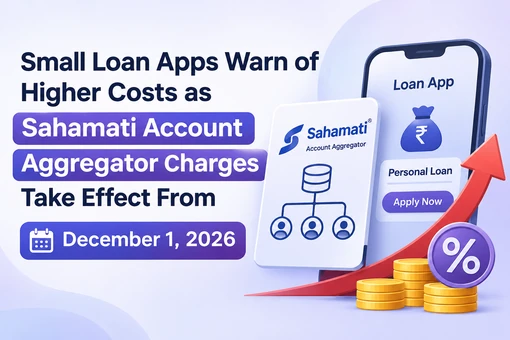


Small-ticket digital lenders are raising concerns over rising underwriting expenses ahead of December 1, 2026, when standard Sahamati Account Aggregator charges officially take effect across India’s consent-based financial data network. While the Sahamati Account Aggregator framework prohibits billing consumers directly for sharing their own bank statements, small loan providers warn that per-fetch data fees of up to ₹9.60 per account (excluding Goods and Services Tax) could squeeze margins on loans between ₹10,000 and ₹50,000 and eventually increase loan processing cost structures.
In recent digital lending news reported by Moneycontrol and Elets BFSI on November 25, 2026, Sahamati Chief Executive BG Mahesh defended the standardized fee schedule originally slated for November 1 before being deferred by a month for festive-season readiness and confirmed that the self-regulatory organization will review the pricing model six months after rollout. For Indian borrowers seeking an instant personal loan, this shift marks the end of zero-cost bank data pulls for lenders, making it essential to watch upfront Key Fact Statement (KFS) disclosures before accepting any credit offer.
What Happened?
Starting December 1, 2026, Financial Information Users (FIUs) including banks, Non-Banking Financial Companies (NBFCs), and fintech lenders must pay standardized Sahamati Account Aggregator charges every time they fetch customer account data through the Sahamati Account Aggregator ecosystem. Consumers cannot be charged directly for data sharing, though small lenders warn higher loan processing cost burdens may affect future loan pricing.
How Much Are the New Sahamati Account Aggregator Charges?
Under the uniform rate card established by Sahamati which the Reserve Bank of India (RBI) formally recognized as the Self-Regulatory Organization (SRO) for the Account Aggregator India ecosystem in June 2026 data users pay a fixed fee per successful account fetch under a single standard contract. According to industry rate-card disclosures and reporting by Elets BFSI:
-
Seven-Month Bank Statement Fetch: Costs lenders between ₹5.88 and ₹6.55 per account (before 18% GST).
-
13-Month Bank Statement Fetch: Costs lenders between ₹8.64 and ₹9.60 per account (before 18% GST).
-
Multi-Account Applicant Underwriting: Because many applicants hold two or three bank accounts, fetching statements across multiple accounts for a single loan application can cost a lender roughly ₹23 to ₹34 inclusive of GST.
-
Separate Technology Expenses: This standardized Sahamati Account Aggregator fee splits revenue among the Account Aggregator entity, the Financial Information Provider (the bank holding the customer's data), and Sahamati meaning lenders must still pay Technology Service Providers (TSPs) separately for software integration and statement analytics.
Understanding how India’s Digital Public Infrastructure is changing financial services shows why this pricing transition matters. For years, banks sharing data as Financial Information Providers earned zero fee per pull while Sahamati operated largely on grants before raising ₹50 crore from over 30 financial institutions in April 2026 to build sustainable infrastructure for its 207 million+ user base.
Account Aggregator India: Earlier Model vs. December 2026 Rate Card
|
Area |
Earlier Situation (Pre-December 2026) |
New Development (From December 1, 2026) |
What It Means for Borrowers |
|
Direct Fee to Customers |
₹0 (Free for consumers sharing data) |
₹0 (Direct customer charges remain prohibited) |
You will never pay a separate fee to an Account Aggregator app just to share your bank statement. |
|
Lender Data-Fetch Cost |
Patchwork of bilateral deals; banks received no FIP fee |
Standard Sahamati Account Aggregator charges of ₹5.88–₹9.60 + GST per bank account pull |
Every small loan app and NBFC faces a measurable per-applicant underwriting cost. |
|
Multi-Account Pull Impact |
Often absorbed within bundled TSP agreements |
Fetching 2–3 accounts per applicant costs lenders ~₹23–₹34 (incl. GST), plus separate TSP fees |
Lenders may become more selective about how many bank accounts they pull per application. |
|
Regulatory & Governance Review |
Transitional grant-backed ecosystem scaling |
Uniform SRO rate card effective Dec 1, 2026, with a formal 6-month review promised by Sahamati |
Pricing remains under regulatory watch; lenders must still disclose all borrower fees in the KFS. |
Why Is a Small Loan App More Sensitive to Data-Fetch Fees Than a Big Bank?
When a commercial bank underwrites a ₹10,00,000 personal loan or a ₹40,00,000 home loan, spending ₹30 on Sahamati Account Aggregator data verification represents a negligible fraction of its interest income. The unit economics look very different for a small loan app disbursing ₹5,000 to ₹50,000 for 61 days to 9 months.
Small-ticket digital lenders rely heavily on real-time bank statement cash-flow analysis because many of their users such as students, first-jobbers, and gig workers have thin credit bureau files. Furthermore, in digital lending, lenders often run data checks on dozens of applicants for every loan that actually gets approved and disbursed. As industry participants noted in recent digital lending news, paying ₹23 to ₹34 per applicant across both approved and rejected files compounds the overall loan processing cost per disbursed loan.
Sahamati CEO BG Mahesh addressed these concerns in Moneycontrol on November 25, 2026, stating that the framework followed nearly three years of Economic Model Committee consultations and will undergo a formal review after six months. He also noted that Sahamati has committed in writing to the regulator to reduce its own fee share if the organization becomes highly profitable.
What This Means for Borrowers
For everyday borrowers comparing an instant personal loan across banks, NBFCs, and fintech apps, separating confirmed rules from industry speculation prevents unnecessary worry:
-
Direct Account Aggregator Fees (Unchanged Still ₹0): Under the Account Aggregator India framework, neither the Account Aggregator nor the bank can bill you directly for consenting to share your financial data.
-
Existing Loans & EMIs (Unchanged): If you already have an active personal loan, your interest rate, Equated Monthly Instalment (EMI), and repayment schedule remain governed by your signed loan contract and will not change on December 1, 2026.
-
Processing Fees & Interest Rates on New Loans (Watch Closely): While no regulator has mandated higher loan rates, some small-ticket lenders have indicated in digital lending news reports that sustained Sahamati Account Aggregator charges could eventually nudge up processing fees or interest rates on new micro-loans.
-
Approval & Underwriting Behavior: To control loan processing cost outlays, lenders may ask applicants to link only their primary salary or business bank account rather than pulling three or four secondary accounts simultaneously.
-
Consumer Protection & Transparency: Under the Reserve Bank of India’s Digital Lending Directions, every regulated lender must issue an upfront Key Fact Statement (KFS) showing the exact Annual Percentage Rate (APR), processing fee, GST, and net disbursed amount before you sign.
Hypothetical Example: How Underwriting Costs Affect a ₹50,000 Personal Loan
To see how a modest increase in loan processing cost affects your wallet, consider an illustrative example (for educational understanding only; does not represent Pocketly's actual pricing):
Suppose a borrower takes a ₹50,000 personal loan for a 6-month tenure at an illustrative reducing interest rate of 24% per annum (2% per month):
-
Baseline Scenario (2% Processing Fee + 18% GST): The lender deducts ₹1,180 upfront (₹1,000 fee + ₹180 GST), crediting ₹48,820 to your bank account. Your monthly EMI is approximately ₹8,926, and total interest payable over six months is roughly ₹3,556.
-
Higher-Fee Scenario (2.5% Processing Fee + 18% GST): If a lender raises its processing charge by 0.5 percentage points to offset higher verification and Sahamati Account Aggregator expenses, the upfront deduction increases to ₹1,475 (₹1,250 fee + ₹225 GST), crediting ₹48,525 to your account a ₹295 difference in net disbursal, while the monthly EMI stays ₹8,926.
You can test how different interest rates and fee structures affect your own monthly budget using Pocketly’s personal loan EMI calculator and compare reducing-balance quotes against flat-rate offers on our flat vs reducing rate calculator.
What Borrowers Should Check Before Taking an Instant Personal Loan
Whether you apply through a bank portal or a small loan app, checking a few core terms before consenting to data pulls or signing a loan agreement keeps your borrowing costs predictable:
-
Verify the Regulated Lender: Ensure the platform partners with an RBI-registered bank or NBFC rather than an unlicensed intermediary, and check that it follows responsible lending practices.
-
Inspect the Key Fact Statement (KFS): Check the all-inclusive Annual Percentage Rate (APR), processing charges, 18% GST, and exact net amount credited to your savings account.
-
Check Your Debt-to-Income Comfort: Keep total monthly EMIs manageable relative to your take-home pay using a FOIR calculator before adding a new short-term obligation.
-
Link Only Active Primary Bank Accounts: When using the Sahamati Account Aggregator consent screen for an instant personal loan, select the primary account where your salary, stipend, or business revenue is credited to streamline verification.
-
Review Repayment & Late-Fee Rules: Confirm the repayment tenure fits your income cycle and understand what happens when an EMI is missed or paid late so your credit score stays protected.
For borrowers looking for transparent, small-ticket digital credit without lengthy physical paperwork, Pocketly facilitates unsecured personal loans from ₹1,000 to ₹50,000 through its RBI-registered NBFC partner, Speel Finance Company Private Limited (CIN: U65920MH1995PTC090558), subject to digital KYC and underwriting criteria. Depending on how you earn, you can explore a personal loan for salaried professionals before payday, a personal loan for self employed freelancers managing irregular invoice cycles, or a loan for non salaried students and gig workers with every fee and APR disclosed upfront in your KFS.
Conclusion
The rollout of Sahamati Account Aggregator charges on December 1, 2026, introduces a standardized commercial model for Account Aggregator India, ending years of free data pulls for lenders while keeping data sharing free for consumers. While small-ticket lenders and digital lending news analysts are closely watching how per-fetch fees impact loan processing cost margins on micro-loans, borrowers can protect themselves by linking primary accounts, checking their Key Fact Statement upfront, and comparing total APRs before accepting any instant personal loan.
Key Takeaways
-
December 1, 2026 Rollout: Standard Sahamati Account Aggregator charges take effect on December 1, 2026 (deferred from November 1), requiring lenders and other Financial Information Users to pay per bank account data fetch.
-
Per-Fetch Rate Card: Lenders pay ₹5.88–₹6.55 + GST per account for a 7-month statement and ₹8.64–₹9.60 + GST per account for a 13-month statement totaling roughly ₹23–₹34 (with GST) when pulling two to three accounts per applicant.
-
Free for Consumers: Individual borrowers cannot be charged directly for sharing their financial statements through the Account Aggregator India framework.
-
Small-Ticket Margin Pressure: Every small loan app underwriting loans of ₹10,000 to ₹50,000 warns that fixed per-pull fees across all applicants could raise unit loan processing cost levels and potentially affect future borrower pricing.
-
Six-Month Review: Sahamati CEO BG Mahesh confirmed on November 25, 2026, that the pricing framework will be reviewed six months after implementation.
Need a Transparent Small-Ticket Loan Without Hidden Surprises?
Whether you are covering an unexpected medical bill, exam fee, or month-end cash gap, explore 100% digital personal loans from ₹1,000 to ₹50,000 on Pocketly facilitated through RBI-registered NBFC Speel Finance Company Private Limited with upfront Key Fact Statement disclosures and clear repayment schedules.
FAQs
1. What are the new Sahamati Account Aggregator charges starting December 1, 2026?
Under Sahamati’s standardized pricing model effective December 1, 2026, lenders and other Financial Information Users pay ₹5.88 to ₹6.55 (plus GST) per account for a seven-month bank statement and ₹8.64 to ₹9.60 (plus GST) per account for a 13-month statement.
2. Do borrowers have to pay Sahamati Account Aggregator fees directly?
No. Under the Account Aggregator India rules, customers cannot be charged directly for consenting to share their financial data. The Sahamati Account Aggregator charges are billed to the bank, NBFC, or fintech lender requesting the information.
3. Will small loan apps increase interest rates or processing fees because of Account Aggregator charges?
No regulatory rule mandates an automatic rate hike, and existing loan EMIs remain unchanged. However, several small-ticket lenders have warned in digital lending news reports that higher per-applicant loan processing cost expenses could eventually be passed on through slightly higher processing fees or interest rates on new micro-loans.
4. Why did Sahamati introduce Account Aggregator charges now?
Sahamati, recognized by the RBI as the Self-Regulatory Organization for the Sahamati Account Aggregator network in June 2026, introduced uniform pricing after nearly three years of industry consultation to create a financially sustainable model for banks (FIPs), Account Aggregators, and network operations across 207 million+ users.
5. Does this development affect my existing personal loan EMI?
No. Existing personal loan contracts, sanctioned interest rates, and monthly EMI schedules are completely unaffected by the December 1, 2026 rollout of Sahamati Account Aggregator charges.
6. How can I check if a small loan app has added extra processing charges?
Under RBI Digital Lending Directions, every regulated lender must give you a standardized Key Fact Statement (KFS) before you sign the loan agreement. Always check the KFS for the exact processing fee, 18% GST, net disbursed amount, and all-inclusive Annual Percentage Rate (APR).
Sources
-
Elets BFSI / BFSI Network (November 25, 2026): "Sahamati Defends Account Aggregator Fees as Lenders Push Back" (Reporting on December 1, 2026 rollout, ₹5.88–₹9.60 per-account rate card, small-ticket lender concerns, and BG Mahesh statements to Moneycontrol). https://bfsi.eletsonline.com/sahamati-account-aggregator-fees/
-
Elets BFSI (October 27, 2026): "Sahamati Defers Account Aggregator Pricing Model to December 1, Extends Free Data Access for Lenders by a Month" (Details on FIU, FIP, and Sahamati fee components and three-year Economic Model Committee consultation). https://bfsi.eletsonline.com/sahamati-defers-account-aggregator-pricing-model-december-1-fiu-fip-fees/
-
Sahamati (Official Ecosystem Portal): Account Aggregator (AA) Apps, Knowledge Hub & Policy Circulars (RBI-recognized SRO framework for Account Aggregators in India). https://sahamati.org.in/account-aggregator-apps/
-
Reserve Bank of India (RBI): Master Direction – Reserve Bank of India (Digital Lending) Directions & Account Aggregator Framework (Rules on Key Fact Statements, APR transparency, and consent-based data sharing). https://www.rbi.org.in/