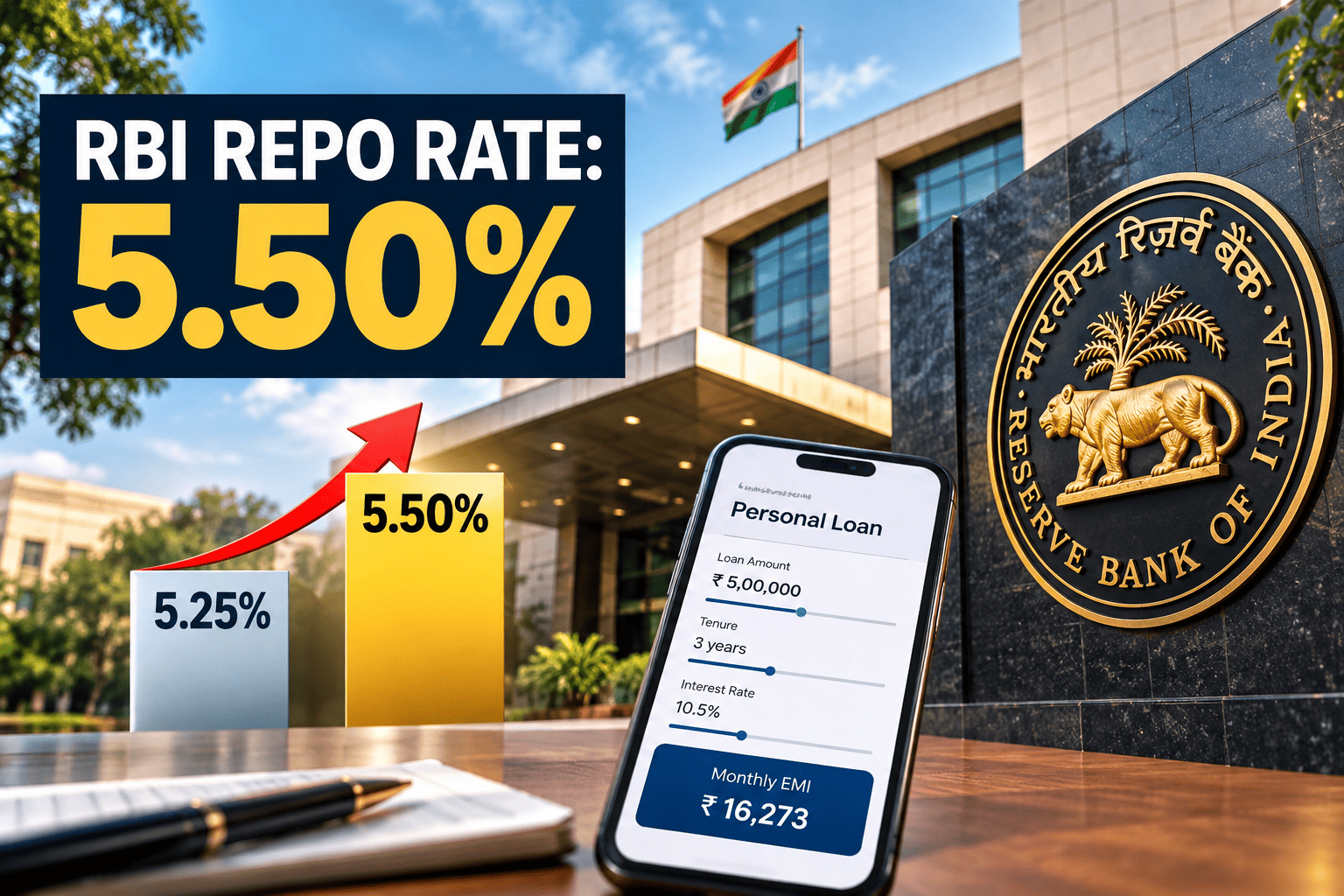


On 7th October 2026, the RBI hiked its benchmark repo rate from 5.25% to 5.50% for the first time since February 2023. The six-member Monetary Policy Committee agreed unanimously to the rate hike, and upgraded the policy stance from neutral to calibrated tightening.
For the borrowers of personal loans the key takeaway is that the increase does not apply to every existing personal loan EMI for them when the repo rate is raised. The actual impact will vary depending on the interest rate type of the loan, the pricing policy of the lender, the cost of funding and terms of the individual loan agreement.
What happened?
On 7th October 2026, the RBI Monetary Policy Committee increased the policy repo rate by 25 basis points to 5.50%. The decision came with everyone's vote. Additionally, the RBI has also shifted the stance of its monetary policy from “neutral” to “calibrated tightening”, indicating a more stringent approach towards inflationary pressure.
What did RBI announce in the October 2026 policy?
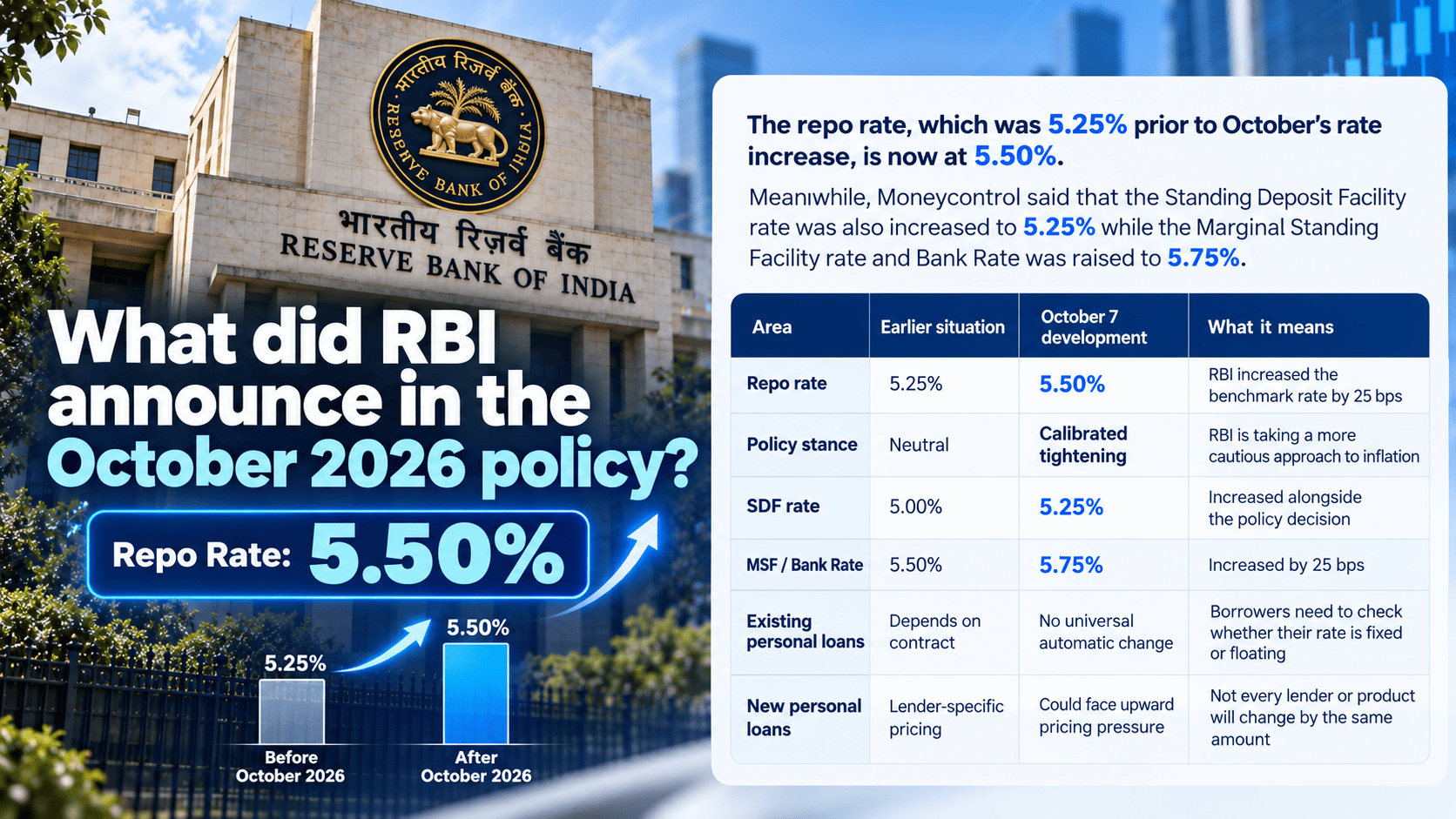
The repo rate, which was 5.25% prior to October's rate increase, is now at 5.50%.
Meanwhile, Moneycontrol said that the Standing Deposit Facility rate was also increased to 5.25% while the Marginal Standing Facility rate and Bank Rate was raised to 5.75%.
|
Area |
Earlier situation |
October 7 development |
What it means |
|
Repo rate |
5.25% |
5.50% |
RBI increased the benchmark rate by 25 bps |
|
Policy stance |
Neutral |
Calibrated tightening |
RBI is taking a more cautious approach to inflation |
|
SDF rate |
5.00% |
5.25% |
Increased alongside the policy decision |
|
MSF / Bank Rate |
5.50% |
5.75% |
Increased by 25 bps |
|
Existing personal loans |
Depends on contract |
No universal automatic change |
Borrowers need to check whether their rate is fixed or floating |
|
New personal loans |
Lender-specific pricing |
Could face upward pricing pressure |
Not every lender or product will change by the same amount |
How Will the RBI Repo Rate Hike Affect NBFC Personal Loans?
The RBI increased the repo rate from 5.25% to 5.50% on October 7, 2026. This may affect borrowing costs for banks and NBFCs, but personal loan interest rates will not necessarily increase immediately.
NBFCs consider several factors when setting loan interest rates, including funding costs, repayment risk, loan tenure and the borrower's credit profile.
What should personal loan borrowers know?
-
Existing fixed-rate loans: Your EMI will generally remain unchanged if your interest rate is fixed for the loan tenure.
-
Floating-rate loans: Your interest rate may change according to the loan agreement and applicable reset conditions.
-
New personal loans: Some lenders may revise their rates depending on funding costs and lending policies.
Before applying for a loan, compare the interest rate, processing fee, EMI and total repayment amount.
You can use Pocketly's Personal Loan EMI Calculator to understand your monthly repayment before applying.
Why did RBI increase the repo rate?
The rate hike comes as inflation pressures have increased.
India’s consumer inflation reached 4.82% year-on-year in August, above RBI’s 4% medium-term target for a third consecutive month. Higher oil and food prices have contributed to the inflation pressure.
At the same time, economic growth has remained strong. India recorded 7.8% GDP growth in the April-June quarter, giving the central bank more room to tighten monetary policy while responding to inflation.
RBI also raised its FY27 real GDP growth projection to 7.1% from 6.7%, according to Moneycontrol’s reporting on the policy announcement.
What does the RBI repo rate hike mean for personal loan borrowers?
The immediate impact is not the same for every personal loan borrower.
The repo rate is the rate at which RBI lends short-term funds to banks against eligible securities. Changes in the repo rate can influence broader borrowing costs in the financial system, but personal loan pricing also depends on the lender’s cost of funds, borrower risk profile, credit history, income, loan amount, tenure and internal pricing policies.
Therefore, a 25-basis-point RBI hike should not be interpreted as an automatic 25-basis-point rise in every personal loan.
Will personal loan interest rates increase after the RBI repo rate hike?
New personal loan rates could face upward pressure, but an increase is not automatic or uniform.
Banks and NBFCs decide personal loan pricing using several factors. If their funding costs increase following tighter monetary conditions, some lenders may revise rates on new loans.
However, the timing and size of any change can differ between lenders and products.
Borrowers should therefore compare the actual annual interest rate, processing charges, tenure, EMI and total repayment amount offered to them rather than assuming every lender has increased rates by exactly 0.25%.
Will existing personal loan EMIs rise?
Many existing fixed-rate personal loans should not see their EMI change simply because RBI increased the repo rate.
If your loan agreement has a fixed interest rate for the agreed tenure, a change in the RBI repo rate generally does not automatically alter that contracted rate.
For loans with a floating or benchmark-linked interest rate, the impact depends on the benchmark, reset terms and lender policy.
Borrowers should check their loan agreement or Key Fact Statement rather than assuming their EMI has changed.
This distinction is particularly important because Moneycontrol’s reported example of an EMI increase relates to a floating-rate home loan, where benchmark transmission operates differently.
Does the rate hike change personal loan eligibility or credit-score requirements?
No general RBI announcement from this policy decision directly changes personal loan eligibility, documentation or credit-score requirements.
The October 7 decision is a monetary-policy rate change.
Individual lenders will continue to assess applications using their applicable underwriting policies, which may consider factors such as income, repayment capacity, existing obligations, credit history and verification.
The repo-rate announcement should therefore not be described as a new personal-loan eligibility rule.
Will loan approval become harder?
The RBI announcement itself does not introduce a new approval rule for personal loans.
However, lenders may adjust pricing or credit strategy based on funding conditions, economic conditions and their own risk policies.
Approval remains subject to the lender’s eligibility, verification and underwriting requirements.
What this means for borrowers
Borrowers considering a new personal loan should focus on the actual terms available to them rather than making a decision based only on the headline repo rate.
Before accepting a loan, check:
-
applicable interest rate
-
whether the rate is fixed or floating
-
EMI
-
loan tenure
-
processing charges
-
total repayment amount
-
late-payment charges
-
applicable lender details
-
Key Fact Statement, where applicable
-
prepayment or foreclosure conditions
-
other terms and conditions
A lower EMI should also not be considered in isolation. A longer tenure can reduce the monthly payment while increasing the total amount repaid over the life of the loan.
Example: why a 25-bps RBI hike does not mean every EMI rises immediately
Consider two borrowers who already have personal loans.
Borrower A has a fixed-rate loan. If the contract fixes the rate for the full tenure, today’s RBI repo-rate increase does not by itself change the agreed EMI.
Borrower B has a loan whose rate can reset according to an applicable benchmark. Any impact would depend on the lender’s benchmark, reset date and loan terms.
This is why borrowers should check the specific loan agreement rather than simply adding 0.25% to their current interest rate.
What should new personal loan borrowers do now?
There is no need to assume that every personal loan has suddenly become expensive.
Instead, compare offers using the total cost of borrowing.
If you are exploring a personal loan through Pocketly, review the applicable loan amount, interest rate, fees, tenure, EMI, total repayment obligation and lender disclosures before accepting an offer. Eligibility, approval, pricing and disbursal remain subject to applicable lender criteria and verification.
What happens next?
RBI Governor Sanjay Malhotra said near-term rate cuts are not currently expected, with future policy action likely to involve either another increase or a pause depending on inflation and economic conditions, according to Moneycontrol.
That does not guarantee another rate hike.
Future RBI decisions will depend on incoming inflation, growth and broader economic data.
For borrowers, the key development to watch is whether banks and NBFCs begin revising lending rates and how quickly any change reaches new retail-loan offers.
Key Takeaways
-
RBI raised the repo rate by 25 bps to 5.50% on October 7, 2026.
-
The MPC voted unanimously for the rate increase.
-
RBI changed its stance from neutral to calibrated tightening.
-
The repo-rate hike does not automatically increase every personal loan EMI.
-
Existing fixed-rate personal loans may remain unaffected by the repo change.
-
New personal-loan pricing could face upward pressure if lenders' funding costs rise
-
No new general personal-loan eligibility or documentation rule was announced as part of this repo-rate decision.
-
Borrowers should check the actual interest rate, EMI, tenure, fees and total repayment before taking a loan.
Check the complete cost before taking a personal loan
Interest rates are only one part of a personal loan. Before borrowing, review the EMI, tenure, processing charges, total repayment amount, applicable lender details and Key Fact Statement.
With Pocketly, eligible users can check available personal-loan options digitally. Approval, loan amount, pricing and disbursal are subject to applicable lender eligibility and verification requirements.
Check your eligibility with Pocketly and review the applicable loan terms before making a borrowing decision.
FAQs
1. What is the RBI repo rate today?
The RBI repo rate is 5.50% after the Monetary Policy Committee increased it by 25 basis points on October 7, 2026. The previous rate was 5.25%. The six-member MPC unanimously supported the increase.
2. Will personal loan EMIs increase after the RBI repo rate hike?
Not necessarily. Many personal loans use fixed interest rates, so an existing fixed-rate EMI does not automatically change when the repo rate rises. For floating or benchmark-linked loans, the impact depends on the lender, benchmark and reset conditions.
3. Will personal loan interest rates rise after the repo rate reaches 5.50%?
They may face upward pressure, particularly for new loans if lenders experience higher funding costs. However, RBI's 25-bps hike does not require every lender to raise every personal-loan rate by 25 bps.
4. Does the RBI repo rate directly affect NBFC personal loans?
Not in a simple one-to-one manner. Repo-rate changes can influence financial-system funding conditions, but NBFC personal loan pricing also depends on borrowing costs, risk, competition and the lender's individual pricing strategy.
5. Does the RBI rate hike affect my credit score?
No. A repo-rate change does not directly alter your credit score. Your credit profile is influenced by factors such as repayment behaviour, credit utilisation and other information recorded in your credit history.
6. Has RBI changed personal loan eligibility rules in October 2026?
The October 7 monetary-policy announcement is a repo-rate decision and does not itself establish a new general personal-loan eligibility requirement. Lenders continue to apply their respective eligibility and underwriting criteria.
7. Is this the first RBI repo-rate hike since 2023?
Yes. The October 2026 increase is the first repo-rate hike since February 2023, when RBI had increased the policy rate by 25 basis points to 6.50%.
Will RBI increase the repo rate again in December 2026?
The RBI has not announced another rate hike for December 2026. Future decisions will depend on inflation, economic growth and other financial conditions.
Will the RBI repo rate hike make personal loans expensive?
Personal loan interest rates may increase if lenders revise their pricing. However, a 25-basis-point repo rate hike does not mean every personal loan becomes 0.25% more expensive.
Should I apply for a personal loan after the RBI rate hike?
You can consider applying if you need funds and can comfortably afford the repayments. Compare interest rates, fees, EMI and total repayment before choosing a loan.
Can I calculate my personal loan EMI after the RBI rate hike?
Yes. Use a personal loan EMI calculator to compare different interest rates and loan tenures. This can help you understand how a change in interest rate may affect your monthly payment.
Sources
Reserve Bank of India
Official RBI website and Press Releases section, checked October 7, 2026. At the time of verification, the RBI press-release index had not yet surfaced the October monetary-policy statement.
Reserve Bank of India official website
Reuters — October 7, 2026
India raises policy rate by 25 bps in first hike in nearly four years
Confirms the 25-bps increase to 5.50%, unanimous MPC vote, change to calibrated tightening, inflation context and economic-growth context.
Read Reuters report
Moneycontrol — October 7, 2026
RBI MPC hikes repo rate by 25 bps: Know how much more home loan borrowers will have to pay
Used for additional borrower context. Its EMI example relates to floating-rate home loans and has not been presented as a personal-loan calculation.
Read Moneycontrol report
Moneycontrol — October 7, 2026
RBI rules out near-term rate cuts; next move can only be hike or pause, Malhotra says
Used for policy stance, standing facility rates and updated RBI growth projections.
Read Moneycontrol policy report