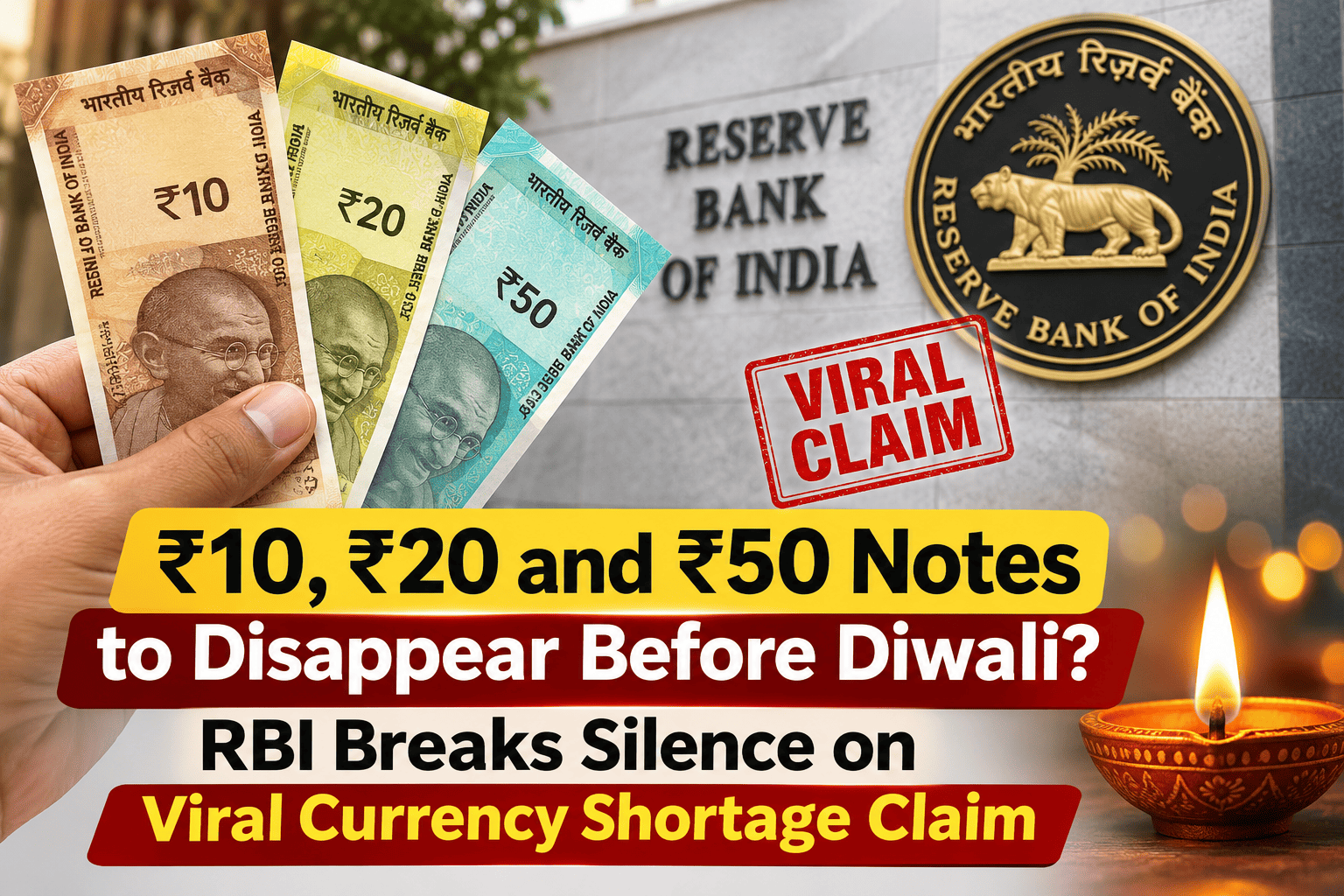


RBI latest news 2026: The Reserve Bank of India has rejected a fake circular claiming that ₹10, ₹20 and ₹50 currency notes will be in short supply during Diwali. Here's what the RBI clarified, what the viral message claimed and what people should know about small-denomination notes.
New Delhi, November 4, 2026: Are ₹10, ₹20 and ₹50 currency notes going to become difficult to find this Diwali? A message circulating on WhatsApp and social media has raised that concern among people who regularly use cash for shopping, travel and everyday purchases.
The Reserve Bank of India (RBI) has now rejected the claim, confirming that sufficient stocks of currency notes, including smaller denominations, are available in its vaults and currency chests.
The clarification follows the circulation of a forged RBI circular dated October 27, 2026. The document claimed that new ₹10, ₹20 and ₹50 notes might not be available in sufficient quantities during the festive season because of India's increasing use of digital payments.
The circular used the RBI's name and logo and carried a purported governor's signature to appear authentic.
However, the central bank confirmed on November 2 that the document was fabricated. The Press Information Bureau's Fact Check unit also rejected the claim.
According to reports published by Moneycontrol on November 3 and The Economic Times on November 3, the RBI has advised the public to rely on official communications rather than forwarded messages.
Moneycontrol+1
RBI currency note news: What has been confirmed?
|
Question |
Verified information |
|
Are ₹10 notes being discontinued? |
No such announcement |
|
Are ₹20 notes being discontinued? |
No such announcement |
|
Are ₹50 notes being discontinued? |
No such announcement |
|
Has RBI warned of a Diwali cash shortage? |
No |
|
Date on the forged circular |
October 27, 2026 |
|
RBI clarification |
November 2, 2026 |
|
PIB Fact Check response |
November 2, 2026 |
|
Are sufficient notes available? |
RBI confirms adequate stocks in vaults and currency chests |
|
Has RBI announced a reduction in printing these notes? |
No such announcement in the clarification |
Sources: RBI's November 2 public clarification, PIB Fact Check and November 3 reporting by Moneycontrol and The Economic Times.
Sotwe+2
What did the fake RBI circular say about ₹10, ₹20 and ₹50 notes?
The fake notice appeared under the title Important Advisory on Availability of Small Denomination Notes during Diwali.
It claimed that the RBI was reducing the printing of smaller currency notes as India moved towards greater use of cashless payment methods.
The document also encouraged people to use UPI, debit cards, credit cards and net banking rather than depend on cash for festive purchases.
Those statements were presented as official RBI policy, even though the central bank had issued no such advisory.
The forged document was designed to look credible. It included the RBI's branding, an official-looking format and a purported signature. That presentation made it easier for the message to circulate as genuine financial news.
For readers searching for the latest RBI ₹10 note news, RBI ₹20 note news or ₹50 note updates, the central fact is straightforward: the alleged currency shortage warning was fake.
The RBI has not announced that these denominations will be withdrawn from circulation or become unavailable during Diwali 2026.
The Economic Times
RBI confirms sufficient currency notes are available
The RBI addressed the viral claims through its official communication on November 2.
It explained that individuals had fraudulently used the central bank's identity to circulate a forged circular warning about the availability of lower-denomination notes.
The RBI confirmed that sufficient quantities of currency notes across denominations were available in its vaults and currency chests.
Currency chests are facilities through which banks maintain currency stocks on behalf of the RBI. They play a role in distributing banknotes through the banking system.
The clarification is relevant to people who regularly use ₹10, ₹20 and ₹50 notes for small payments.
It also addresses concerns among shopkeepers who depend on smaller denominations to return change.
However, the RBI's statement about adequate currency stocks should not be interpreted as a guarantee that every individual bank branch or ATM will have every denomination available at every moment.
Local cash availability can depend on distribution and demand.
Why did the ₹10, ₹20 and ₹50 note shortage rumour spread before Diwali?
The timing of the forged notice made the claim particularly noticeable.
During Diwali, households often spend more on groceries, sweets, clothing, gifts, travel and religious celebrations. Cash remains useful for small purchases, particularly when digital payments are unavailable or inconvenient.
A customer buying vegetables worth ₹70 may pay with a ₹100 note and expect ₹30 in change. A roadside vendor selling an item for ₹20 may need several smaller notes to complete transactions throughout the day.
Because these denominations are familiar and frequently used, a warning about their possible shortage can attract attention.
The fake circular also connected its claim to the increasing popularity of UPI payments. That made the story sound plausible to readers who have seen digital payments become more common.
But the growth of UPI does not establish that the RBI has decided to stop printing ₹10, ₹20 or ₹50 notes.
The claim required an official source, and the RBI's clarification directly contradicted it.
Are ₹10, ₹20 and ₹50 notes still legal tender in India?
Yes. The RBI has made no announcement withdrawing these denominations from circulation.
People can continue using ₹10, ₹20 and ₹50 notes for ordinary payments.
The recent clarification concerns a fake shortage advisory. It does not announce demonetisation, withdrawal of legal-tender status or a new deadline for exchanging existing notes.
There is also a difference between older and newly printed banknotes. An older genuine banknote does not automatically become invalid because a newer design exists.
The public should distinguish among three separate issues: whether a note is legal tender, whether new notes are being printed and whether a particular branch has sufficient cash available.
The viral message did not provide reliable evidence of a change to any of these policies.
Does the RBI want people to stop using cash and switch to UPI?
The forged circular suggested that reduced printing of smaller notes was connected to India's transition towards digital payments.
The RBI rejected that circular.
UPI remains a convenient payment option, particularly for customers who prefer not to carry cash. However, using UPI is a choice, and the November 2 clarification does not introduce a requirement to abandon cash.
Digital payments also have their own security considerations. Customers should check merchant details before approving payments and never share their UPI PIN.
For readers interested in newer payment services, Pocketly has also covered the Fibe UPI Payments launch in India, including support for eligible RuPay credit cards and credit lines.
A credit line linked to UPI is different from paying directly from a savings account. It involves borrowing and may attract interest or other charges depending on the lender's terms.
National Payments Corporation of India
How to identify a fake RBI circular or banking message
The forged currency notice shows why financial messages should be checked before being forwarded.
An official-looking logo, reference number or signature does not establish that a document is genuine.
If a WhatsApp message claims that the RBI has introduced new banking rules or discontinued a currency note, readers should take a few precautions:
-
Visit the official RBI website and look for the announcement.
-
Check whether the information appears on an RBI-verified communication channel.
-
Consult PIB Fact Check for government-related misinformation.
-
Avoid clicking unknown links requesting banking credentials or personal information.
-
Do not forward an unverified circular simply because it appears to come from a government institution.
Fake financial notices can also be used to direct people towards phishing websites or fraudulent payment requests.
Pocketly readers can learn more about suspicious financial offers in our guide to personal loan scams to watch out for in 2026–2027.
The guide explains common tactics involving fake loan apps, advance-fee requests, fraudulent KYC messages and impersonation.
What should consumers do if they cannot find smaller currency notes?
A temporary lack of ₹10, ₹20 or ₹50 notes at a particular shop or bank branch should not automatically be interpreted as a nationwide shortage.
Customers can ask their bank about the availability of smaller denominations, use existing cash where practical or choose a digital payment method accepted by the merchant.
For example, someone making a ₹35 purchase may prefer to pay using smaller notes rather than request change for ₹500. If the shop accepts UPI, digital payment is another option.
People should avoid withdrawing unusually large amounts of cash because of an unverified social media message.
The RBI has confirmed sufficient stocks in its vaults and currency chests, although it has not provided a new denomination-wise stock figure in the clarification.
Moneycontrol
Why financial misinformation deserves attention
Currency rumours can affect consumer behaviour even when the underlying claims are false.
A fabricated announcement about cash availability may encourage unnecessary bank visits or cash withdrawals. It can also confuse small businesses preparing for periods of higher customer spending.
The latest RBI clarification demonstrates the value of checking financial information before making decisions.
The same approach applies when comparing personal loans, credit cards or digital lending applications.
Borrowers should verify the regulated lender, examine the Key Facts Statement and understand the complete repayment obligation.
For those considering borrowing, Pocketly's guide to applying for a personal loan online explains eligibility checks, required information and the application process.
Customers can also use the online EMI calculator to estimate repayments before accepting a loan.
These resources are relevant to financial planning, although the RBI's currency clarification does not create any reason to borrow money.
Conclusion: RBI rejects currency shortage rumours; consumers should rely on verified information
The latest RBI currency note clarification puts an end to the misleading claim that ₹10, ₹20 and ₹50 notes will become scarce during Diwali 2026.
The central bank has confirmed sufficient stocks of smaller-denomination currency notes and warned the public against relying on forged circulars.
Consumers can continue using cash and digital payment methods according to their needs. There is no reason to change spending or withdrawal habits because of the fake notice.
Financial decisions should always begin with reliable information, whether someone is checking currency updates, reviewing a bank offer or applying for a personal loan.
For eligible customers who need short-term financing, Pocketly offers digital personal loans ranging from ₹1,000 to ₹50,000 through RBI-registered NBFC Speel Finance Company Private Limited.
Pocketly's published information includes digital applications and repayment options, subject to approval and applicable terms. Customers should review interest rates, APR, processing fees and repayment schedules before borrowing.
For more information about borrower protections, visit Pocketly's responsible lending guidelines or read the Pocketly loan eligibility and repayment FAQs.
Pocketly is not affiliated with the RBI's currency-note clarification.
Sources for the article
-
The Economic Times, November 3, 2026 — RBI clarification on ₹10, ₹20 and ₹50 notes
-
Moneycontrol, November 3, 2026 — RBI rejects forged currency circular
-
The Economic Times, November 2, 2026 — PIB Fact Check debunks viral notice
Frequently asked questions
1. Is there a shortage of ₹10, ₹20 and ₹50 notes in India?
The RBI has rejected a viral claim about a nationwide shortage and confirmed sufficient stocks of currency notes in its vaults and currency chests.
2. Is the ₹10 note being discontinued in 2026?
No. The RBI has not announced the discontinuation of ₹10 notes in connection with the viral Diwali message.
3. Will ₹20 notes stop circulating after Diwali?
No such decision has been announced. The viral circular claiming reduced availability of smaller notes was fake.
4. Is the ₹50 note banned in India?
No. The RBI has made no announcement banning ₹50 currency notes.
5. Has the RBI stopped printing smaller currency notes?
The forged circular claimed that printing was being progressively reduced. The RBI rejected the document and has not confirmed that claim.
6. Why is the ₹10, ₹20 and ₹50 currency shortage news trending?
A fabricated RBI circular dated October 27, 2026, circulated on WhatsApp and social media. The RBI and PIB Fact Check rejected it on November 2.
7. Should people withdraw extra cash before Diwali?
The RBI's clarification provides no reason to make additional withdrawals because of the viral shortage claim. People can plan their cash requirements according to their usual spending needs.
8. Where can I check the latest RBI currency note updates?
Visit the official RBI website and verified RBI communication channels. PIB Fact Check is another useful resource for checking viral government-related claims.