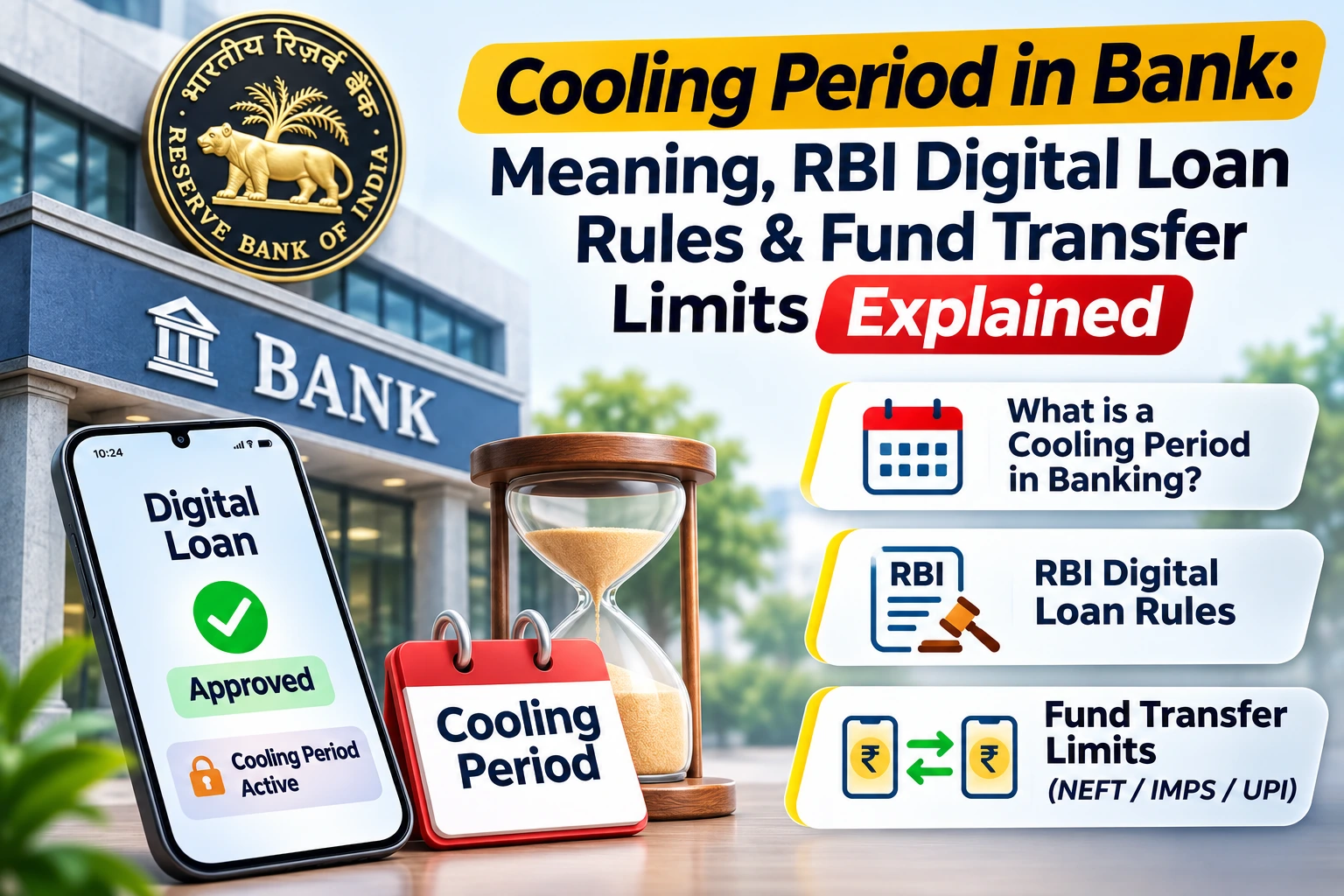


A cooling period in bank operations refers to a mandatory waiting or review window enforced in two primary situations in India: first, a security hold (typically 30 minutes to 24 hours) after you add a new beneficiary for NEFT, RTGS, or IMPS fund transfers; and second, a borrower-protection window—also called a cooling-off period—under Reserve Bank of India (RBI) Digital Lending Directions that lets you cancel a digital loan without prepayment penalties by repaying the principal and proportionate Annual Percentage Rate (APR). While these rules safeguard Indian account holders and borrowers against fraud and impulsive debt, exact durations vary across banks and regulated lenders. At Pocketly, we follow the RBI's digital lending framework transparently so you always know your exit window before accepting a loan.
Quick Answer: What Is a Cooling Period in Banking?
-
For Bank Fund Transfers: A temporary waiting time (often 30 minutes to 24 hours) or capped transfer limit after adding a new payee in net banking or mobile banking to prevent unauthorised account drains.
-
For Digital Personal Loans: Under the RBI (Digital Lending) Directions, 2025, regulated lenders must provide a cooling-off period (at least 3 days for loans with a tenure of 7 days or more, and 1 day for loans under 7 days) during which you can exit the loan without foreclosure penalties.
-
For Rejected Loan Applications: An informal 30-to-90-day waiting window recommended before reapplying so you can improve your credit profile and avoid multiple hard CIBIL inquiries.
-
Key Check: Always verify the exact cooling period in banking inside your bank's transfer alert or your lender's mandatory Key Fact Statement (KFS).
What Is Cooling Period in Bank?
Understanding what is cooling period in bank terminology requires looking at how Indian banks and RBI-regulated Non-Banking Financial Companies (NBFCs) protect consumers at two critical financial moments: sending money and borrowing money.
In everyday retail banking, the cooling period meaning in banking is a built-in safety pause. When you register a new payee or change high-risk account credentials (such as resetting net banking passwords or updating your mobile number), banks temporarily restrict outward fund transfers. During this window, the bank sends SMS and email alerts so you can block the payee immediately if a fraudster compromised your account.
In digital lending, the cooling-off period serves a complementary consumer-protection role. According to the RBI's digital lending framework, borrowers who take an instant personal loan online must receive an explicit look-up window after disbursal. If you realise you borrowed more than needed or found better terms, you can return the principal plus proportionate daily APR—along with any disclosed one-time processing fee—without paying standard foreclosure penalties.
How Does a Cooling Period in Banking Work Across Different Scenarios?
Depending on whether you are transferring funds, cancelling a digital loan, or reapplying after a declined credit request, a cooling period in bank systems operates under distinct rules.
|
Banking / Credit Scenario |
Typical Cooling Period Duration |
Governing Rule / Policy |
What Happens During the Window |
|
Adding a New Beneficiary (NEFT / RTGS / IMPS) |
30 minutes to 24 hours (varies by bank) |
Individual bank cybersecurity and risk policies |
Fund transfers to the new payee are either paused or capped at a lower initial limit. |
|
UPI First-Time High-Value Transfers |
Up to 24 hours (for new users or device/SIM changes) |
NPCI & bank security guidelines |
Outward UPI limits are temporarily capped (often at ₹5,000 for the first 24 hours on Android). |
|
Digital Personal Loan Cancellation |
Minimum 3 days (tenure ≥ 7 days) or 1 day (tenure < 7 days) |
RBI (Digital Lending) Directions, 2025 |
Borrower can exit the loan by paying principal, proportionate APR, and disclosed one-time fee. |
|
Post-Loan Rejection Reapplication |
30 to 90 days (recommended best practice) |
Credit bureau & lender underwriting norms |
Gives you time to fix KYC errors, lower FOIR, and avoid clustering hard credit inquiries. |
1. Beneficiary Addition Cooling Period in Net Banking & Mobile Apps
When you add a new recipient's bank account number and IFSC code for NEFT, RTGS, or IMPS, Indian banks trigger a cooling period in banking before activating full transfer limits:
-
Initial Activation Delay: Many major Indian banks enforce a 30-minute waiting period before you can initiate any transfer to the newly added beneficiary.
-
Temporary Transaction Caps: Even after initial activation, several banks restrict transfers to a new payee (for example, capping transfers at ₹50,000 or ₹1,00,000) during the first 24 hours.
-
Fraud Interruption: If a scammer gains access to your login credentials and adds a mule account, the SMS/email alert combined with the waiting period gives you time to freeze your account via official bank channels.
2. RBI Cooling-Off Period on Digital Personal Loans
Under Paragraph 10 of the Reserve Bank of India (Digital Lending) Directions, 2025, every Regulated Entity (bank or NBFC) offering digital loans must provide a mandatory cooling-off period:
-
Minimum Duration: The exit window cannot be less than 3 days for loans with a tenure of 7 days or more, and not less than 1 day for loans with a tenure of less than 7 days.
-
Upfront KFS Disclosure: The exact duration of your cooling-off period and any applicable one-time processing charge must be clearly stated upfront in your Key Fact Statement (KFS).
-
Penalty-Free Exit: If you exit within this window, the lender cannot levy prepayment or foreclosure penalties—you only repay the disbursed principal, proportionate daily APR for the days you held the funds, and a reasonable one-time processing fee if disclosed in advance in the KFS.
How to Cancel a Digital Loan During the Cooling-Off Period
If you take a digital loan and decide within the look-up window that you no longer need the funds, follow this step-by-step process to exercise your cooling-off period rights cleanly:
-
Check Your Key Fact Statement (KFS): Open your KFS or loan agreement immediately to confirm the exact deadline (date and timestamp) of your cooling-off period and whether a one-time processing fee is retained upon exit.
-
Raise a Cancellation Request via Official Channels: Contact the lender through its official mobile app support desk or published customer care email before the window expires. Never rely on unverified phone numbers found on search engines.
-
Verify the Exact Exit Settlement Amount: Request a written breakdown showing the principal amount, proportionate APR for the elapsed days, and any KFS-disclosed one-time processing fee.
-
Complete the Repayment Through Verified Rails: Transfer the exact settlement amount using the lender's official in-app repayment portal or designated bank account and save the Unique Transaction Reference (UTR) receipt.
-
Collect Your Loan Closure Confirmation / NOC: Ensure the lender marks your loan as cancelled/closed and issues a formal No Objection Certificate (NOC) so your credit bureau report reflects zero overdue balance.
Cooling-Off Period vs. Loan Foreclosure: What Is the Difference?
Borrowers frequently confuse exiting a loan during the cooling-off period with standard loan foreclosure. While both close your loan early, the cost and regulatory protections differ significantly.
|
Comparison Parameter |
Cooling-Off Period Exit |
Standard Loan Foreclosure |
|
When It Applies |
Within the initial look-up window (typically 1–3 days from disbursal, per KFS) |
Any time after the cooling-off period expires (subject to lock-in terms, if any) |
|
Regulatory Mandate |
Mandatory under RBI Digital Lending Directions for covered digital loans |
Governed by RBI Fair Practices Code and individual lender terms |
|
Foreclosure Penalty |
Zero foreclosure penalty permitted |
Fixed-rate personal loans may carry a 2%–5% foreclosure fee on outstanding principal |
|
Interest Charged |
Proportionate APR only for the exact number of days the funds were held |
Accrued interest up to the formal foreclosure settlement date |
|
Processing Fee Treatment |
Lender may retain a reasonable one-time processing fee only if disclosed upfront in KFS |
Upfront processing fee already paid/deducted is generally non-refundable |
If you pass the initial cooling-off period and later decide to close an active personal loan early, you can estimate your net interest savings against standard preclosure fees using our free loan foreclosure calculator.
How We Approach Transparent Digital Credit at Pocketly
When you need urgent funds for a medical bill, rent gap, or freelance cash-flow delay, waiting 24 hours for a bank beneficiary hold—or 5 to 7 days for traditional branch loan processing—can feel stressful. At Pocketly, we streamline short-term borrowing while strictly adhering to RBI transparency standards:
-
Regulated NBFC Underwriting: All personal loans on our platform—ranging from ₹1,000 to ₹50,000 with repayment tenures from 61 days to 9 months—are sanctioned and disbursed by our RBI-registered NBFC partner, Speel Finance Company Private Limited, in alignment with our responsible lending charter.
-
Upfront Key Fact Statement (KFS): Before you accept any loan offer, we display the exact loan amount, monthly interest rate (2% to 3% per month), processing fee (0% to 7.5% plus applicable GST), APR, repayment schedule, and applicable cooling-off period terms clearly in your KFS.
-
Options for Every Income Profile:
-
If you earn a regular monthly paycheck, explore our personal loan for salaried applicants to bridge mid-month expenses.
-
If you run a small business or freelance, check our personal loan for self employed option to manage working capital gaps.
-
If you are a student or gig worker without conventional salary slips, our personal loan for non salaried category evaluates your digital cash flows and KYC credentials.
-
Plan Repayments Before Borrowing: While our paperless digital application takes just a few minutes to submit—often searched by borrowers looking for an instant personal loan online in 2 minutes—final approval and bank disbursal depend on real-time KYC validation and underwriting checks. Before you apply, test your monthly instalment on our personal loan EMI calculator or check your borrowing capacity with our personal loan eligibility calculator.
If you are comparing platforms to find the best loan app in India for your needs, always verify the underlying RBI-registered NBFC or bank, review the KFS for full APR and cooling-off period disclosures, and confirm that repayments fit comfortably within your budget.
What Should You Check & Common Mistakes to Avoid
Whether you are navigating a bank transfer hold or reviewing a digital loan agreement, avoiding these common mistakes protects both your money and your CIBIL score:
-
Waiting Until the Last Minute for Urgent Bank Transfers: Because banks enforce a cooling period in bank payee additions, add and verify beneficiaries at least 24 hours before large rent, tuition, or vendor payments.
-
Falling for "Cooling Period Bypass" Scams: Bank staff never call asking for your OTP, CVV, or screen-sharing access to "instantly remove" a beneficiary cooling period in banking. Report suspicious calls immediately to the National Cyber Crime Helpline at 1930.
-
Assuming Cooling-Off Cancellation Is Automatic: Simply leaving disbursed loan funds untouched in your savings account does not cancel the loan. You must formally notify the lender and repay the principal plus proportionate APR within the KFS window.
-
Reapplying Immediately After a Loan Rejection: Submitting back-to-back applications across multiple apps after a rejection triggers multiple hard bureau inquiries and lowers your credit score. Use a FOIR calculator and 50 30 20 rule calculator to rebalance your debt-to-income ratio before applying again.
-
Using Unregulated 7-Day Loan Apps: Predatory, unlicensed apps ignore RBI rules on Key Fact Statements and cooling-off period exits. Learn how to spot illegal short-term traps in our guide on 7 days loan vs 30 days loan and review our RBI guidelines for loan recovery in India to know your borrower rights.
Final Takeaway: Use the Cooling Period in Bank Rules to Protect Your Finances
Whether it is a 30-minute security hold on a newly added bank payee or the RBI's mandatory cooling-off period on digital loans, a cooling period in bank systems exists to protect you from fraud, rushed decisions, and avoidable debt. Always add bank beneficiaries ahead of urgent due dates, read every line of your Key Fact Statement before accepting credit, and borrow only what fits comfortably within your monthly budget.
Also Read: Latest Guides & News on Pocketly
Explore our latest 10 guides and regulatory updates to borrow safely and manage your personal finances in 2026:
Frequently Asked Questions (FAQs)
1. What is cooling period in bank when adding a new beneficiary?
A cooling period in bank payee registration is a mandatory security waiting time—typically 30 minutes to 24 hours—before you can transfer full amounts to a newly added NEFT, RTGS, or IMPS recipient. Banks use this window and send SMS/email alerts so you can stop fraudulent transfers if your account credentials were compromised.
2. What is the cooling period meaning in banking for personal loans?
In lending, the cooling period meaning in banking (officially termed the cooling-off period by the RBI) is a post-disbursal look-up window during which a borrower can cancel a digital loan without prepayment penalties by repaying the principal, proportionate daily APR, and any upfront KFS-disclosed one-time processing fee.
3. How many days is the RBI cooling-off period for digital loans in India?
Under the Reserve Bank of India (Digital Lending) Directions, 2025, the cooling-off period must be at least 3 days for digital loans with a tenure of 7 days or more, and at least 1 day for loans with a tenure of less than 7 days. The exact duration is printed in your Key Fact Statement (KFS).
4. Can I bypass or remove the cooling period in banking for urgent fund transfers?
No, you cannot manually bypass a bank's beneficiary cooling period in banking because it is an automated anti-fraud control. If you need to send money urgently before a bank's NEFT/IMPS payee activation completes, you may use alternative verified channels such as UPI within your bank's permitted daily limits.
5. Do I have to pay any penalty if I cancel a loan during the cooling-off period?
No, RBI guidelines prohibit lenders from charging foreclosure or prepayment penalties when you exit a covered digital loan within the cooling-off period. However, you must repay the disbursed principal, proportionate APR for the days the funds remained with you, and any reasonable one-time processing fee disclosed upfront in the KFS.
6. How long is the cooling period after a bank or NBFC rejects a loan application?
While the RBI does not mandate a fixed waiting period after a loan rejection, financial planners recommend observing a 30-to-90-day cooling period in bank or NBFC applications. Waiting lets you correct KYC discrepancies, lower your existing debt obligations, and prevent multiple hard CIBIL inquiries from lowering your credit score.
7. How can I check my eligibility and EMI before applying with Pocketly?
Before applying for a personal loan of ₹1,000 to ₹50,000 with us, use our free personal loan EMI calculator to estimate your monthly repayments and review your Key Fact Statement upfront. You can explore tailored options across our personal loan for salaried, personal loan for self employed, and personal loan for non salaried pages.
8. Is Pocketly an RBI-regulated lender and can I get an instant personal loan online in 2 minutes?
Pocketly is a digital lending platform, and all loans are sanctioned and disbursed by our RBI-registered NBFC partner, Speel Finance Company Private Limited. While completing our digital KYC and application takes just a few minutes—often searched as an instant personal loan online in 2 minutes—final approval and disbursal depend on automated verification and underwriting checks.