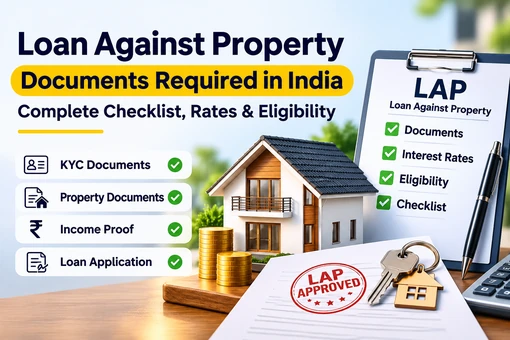


The loan against property documents required by Indian banks and Housing Finance Companies (HFCs) fall into three mandatory categories: KYC identity and address proofs (PAN card, Aadhaar card), income and banking records (salary slips, Form 16, or 2–3 years of ITRs and 6–12 months of bank statements), and property title papers (registered Sale Deed, 13–30 year Encumbrance Certificate, approved building plan, and latest property tax receipts). Because a loan against property involves multi-week legal and technical property verification, it is designed for large-ticket, long-term funding. If you need smaller, collateral-free funds between ₹1,000 and ₹50,000 without property paperwork, at Pocketly, we facilitate 100% digital personal loans through our RBI-registered NBFC partner, Speel Finance Company Private Limited, subject to verification and underwriting.
Quick Answer: At a Glance
Before gathering files for your application, review how lenders categorize the loan against property documents required across borrower profiles:
|
Document Category |
Core Papers Needed |
Who Must Submit |
Primary Underwriting Purpose |
|
KYC & Identity |
PAN Card, Aadhaar Card, Passport/Voter ID, photographs |
Applicant, co-applicants, and property co-owners |
Verifies identity, age, signature, and tax tracking under RBI KYC norms |
|
Income Proof (Salaried) |
Last 3–6 months salary slips, latest 2 years Form 16, 6–12 months salary bank statements |
Salaried individuals |
Assesses net take-home pay and Fixed Obligation to Income Ratio (FOIR) |
|
Income Proof (Self-Employed) |
Last 2–3 years ITRs with computation, CA-audited P&L & Balance Sheet, GST returns, 12 months bank statements |
Business owners, traders, and professionals |
Evaluates business continuity (typically 3–5 years) and cash-flow stability |
|
Property Title & Legal |
Registered Sale/Title Deed, prior chain deeds (13–30 years), Encumbrance Certificate (EC), Khata/mutation extract |
Property owner(s) |
Confirms clear, marketable ownership free from third-party legal disputes |
|
Municipal & Technical |
Approved building plan, Occupancy/Completion Certificate (OC/CC), latest property tax receipt, Society NOC |
Property owner(s) |
Validates construction legality and establishes appraised market valuation |
What Is a Loan Against Property and How Does It Work?
A loan against property (LAP) is a secured mortgage facility where you pledge an existing residential, commercial, or industrial property as collateral to raise funds for business expansion, education, medical treatment, or debt consolidation. While the lender holds a legal charge over your title deeds until full repayment, you retain full physical possession and can continue living in or leasing out the property.
Under Reserve Bank of India (RBI) lending guidelines, regulated banks and loan against property finance companies evaluate both your property's fair market value and your monthly repayment capacity before sanctioning credit. Typically, lenders sanction 50% to 75% of the appraised property value (Loan-to-Value ratio) over tenures extending up to 15–20 years. If you want to understand how collateral backing separates mortgage credit from unsecured borrowing, read our breakdown of different types of loans in India.
Complete Checklist of Loan Against Property Documents Required
Preparing the exact loan against property documents required before submitting your file prevents legal holds and repeated branch visits. Lenders divide documentation into four distinct buckets:
1. Mandatory KYC and Personal Documents
-
PAN Card: Mandatory for all financial applicants, co-applicants, and property owners for tax and credit bureau tracking.
-
Aadhaar Card: Serves as primary proof of identity, age, and current residential address.
-
Alternative Identity/Address Proof: Valid Passport, Voter ID, Driving Licence, or latest utility bill (electricity/water/gas) if current residence differs from Aadhaar.
-
Application & Photographs: Duly signed application form with recent passport-size photographs and signature verification (via PAN, Passport, or banker's attestation).
2. Income and Financial Documents (Salaried vs. Self-Employed)
-
For Salaried Applicants:
-
Last 3 to 6 months' computer-generated salary slips (including bonus/variable pay proof if applicable).
-
Latest 2 years' Form 16 or employer continuity certificate.
-
Last 6 to 12 months' primary salary bank account statements showing regular salary credits and existing EMI debits.
-
For Self-Employed Professionals & Business Owners:
-
Last 2 to 3 years' Income Tax Returns (ITRs) along with computation of income.
-
CA-certified Profit & Loss statements and Balance Sheets (with schedules) for the past 2–3 years, plus Tax Audit Report (Form 3CD) where turnover exceeds statutory audit limits.
-
Last 12 months' operative current and savings account statements.
-
Business existence proof: GST Registration Certificate, Udyam Registration, Shop and Establishment Licence, Partnership Deed, or Certificate of Incorporation with MOA/AOA and Board Resolution.
3. Property Ownership, Legal, and Municipal Documents
-
Original Registered Sale Deed / Title Deed: Establishes your current legal ownership of the pledged asset.
-
Chain of Title Documents: Previous sale deeds, allotment letters, or conveyance deeds tracing ownership history across 13 to 30 years.
-
Encumbrance Certificate (EC): Official sub-registrar record confirming the property has no active mortgages, liens, or legal encumbrances.
-
Municipal & Tax Records: Latest paid property tax receipts, Khata certificate/extract (or local municipal mutation record), and land conversion certificate (where applicable).
-
Construction & Society Approvals: Sanctioned building plan, Occupancy Certificate (OC) or Completion Certificate (CC) for ready properties, and a No Objection Certificate (NOC) from the cooperative housing society or builder.
4. Special-Case Documents (Inherited, Tenanted, or Balance Transfer)
-
Inherited or Gifted Property: Registered Will, Succession Certificate, Legal Heir Certificate, Probate order, or registered Gift/Partition Deed alongside updated mutation records.
-
Rented/Commercial Property: Registered lease agreements and 6–12 months of bank statements reflecting rental inflows.
-
LAP Balance Transfer: Foreclosure letter, List of Documents (LOD) held by the existing lender, and the last 12 months' loan account statement.
Loan Against Property Interest Rate, Tax Benefits & CIBIL Rules (2026)
Beyond assembling the loan against property documents required, evaluating pricing, credit score flexibility, and tax rules ensures you borrow cost-effectively:
Loan Against Property Interest Rate & Lowest Interest Rate Factors
As of November 2026 (with the RBI Policy Repo Rate standing at 5.50% following the October 2026 Monetary Policy Committee review), floating loan against property interest rate slabs across major Indian banks generally start between 8.30% and 9.50% p.a. for prime salaried borrowers, while NBFCs and loan against property finance companies typically price offers between 9.50% and 14.00%+ p.a. depending on property type and risk profile.
To qualify for a loan against property lowest interest rate, lenders look for:
-
A 750+ CIBIL score with zero recent EMI defaults.
-
Residential self-occupied collateral located within municipal limits (which carries lower risk weight than industrial or vacant land).
-
A lower Loan-to-Value (LTV) ratio (borrowing 50%–60% of property value rather than the maximum 75%) and a comfortable Fixed Obligation to Income Ratio (FOIR) tested via our FOIR calculator.
-
Comparing external benchmark spreads and upfront processing charges on our loan comparison calculator.
Loan Against Property Tax Benefits Under the Income Tax Act
Unlike a standard home loan, a loan against property does not offer principal repayment deductions under Section 80C, nor does it qualify for tax relief if spent on weddings, travel, or personal consumption. However, loan against property tax benefits apply on interest paid under two specific sections of the Income Tax Act (subject to applicable tax regime rules and end-use proof):
-
Section 37(1) (Business Use): If you use LAP funds exclusively for business working capital, machinery, or expansion, you can claim the entire interest paid along with processing and documentation fees as a deductible business expense.
-
Section 24(b) (Residential Housing Use): If you use LAP proceeds to buy, construct, or renovate another residential house property, you can claim interest deductions up to ₹2,00,000 per financial year (under the old tax regime for self-occupied property), provided you retain contractor invoices and bank utilization trails.
Loan Against Property with Bad CIBIL, Low Score, or Without Income Proof
Many borrowers ask whether they can secure a loan against property with bad cibil, a loan against property for low cibil score, or a loan against property without income proof:
-
Low or Bad CIBIL Score: Because the lender holds tangible real estate security, select HFCs and NBFCs consider applications with scores between 600 and 699 provided past defaults were minor and current cash flows are strong though at a higher loan against property interest rate.
-
Without CIBIL or Without Income Proof: Applying for a loan against property without cibil (thin credit file) or a loan against property without income proof (no formal ITR/salary slips) is possible through specialized NBFCs using surrogate income assessment such as 12 months' bank statement cash-flow analysis, GST turnover, liquid assets, or adding an earning co-applicant typically at a conservative 40%–55% LTV ratio.
|
Borrowing Scenario |
Traditional Commercial Bank |
Specialized HFC / NBFC |
Pocketly Digital Micro-Credit (Unsecured) |
|
Collateral Needed |
Residential or commercial property |
Residential, commercial, or mixed-use property |
Zero property or asset collateral required |
|
Loan Amount |
₹10 Lakh to ₹5 Crore+ |
₹5 Lakh to ₹3 Crore+ |
₹1,000 to ₹50,000 |
|
CIBIL Requirement |
Strictly 700–750+ preferred |
Flexible (considers 600+ or co-applicants) |
No prior CIBIL score required to apply |
|
Income Proof |
Mandatory salary slips / 2–3 yrs ITR |
Surrogate cash-flow / GST options available |
100% paperless PAN, Aadhaar & Video KYC |
|
Turnaround Time |
10 to 25 working days (legal/valuation) |
5 to 12 working days |
Fast digital application & direct transfer |
Step-by-Step Application Process for a Loan Against Property
-
Verify Property & Borrowing Eligibility: Confirm all title deeds are clear and check how much EMI your income can support using our loan affordability calculator and home loan EMI calculator.
-
Submit Application & KYC/Income Documents: Provide your PAN, Aadhaar, bank statements, and income proofs online or at the lender's branch.
-
Legal Title Search & Technical Valuation: The lender's empanelled lawyer verifies the 13–30 year chain of title and Encumbrance Certificate, while an engineer inspects the property to determine its market value.
-
Sanction Letter & Key Fact Statement (KFS): Review the sanctioned amount, applicable loan against property interest rate, processing fee, APR, and foreclosure rules in your KFS.
-
Mortgage Registration & Disbursal: Sign the loan agreement, deposit original title deeds (Equitable Mortgage or Memorandum of Deposit of Title Deeds), and receive funds in your bank account.
Need Urgent Funds Without Pledging Property? Explore Pocketly
Pledging real estate and gathering dozens of loan against property documents required makes sense when you need ₹15 lakh for business expansion. However, if you are a student, first-jobber, salaried employee, or freelancer facing a ₹5,000 medical bill, bike repair, or month-end rent gap, mortgaging property or waiting three weeks for legal checks is unnecessary.
At Pocketly, we facilitate collateral-free, 100% digital personal loans from ₹1,000 to ₹50,000 with flexible tenures from 61 days to 9 months, issued by our RBI-registered NBFC partner, Speel Finance Company Private Limited (CIN: U65920MH1995PTC090558), subject to verification and underwriting:
-
Salaried Earners: Bridge unexpected expenses ahead of payday with our personal loan for salaried applicants.
-
Self-Employed & Freelancers: Smooth out delayed client payments without branch paperwork via our personal loan for self employed option.
-
Non-Salaried & Young Earners: Apply without corporate salary slips or a prior CIBIL score through our personal loan for non salaried pathway.
Before choosing any loan amount, model your monthly repayment using our personal loan EMI calculator and review your upfront Key Fact Statement (monthly interest of 2%–3%, processing fee of 0%–9.4% inclusive of 18% GST, and maximum APR up to 99.73% on core micro-products). Note that while our digital onboarding takes just a few minutes, an instant personal loan online in 2 minutes refers to fast mobile application submission rather than guaranteed approval or guaranteed two-minute disbursal.
Common Mistakes to Avoid When Submitting LAP Documents
-
Submitting Photocopies Without Original Title Deeds: Banks require original registered sale deeds and prior chain documents for physical verification before disbursal.
-
Ignoring Outdated Encumbrance Certificates or Unpaid Property Taxes: Pending municipal tax dues or an unclosed past mortgage entry on the EC will stall legal clearance.
-
Overlooking Prepayment & Foreclosure Clauses: Under RBI norms, floating-rate term loans sanctioned to individual borrowers for non-business purposes carry zero foreclosure charges, whereas business-purpose LAP facilities may attract 2%–4% prepayment fees. Check exit costs using our loan foreclosure calculator.
-
Borrowing Beyond Safe Repayment Limits: Keep total EMIs under 40%–50% of net monthly income, and review our guide on what happens if a loan EMI is missed so you protect your property and credit score.
Final Takeaway: Prepare Your Checklist & Choose the Right Credit Fit
Organizing the loan against property documents required from your PAN and bank statements to your registered Sale Deed and Encumbrance Certificate prevents processing delays and helps you negotiate a competitive loan against property interest rate. Always verify how end-use affects loan against property tax benefits and borrow strictly within your monthly repayment comfort.
When your requirement is a smaller, short-term personal expense rather than a multi-lakh property mortgage, skip the collateral paperwork and explore transparent digital credit with us:
Also Read: Latest Guides & News on Pocketly
-
Types of Loans in India (2026): 12 Popular Loan Options, Secured vs Unsecured Credit Explained
-
Types of Home Loans in India (2026): Complete Guide to Housing Credit & Interest Rates
-
Top 20 Loan Apps in India (2026): Compare RBI-Registered Lenders & Limits
-
Personal Loan for Salaried with Low CIBIL Score: Eligibility, Process & Costs in India (2026)
-
How to Apply for a Personal Loan: A Simple Step-by-Step Guide
-
List of Loan Apps Banned in India (2019–2026) & Complaint Guide
-
RBI New Rules 2026: Stop Switch & Trusted Person for Bank Fraud
Frequently Asked Questions (FAQs)
1. What are the mandatory loan against property documents required in India?
The essential loan against property documents required include your PAN card, Aadhaar card, recent photographs, income proof (last 3–6 months' salary slips and Form 16 for salaried applicants, or 2–3 years' ITRs and audited financials for self-employed borrowers), 6–12 months' bank statements, and original property title papers including the registered Sale Deed, Encumbrance Certificate, approved building plan, and latest property tax receipt.
2. Can I get a loan against property without income proof?
Yes, select NBFCs and HFCs offer a loan against property without income proof (no formal salary slips or ITRs) by evaluating alternative repayment indicators such as 12 months' bank statement cash flows, GST returns, business turnover, or an earning co-applicant, usually at a lower Loan-to-Value (LTV) ratio of 40% to 55%.
3. Is it possible to get a loan against property with bad CIBIL or without CIBIL?
You can apply for a loan against property with bad cibil, a loan against property for low cibil score, or a loan against property without cibil through specialized loan against property finance companies and HFCs, because the pledged real estate lowers lender risk. However, expect stricter property valuation checks, lower LTV limits, and a higher loan against property interest rate.
4. How can I get a loan against property lowest interest rate in 2026?
To qualify for a loan against property lowest interest rate, maintain a 750+ CIBIL score, pledge a clear-title residential property inside municipal limits, keep your Loan-to-Value ratio below 60%, and compare repo-linked floating rates across banks before signing your Key Fact Statement.
5. What are the loan against property tax benefits in India?
Loan against property tax benefits apply only to interest payments based on end-use: under Section 37(1), business owners can deduct 100% of interest and processing fees if funds are used exclusively for business operations, while Section 24(b) allows up to ₹2 lakh interest deduction if funds are used to buy, construct, or renovate a residential house. No deduction is allowed under Section 80C or for personal expenses.
6. What documents are needed if the pledged property is inherited or jointly owned?
For inherited property, lenders require the registered Will, Succession Certificate, or Legal Heir Certificate along with updated municipal mutation records. For jointly owned property, all co-owners must provide KYC documents and sign as co-applicants or guarantors.
7. Does Pocketly offer a loan against property?
No, we do not issue property-backed mortgage loans. At Pocketly, we facilitate 100% digital, collateral-free personal loans from ₹1,000 to ₹50,000 (tenures of 61 days to 9 months) through our RBI-registered NBFC partner, Speel Finance Company Private Limited, subject to digital KYC and underwriting approval.
8. What documents are required to apply for a personal loan with Pocketly?
Our application process is 100% paperless and requires zero property documents or physical salary slips. You only need valid PAN card details, Aadhaar-based digital address verification, a smartphone camera for in-app Video KYC, and an active Indian savings bank account in your own name.
9. Can self-employed or non-salaried earners apply for a personal loan with Pocketly?
Yes. If you're self-employed, you can explore our personal loan for self employed applicants. If you earn through gigs, freelance work, or regular monthly allowances without a conventional salary, you can check our personal loan for non salaried option.
10. What should I check when comparing options for the best loan app in India?
If you're comparing platforms to find the best loan app in India for short-term credit, verify that the lending partner is an RBI-registered bank or NBFC, inspect the upfront Key Fact Statement (KFS) for total APR and processing fees, and calculate your monthly outgo on our personal loan EMI calculator before accepting an offer.