

Understanding the types of home loans in India ensures you apply for a mortgage product aligned with your exact property goal whether you are buying a ready apartment, constructing on your own land, or refinancing an existing mortgage. Indian commercial banks and Housing Finance Companies (HFCs) regulated by the Reserve Bank of India (RBI) and National Housing Bank (NHB) classify home loans by end-use and interest structure, with starting home loan interest rate offers hovering around 7.15% to 7.60% p.a. as of November 2026 (against the 5.50% RBI policy repo rate). However, actual sanction limits, interest spreads, and tenure always depend on property legal checks and borrower underwriting. While Pocketly does not issue long-term property mortgages, we help young salaried and self-employed earners bridge short-term, collateral-free personal expenses from ₹1,000 to ₹50,000 through our RBI-registered NBFC partner, Speel Finance Company Private Limited.
Quick Answer: Types of Home Loans in India
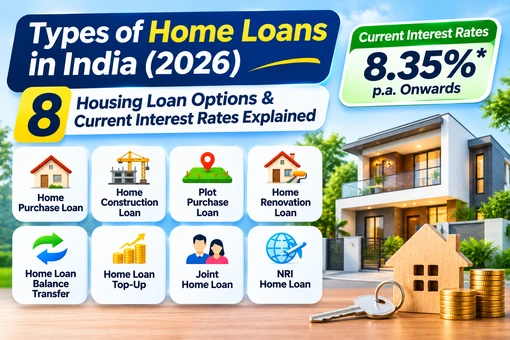
When comparing the different types of home loans available in India, lenders group housing credit across eight primary categories based on what you are financing and how repayments are structured:
|
Type of Home Loan |
Primary Purpose |
Disbursement Method |
Typical Tenure |
Key Regulatory / Pricing Feature |
|
Home Purchase Loan |
Buying a ready-to-move or under-construction flat/house |
Lump sum (ready) or construction-linked tranches |
Up to 30 years |
LTV capped at 75%–90% by RBI based on property value |
|
Land / Plot Purchase Loan |
Buying a residential plot inside municipal/development limits |
Lump sum upon sale-deed registration |
Up to 15 years |
Lower LTV (typically 70%–75%); no Section 80C/24(b) tax deduction until construction |
|
Home Construction Loan |
Building a house on an already-owned plot |
Staged tranches verified by technical engineer |
Up to 25–30 years |
Pre-EMI interest charged during construction phase |
|
Composite Home Loan |
Buying a plot and constructing a house under one contract |
Split tranches (land purchase + building stages) |
Up to 25–30 years |
Construction must typically begin within 1–2 years |
|
Home Extension & Renovation Loan |
Adding a room/floor or repairing an existing home |
Lump sum or staged contractor bills |
Up to 15 years |
Requires architect/engineer cost estimate |
|
Home Loan Balance Transfer |
Shifting an existing mortgage to another lender at a lower home loan interest rate |
Direct cheque/RTGS to existing lender |
Remaining mortgage term |
Zero foreclosure fee on floating-rate individual loans |
|
Top-Up Home Loan |
Extra borrowing over an active mortgage for personal or home needs |
Lump sum to borrower's account |
Up to remaining home loan tenure |
Slightly higher rate than base home loan; lower than unsecured debt |
|
PMAY-Urban 2.0 Subsidy Loan |
Affordable housing for EWS, LIG & MIG families |
Interest subsidy credited to loan account |
Up to 20 years |
Subject to PMAY-U 2.0 income and carpet-area norms |
What Are the Different Types of Home Loans in India?
Selecting the right category among the different types of home loans prevents documentation delays and protects your tax eligibility under the Income Tax Act.
1. Home Purchase Loan
This is the most common mortgage category in India, designed for buying a resale flat, a builder-floor apartment, or a new residential unit. For ready-to-move properties, the bank disburses the sanctioned amount in a single tranche at registration. For under-construction properties, disbursements happen in construction-linked stages as building milestones are completed. You can test monthly instalments before applying using our home loan EMI calculator.
2. Land or Plot Purchase Loan
A plot loan finances the purchase of a residential plot approved by local development authorities (such as BDA, DDA, or municipal corporations). Unlike standard home loans, plot loans generally carry shorter tenures (up to 15 years), lower Loan-to-Value (LTV) ceilings (around 70%–75%), and do not qualify for Income Tax deductions until a residential structure is built on the land.
3. Home Construction Loan
If you already hold a clear title deed to a residential plot, a construction loan funds raw materials, labour, and contractor expenses. Lenders inspect approved municipal building plans and release money in phases after an empanelled technical valuer certifies progress. During construction, borrowers usually pay only simple interest on the disbursed amount (Pre-EMI) before full EMIs begin.
4. Composite Home Loan
A composite loan combines plot acquisition and house construction into a single credit facility. Lenders apply blended or phased terms often referred to as composite loan interest structures requiring you to start construction within a stipulated window (usually 12 to 24 months from plot registration), failing which the bank may reclassify the interest rate upward.
5. Home Improvement and Extension Loans
-
Home Improvement / Renovation Loan: Covers tiling, plumbing, electrical rewiring, painting, and structural waterproofing on an existing property.
-
Home Extension Loan: Funds structural additions such as constructing an extra bedroom, balcony, or additional floor. Both require a certified cost estimate from an architect or civil engineer.
6. Home Loan Balance Transfer
When another bank or HFC offers a significantly lower home loan interest rate, you can refinance your unpaid principal via a balance transfer. Under RBI guidelines, banks and NBFCs cannot charge foreclosure penalties on floating-rate home loans sanctioned to individual borrowers for non-business purposes. Compare potential switching savings on our loan balance transfer calculator.
7. Home Loan Top-Up
Available to existing borrowers with a clean repayment track record (typically 12+ months of timely EMIs), a top-up loan provides additional funds over your active mortgage without fresh property valuation paperwork. Proceeds can be used for interiors, education, or medical expenses, though tax deductions apply only if used for home renovation or construction.
8. Government-Linked Affordable Housing Loans (PMAY-Urban 2.0)
Under the Government of India's Pradhan Mantri Awas Yojana – Urban 2.0 (PMAY-U 2.0), eligible Economically Weaker Section (EWS), Low-Income Group (LIG), and Middle-Income Group (MIG) homebuyers can access interest subsidy benefits on home loans through Primary Lending Institutions, subject to official income slabs, carpet-area limits, and first-time homeownership rules.
Types of Home Loan Interest Rate Structures
Beyond property purpose, the types of home loans also differ by how lenders price your home loan interest rate:
-
Floating (Adjustable) Interest Rate: Linked to an external benchmark such as the RBI Policy Repo Rate (currently 5.50% following the October 2026 Monetary Policy Committee revision) plus the lender's fixed spread and credit risk premium. Under RBI External Benchmark Lending Rate (EBLR) norms, banks reset floating rates at least once every three months, meaning your EMI or tenure moves in line with repo rate changes.
-
Fixed Interest Rate: Locks your home loan interest rate for either the entire tenure or a specific reset window. Fixed-rate home loans typically start 1.5% to 3% higher than floating offers and may attract foreclosure charges if prepaid from borrowed funds.
-
Hybrid / Dual-Rate Home Loans: Charges a fixed home loan interest rate for an initial period (typically 2 to 5 years) before automatically converting into a repo-linked floating rate for the remaining tenure.
You can compare reducing-balance mortgage schedules against other interest methods on our flat vs reducing rate calculator.
RBI LTV Rules, Eligibility & Documents Needed for Home Loans
Before sanctioning any of the types of home loans, lenders evaluate both property value and borrower repayment capacity under RBI Master Directions:
RBI Statutory Loan-to-Value (LTV) Caps
-
Properties up to ₹30 Lakh: Maximum 90% LTV (Minimum 10% down payment from savings).
-
Properties above ₹30 Lakh up to ₹75 Lakh: Maximum 80% LTV (Minimum 20% down payment).
-
Properties above ₹75 Lakh: Maximum 75% LTV (Minimum 25% down payment).
-
Note: Stamp duty, registration charges, and GST are excluded from property valuations and must be paid out of pocket. Verify your down payment requirement on our loan to value calculator.
Core Eligibility & Document Checklist
-
Credit Score & Age: Most banks prefer a CIBIL score of 750+ for their lowest home loan interest rate slabs, with repayment completing before age 60–65 (salaried) or 70 (self-employed). Check your borrowing power on our home loan eligibility calculator and loan affordability calculator.
-
KYC & Income Proof: PAN card, Aadhaar-based address verification, last 3–6 months' salary slips and Form 16 (for salaried applicants), or 2–3 years' ITR with audited financials (for self-employed professionals).
-
Property Legal Chain: Sale agreement, title deeds, approved building layout, Occupancy/Completion Certificate (for ready flats), and Encumbrance Certificate.
How Pocketly Supports Short-Term Liquidity Alongside Major Financial Goals
Buying a home involves multi-lakh commitments, legal due diligence, and multi-week bank approvals. However, when you need small, immediate funds between ₹1,000 and ₹50,000 such as moving deposits, utility connections, sudden medical bills, or month-end expenses pledging property or waiting weeks for a bank loan is impractical.
At Pocketly, we facilitate 100% digital, collateral-free personal loans through Speel Finance Company Private Limited (an RBI-registered NBFC) with transparent Key Fact Statement (KFS) disclosures and tenures from 61 days to 9 months:
-
Salaried Professionals: Bridge pre-payday expenses smoothly through our personal loan for salaried applicants.
-
Self-Employed & Freelancers: Manage irregular invoice cycles or urgent work expenses via our personal loan for self employed option.
-
Young Earners & Non-Salaried Profiles: Access starter digital credit without a mandatory prior CIBIL score through our personal loan for non salaried pathway.
Before taking any short-term credit, model your monthly outflow on our personal loan EMI calculator.
What Should You Check Before Applying? (And Common Mistakes to Avoid)
When comparing lenders across the different types of home loans or evaluating digital apps to find the best loan app in India for smaller personal needs always check the regulated lender, total APR, processing fees, prepayment rules, Key Fact Statement (KFS), and total repayment obligation before signing.
Common Mistakes Borrowers Make:
-
Forgetting Stamp Duty & Registration in Budget Planning: Even with an 80% LTV mortgage, state stamp duty, registration fees (typically 6%–8%), and interior costs require substantial liquid cash. Keep your monthly commitments balanced using our FOIR calculator and 50 30 20 rule calculator.
-
Choosing Tenure Based Only on Lowest EMI: Stretching a mortgage from 15 years to 30 years lowers monthly EMIs slightly but can nearly double total interest paid. Test early-payment savings with our loan prepayment calculator and loan foreclosure calculator.
-
Ignoring Multi-Lender Spreads: Comparing offers across banks on our loan comparison calculator ensures processing charges and legal fees do not offset a slightly lower headline home loan interest rate.
-
Using Unregulated Short-Term Apps for Cash Gaps: Never use unauthorized 7-day loan apps to cover housing or household shortfalls. Read our advisory on 7 days loan vs 30 days loan and what happens if you miss a loan EMI to protect your credit profile.
Final Takeaway: Choose the Right Home Loan & Borrow Within Your Budget
Choosing the right option among the types of home loans in India and comparing benchmark-linked home loan interest rate spreads, LTV caps, and prepayment terms can save you lakhs of rupees over your mortgage tenure. And whenever everyday, short-term cash needs arise without requiring property collateral, our transparent, RBI-regulated digital personal credit is built to support you responsibly.
Also Read: Latest Guides & News on Pocketly
-
List of Loan Apps Banned in India (2019–2026) & Complaint Guide
-
How to Apply for a Personal Loan: A Simple Step-by-Step Guide
-
RBI Proposes Stop Switch & Trusted Person for Bank Fraud (Nov 2026)
Frequently Asked Questions (FAQs)
1. What are the main types of home loans available in India?
The primary types of home loans in India include home purchase loans, land/plot purchase loans, home construction loans, composite loans, home renovation and extension loans, balance transfer loans, top-up loans, and PMAY-Urban 2.0 subsidy-linked loans.
2. Which type of home loan interest rate is better: fixed or floating?
Floating-rate home loans linked to an external benchmark like the RBI repo rate typically start lower and carry zero foreclosure penalties for individual borrowers under RBI rules, whereas fixed-rate loans offer EMI certainty at a slightly higher initial home loan interest rate.
3. How much down payment is required across different types of home loans?
Under RBI Loan-to-Value (LTV) rules, you must fund at least 10% of the property value for home loans up to ₹30 lakh, 20% for loans between ₹30 lakh and ₹75 lakh, and 25% for loans above ₹75 lakh, plus stamp duty and registration costs.
4. Can I get tax benefits on all types of home loans?
No. Income tax deductions under Sections 80C and 24(b) (under the old tax regime) apply only after property construction is completed; standalone plot loans do not qualify for tax deductions until a house is built on the plot.
5. Does Pocketly offer home loans or collateral-based property mortgages?
No, we do not offer long-term property mortgages. At Pocketly, we facilitate 100% digital, unsecured personal loans from ₹1,000 to ₹50,000 through our RBI-registered NBFC partner, Speel Finance Company Private Limited, subject to KYC and underwriting approval.
6. Can I get an instant personal loan online in 2 minutes on Pocketly for urgent household expenses?
While completing our mobile registration and paperless KYC takes only a few minutes, an instant personal loan online in 2 minutes refers to quick digital application onboarding rather than guaranteed approval or guaranteed two-minute disbursal.
7. Which Pocketly loan option suits salaried or self-employed earners?
If you earn a regular monthly salary, you can explore our personal loan for salaried applicants; if you run a business or freelance, check our personal loan for self employed or personal loan for non salaried options.
8. How can I check my monthly EMI before applying for a loan?
For housing credit, estimate your monthly mortgage instalment on our home loan EMI calculator; for short-term digital credit up to ₹50,000, check your repayment schedule on our personal loan EMI calculator.