

Difference Between NBFCs and Banks: 10 Key Differences
Banks and NBFC's are both providers of loans, and it is easy to think that they operate in a similar fashion. They don't.
This distinction is significant if you have an urgent need for funds and compare the traditional bank loan with a digital personal loan.
A bank can receive deposits and accept savings accounts, be involved in the payment system, and provide various types of loans. A Non-Banking Financial Company (NBFC) is an organization that offers financial services including loans, advances and investments, but not all the banking functions.
The difference between NBFCs and banks is not a mere banking issue for young borrowers. It can make a difference in the type of loan you borrow, how you apply for it, and whether you should accept it before you check things out.
A quick explanation is this:
Quick Answer: What Is the Difference Between NBFCs and Banks?
The primary difference between NBFCs and banks is that banks offer banking services like accepting demand deposits and taking part in the payment system whereas NBFCs offer financial services like lending and investment. Both can make loans, but their activities, business models and regulatory requirements are different.
Also Read: NBFC Personal Loan for Bad Credit: Apply Online 2026
NBFC vs Bank at a Glance
|
Feature |
Bank |
NBFC |
|
Full form |
Bank |
Non-Banking Financial Company |
|
Personal loans |
Yes |
Yes |
|
Demand deposits |
Yes |
No |
|
Savings/current accounts |
Yes |
No regular bank accounts |
|
Payment system participation |
Yes |
Not like banks |
|
Cheques drawn on itself |
Yes |
No |
|
Lending |
Yes |
Yes |
|
Digital loans |
Available |
Common among many NBFCs |
|
DICGC deposit protection |
Eligible insured-bank deposits |
NBFC deposits not covered |
|
Suitable for small personal loans |
Depends on product |
Many NBFCs specialise in these products |
The Reserve Bank of India explains that NBFCs cannot accept demand deposits, do not form part of the payment and settlement system, and cannot issue cheques drawn on themselves.
What Is an NBFC?
NBFC means Non-Banking Financial Company.
An NBFC is a company primarily engaged in permitted financial activities. Depending on its category and regulatory permissions, its business may include:
-
Personal loans
-
Vehicle finance
-
Consumer finance
-
Business loans
-
Microfinance
-
Housing-related finance
-
Investment activities
-
Other credit products
This is where many borrowers become confused.
If an NBFC can provide a personal loan, how is it different from a bank?
The answer is that lending is only one part of banking.
A bank can offer a much wider banking relationship involving deposits, payments and other services. An NBFC may specialise heavily in credit without functioning as a traditional bank.
That is the foundation of the NBFC and banks difference.
What Is a Bank?
A bank is a regulated financial institution that provides banking services to individuals and businesses.
Think about what you normally use your bank for.
You may:
-
Receive your monthly salary.
-
Keep money in a savings account.
-
Open a fixed deposit.
-
Transfer money.
-
Use a debit card.
-
Pay bills.
-
Apply for a credit card.
-
Apply for a home, vehicle or personal loan.
-
Maintain a current account for a business.
-
Access other financial services.
Banks therefore have a much broader role in the financial system than simply giving loans.
Eligible deposits with insured banks also receive DICGC protection of up to ₹5 lakh per depositor per bank in the same right and capacity, subject to applicable conditions.
Difference Between NBFCs and Banks: 10 Key Differences
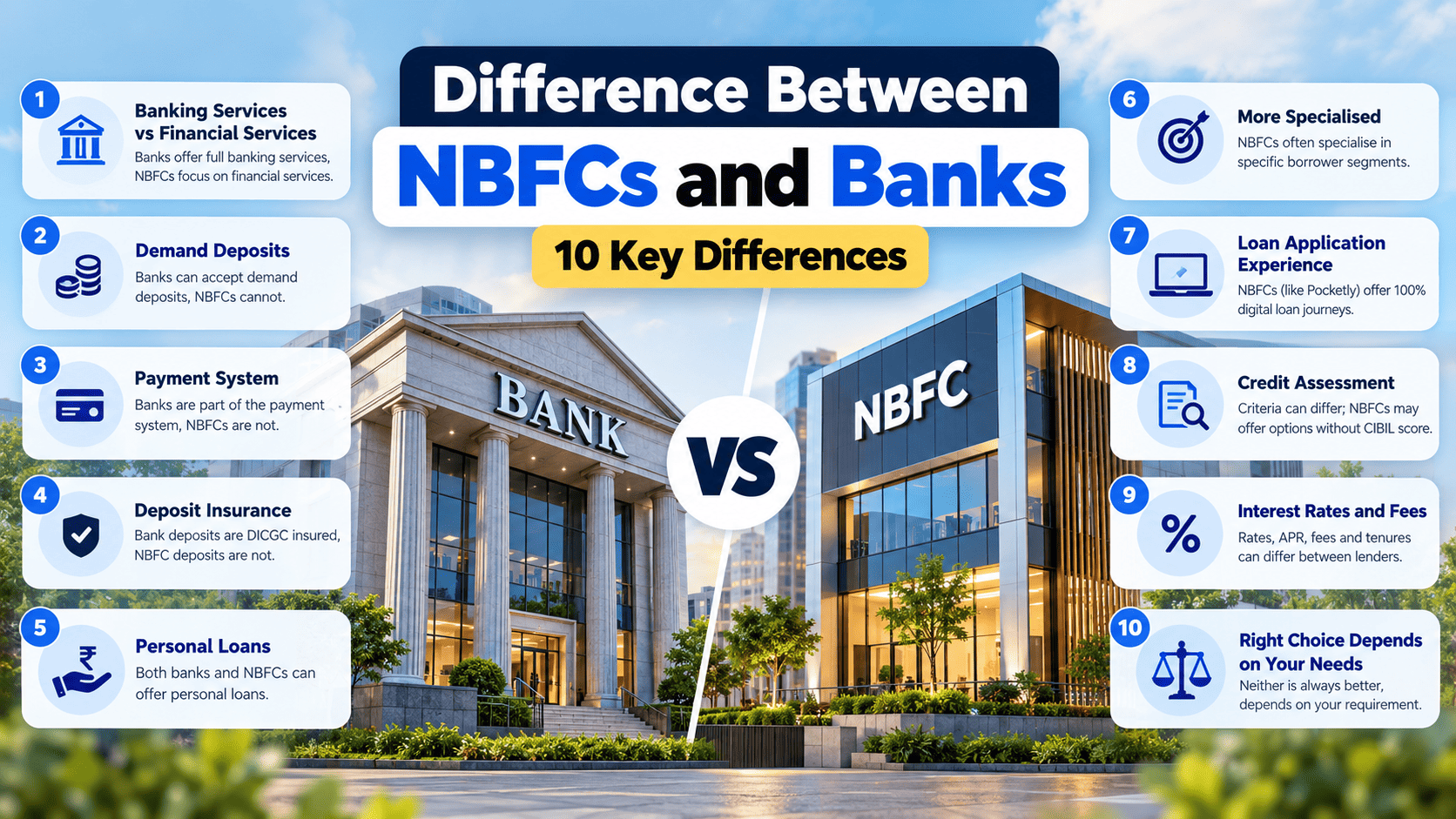
Let's understand banks vs NBFC from a borrower's point of view.
1. Banks Provide Banking Services; NBFCs Focus on Financial Services
This is the biggest distinction.
Banks provide deposit accounts, payments, lending and other banking services.
NBFCs generally focus on specific financial activities, particularly lending, financing and investments depending on their business model.
For a borrower looking only for a personal loan, the two may initially look similar. Their legal and operational structures, however, are different.
2. Banks Can Accept Demand Deposits
Banks can accept demand deposits.
A demand deposit is money that can generally be withdrawn on demand, such as money maintained in a savings or current account.
NBFCs cannot accept demand deposits.
This is one of the clearest answers when someone asks:
“What is the main difference between a bank and NBFC?”
3. Banks Participate in the Payment System
Banks form an important part of India's payment and settlement infrastructure.
NBFCs do not participate in the payment and settlement system in the same way as banks and cannot issue cheques drawn on themselves.
That is why an NBFC should not be viewed simply as another type of bank.
4. Deposit Insurance Is Different
Another major difference between NBFCs and banks concerns deposit insurance.
Eligible deposits maintained with insured banks can receive DICGC insurance protection up to the applicable limit.
DICGC states that deposits mobilised by NBFCs are not covered by its deposit insurance scheme.
For consumers, this is an important distinction when comparing deposit products.
5. Both Banks and NBFCs Can Offer Personal Loans
This is where the comparison becomes relevant to Pocketly users.
You don't necessarily have to borrow only from a traditional bank when you need a personal loan.
NBFCs can also provide credit products to eligible borrowers.
Many NBFCs specialise in particular borrower groups or credit requirements, such as:
-
Small personal loans
-
Short-term financial requirements
-
Consumer purchases
-
Salaried borrowers
-
Self-employed borrowers
-
Young professionals
-
Digital-first borrowers
The availability of a loan still depends on the lender's eligibility requirements and underwriting process.
6. NBFCs Can Be More Specialised
A traditional bank may serve millions of customers across hundreds of financial products.
An NBFC can build its business around a narrower requirement.
This specialisation has become particularly relevant with digital lending.
For example, Pocketly focuses on small personal loans for eligible young borrowers who may need funds for situations such as:
-
Medical expenses
-
Household expenses
-
Upskilling
-
Electronic gadgets
-
Travel
-
Unexpected bills
-
Short-term cash-flow gaps
Pocketly's current product disclosures show loan amounts from ₹1,000 to ₹50,000.
7. Loan Application Experiences Can Differ
Imagine your salary arrives next Monday.
It is Wednesday and your laptop suddenly stops working. You need it for your job, but the repair costs ₹8,000.
You probably don't want to spend several days visiting branches and filling out paperwork for a small requirement.
Digital lending has changed this experience.
Many banks now provide digital loans too, but digital-first NBFC platforms can be designed specifically around online borrowing.
Pocketly, for example, provides a 100% digital journey and says users can complete the process without bank queues or traditional paperwork.
This does not mean every NBFC is faster than every bank. Processing time always depends on the lender, product, eligibility and verification.
8. Credit Assessment Can Differ Between Lenders
Another common assumption is:
“Banks check CIBIL, but NBFCs don't.”
That is incorrect as a general rule.
Every lender has its own underwriting criteria.
Depending on the product, lenders may evaluate information such as:
-
Income
-
Employment
-
Existing debt
-
Repayment history
-
Credit bureau information
-
KYC
-
Bank information
-
Internal risk assessment
-
Other applicable eligibility factors
Pocketly states that its product does not require a CIBIL score to apply, making it relevant to eligible borrowers who may not have an established credit history.
However, no CIBIL score required does not mean guaranteed loan approval.
Applications remain subject to eligibility and verification.
9. Interest Rates and Fees Can Differ
Never assume:
Bank = always cheaper
NBFC = always expensive
Compare the actual offer.
Two lenders may quote very different:
-
Interest rates
-
Processing fees
-
Loan amounts
-
Repayment periods
-
Foreclosure charges
-
Total repayment amounts
For example, Pocketly currently discloses:
|
Pocketly Loan Detail |
Current Disclosure |
|
Loan amount |
₹1,000–₹50,000 |
|
Repayment period |
61 days–9 months |
|
Interest rate |
2%–3% per month |
|
Processing fee |
0%–7.5% + applicable GST |
|
APR |
30%–121% |
|
Foreclosure charge |
2.5% of principal outstanding |
Borrower Tip
Don't choose a loan because the EMI looks small.
Check the APR and total repayment.
A smaller EMI stretched over a longer period can sometimes result in a larger overall repayment.
10. The Right Choice Depends on Your Requirement
This is the most practical part of the banks vs NBFC comparison.
Neither option automatically wins.
A bank may suit you when:
-
You already have a strong relationship with your bank.
-
You need a larger loan.
-
You qualify for a competitive offer.
-
You are comfortable with the available process and timeline.
An NBFC product may be worth considering when:
-
You need a smaller personal loan.
-
You prefer a digital process.
-
You need a specialised credit product.
-
The eligibility requirements suit your profile.
-
The total borrowing cost is manageable.
The institution matters, but the actual loan terms matter more.
Bank vs NBFC for Personal Loans: Which Should You Choose?
Here's a better way to compare them.
|
Question |
What You Should Check |
|
How much do I need? |
Borrow only the required amount |
|
How fast do I need it? |
Check realistic processing timelines |
|
Can I afford it? |
Calculate repayment against monthly income |
|
Which is cheaper? |
Compare APR and total repayment |
|
Is the lender legitimate? |
Verify the regulated lending entity |
|
Are there extra charges? |
Read processing, late and foreclosure charges |
|
What's the tenure? |
Choose a manageable repayment period |
|
Is it digital? |
Check application, KYC and repayment process |
The Golden Rule
Don't choose between a bank and NBFC based only on the institution's name. Compare the actual loan.
Where Does Pocketly Fit in the Bank vs NBFC Comparison?
Pocketly is particularly relevant when discussing the difference between NBFCs and banks because it shows how modern digital lending works.
Pocketly is a technology platform through which Speel Finance Company Private Ltd., an RBI-registered NBFC, provides personal loans
.Pocketly is designed for Young India, including eligible:
-
Personal Loan for Students with an applicable monthly source of income
-
First-jobbers
-
Personal Loan for Salaried professionals
-
Freelancers
-
Personal Loan for Self-employed individuals
-
Young borrowers
Pocketly currently offers eligible borrowers personal loans of ₹1,000 to ₹50,000 through a digital application process.
Pocketly’s loan requests can receive approval in a maximum of 7 minutes, subject to applicable eligibility and verification.
Pocketly also reports 20M+ users and more than 1.3 crore loans disbursed on its supplied website content.
Why Consider Pocketly for a Short-Term Personal Loan?
Pocketly may be relevant when you:
-
Need a relatively small personal loan.
-
Prefer applying through your phone.
-
Don't want a branch-based process.
-
Don't have an established CIBIL score.
-
Want to check the repayment amount before proceeding.
-
Need funds for a genuine short-term expense.
Pocketly users can select the loan amount and repayment period and see the EMI before applying.
Approval and the final amount offered are subject to eligibility and verification.
Before Taking a Personal Loan, Check These 7 Things
Whether you choose a bank, NBFC or Pocketly, don't tap Apply until you understand these seven points.
1. Check the actual lender
Know which regulated entity is providing the loan.
2. Check the APR
APR provides a more useful view of borrowing cost than looking only at an advertised rate.
3. Read the Key Facts Statement
Don't accept a loan without understanding its important terms.
4. Check how much reaches your bank account
The sanctioned amount and actual amount received can differ when applicable charges are deducted.
5. Check total repayment
Ask yourself:
“If I borrow ₹10,000, exactly how much will I repay?”
6. Check the repayment date
Make sure it matches your expected cash flow.
7. Borrow only what you need
A ₹50,000 limit doesn't mean you should borrow ₹50,000.
If your expense is ₹8,000, borrowing significantly more can create unnecessary repayment pressure.
Common Mistakes Young Borrowers Make
Avoid these mistakes regardless of whether you choose banks vs NBFCs:
-
Applying without checking the actual lender
-
Borrowing more than required
-
Looking only at the EMI
-
Ignoring APR
-
Skipping the KFS
-
Ignoring processing fees
-
Missing repayment dates
-
Taking another loan to repay an existing loan without a proper plan
-
Sharing OTPs with unknown people
-
Downloading loan APKs from unverified websites
-
Believing “instant loan” means guaranteed approval
Responsible borrowing is more important than fast borrowing.
Final Verdict: Bank or NBFC?
Understanding the difference between NBFCs and banks helps you make a better borrowing decision, but don't stop at the definition.
Banks provide broader banking services, including deposit accounts, payments and lending. NBFCs primarily focus on financial activities and many specialise in lending to specific customer segments.
When you need a personal loan, compare the lender, APR, interest rate, processing fee, loan amount, tenure, EMI and total repayment.
For eligible young borrowers looking for a smaller personal loan with a completely digital application journey, Pocketly offers personal loans from ₹1,000 to ₹50,000 through Speel Finance Company Private Ltd., an RBI-registered NBFC.
Check your eligibility, review the applicable loan terms and KFS carefully, and borrow only an amount you can comfortably repay.
Need funds for a genuine short-term expense? Check your eligibility with Pocketly and review your personalised loan offer before deciding.
Disclaimer: Loan approval, amount, pricing and disbursal are subject to applicable eligibility, verification, underwriting and loan terms. Borrow responsibly.
FAQs
1. What is the difference between NBFCs and banks?
The main difference between NBFCs and banks is that banks provide full banking services including demand deposits and payment services, while NBFCs mainly undertake permitted financial activities such as lending and investments.
2. What is the NBFC and banks difference for personal loans?
Both can provide personal loans. The difference lies mainly in their business structure, permitted activities, underwriting, product design and services. Compare individual loan offers rather than assuming one is always better.
3. Which is better, banks vs NBFCs?
Neither is universally better. Compare the APR, eligibility, loan amount, tenure, fees, repayment conditions and service before deciding.
4. Can NBFCs give personal loans?
Yes. Personal lending is an important activity for many NBFCs.
5. Can NBFCs accept savings account deposits?
NBFCs cannot accept demand deposits like banks. Certain specifically authorised NBFCs may accept permitted public deposits subject to applicable RBI rules.
6. Are NBFCs regulated by RBI?
NBFCs falling within the applicable regulatory framework are regulated and supervised by the RBI. Always verify the actual regulated lender behind a digital lending platform.
7. Is an NBFC the same as a loan app?
No. A loan app can be a technology platform through which a regulated lender provides credit. Always identify the actual lender.
8. Is Pocketly a bank?
No. Pocketly is a digital lending technology platform. Its responsible-lending disclosure states that personal loans are provided by Speel Finance Company Private Ltd., an RBI-registered NBFC.
9. How much personal loan does Pocketly offer?
Pocketly currently discloses personal loan amounts ranging from ₹1,000 to ₹50,000, subject to eligibility and verification.
10. Does Pocketly require a CIBIL score?
Pocketly states that a CIBIL score is not required to apply. This does not guarantee approval; eligibility and verification still apply.
11. Can salaried people apply for Pocketly?
Eligible salaried individuals can apply. Pocketly's salaried-loan information positions the product for short-term requirements such as unexpected expenses before salary day.
12. Can self-employed people apply for Pocketly?
Pocketly also has a loan offering for eligible self-employed individuals. Its supplied product material specifically discusses expenses that can arise before client payments arrive.