

RBI Account Aggregator Rules 2026: Will Loan Applications Get Easier?
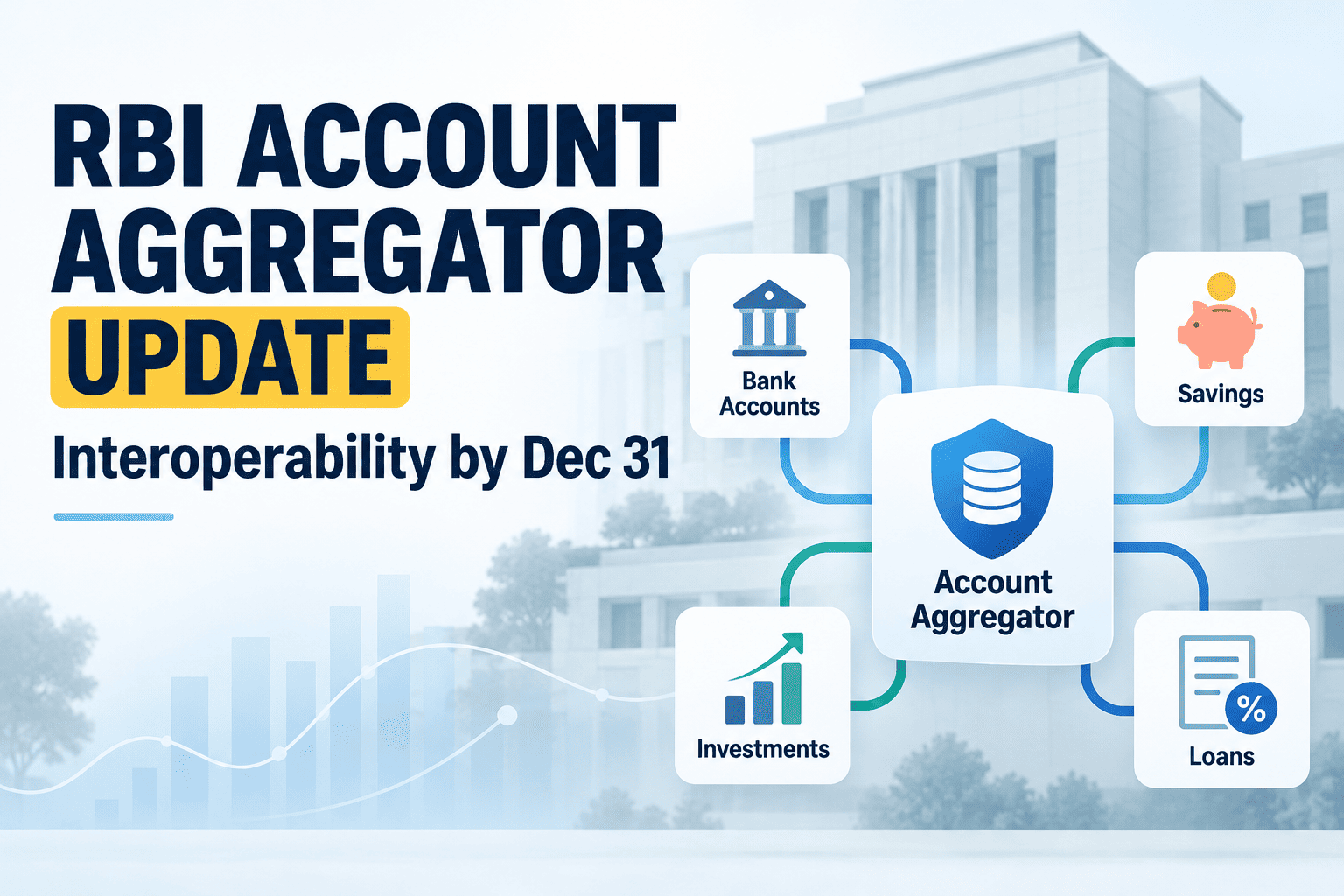
The Reserve Bank of India (RBI) has decided to make NBFC Account Aggregators interoperable, with implementation expected by December 31, 2026.
Once the change is in place, customers should be able to use an Account Aggregator of their choice to access and share eligible financial information held with participating institutions. RBI has also announced a related change that could bring bank deposit details into the Consolidated Account Statement available to demat holders.
For someone applying for a personal loan, the immediate benefit is likely to be a simpler way of sharing financial information. It could reduce some of the back-and-forth involved in verification.
That does not mean easier approval for everyone. Credit checks, income assessment, lender eligibility rules and underwriting will continue.
What has RBI announced?
RBI wants Account Aggregators to work across the network instead of operating through separate connections.
At present, different banks, lenders and other financial institutions may be connected through different Account Aggregators. This can create extra integrations and onboarding steps.
Interoperability is meant to reduce that fragmentation.
When the system is implemented, a customer registered with one participating Account Aggregator should be able to share eligible financial information across participating Financial Information Providers without having to separately onboard with every AA platform.
The important date
December 31, 2026
RBI expects both Account Aggregator interoperability and the related Consolidated Account Statement changes to be implemented by that date.
It is therefore better to say the system will be implemented rather than suggesting every institution already supports full interoperability today.
What is an Account Aggregator?
An Account Aggregator, or AA, is an RBI-regulated NBFC that helps customers share financial information with authorised institutions after giving consent.
It does not lend money.
It does not approve your loan.
It does not decide your credit score.
Its job is to help move financial information securely between participating institutions.
RBI's Account Aggregator directions state that customer information cannot be retrieved, shared or transferred without explicit consent. The directions also say an AA must not ask for or store customer passwords, PINs or private authentication keys.
How the system works
|
Participant |
What it does |
|
Financial Information Provider (FIP) |
Holds eligible customer financial information |
|
Account Aggregator (AA) |
Manages consent and facilitates data sharing |
|
Financial Information User (FIU) |
Receives authorised information for an approved purpose |
|
Customer |
Decides what information can be shared and with whom |
A bank can be a Financial Information Provider. A regulated lender using the information during a loan assessment may operate as a Financial Information User where applicable.
What changes for borrowers?
The biggest change is convenience.
A borrower whose finances are spread across different institutions may find it easier to share information through one Account Aggregator connection.
Here is the difference more clearly:
|
Area |
What could change |
What stays the same |
|
Financial data sharing |
Could become easier across participating institutions |
Customer consent remains necessary |
|
Account Aggregator choice |
Greater flexibility to use an AA of your choice |
Only participating institutions and eligible information are covered |
|
Loan verification |
Some financial information may be collected more efficiently |
Lender verification still applies |
|
Loan approval |
Better information may help assessment |
Approval is not guaranteed |
|
Credit score |
No direct change |
Past repayment history remains |
|
Interest rate |
No direct rate change announced |
Lender determines pricing |
|
EMI |
No automatic change |
Existing loan terms continue |
|
Eligibility |
No new general eligibility rule |
Lender-specific criteria continue |
This distinction matters because the RBI announcement is primarily a data-sharing reform, not a relaxation of lending rules.
Example: A freelancer with money coming into two accounts
Take a simple example.
Arun works as a freelancer.
His monthly income does not arrive as one salary payment. During a particular month, he receives:
-
₹28,000 from one client into Bank A
-
₹18,000 from another client into Bank B
-
₹12,000 from a third client into Bank A
His total inflow for that month is ₹58,000, but it is spread across two accounts.
When Arun applies for a personal loan, a lender may want to understand his cash flow rather than look at only one bank account.
With a more interoperable Account Aggregator network, Arun may be able to authorise eligible information from participating institutions through an AA of his choice.
That can make the information easier to collect and assess.
It still does not mean Arun qualifies automatically.
The lender may also consider his existing debt, repayment history, expenses, credit report, business profile and its own underwriting rules.
Will Account Aggregator interoperability make loan approval faster?
Possibly, but not in every case.
The change can potentially reduce time spent collecting, checking and standardising financial information.
Moneycontrol reported that industry participants expect interoperability to reduce friction for lenders and make access to verified financial data more efficient.
But loan turnaround time can still depend on:
-
Whether the bank or lender participates in the AA ecosystem
-
Whether the required financial information is available
-
Customer consent
-
KYC and other verification
-
Credit checks
-
Lender underwriting
-
Fraud and risk controls
So a better way to describe the change is:
The application process could become smoother. The approval decision remains with the lender.
Could this help self-employed borrowers?
It could be particularly useful where someone's financial position cannot be understood from one salary credit.
That may include:
-
freelancers
-
gig workers
-
small-business owners
-
MSMEs
-
people using several bank accounts
For these applicants, actual cash-flow information can provide additional context to a lender.
Moneycontrol reported that industry participants see potential for Account Aggregator data to improve credit assessment for smaller businesses because lenders can examine authorised cash-flow information rather than relying only on traditional documents or bureau information.
That is an industry expectation. RBI has not said self-employed borrowers will automatically receive more loans.
Will Account Aggregators replace CIBIL?
No.
A credit report and Account Aggregator data answer different questions.
|
Account Aggregator data |
Credit-bureau data |
|
Can show eligible financial information and cash flow |
Shows borrowing and repayment history |
|
Shared only with customer consent |
Maintained as part of the credit-reporting system |
|
Does not create your credit score |
May be used to calculate a credit score |
|
Can help understand income or balances |
Helps show how previous credit was managed |
|
Does not erase defaults |
Missed repayments can remain in credit history |
A lender may use both types of information.
For example, someone could have regular monthly income but also have a history of missed loan repayments. The two pieces of information tell different parts of the story.
Can an Account Aggregator see my bank account without permission?
No.
Explicit customer consent remains a core requirement.
RBI's existing Master Directions say financial information cannot be retrieved, shared or transferred by an Account Aggregator without the customer's explicit consent.
The consent framework can specify information such as the nature of the data requested, why it is needed, who will receive it and the duration of consent.
RBI also says an Account Aggregator must not request or store credentials such as:
-
passwords
-
PINs
-
private keys
Financial information received from Financial Information Providers also should not reside with the Account Aggregator.
What happens to Consolidated Account Statements?
RBI announced another change alongside Account Aggregator interoperability.
SEBI-regulated depositories will be facilitated to include bank deposit account information in Consolidated Account Statements through NBFC Account Aggregators.
This could allow a demat holder to view information relating to securities holdings and bank deposits together instead of checking separate statements.
The measure is also expected by December 31, 2026.
How big is India's Account Aggregator network?
The ecosystem is already large.
According to Department of Financial Services data cited by Moneycontrol, as of March 31, 2026:
|
Metric |
Reported figure |
|
Financial accounts enabled for AA data sharing |
More than 2.88 billion |
|
Accounts linked by users |
Around 284.6 million |
As the number of accounts and participating institutions increases, interoperability becomes more useful because customers and institutions do not have to work through isolated AA connections.
What does this mean for NBFCs and digital lenders?
The benefit on the lender side is mainly operational.
A more connected AA system could reduce the need for separate connections with multiple Account Aggregators.
That may help lenders with:
-
collecting authorised financial information
-
standardising incoming data
-
cash-flow assessment
-
customer onboarding
-
verification
-
underwriting workflows
It could also reduce dependence on manually uploaded statements in situations where the required data is available through the AA ecosystem.
None of this removes the lender's responsibility to assess the borrower properly.
Does this change personal loan interest rates or EMIs?
No direct change has been announced.
Account Aggregator interoperability does not set personal loan interest rates.
It also does not change an existing EMI.
Personal loan pricing can depend on the lender, borrower profile, credit risk, funding costs, amount, tenure and product terms.
So there is no basis for saying:
“RBI's new Account Aggregator rule will reduce personal loan rates.”
That is not what RBI announced
What should you compare before taking a personal loan?
Even if technology makes the application process quicker, the loan still needs to make financial sense.
Before accepting an offer, check:
-
Interest rate
-
Monthly EMI
-
Loan tenure
-
Processing fee
-
Total repayment amount
-
Late-payment charges
-
Prepayment or foreclosure terms
-
Name of the regulated lender
-
Key Fact Statement, where applicable
-
Repayment schedule and other loan conditions
A small example
Two ₹50,000 personal loans can have the same monthly EMI but different total costs.
A longer tenure may reduce the amount paid every month, while increasing the amount paid over the entire loan period.
That is why borrowers should compare total repayment, not only the EMI.
What does this mean for Pocketly users?
For Pocketly users, the new Account Aggregator system should be viewed as an improvement to India's financial-data infrastructure.
It is not a shortcut around normal credit assessment.
When considering a personal loan through Pocketly, review the applicable lender, interest rate, EMI, tenure, processing charges, total repayment and Key Fact Statement before accepting the loan.
You can also use Pocketly's personal loan EMI calculator to compare how changes in loan amount, tenure and applicable rate affect monthly repayment.
Approval, available loan amount, pricing and disbursal remain subject to the applicable lender's eligibility, verification and underwriting requirements.
Key points to remember
-
RBI announced Account Aggregator interoperability on October 7, 2026.
-
Implementation is expected by December 31, 2026.
-
Customers should get more flexibility in choosing an Account Aggregator.
-
Customer consent remains compulsory.
-
The change can make financial-data sharing less fragmented.
-
It could help lenders collect and assess authorised information more efficiently.
-
It does not guarantee personal loan approval.
-
It does not increase a credit score automatically.
-
It does not directly reduce personal loan interest rates.
-
It does not change an existing EMI.
FAQs
What are RBI's new Account Aggregator rules in 2026?
RBI has decided to introduce interoperability among NBFC Account Aggregators. Once implemented, customers should be able to access and share eligible financial information across participating Financial Information Providers through an Account Aggregator of their choice. The measure is expected to be implemented by December 31, 2026.
Will Account Aggregators make personal loans easier to get?
They may make financial-data sharing and verification more convenient, but they do not guarantee approval. The lender will still assess eligibility, income, repayment capacity, credit history and other underwriting factors.
Does an Account Aggregator approve loans?
No. An Account Aggregator manages customer consent and facilitates secure sharing of eligible financial information. The bank, NBFC or other regulated lender makes the credit decision.
Can an Account Aggregator access my bank details without consent?
No. RBI requires explicit customer consent before financial information is retrieved or shared through an Account Aggregator.
Will Account Aggregator interoperability increase my CIBIL score?
No. It does not directly change a credit score or remove previous repayment history. Account Aggregator data and credit-bureau data perform different functions.
Will my personal loan EMI change because of the new AA rules?
No. The interoperability announcement does not change existing loan repayment terms. Your EMI continues to depend on your loan amount, interest rate, tenure and applicable agreement.
When will the new Account Aggregator system start?
RBI expects the interoperability and related Consolidated Account Statement measures to be implemented by December 31, 2026.
Sources
Reserve Bank of India: Account Aggregator Master Directions — consent, data handling and security requirements. System Health
Akashvani News: RBI's October 7 announcement confirming interoperability among NBFC Account Aggregators. Akashvani News
Moneycontrol: RBI Account Aggregator interoperability, December 2026 implementation and ecosystem data. Moneycontrol
Moneycontrol: RBI's change allowing bank deposit information to be added to Consolidated Account Statements. Moneycontrol