

NBFC Small Loans in India Take 47% Share of Loans Under ₹2 Lakh in India
Small loans are becoming a major part of India's credit market, and NBFCs are handling a large share of them.
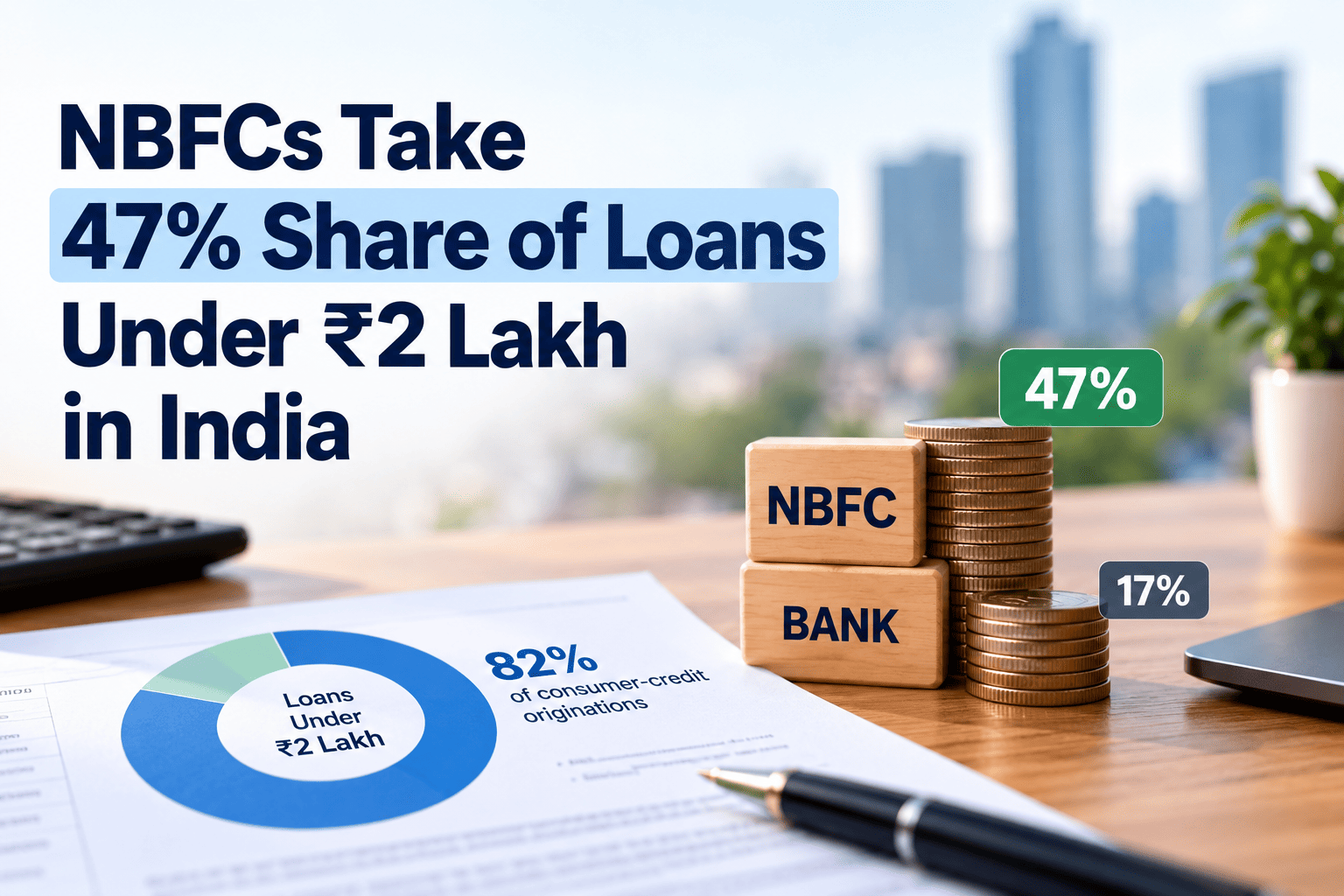
Non-Banking Financial Companies (NBFCs) accounted for 47% of loan originations up to ₹2 lakh by volume as of June 2026, according to a new report from TransUnion CIBIL and the Finance Industry Development Council (FIDC).
Banks accounted for 17% of originations in the same loan-size segment.
There is another number worth looking at. Loans up to ₹2 lakh now make up 82% of consumer-credit originations by volume in India. That gives a clearer picture of how common small-ticket borrowing has become.
The findings were published on October 5, 2026, as part of the report Bharat Nirman: NBFC Forming the Foundation of Credit Dispersion.
What happened?
NBFCs now account for 47% of loan originations up to ₹2 lakh by volume in India.
The data is based on the market position as of June 2026. Banks account for 17% of originations in the same segment.
This is a market trend, rather than a new RBI rule. Nothing in the report changes existing EMIs, loan interest rates or repayment terms.
Small loans now make up 82% of consumer-credit originations
The ₹2 lakh figure deserves some context.
According to TransUnion CIBIL, loans of up to ₹2 lakh account for 82% of consumer-credit origination volumes.
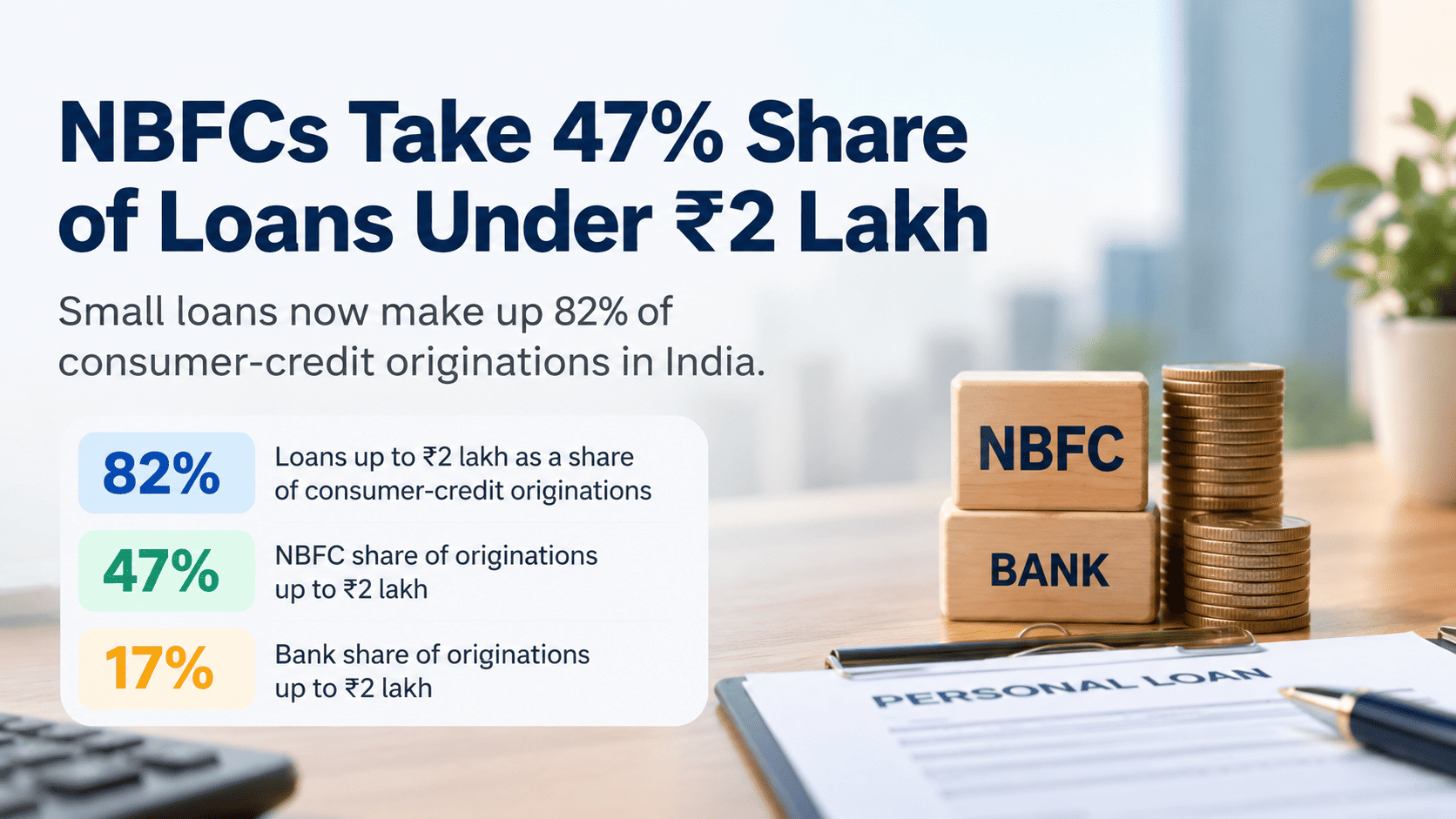
Within this segment:
|
Lending data |
Share |
|
Loans up to ₹2 lakh as a share of consumer-credit originations |
82% |
|
NBFC share of originations up to ₹2 lakh |
47% |
|
Bank share of originations up to ₹2 lakh |
17% |
|
NBFC share of total retail originations by volume |
43% |
|
NBFC share of total retail originations by value |
30% |
There is an important distinction here.
The 47% figure is based on the number of loan originations. It does not mean NBFCs own 47% of the total value of loans below ₹2 lakh.
That difference also helps explain why NBFCs have a 43% share of overall retail originations by volume but a lower 30% share by value.
They are doing a large number of relatively smaller loans.
Why are borrowers choosing NBFCs for smaller loans?
There is no single reason
But NBFCs have become an important route to formal credit for people who may be looking for smaller loan amounts. Their presence also extends well outside large cities.
TransUnion CIBIL says semi-urban and rural markets account for more than 58% of NBFC loans by volume.
The borrower mix has changed too.
In June 2016, people from semi-urban and rural areas accounted for 31% of the NBFC credit-active consumer base. By June 2026, that figure had increased to 59%.
Younger borrowers are also a sizeable part of the market. Consumers below 35 years of age represented 47% of NBFC credit-active consumers in June 2026.
For someone borrowing ₹20,000, ₹50,000 or ₹1 lakh, access to a suitable small-ticket product can be more relevant than having access to a much larger loan.
Still, easier access should not be confused with guaranteed approval. Every lender has its own eligibility checks and underwriting process.
NBFCs are also bringing new borrowers into formal credit
NBFCs are playing another role: introducing people to formal borrowing.
As of June 2026, they accounted for 47% of New-to-Credit consumer originations.
A New-to-Credit borrower is someone entering the formal credit system without an established borrowing history on the credit bureau.
The report also found that 36% of credit-eligible consumers had accessed credit through an NBFC, while 46% of credit-active consumers held an NBFC loan.
Interestingly, NBFC customers are no longer dominated by first-time borrowers.
The share of first-time borrowers in NBFC originations fell from 28% in June 2016 to 16% in June 2026.
That suggests existing borrowers are increasingly returning to NBFCs or using them for additional credit needs.
What about bad loans?
Small loans often raise another question: are defaults increasing?
The latest NBFC data does not show a deterioration across the overall portfolio covered by the study.
The 90+ days balance-level delinquency rate declined from 2.7% in June 2019 to 1.1% in June 2026.
In simple terms, this measure looks at loan balances that are overdue by more than 90 days.
That does not mean every category of NBFC loan has the same delinquency rate. A ₹20,000 unsecured personal loan, vehicle loan and business loan can have very different risk profiles.
So the 1.1% number should be read as a broad NBFC portfolio indicator from this study, rather than the default rate for every small personal loan.
More borrowers are checking their credit
One change in borrower behaviour is easy to miss.
In June 2018, only 3% of NBFC consumers covered by the study were monitoring their credit. By June 2026, that figure had climbed to 48%.
That is a large jump in eight years.
The report also found a difference in repayment recovery.
Among borrowers who monitored their credit, 52% of previously delinquent accounts returned to regular repayment within 12 months. The comparable figure was 48% among borrowers who were not monitoring their credit.
Checking your CIBIL score will not automatically improve it. But knowing what appears in your credit report can make it easier to spot missed payments, incorrect information or accounts that need attention.
What does the 47% NBFC share mean for borrowers?
For borrowers, the biggest takeaway is fairly simple: NBFCs have become a major source of small-ticket credit in India.
It does not mean loans have suddenly become cheaper.
It does not mean everyone applying for a loan below ₹2 lakh will be approved.
And it does not mean RBI has introduced a special loan scheme for borrowers seeking less than ₹2 lakh.
The report measures what is happening in the lending market.
Your own loan offer can still depend on factors such as your income, existing debt, repayment history, credit profile and the lender's eligibility rules.
The amount offered to one borrower may therefore be very different from what another borrower receives.
Will NBFC personal loan interest rates come down?
There is no interest-rate change announced in this report.
A larger NBFC share in small loans does not automatically reduce the rate paid by borrowers.
If you are comparing an NBFC personal loan, look at the actual cost attached to your offer.
The interest rate is only one part of that cost.
Check the APR, processing fee, applicable taxes, repayment tenure, EMI or repayment amount, late-payment charges and total amount payable.
A loan with a smaller EMI can still cost more if the repayment period is longer.
Taking a ₹50,000 loan? Check the numbers first
Suppose you need ₹50,000.
Don't decide based only on how quickly the money may be available.
Before accepting the loan, check:
-
How much will reach your bank account?
-
What interest rate applies?
-
What is the APR?
-
Is there a processing fee?
-
How much will you repay every month?
-
How long is the repayment period?
-
What is the total repayment amount?
-
What happens if a payment is late?
-
Is there a foreclosure or prepayment charge?
-
Which regulated lender is providing the loan?
The Key Fact Statement (KFS) is particularly useful here because it brings important loan information together before you accept the credit.
Read it rather than relying only on an advertisement or app screen.
Where Pocketly fits in
For borrowers looking for smaller personal loans, Pocketly provides a digital application process.
Pocketly currently lists personal loans from ₹1,000 to ₹50,000, with repayment periods ranging from 61 days to nine months. The final amount and terms depend on the applicable eligibility and assessment.
Pocketly's responsible-lending information identifies Speel Finance Company Private Limited as an RBI-registered NBFC that lends personal loans through the Pocketly technology platform.
The application process is digital, but borrowers should still treat it like any other financial commitment.
Check the interest rate, APR, fees, repayment dates and total amount payable before accepting the loan.
If the EMI does not comfortably fit into your monthly budget, borrowing a smaller amount or waiting may be the better choice.
Small-ticket credit is becoming a bigger part of India's lending story
The headline number is 47%, but the 82% figure may be even more useful for understanding what is happening.
More than eight out of every ten consumer-credit originations by volume are now for amounts up to ₹2 lakh, according to the TransUnion CIBIL-FIDC study.
NBFCs handle 47% of originations within that segment.
Their credit-active consumer base has also grown nearly seven times over the past decade, while their share of total retail loan originations has moved from 33% to 43%.
That puts NBFCs firmly into the everyday borrowing market, particularly for people looking for smaller amounts.
For borrowers, though, the basic rule stays the same: access to credit is only one part of the decision. The cost of that credit and your ability to repay it deserve just as much attention.
Key takeaways
-
NBFCs account for 47% of loan originations up to ₹2 lakh by volume.
-
Banks account for 17% of originations in the same segment.
-
Loans up to ₹2 lakh make up 82% of consumer-credit originations by volume.
-
NBFCs account for 43% of total retail loan originations by volume and 30% by value.
-
The NBFC credit-active consumer base has grown nearly seven times over the past decade.
-
90+ day balance-level delinquency declined from 2.7% in June 2019 to 1.1% in June 2026.
-
The report does not announce a new RBI rule or a change to existing loan interest rates.
Need a small personal loan for an unexpected expense?
You can check your eligibility and available loan options through Pocketly. Before accepting any offer, review the interest rate, APR, applicable fees, repayment tenure and total repayment amount.
Loan availability, approval and final terms are subject to eligibility, verification and the lender's assessment.
FAQs
What is the NBFC share of small loans in India?
NBFCs accounted for 47% of consumer-credit originations up to ₹2 lakh by volume as of June 2026. Banks accounted for 17% in the same segment, according to the TransUnion CIBIL-FIDC report.
Why are NBFCs giving more small-ticket loans?
NBFCs have built a large presence in smaller-ticket lending and outside major urban centres. Semi-urban and rural markets account for more than 58% of NBFC loans by volume. Their digital lending models can also make it possible to serve borrowers across a wider geographic area.
Can I get an NBFC loan under ₹2 lakh?
Many NBFCs offer loans within this range, but availability depends on the individual lender and product. Approval is not automatic. Your income, existing obligations, credit history and other eligibility checks may affect the decision.
Does the 47% figure mean NBFC loans are cheaper than bank loans?
No. The figure measures NBFCs' share of loan originations in the up-to-₹2-lakh segment. It does not compare interest rates. Borrowers should compare APR, processing charges, repayment tenure and total repayment rather than assuming one lender category will always be cheaper.
Has RBI announced a new rule for loans below ₹2 lakh?
No. The latest 47% figure comes from a TransUnion CIBIL and FIDC study of India's credit market. It is not a new Reserve Bank of India loan rule.
Do NBFC loans affect CIBIL scores?
A loan reported to credit bureaus can form part of your credit history. Your repayment behaviour can then affect your credit profile. Paying on time and checking your credit report regularly can help you understand how your borrowing activity is being recorded.
What should I check before taking an NBFC personal loan?
Start with the Key Fact Statement. Check the APR, interest rate, processing charges, repayment amount, tenure, total repayment, late-payment charges and lender details. Borrow only an amount you can reasonably repay.
Sources
-
TransUnion CIBIL: NBFCs Support 50% of New-to-Credit Originations
-
TransUnion CIBIL: Bharat Nirman: NBFC Forming the Foundation of Credit Dispersion
-
The Economic Times: NBFCs Account for Nearly Half of Small Loans While Delinquencies Stay Low
-
Reserve Bank of India: RBI Guidelines on Digital Lending
-
Reserve Bank of India: RBI Financial Awareness Messages