

NBFC Loans in FY27: 5 Changes That Could Affect Borrowers
New Delhi, September 30, 2026: Funding conditions for India's non-banking financial companies could improve during FY27 as additional liquidity in the banking system helps contain incremental borrowing costs, according to a Nuvama report cited by ETBFSI on September 29.
For borrowers, this does not mean NBFC personal loan interest rates will automatically fall. Loan pricing still depends on the lender's funding costs, borrower risk, credit profile, loan product, tenure and other underwriting factors. What has changed is the funding environment surrounding banks and NBFCs, making it worth watching how those conditions feed into retail lending.
What happened?
Nuvama said higher banking-system liquidity associated with FCNR(B) mobilisation could benefit NBFCs by helping keep incremental funding costs under control. The report expects liquidity conditions to support credit growth during FY27, although the eventual impact on individual borrowers and loan pricing will depend on lender-specific decisions.
This is an industry outlook, rather than a new RBI rule requiring NBFCs to reduce personal loan rates.
Why is banking liquidity important for NBFC loans?
NBFCs raise funds from several sources and use that capital to provide credit to customers and businesses. Consequently, changes in the cost and availability of funding can influence lending economics.
ICRA said in June 2026 that RBI measures supporting FCNR deposit mobilisation were expected to increase fund availability in the banking system. It revised its FY27 incremental bank-credit estimate to ₹28.75-30.25 trillion, representing expected year-on-year growth of 13.5%-14.2%.
Nuvama's September assessment takes the borrower-relevant story a step further: additional liquidity could help NBFCs contain their incremental funding costs.
Here are five developments borrowers should watch.
1. NBFC funding costs could get some relief
The most direct development concerns the cost at which NBFCs obtain fresh funding.
According to the Nuvama report, several NBFCs expect additional banking-system liquidity to help keep incremental funding costs in check.
This is relevant because funding cost is one component of lending economics.
However, lower or more stable funding costs do not create an automatic one-for-one reduction in NBFC loan interest rates. Each lender determines its loan pricing according to its funding mix, operating expenses, expected credit losses, borrower risk and other commercial factors.
For someone considering an NBFC personal loan, the practical approach remains the same: compare the applicable annual percentage rate, interest charges, processing fee, repayment amount and other charges instead of assuming system liquidity will result in a cheaper loan.
2. More banking liquidity could support credit availability
The FCNR(B) mobilisation has added liquidity to the banking system.
ETBFSI reported earlier in September that outstanding FCNR(B) mobilisation had reached $127.2 billion, while CareEdge estimated core banking-system liquidity could reach ₹13-14 lakh crore by December.
Separate banking data reported by ETBFSI showed that FCNR(B) inflows had reduced banks' reliance on certificates of deposit. Outstanding CDs declined from ₹6.90 lakh crore to ₹6.36 lakh crore during the fortnight ending August 31, 2026.
For NBFC lending, easier access to funding can support the ability of lenders to extend credit.
That still does not guarantee approval for an individual applicant. Loan eligibility and sanction remain subject to the lender's underwriting process.
3. NBFC personal loan rates may not move immediately
Borrowers searching for NBFC loan interest rates should separate wholesale funding conditions from retail loan pricing.
A reduction or stabilisation in an NBFC's incremental cost of funds can improve its lending economics, but personal-loan rates depend on additional factors.
These can include the borrower's repayment profile, loan amount, tenure, product structure and the lender's own pricing and risk policies.
Nuvama specifically described the benefit as helping keep NBFC incremental funding costs in check. The report did not announce a mandatory reduction in consumer lending rates.
Example
Suppose a borrower is considering a ₹50,000 personal loan.
Even if market conditions reduce a lender's cost of obtaining fresh funds, it does not follow that the borrower's offered rate will decline by the same amount.
The borrower should therefore compare the actual loan offer rather than relying on changes in the repo rate or banking-system liquidity alone.
4. Credit growth could remain an important FY27 theme
Liquidity is also expected to support broader credit growth.
ICRA revised its FY27 incremental credit estimate upward to ₹28.75-30.25 trillion in June, while identifying retail and MSME lending among the important growth drivers.
Nuvama similarly expects improved liquidity to support credit growth during FY27.
For borrowers, stronger system-wide credit growth can mean lenders have more capacity to originate loans. It should not be interpreted as weaker underwriting or automatic eligibility.
A lender can have ample liquidity while still rejecting an application based on its eligibility and risk criteria.
5. Borrowers should watch the RBI policy environment
Interest-rate conditions remain another variable.
As of RBI data published in August 2026, the policy repo rate stood at 5.25%, with the Cash Reserve Ratio at 3.00% and Statutory Liquidity Ratio at 18.00%.
Future monetary-policy decisions could influence funding conditions across banks and NBFCs. The direction and size of any future repo-rate change, however, should not be treated as confirmed until the Reserve Bank of India announces it.
This distinction is particularly relevant because the Nuvama report discusses the potential effect of a possible shallow repo-rate hike cycle. That is an outlook, rather than an announced RBI rate decision.
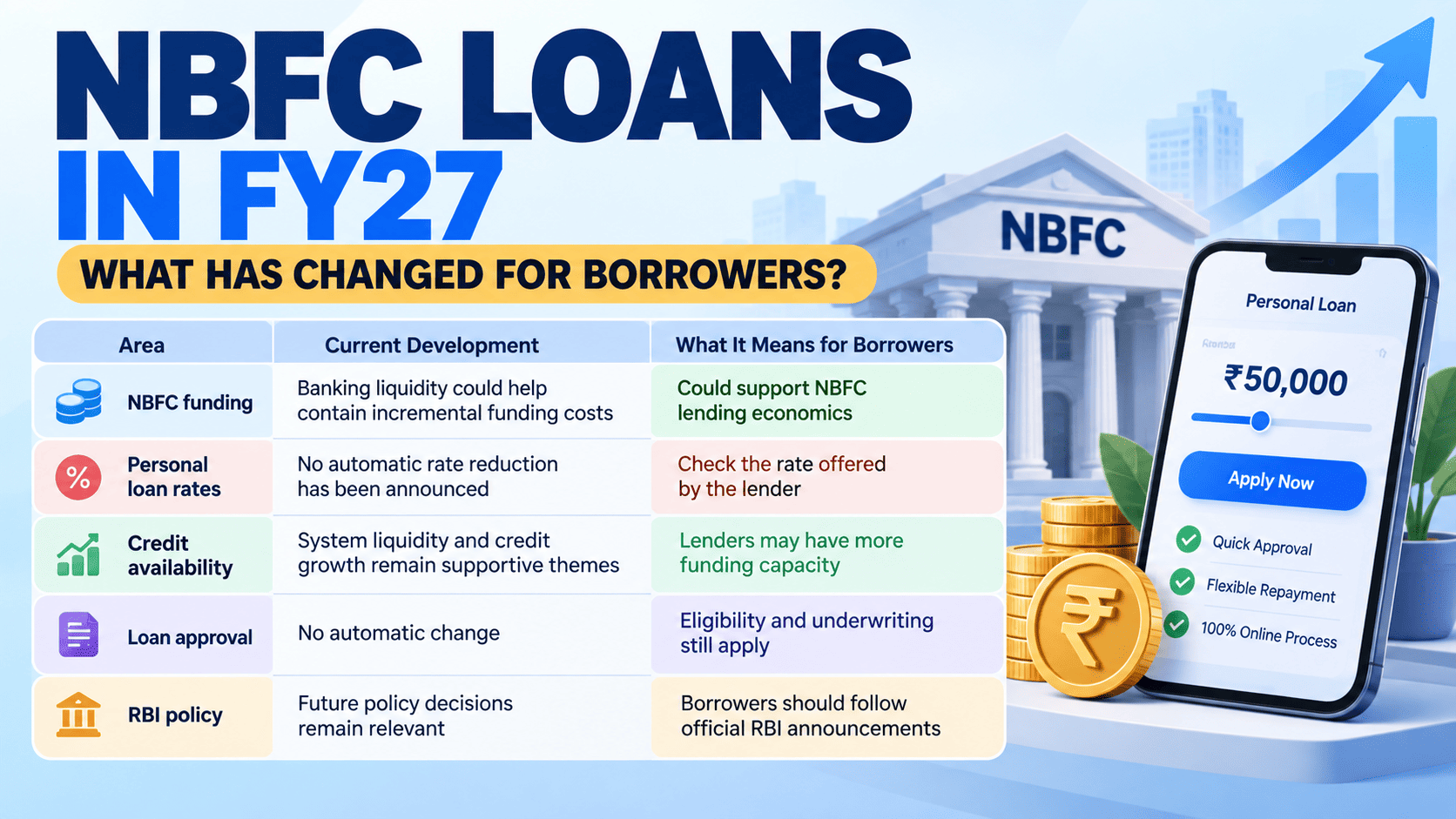
NBFC loans FY27: what has changed for borrowers?
|
Area |
Current Development |
What It Means for Borrowers |
|
NBFC funding |
Banking liquidity could help contain incremental funding costs |
Could support NBFC lending economics |
|
Personal loan rates |
No automatic rate reduction has been announced |
Check the rate offered by the lender |
|
Credit availability |
System liquidity and credit growth remain supportive themes |
Lenders may have more funding capacity |
|
Loan approval |
No automatic change |
Eligibility and underwriting still apply |
|
RBI policy |
Future policy decisions remain relevant |
Borrowers should follow official RBI announcements |
The central takeaway is that the current development concerns the funding environment, rather than a new borrower-level rule.
What this means for borrowers
If you are planning to take an NBFC personal loan during FY27, five areas deserve attention: the applicable interest rate, APR, processing charges, tenure and total repayment obligation.
Better liquidity in the financial system can help lenders manage funding costs, but it does not remove the need to compare actual loan terms.
Borrowers should also check the lender or regulated lending entity behind a digital loan platform and read the Key Fact Statement and applicable terms before accepting a loan.
What borrowers should check before taking a personal loan
Before accepting any personal loan, check:
-
Loan amount sanctioned
-
Applicable interest rate and APR
-
Processing fee and applicable taxes
-
Total amount you will receive
-
EMI or repayment schedule
-
Total repayment amount
-
Loan tenure
-
Late-payment or penal charges
-
Foreclosure or prepayment conditions
-
Key Fact Statement and lender details
Pocketly is the technology platform through which RBI-registered NBFC Speel Finance Company Private Limited provides personal loans, according to Pocketly's responsible-lending disclosure.
Pocketly's current disclosure lists loan amounts of ₹1,000-₹50,000, repayment periods from 61 days to nine months and applicable pricing information. Borrowers should check the terms displayed for their specific offer before proceeding.
Will NBFC personal loans become cheaper in FY27?
There is currently no basis for saying that all NBFC personal loans will become cheaper.
The September 29 Nuvama report indicates that additional liquidity could help NBFCs contain incremental funding costs. Whether that results in lower rates for consumers depends on individual lenders, monetary-policy conditions, risk costs, competition and borrower profiles.
Borrowers should therefore focus on the actual cost disclosed in their loan offer.
Key Takeaways
-
Nuvama says higher banking-system liquidity could help contain incremental NBFC funding costs in FY27.
-
This is an industry outlook, not an RBI order cutting NBFC personal-loan rates.
-
ICRA expects FY27 bank-credit growth to remain healthy and estimated incremental credit expansion of ₹28.75-30.25 trillion.
-
Better funding conditions could support NBFC lending capacity, but approval remains subject to underwriting.
-
Borrowers should compare the actual APR, interest rate, fees, tenure and total repayment amount before taking a loan.
Need a personal loan? Check the full cost before you borrow
With Pocketly, eligible users can apply digitally for personal loans offered through Speel Finance Company Private Limited. Before accepting an offer, review your applicable interest rate, APR, fees, tenure and total repayment amount.
Sources
ETBFSI / ANI, September 29, 2026
"FCNR(B) liquidity may squeeze bank margins, offer relief to NBFCs: Report"
Read the ETBFSI report
ICRA, June 30, 2026
"Enhanced fund inflow from FCNR deposits will boost credit growth"
Read the ICRA research update
Reserve Bank of India
Official RBI material covering the 2026 FCNR(B) measures and related reporting framework.
Reserve Bank of India information
ETBFSI, September 16, 2026
"FCNR(B) inflows reduce banks' reliance on CDs as funding needs ease"
Read the liquidity report
FAQs
1. What are NBFC loans?
NBFC loans are credit products provided by Non-Banking Financial Companies. Depending on the NBFC, these can include personal loans, vehicle loans, business loans and other forms of credit. Loan eligibility, pricing and repayment terms vary by lender and borrower profile.
2. Will NBFC loan interest rates fall in FY27?
There is no confirmed across-the-board reduction in NBFC loan interest rates. Nuvama expects additional banking liquidity to help contain incremental NBFC funding costs, but retail loan pricing will continue to depend on individual lenders and borrower-specific factors.
3. Why does banking liquidity affect NBFC lending?
Many NBFCs depend partly on banks and debt markets for funding. When liquidity is easier and incremental funding costs are contained, it can improve the economics of providing new credit. The eventual impact on a borrower's interest rate is determined by the lender.
4. What is FCNR(B)?
FCNR(B) stands for Foreign Currency Non-Resident (Bank) deposit. It allows eligible non-residents to maintain term deposits with authorised Indian banks in designated foreign currencies. RBI measures around FCNR(B) mobilisation have contributed to the current discussion about banking-system liquidity.
5. Does higher NBFC liquidity guarantee personal loan approval?
No. Funding availability and individual loan approval are different issues. Approval remains dependent on the lender's eligibility rules, underwriting process, borrower information and risk assessment.
6. What should I compare before taking an NBFC personal loan?
Compare the applicable interest rate, APR, processing fee, amount received, repayment amount, tenure, late-payment charges and foreclosure terms. Read the Key Fact Statement and verify the regulated lending entity before accepting an offer.
7. Is Pocketly an NBFC?
Pocketly is technology platform used by Speel Finance Company Private Limited, which Pocketly states is an RBI-registered NBFC.