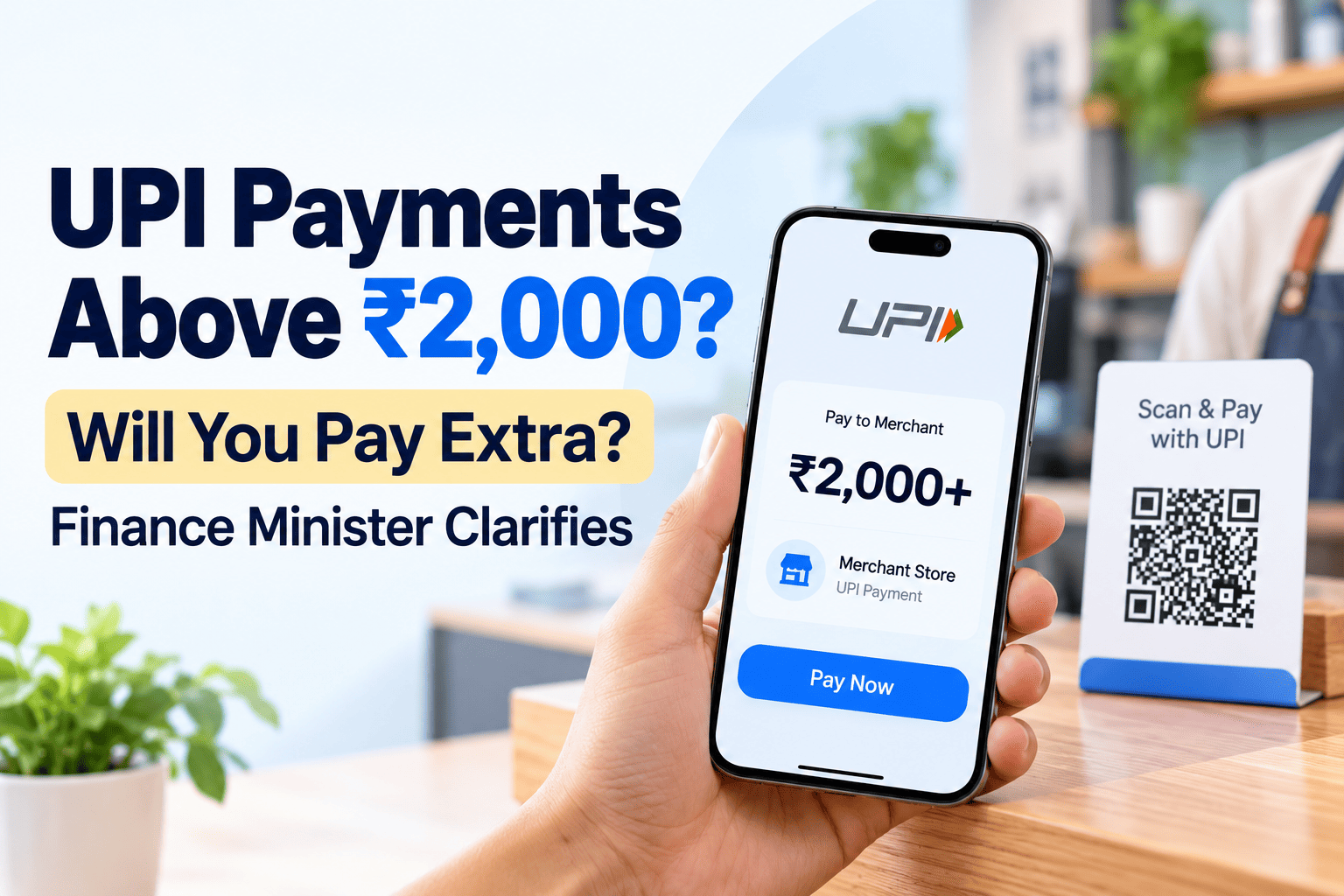


If you make a UPI payment above ₹2,000, you will not be charged an additional transaction fee simply because your payment crosses that amount.
The clarification is significant after questions around the new Merchant Discount Rate (MDR) framework created confusion over whether ordinary UPI users would have to start paying for higher-value transactions.
The Ministry of Finance has said that person-to-person UPI transfers will continue to be free regardless of the amount. For merchant payments, a 0.4% MDR applies to specified person-to-merchant transactions above ₹2,000, but the MDR is a charge within the merchant payment ecosystem rather than a fee imposed on the customer making the UPI payment.
Finance Minister Nirmala Sitharaman also clarified that consumers will not bear the MDR. The charge is associated with services provided within the payments ecosystem and is not a tax, cess or surcharge collected by the government.
What happened?
India introduced a revised UPI MDR framework under which specified person-to-merchant payments above ₹2,000 can attract a 0.4% Merchant Discount Rate. Customers do not pay this MDR. Person-to-person UPI transfers remain free regardless of transaction value, while approximately 96% of merchant transactions are expected to remain unaffected.
The key distinction is between a customer transaction fee and a Merchant Discount Rate
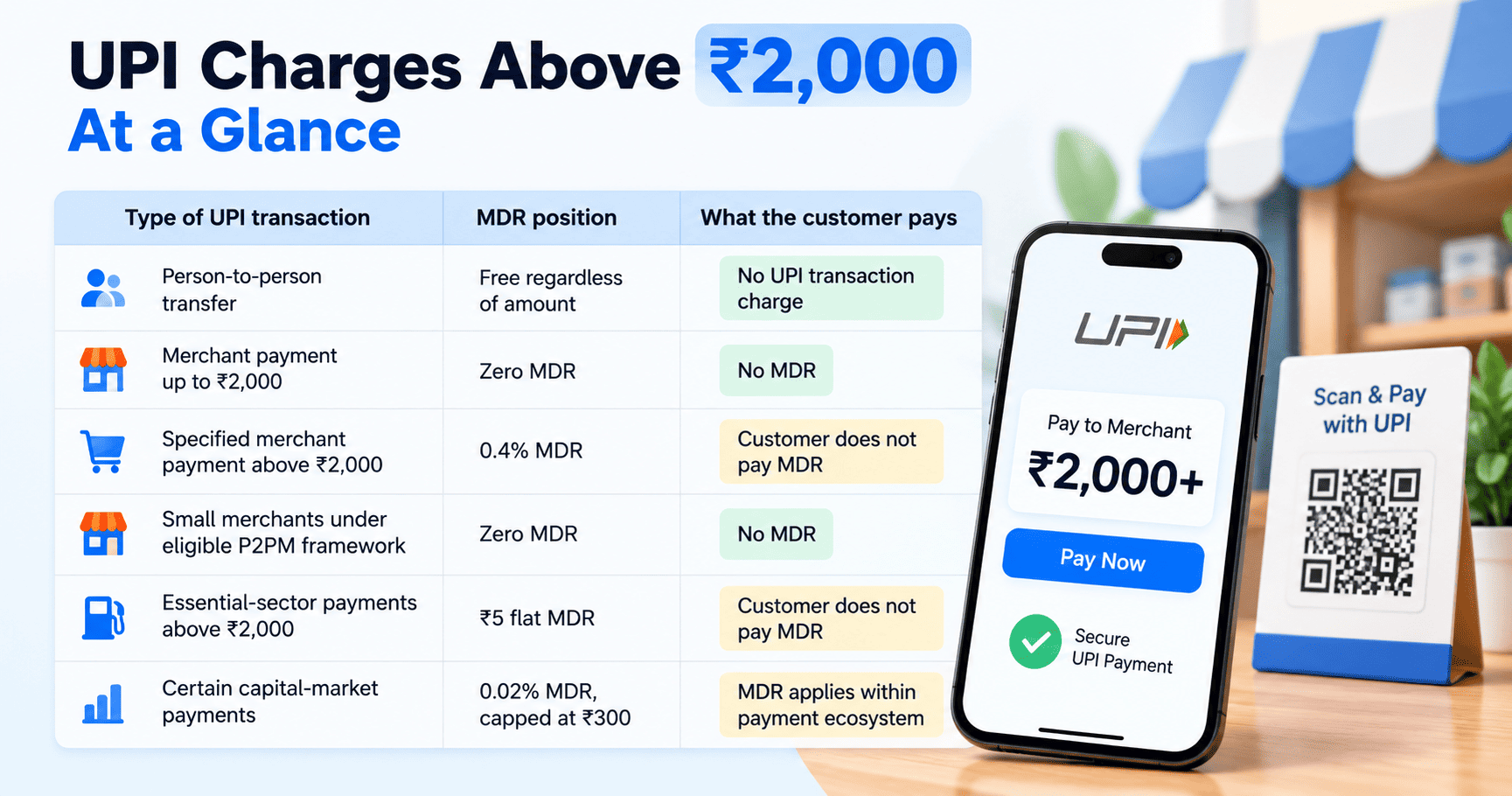
What are the new UPI charges above ₹2,000?
MDR is a fee associated with accepting a digital payment. Under the new framework, specified person-to-merchant UPI transactions above ₹2,000 attract a nominal MDR of 0.4%.
For transactions of ₹75,000 or more, the MDR is capped at ₹300 per transaction. The Ministry of Finance says the MDR is shared among participants in the payments ecosystem, including banks, payment service providers and UPI application providers.
That does not mean a customer paying ₹3,000 at a shop should see an additional 0.4% UPI fee added to the payment.
Banks have been advised to ensure that merchants do not pass the MDR on to customers, while UPI application providers are prohibited from imposing platform fees or hidden charges under the framework.
|
Type of UPI transaction |
MDR position |
What the customer pays |
|
Person-to-person transfer |
Free regardless of amount |
No UPI transaction charge |
|
Merchant payment up to ₹2,000 |
Zero MDR |
No MDR |
|
Specified merchant payment above ₹2,000 |
0.4% MDR |
Customer does not pay MDR |
|
Small merchants under eligible P2PM framework |
Zero MDR |
No MDR |
|
Essential-sector payments above ₹2,000 |
₹5 flat MDR |
Customer does not pay MDR |
|
Certain capital-market payments |
0.02% MDR, capped at ₹300 |
MDR applies within payment ecosystem |
Source: Ministry of Finance/Press Information Bureau.
Will customers pay extra for UPI payments above ₹2,000?
No. Crossing ₹2,000 does not automatically create a transaction charge for the person making the UPI payment.
The Finance Ministry says the MDR applies within the merchant payment ecosystem and is not a customer charge. Sitharaman reiterated that consumers should not bear this cost.
For example, suppose you buy a smartphone accessory costing ₹3,000 and pay the merchant through UPI.
The purchase price remains ₹3,000 from the customer's perspective under the framework. A qualifying merchant transaction may generate MDR within the payments ecosystem, but the MDR should not be added to your UPI payment as a separate customer charge.
Are person-to-person UPI transfers above ₹2,000 charged?
No.
This is one of the most important points in the UPI new rules for 2026.
If you send ₹3,000, ₹10,000 or another permitted amount directly to another individual using UPI, the new merchant MDR framework does not apply simply because the transfer exceeds ₹2,000.
The Ministry of Finance says all person-to-person transactions remain free irrespective of the amount transferred.
Normal transaction limits set by banks or the National Payments Corporation of India (NPCI) can still apply. Those limits are risk-management or operational limits rather than charges triggered by the ₹2,000 threshold.
Which merchants are affected by UPI MDR charges?
The standard 0.4% MDR applies to specified person-to-merchant transactions above ₹2,000.
Small merchants have additional protection. Street vendors and other small businesses receiving up to ₹1 lakh per month through eligible UPI QR payments under the Person-to-Person-Merchant category continue to receive zero-MDR treatment.
The government estimates that only around 4% of merchant transactions will attract MDR, leaving approximately 96% unaffected.
Certain sectors have separate treatment. Payments above ₹2,000 in sectors including railways, telecommunications, insurance, fuel and agricultural inputs attract a flat ₹5 MDR rather than the standard percentage-based charge.
Capital-market transactions involving categories such as mutual funds, securities, stockbrokers and dealers attract a 0.02% MDR, capped at ₹300 per transaction.
Is the new UPI MDR a government tax?
No.
The Ministry of Finance states that MDR is neither a tax nor a charge collected by the government or NPCI. Instead, the money is distributed among participants in the payment ecosystem to support UPI operations and expansion.
Sitharaman also described the charge as distinct from a tax, cess or surcharge.
This distinction is useful because headlines referring broadly to "UPI charges above ₹2,000" can create the impression that the government has imposed a new tax on every UPI user.
That is not how the framework works.
When do the new UPI MDR charges take effect?
Reporting on the implementation framework states that the new MDR structure for specified merchant payments is scheduled to take effect from October 15, 2026.
The Ministry of Finance had earlier issued its framework on September 14, followed by detailed operational information on September 15.
Consumers should therefore distinguish the announcement date from the implementation date.
Why was MDR introduced for some UPI merchant payments?
The stated objective is to support the long-term sustainability of India's UPI infrastructure while keeping individual payments and most merchant transactions free.
The government says MDR revenue from qualifying higher-value merchant payments will support participants such as banks, payment service providers and UPI app providers involved in operating and expanding the payment infrastructure.
The framework also attempts to limit the impact on smaller businesses through the ₹2,000 threshold and zero-MDR treatment for eligible small merchants.
What this means for borrowers
The UPI MDR change does not directly change personal loan interest rates, EMIs, loan eligibility, credit scores, loan approval requirements or processing fees.
Those are separate aspects of lending.
For borrowers using UPI for everyday payments, the practical point is simpler: a UPI payment exceeding ₹2,000 does not automatically mean the borrower will pay an additional UPI transaction fee.
Borrowers should still check the payment amount displayed before authorising any UPI transaction and review the lender's repayment instructions when paying an EMI or other loan-related amount.
What borrowers should check before taking a personal loan
UPI charges and personal-loan charges are different.
Before accepting any personal loan, borrowers should review:
-
applicable interest rate
-
Annual Percentage Rate (APR)
-
processing fee and applicable taxes
-
loan tenure
-
EMI or repayment schedule
-
total repayment amount
-
late-payment charges
-
foreclosure or prepayment conditions
-
Key Fact Statement
-
lender identity
-
loan agreement and terms
Pocketly provides a 100% digital personal-loan journey and displays information about borrowing costs, fees and lending terms on its platform. Its lending partner, Speel Finance Company Private Limited, is an RBI-registered NBFC.
Pocketly currently lists personal-loan amounts from ₹1,000 to ₹50,000, with applicable pricing and repayment details disclosed on its platform. Borrowers should check the terms presented for their individual offer before accepting a loan.
Key takeaways
-
Customers are not charged MDR merely because a UPI payment exceeds ₹2,000.
-
Person-to-person UPI transfers remain free regardless of the amount.
-
A 0.4% MDR applies to specified person-to-merchant payments above ₹2,000.
-
The MDR is borne within the merchant/payment ecosystem rather than being a customer transaction charge.
-
Eligible small merchants continue to receive zero-MDR treatment.
-
Approximately 96% of merchant transactions are expected to remain unaffected.
-
The UPI MDR framework does not directly change personal-loan interest rates, EMIs, eligibility or credit scores.
FAQs
1. Are UPI payments above ₹2,000 chargeable in 2026?
Customers do not have to pay an additional MDR simply because a UPI payment exceeds ₹2,000. A 0.4% MDR applies to specified person-to-merchant transactions above the threshold, but the government says this charge is borne within the merchant payment ecosystem rather than by the customer.
2. Will I pay 0.4% extra if I send ₹5,000 through UPI?
No, if you are making a person-to-person UPI transfer. P2P UPI transactions remain free irrespective of the amount. For qualifying merchant transactions above ₹2,000, the 0.4% figure refers to MDR and is not a customer transaction fee.
3. What is UPI MDR?
Merchant Discount Rate, or MDR, is a charge associated with merchants accepting digital payments. Under the revised framework, qualifying UPI merchant transactions above ₹2,000 can attract MDR that is distributed among participants in the payments ecosystem.
4. Are UPI transactions below ₹2,000 still free?
Yes. Merchant UPI payments up to ₹2,000 remain under zero MDR. Person-to-person transfers remain free regardless of their value.
5. Do small shops have to pay UPI MDR?
Eligible small merchants receiving up to ₹1 lakh per month through UPI QR codes under the P2PM category continue to receive zero-MDR treatment, according to the Ministry of Finance.
6. Is the UPI MDR a government tax?
No. The Ministry of Finance says MDR is not a tax or government charge. Finance Minister Nirmala Sitharaman has also clarified that it is not a tax, cess or surcharge.
7. Does the UPI MDR rule affect personal loan EMIs?
The MDR framework does not directly change a borrower's loan interest rate, EMI, eligibility, credit score or processing fee. Borrowers should continue following the repayment instructions and terms provided by their lender.
Need short-term funds for an unexpected expense?
Check your eligibility on Pocketly and review the applicable loan amount, repayment period, interest, APR, processing charges and total repayment obligation before accepting an offer.
Borrow responsibly. Choose a repayment amount and tenure you can manage.
Sources