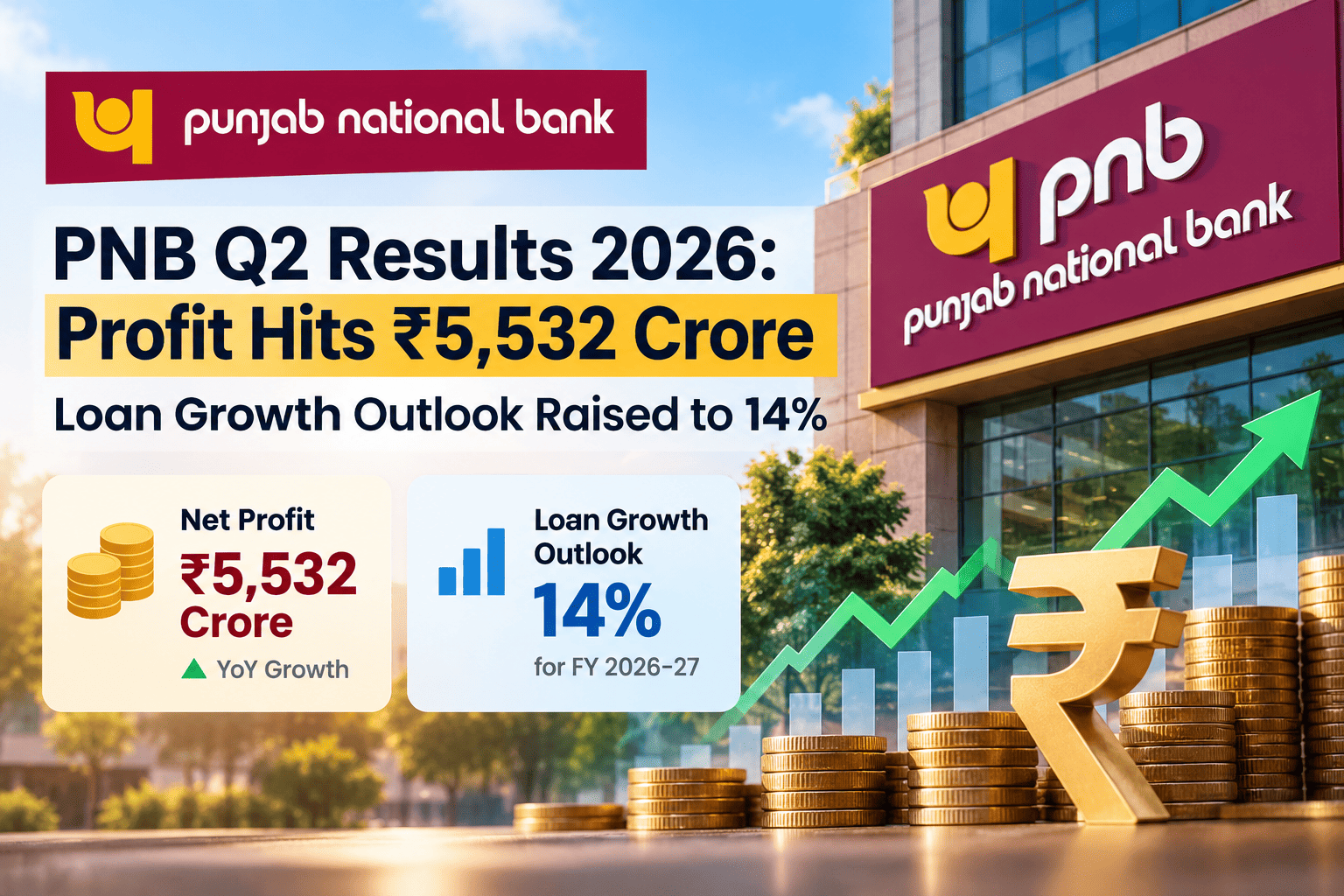


New Delhi, October 17, 2026: Punjab National Bank (PNB) reported a net profit of ₹5,532 crore for the July–September quarter of FY2026–27, up 12.8% from ₹4,904 crore a year earlier. The public sector lender also raised its full-year credit growth forecast to 13–14%, citing stronger demand for corporate and retail loans.
The results were announced on Friday, October 16. Net interest income increased 10.8% to ₹11,601 crore, while the bank's gross non-performing asset (NPA) ratio improved to 2.55%.
For borrowers, the development indicates growing demand for bank credit. It does not mean that personal loans will automatically become cheaper or easier to obtain.
PNB Q2 FY27 results: Key numbers
|
Financial indicator |
Q2 FY27 result |
|
Net profit |
₹5,532 crore |
|
Year-on-year profit growth |
12.8% |
|
Net interest income |
₹11,601 crore |
|
NII growth |
10.8% |
|
Operating profit |
₹7,532 crore |
|
Operating profit growth |
4.2% |
|
Global deposits |
₹17.77 lakh crore |
|
Global advances growth |
14.7% |
|
Gross NPA ratio |
2.55% |
|
Net NPA ratio |
0.25% |
|
Global net interest margin |
2.58% |
|
Revised FY27 credit growth forecast |
13–14% |
Source: Punjab National Bank's Q2 FY27 financial results, investor presentation and October 16–17 reporting.
PNB's total income increased to ₹38,185 crore from ₹36,214 crore in the corresponding quarter last year.
The increase in net interest income shows that the bank earned more from its lending activities after accounting for interest paid on deposits and other borrowings.
Why did PNB raise its loan growth forecast?
PNB increased its FY27 credit growth projection from 12–13% to 13–14% after reporting stronger demand across its lending business.
The bank's global advances grew 14.7% year-on-year. Management also expects retail credit growth of around 17–18% during the festive quarter.
Corporate borrowing and retail lending are contributing to demand, although they serve different customers and have different approval processes.
The revised forecast is a projection for the financial year, not a guarantee that lending will reach the upper end of the range.
Does higher loan growth mean faster personal loan approval?
Not necessarily.
A bank can increase its overall lending while continuing to reject applications that do not meet its credit standards.
For an individual borrower, approval may depend on income, existing EMIs, repayment history, credit profile and the lender's assessment of repayment capacity.
Readers comparing digital borrowing options can also review Pocketly's guide to the fastest way to get a personal loan in India, which explains why application speed and actual loan disbursal are different.
PNB's bad loan ratio falls to 2.55%
One of the significant developments in the September quarter was an improvement in asset quality.
PNB reported a gross NPA ratio of 2.55% and a net NPA ratio of 0.25%.
An NPA is a loan that has stopped performing according to the applicable overdue classification rules. A lower NPA ratio can indicate improvement in the quality of a bank's outstanding loan portfolio.
However, a declining NPA ratio does not mean every borrower is financially stronger or that future defaults have been eliminated.
PNB's provision coverage ratio reached 97.32%, indicating substantial provisioning coverage against its non-performing assets under the bank's reported methodology.
The bank also maintained additional floating provisions as a buffer against potential future credit risks.
Why do NPAs matter to ordinary borrowers?
Banks must balance lending growth with the risk of customers missing repayments.
A lender may consider several factors before offering credit:
-
Existing monthly loan obligations
-
Income and employment stability
-
Credit repayment history
-
Total outstanding debt
-
Affordability of the proposed EMI
Borrowers can learn more about how regulated non-bank lenders assess applications in Pocketly's article on NBFC personal loans in India.
Deposits rise as PNB expands lending
PNB reported global deposits of approximately ₹17.77 lakh crore, up 9.9% year-on-year.
Deposit growth is important because customer deposits are a major funding source for banks.
The bank's credit-deposit ratio stood at around 75.5%, reflecting the proportion of deposits deployed into lending.
PNB indicated that it did not anticipate an immediate increase in deposit rates, citing its liquidity position.
That statement relates to PNB's funding outlook. It should not be interpreted as a prediction that interest rates across all Indian banks will remain unchanged.
Will PNB's Q2 results affect personal loan interest rates?
PNB's quarterly profit does not directly determine the interest rate charged on every personal loan.
Loan pricing depends on the lender, product, borrower risk, funding costs and applicable interest-rate structure.
This question is particularly relevant after the Reserve Bank of India increased the repo rate to 5.50% on October 7, 2026.
Pocketly has separately explained how the October RBI repo rate hike may affect personal loan EMIs.
For existing fixed-rate loans, the agreed interest rate generally remains unchanged for the fixed-rate period. Floating-rate or benchmark-linked loans may respond to changes in the relevant benchmark according to their contractual reset provisions.
New borrowers should compare the actual annual percentage rate, processing fees, repayment tenure and total amount payable rather than assume a profitable bank will offer cheaper credit.
How does PNB's loan growth compare with other public sector banks?
PNB's revised credit outlook comes during a period of reported demand for bank financing.
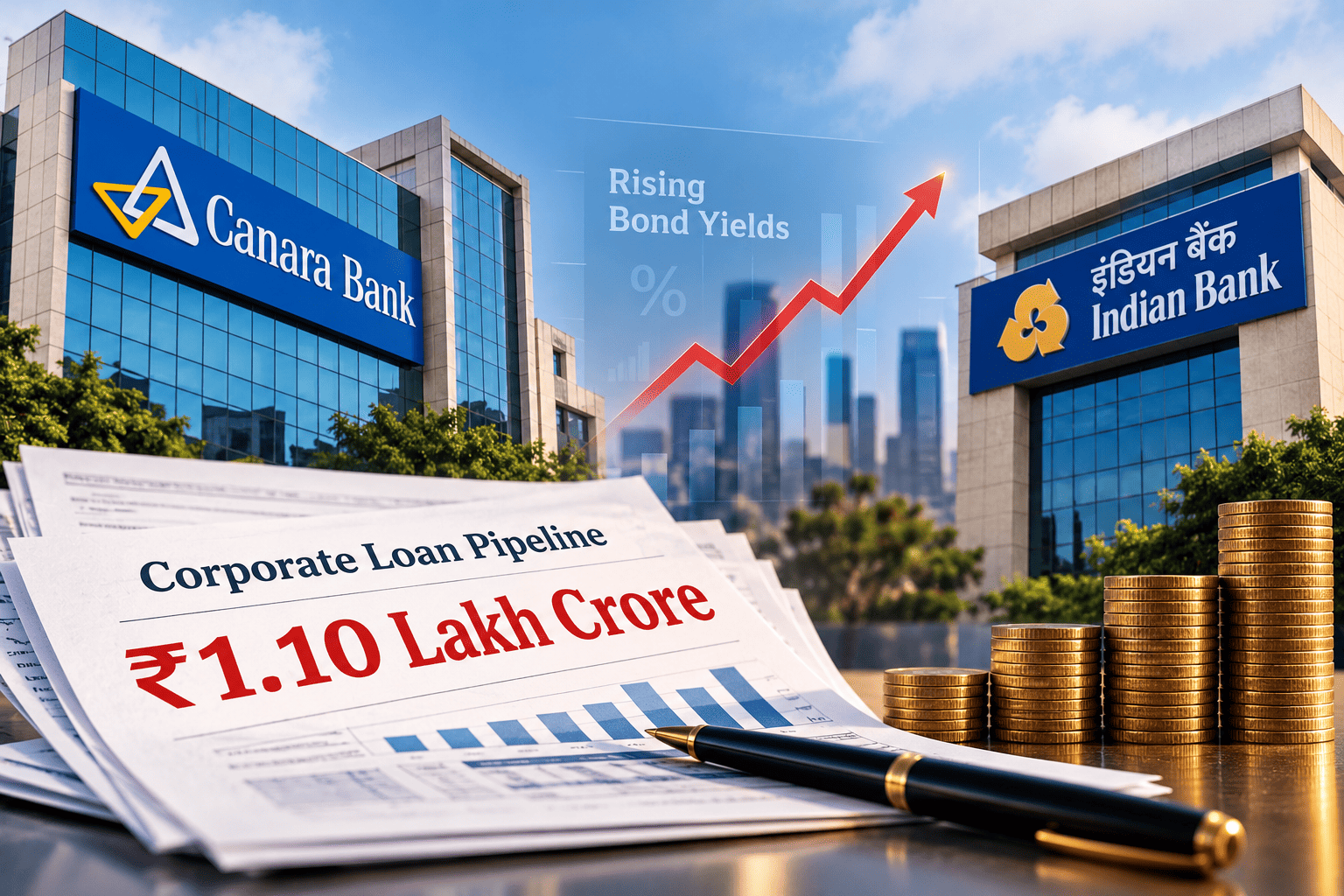
In another development reported on October 16, Canara Bank and Indian Bank disclosed a combined corporate loan pipeline of approximately ₹1.10 lakh crore.
That pipeline includes loans at different stages of approval and processing; it is not the same as money already disbursed.
Read Pocketly's report on Canara Bank and Indian Bank's ₹1.10 lakh crore corporate loan pipeline for the breakdown.
These developments show that lending demand is receiving attention across several public sector banks. They do not establish that every loan category or every lender is growing at the same rate.
What do PNB's results mean for people planning to borrow?
For salaried employees, first-jobbers, freelancers and other eligible applicants, PNB's results provide information about the wider banking environment.
They do not change an individual's eligibility for a personal loan.
Before accepting any offer, borrowers should check the lender's identity, interest rate, annual percentage rate, fees, repayment dates and total cost.
Those considering an NBFC loan can read Pocketly's guide to NBFC personal loans to understand how this lending model differs from borrowing directly from a bank.
Pocketly offers eligible personal loans of ₹1,000–₹50,000 through its lending NBFC, Speel Finance Company Private Limited. Loan approval, pricing and disbursal remain subject to verification and the lender's assessment. Pocketly's responsible lending policy explains its approach to borrower information and loan disclosures.
What happens next for Punjab National Bank?
Investors and banking analysts will monitor whether PNB can sustain its credit growth while keeping bad loans under control.
The main developments to watch are its revised 13–14% annual credit growth target, deposit mobilisation, net interest margins and retail lending performance during the festive quarter.
PNB's next quarterly results will provide a clearer picture of whether the stronger loan demand reported in September continues.
For borrowers, the immediate lesson remains practical: stronger bank earnings do not replace the need to check individual loan terms.
Key takeaways
-
PNB reported ₹5,532 crore in Q2 FY27 net profit, up 12.8% year-on-year.
-
Net interest income rose 10.8% to ₹11,601 crore.
-
The bank raised its FY27 credit growth outlook to 13–14%.
-
Global advances grew 14.7%, while deposits increased 9.9%.
-
Gross NPAs improved to 2.55% and net NPAs to 0.25%.
-
Higher lending growth does not guarantee personal loan approval or lower EMIs.
Frequently asked questions
1. What is PNB's Q2 FY27 net profit?
Punjab National Bank reported a net profit of ₹5,532 crore for the quarter ended September 30, 2026, up 12.8% from ₹4,904 crore a year earlier.
2. When were PNB Q2 results 2026 announced?
PNB announced its July–September 2026 quarterly results on October 16, 2026.
3. What is PNB's loan growth forecast for FY27?
PNB raised its FY27 credit growth forecast to 13–14%, compared with its earlier guidance of 12–13%.
4. How much did PNB's net interest income grow?
PNB's net interest income increased 10.8% year-on-year to ₹11,601 crore in Q2 FY27.
5. What is PNB's gross NPA ratio in September 2026?
PNB reported a gross NPA ratio of 2.55% and a net NPA ratio of 0.25%.
6. Will PNB personal loan interest rates fall after its profit increase?
Not automatically. Personal loan rates depend on lending policies, funding costs, borrower eligibility and the terms of the particular loan.
7. Does PNB's higher credit growth forecast mean loans will be approved more easily?
No. A higher credit growth forecast does not remove credit checks, income assessment or other eligibility requirements.
8. How much did PNB deposits grow in Q2 FY27?
PNB reported global deposits of approximately ₹17.77 lakh crore, representing 9.9% year-on-year growth.
Sources
-
Punjab National Bank — official stock exchange disclosures, October 16–17, 2026. Financial results, investor presentation and related announcements.
-
Financial Express — PNB profit climbs 12.8%, credit growth outlook raised to 13–14%, October 17, 2026.
-
Business Standard / PTI — PNB Q2 results: Net profit rises to ₹5,532 crore, October 16, 2026.
-
Financial Express — PNB Q2 results: NII and asset quality, October 16, 2026.