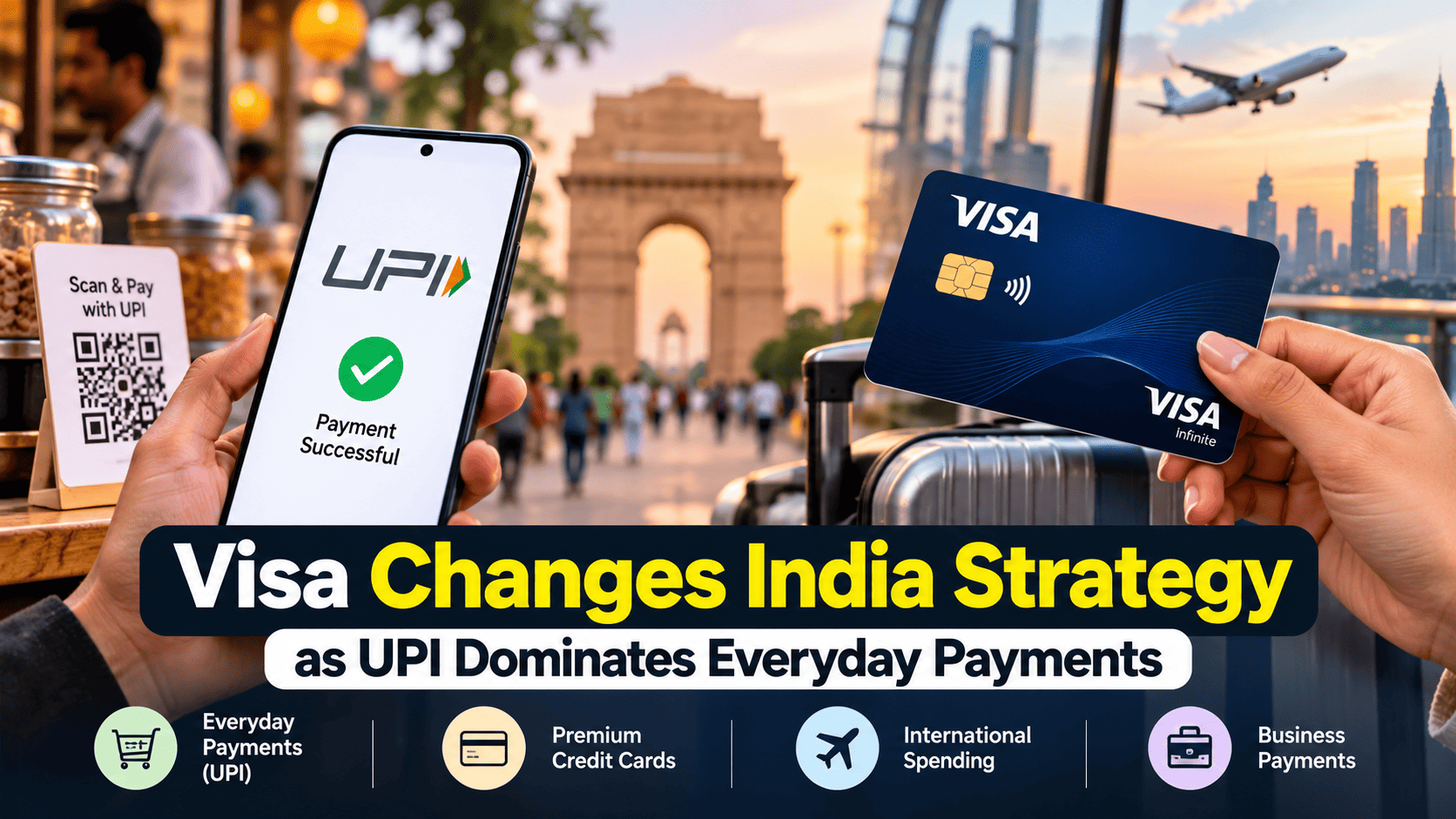


Visa is placing greater emphasis on premium credit cards, international spending and business payment services in India as UPI becomes the preferred option for everyday transactions.
In an interview reported by The Times of India on October 19, Visa's group country manager Suresh Sethi described a payments market where consumers increasingly use UPI for smaller purchases while cards serve different spending needs.
The company is expanding its attention beyond conventional card transaction revenue to business-to-business transfers, data consulting, cybersecurity and AI-based fraud detection.
The development raises a practical question for Indian consumers: if UPI already handles daily payments, what additional value can a Visa card provide?
Why Visa is focusing on premium cardholders in India
A customer buying groceries for ₹300 may find scanning a UPI QR code sufficient. The same customer booking an overseas hotel or paying for an international subscription may have different requirements.
Visa sees an opportunity in those differences.
According to the October 19 report, the company is concentrating on consumers who spend more on travel, lifestyle services and international purchases. It is also developing services for businesses and financial institutions.
Visa's approach is supported by research it published earlier this year.
In April 2026, Visa Consulting & Analytics released a whitepaper examining spending patterns among affluent Indian consumers.
The research, which drew on a Visa-commissioned YouGov study and VisaNet data, reported that:
-
Cross-border spending penetration reached 63% among consumers in its elite tiers.
-
Travel represented 58% of discretionary spending among its Ultra Elite segment.
-
Affluent spending patterns were extending beyond major metros into cities such as Jaipur, Surat and Lucknow.
These findings describe the consumer groups examined in Visa's research. They should not be interpreted as percentages for India's entire population.
The commercial opportunity is straightforward. Consumers who travel internationally or make frequent high-value purchases may place greater importance on global card acceptance, foreign-exchange costs and payment-related services.
Is UPI replacing Visa and other credit card networks?
UPI has become central to everyday digital payments in India, but it does not serve exactly the same function as a credit card.
UPI is a payment system that can move money between bank accounts and also supports certain other payment arrangements. Visa operates a global card payment network.
A standard bank-account UPI payment usually uses money already available in the payer's account. A credit card generally provides access to a revolving credit facility issued by a bank or another authorised issuer, subject to its terms.
This difference affects when and why people use each payment method.
|
Payment need |
UPI |
Visa credit card |
|
Small purchases at local shops |
Widely used through QR payments |
Depends on merchant acceptance |
|
Bank-to-bank transfers |
Core functionality |
Not the standard use of a credit card |
|
International travel purchases |
Depends on supported cross-border arrangements |
Accepted wherever the relevant card network and issuer support the transaction |
|
Short-term credit |
Available only through eligible linked credit arrangements |
Available through the card's credit limit |
|
Rewards and travel privileges |
Depend on the linked payment product |
Depend on the issuer and card programme |
|
Foreign-exchange charges |
Depend on the payment arrangement |
Depend on the issuer, card and transaction |
The distinction is also becoming less rigid. Eligible RuPay credit cards can be linked to UPI for supported merchant payments, showing that credit and UPI can work together.
Visa's reported strategy therefore points to a market in which payment methods increasingly serve different purposes.
Why international spending is important to Visa
An Indian traveller paying for a hotel in Singapore may care about three things: whether the payment is accepted, what exchange rate is applied and how much the bank charges for converting the currency.
A premium card can be useful in that situation, but the Visa logo alone does not establish the final cost.
Cardholders need to examine the issuing bank's foreign-currency markup, applicable taxes, exchange-rate terms and any additional transaction charges.
For example, on an overseas purchase worth ₹50,000 after currency conversion:
|
Illustrative forex markup |
Additional markup before tax |
|
0% |
₹0 |
|
1% |
₹500 |
|
2% |
₹1,000 |
|
3.5% |
₹1,750 |
The example isolates the markup and does not include taxes or other charges. Actual conversion costs depend on the card agreement and transaction processing.
This explains why a card with lower foreign-exchange charges could be more useful to a frequent international traveller than one offering rewards they rarely use.
Sethi's October 19 interview also highlighted Visa's premium offerings, including Infinite Privilege and Infinite Reserve, as the company competes for higher-spending customers.
However, premium branding does not guarantee lower charges. Consumers should compare the specific products offered by issuing banks.
Visa is also expanding beyond card payments
The October 19 report identifies several services outside traditional consumer card transactions.
Business-to-business money movement is one area. Companies making payments to suppliers, service providers or international partners may need solutions involving transaction processing, reconciliation and payment visibility.
Visa is also pursuing consulting and data services for financial institutions.
Another focus is cyber-resilience and AI-enabled threat detection.
These services address a different problem from the one faced by a shopper scanning a QR code. Banks and payment companies must identify suspicious transactions, protect payment systems and manage fraud risks across large volumes of activity.
This creates potential business opportunities even where UPI is already the preferred consumer payment method.
It does not mean Visa is withdrawing from ordinary card payments or that UPI users will be required to switch to cards.
What does Visa's strategy mean for UPI users?
For most people using UPI to pay rent, transfer money to family or make routine purchases, the reported Visa strategy does not require any change.
It is a business decision by a payment network, not a new RBI rule affecting UPI users.
Consumers should also avoid confusing the strategy with recent discussions about merchant payment charges.
Pocketly previously explained the distinction between customer charges and merchant payment costs in its report on UPI payments above ₹2,000 and MDR.
Visa's focus on premium spending does not establish any new fee for bank-account UPI transactions.
For merchants, the choice of payment acceptance methods will continue to depend on customer demand, transaction costs and the services offered by payment providers.
A small neighbourhood shop may rely heavily on UPI QR payments. A business serving international customers may need card acceptance as well.
Could premium credit cards become more attractive?
Premium cards can offer travel-related benefits, rewards and other services, but the value depends on how the customer actually spends.
Consider two people.
One spends mainly on groceries, utilities and local transport. They pay their bills from their bank account and rarely travel overseas.
The other travels abroad several times a year and regularly pays international merchants.
The second person may find more value in a card with suitable overseas acceptance and competitive foreign-exchange charges.
But both should examine the annual fee, eligibility conditions and interest charges before applying.
A premium card is still a credit product. Carrying an unpaid balance can result in finance charges that outweigh rewards or travel benefits.
Readers considering their first card can refer to Pocketly's credit cards for beginners guide for an introduction to card billing and repayment.
What the latest payment developments mean for borrowers
India's digital payment growth has made transferring money easier, but payment convenience should not be confused with access to credit.
A UPI transaction from a bank account is generally a payment using available funds. A credit card allows eligible customers to borrow within a sanctioned limit. A personal loan is a separate credit arrangement with its own interest rate, repayment schedule and eligibility conditions.
That distinction matters when someone needs money for an unexpected expense.
Using a credit card to withdraw cash, for example, may involve fees and interest from the transaction date, depending on the issuer's terms.
A personal loan may have a defined repayment schedule, but borrowers must compare the APR, fees and total repayment amount.
Pocketly's explanation of the difference between a line of credit and a credit card provides further context on borrowing arrangements.
For people considering a personal loan, the Pocketly EMI calculator can help illustrate how the loan amount, interest rate and tenure affect repayment.
Visa's October 19 announcement does not change personal loan interest rates, eligibility or EMI obligations.
What should Indian consumers watch next?
The next developments will be in the actual products and services that Visa and its banking partners introduce.
Consumers can look for changes in foreign-exchange fees, international acceptance, annual card charges and eligibility for premium benefits.
Businesses may see more payment-processing, fraud-monitoring and cross-border money-movement offerings.
For UPI users, the key question remains whether a payment method offers a clear benefit for a particular transaction.
Visa's India strategy suggests that the country's payments market can support both high-volume everyday transfers and specialised card services.
The outcome will depend on whether those services provide enough value to justify their costs.
Frequently asked questions
1. Why is Visa changing its India strategy in 2026?
Visa is increasing its focus on affluent consumers, cross-border spending and higher-value payment services as UPI handles a large share of everyday transactions. The company is also expanding its business payment, consulting and fraud-prevention services.
2. Is UPI replacing Visa credit cards in India?
UPI competes with cards for certain payments, particularly routine domestic purchases. Credit cards continue to serve other needs, including access to credit, international payments and issuer-specific benefits.
3. Will Visa credit cards become more expensive in India?
The October 19 report does not announce an industry-wide increase in card fees or interest rates. Charges depend on individual card products and issuing banks.
4. Can Visa cards be used for international payments?
Eligible Visa cards can be used at supported international merchants, subject to issuer restrictions and transaction settings. Currency conversion and other charges may apply.
5. Does Visa's new strategy affect UPI transaction charges?
No new UPI charge is established by Visa's reported business strategy. UPI fees and merchant payment rules are separate regulatory and payment-system matters.
Sources
1. The Times of India — 19 October 2026
Amid UPI user surge, Visa bets on affluent consumers
Original reporting on Suresh Sethi's comments, Visa's premium consumer focus, international payments and business services.
2. Visa — 22 April 2026
Visa Reveals a New Premium Spending Playbook in Affluent India
Visa's published research on affluent consumer spending, travel and cross-border payments.
3. National Payments Corporation of India
Primary reference for UPI payment-system information and supported features.
This report distinguishes Visa's stated strategy from Pocketly's analysis of its implications. Card fees, credit terms and benefits depend on the issuing financial institution and product.