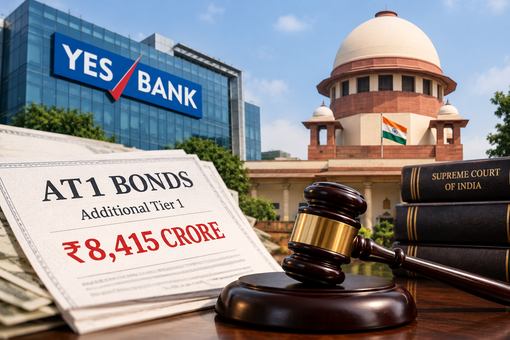


New Delhi, October 16, 2026: Investors who lost money when YES Bank cancelled its Additional Tier-1 (AT1) bonds in 2020 have won a major legal battle. The Supreme Court has upheld a Bombay High Court ruling that set aside the bank's decision to write down bonds worth ₹8,415 crore.
The judgment, delivered on October 15, found that YES Bank's administrator acted beyond his authority when he cancelled the bonds after the government's final reconstruction scheme had taken effect.
The ruling restores the legal rights of affected bondholders. It does not, however, establish a date on which every investor will receive a payment.
YES Bank said it was examining the judgment. In a separate development on October 16, S&P Global Ratings said the ruling was unlikely to affect the bank's credit ratings, although it would weigh on earnings.
YES Bank AT1 Bond Verdict: Key Details
|
Particular |
Details |
|
Supreme Court judgment |
October 15, 2026 |
|
Bonds involved |
₹8,415 crore |
|
Bond type |
Additional Tier-1 (AT1) |
|
Original write-down |
March 14, 2020 |
|
Bombay High Court ruling |
January 20, 2023 |
|
Supreme Court decision |
Upheld the High Court; dismissed appeals |
|
Bank's response |
Reviewing the judgment |
|
Latest ratings update |
S&P expects an earnings impact but no ratings change |
The appeals were filed by YES Bank, the Reserve Bank of India and the Union government after the Bombay High Court ruled in favour of bondholders.
Why Did the Supreme Court Reject the Write-Off?
The court's decision turned on what happened during YES Bank's rescue in March 2020.
The government published the final YES Bank Reconstruction Scheme on March 13, 2020. An earlier draft had included a provision allowing AT1 bonds to be written down. That provision was absent from the final approved scheme.
On March 14, the bank's administrator nevertheless cancelled the bonds.
The Supreme Court held that the administrator could not rely on general powers to take an action that was not authorised under the applicable reconstruction framework.
What the Court Examined
-
The draft scheme: It had included a provision for writing down AT1 bonds.
-
The final scheme: The provision was removed before the scheme took effect.
-
The administrator's decision: The bonds were written down after the final scheme was notified.
-
The applicable rules: The administrator's authority had to be assessed against the reconstruction scheme, RBI regulations and bond documents.
The court concluded that the write-down had not followed the required legal process.
This distinction is important. The judgment does not make all AT1 bond write-downs unlawful. AT1 instruments can absorb losses when the relevant regulatory conditions and contractual procedures are satisfied.
How Did YES Bank's ₹8,415 Crore Bond Dispute Begin?
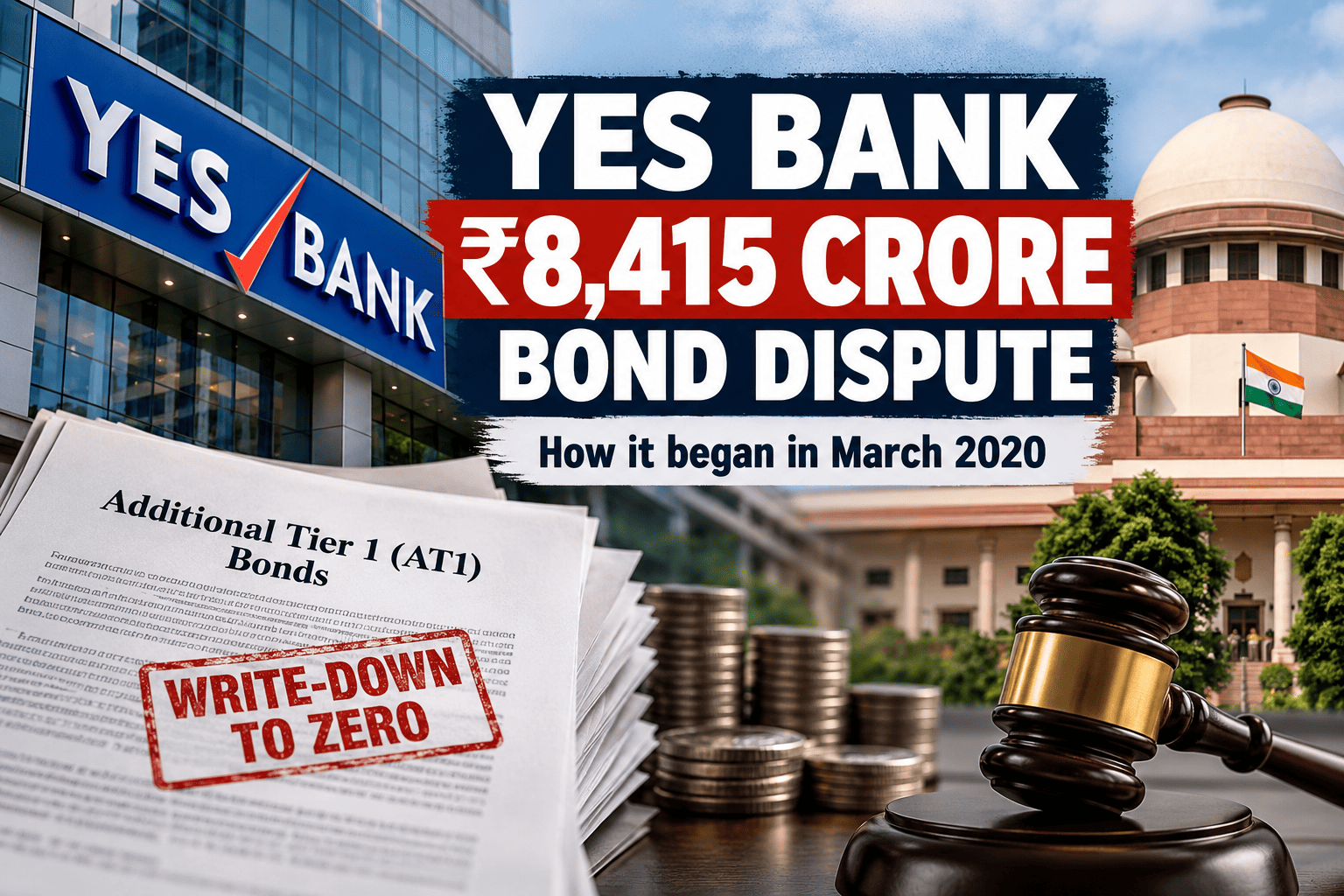
YES Bank issued two major series of AT1 bonds before its financial crisis.
|
Bond issue |
Amount |
|
December 2016 |
₹3,000 crore |
|
October 2017 |
₹5,415 crore |
|
Total |
₹8,415 crore |
By early 2020, YES Bank was facing serious financial difficulties. The RBI intervened, and the government introduced a reconstruction scheme to stabilise the lender.
The bank's AT1 bonds were written down to zero during that process.
Bondholders challenged the decision in court. The Bombay High Court set aside the write-down in January 2023, but the matter continued after YES Bank and the authorities appealed.
The Supreme Court's October 15 ruling has now upheld the High Court's decision.
What Are AT1 Bonds? Why Can Investors Lose Money?
AT1 bonds are issued by banks to strengthen their regulatory capital.
They usually offer higher coupon rates than many conventional debt products, but the additional return comes with significant risk.
Unlike an ordinary fixed deposit, an AT1 bond may have no fixed maturity date. Its terms can allow coupon cancellation, conversion into shares or a reduction in principal when specified conditions are met.
AT1 Bonds vs Bank Fixed Deposits
|
Feature |
AT1 bonds |
Fixed deposits |
|
Main purpose |
Raise bank capital |
Accept customer deposits |
|
Maturity |
Usually perpetual |
Agreed tenure |
|
Returns |
Coupon payments subject to terms |
Interest under deposit terms |
|
Principal protection |
Can be written down under specified conditions |
Eligible deposits have limited insurance protection |
|
Risk level |
High |
Generally lower |
|
Suitable for |
Investors able to understand complex capital risks |
Customers seeking conventional deposit products |
Eligible bank deposits are insured by the Deposit Insurance and Credit Guarantee Corporation (DICGC) up to ₹5 lakh per depositor per bank, including principal and interest, subject to applicable rules.
AT1 bonds do not receive that deposit insurance protection.
Why Did the Court Question the Sale of Bonds to Individual Investors?
The Supreme Court also raised concerns about YES Bank offering these complex instruments to retail investors.
The court noted that the applicable RBI framework restricted the sale of these high-risk securities to institutional investors, yet YES Bank had offered them to individuals.
This was significant because a customer buying a bank bond may not understand that the investment can be permanently written down.
Some affected families had argued that the risks were not properly explained.
The court also criticised regulatory oversight during the period before YES Bank's reconstruction.
Questions Investors Should Ask Before Buying Bank Bonds
-
Can the bank cancel coupon payments?
-
Is the bond perpetual, or does it have a fixed maturity?
-
Can the principal be written down to zero?
-
Is there a reliable way to sell the bond before redemption?
-
What happens if the issuing bank faces financial stress?
-
Does the product carry deposit insurance?
-
Have the offer documents and risk disclosures been provided?
A bond issued or sold by a bank is not automatically as safe as a fixed deposit.
Will YES Bank Bondholders Get Their Money Back?
The Supreme Court has set aside the disputed write-down, but investors should wait for official instructions about implementation and payments.
The judgment restores the rights that were affected by the 2020 cancellation. It also addresses coupon obligations under the relevant bond documents.
That is different from an announcement that every bondholder will receive an immediate cash refund.
What Affected Investors Should Do
-
Keep the original bond purchase records.
-
Check the ISIN and the bond series held.
-
Review depository and demat statements.
-
Follow announcements from YES Bank and the bond trustee.
-
Check whether any payment instructions or claim procedures are officially announced.
-
Avoid responding to unsolicited messages promising fast recovery in exchange for a fee.
Investors should also distinguish between the face value of their bonds, accrued coupon entitlements and any future payment arrangements.
Why Did YES Bank Shares Fall After the Ruling?
YES Bank shares fell as much as 14.5% during trading on October 15 following the Supreme Court judgment.
Investors were concerned about the financial consequences of reversing the write-down.
Restoring the bonds could create a one-time charge in the bank's profit and loss account and reduce its capital adequacy ratio.
However, a decline in share price does not mean the bank has stopped operating or that existing customer accounts have been cancelled.
What Could Be Affected?
|
Area |
What to watch |
|
Bank earnings |
Possible one-time financial charge |
|
Capital adequacy |
Potential reduction in capital ratios |
|
AT1 bondholders |
Implementation of restored rights |
|
Shareholders |
Market reaction and future disclosures |
|
Depositors |
No automatic change to deposit terms |
|
Loan customers |
Existing agreements remain applicable |
On October 16, S&P Global Ratings said it did not expect the judgment to affect YES Bank's credit ratings, despite the anticipated earnings impact.
That assessment provides additional context, but it does not remove the need to monitor the bank's official disclosures.
Will the Judgment Affect Personal Loan Customers?
The ruling concerns AT1 bonds issued by YES Bank. It does not directly change the repayment schedule of an existing personal loan.
A borrower with a fixed-rate personal loan should continue making payments according to the agreement unless the lender formally communicates an applicable change.
Loan interest rates depend on factors such as funding costs, credit risk, the lender's pricing policy and the terms of the loan.
For anyone applying for a new loan, the more useful questions are:
-
What is the annual percentage rate (APR)?
-
How much is the processing fee?
-
What will the total repayment amount be?
-
Is the interest rate fixed or floating?
-
What charges apply if an EMI is late?
-
Can the monthly repayment fit within the household budget?
You can read Pocketly's guide to understanding your credit score before applying for a loan.
Pocketly also has an explainer on NBFC personal loans for people with bad credit, covering eligibility and repayment considerations.
What Happens Next?
YES Bank has said it is reviewing the Supreme Court's decision and will make disclosures as required.
The next developments to follow are:
-
The bank's implementation of the judgment.
-
Official communication to affected bondholders.
-
The accounting treatment of restored AT1 obligations.
-
Changes, if any, to reported capital ratios.
-
Further regulatory or exchange disclosures.
The judgment is a significant outcome for the investors who challenged the write-down. Its wider implications will depend on how the decision is implemented and on the legal facts of other cases.
Conclusion
The Supreme Court's decision ends a major stage of the legal battle over YES Bank's ₹8,415 crore AT1 bond write-down.
The court found that the administrator had acted without the required authority under the final reconstruction scheme. It also raised concerns about the sale of complex, high-risk securities to individual investors.
For bondholders, attention now turns to how the ruling will be implemented. For other bank customers, the judgment does not automatically alter deposits or loan agreements.
The case is also a reminder to understand a financial product's risks before committing money to it, particularly when higher returns come with the possibility of losing the principal.
This article is for news and financial education. It does not constitute investment advice.
Frequently Asked Questions
1. What did the Supreme Court decide in the YES Bank AT1 bond case?
On October 15, 2026, the Supreme Court upheld the Bombay High Court's decision setting aside YES Bank's ₹8,415 crore AT1 bond write-down from March 2020.
2. Why was the YES Bank bond write-off ruled invalid?
The court found that the administrator lacked the authority to write down the bonds after the final reconstruction scheme had taken effect. The provision allowing the write-down had been removed from that scheme.
3. Will YES Bank AT1 bondholders receive their money?
The ruling restores bondholders' legal rights, but the timing and method of implementation require official clarification. Investors should not assume immediate payment.
4. What is the difference between AT1 bonds and fixed deposits?
AT1 bonds are high-risk capital instruments that can absorb bank losses. Fixed deposits have agreed terms and eligible deposit insurance protection, subject to limits.
5. Did the Supreme Court ban AT1 bond write-offs?
No. The ruling concerns the legality of YES Bank's specific 2020 action. AT1 bonds can still be written down when applicable regulatory and contractual conditions are met.
6. Will YES Bank personal loan EMIs increase after the ruling?
The judgment does not automatically increase personal loan EMIs. Borrowers remain subject to their existing loan agreements.
7. How much did YES Bank shares fall after the judgment?
Reuters reported that the shares fell as much as 14.5% during trading on October 15, 2026.
8. What did S&P say about the judgment?
On October 16, S&P Global Ratings said it expected an earnings impact but did not expect the ruling to affect YES Bank's credit ratings.
Sources to include below the article
-
Supreme Court judgment — YES Bank Limited v. Axis Trustee Services Limited (2026 INSC 1132) — Reproduced judgment text, dated October 15, 2026.
-
Reuters — Supreme Court voids YES Bank's AT1 bond write-off — October 15, 2026.
-
Reuters — S&P says YES Bank's ratings unlikely to be affected — October 16, 2026.
-
Moneycontrol — Why the Supreme Court upheld the High Court's decision — October 15, 2026.
-
LiveLaw — Supreme Court questions regulatory oversight and bond sales — October 15, 2026.