

RBI Withdraws ₹1 Trillion From Banking System: What Borrowers Should Know
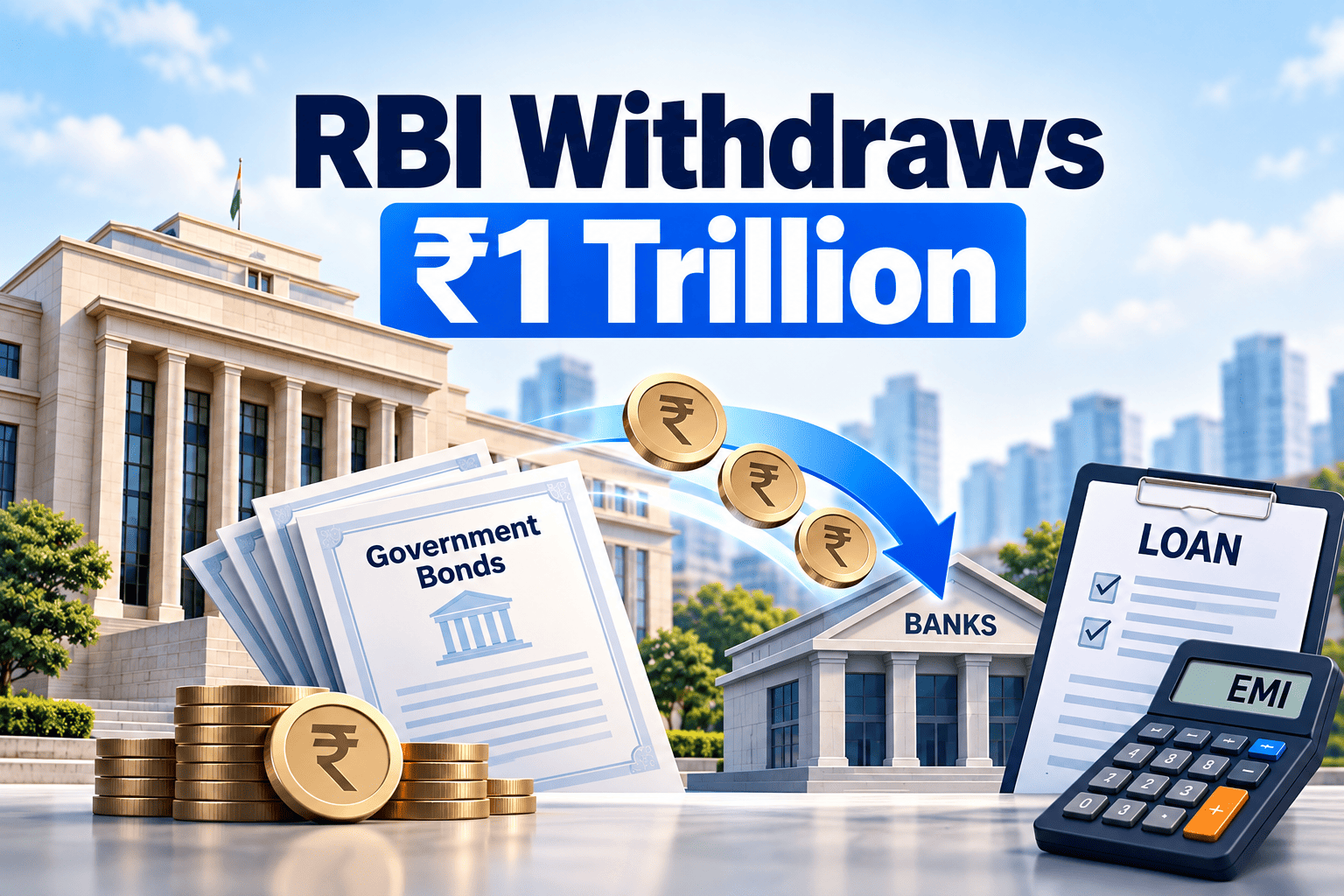
The Reserve Bank of India (RBI) has net sold government bonds worth ₹1 trillion during the current financial year, marking its biggest annual net bond sale in more than a decade.
The move is designed to withdraw excess liquidity from India's banking system after surplus cash had pushed overnight market rates below the RBI's policy rate.
For borrowers, the immediate question is simple: does RBI's ₹1 trillion liquidity withdrawal mean personal loan and other lending rates will increase?
The direct answer is no immediate loan-rate increase has been announced as part of the bond sales. Open market operation (OMO) sales primarily remove surplus liquidity from the banking system. However, tighter liquidity can improve the transmission of monetary policy and therefore becomes relevant to borrowers if the RBI separately changes its policy rate or lenders revise their pricing.
What happened?
The Reserve Bank of India has net sold ₹1 trillion of government bonds in FY2026-27, according to reporting based on RBI data. It is the central bank's largest annual net bond sale in more than a decade.
The bond sales are being used to absorb excess cash from the banking system rather than directly change consumer loan interest rates.
RBI had announced ₹1 lakh crore of OMO sales in three tranches scheduled for September 17, September 21 and September 28, 2026.
Why is RBI withdrawing liquidity?
India's banking system accumulated a substantial liquidity surplus following foreign-currency inflows through a special RBI window.
This additional rupee liquidity pushed overnight money-market rates below the RBI's policy rate. When banking-system liquidity is very high, banks have less need to borrow funds at the central bank's policy rate.
That can weaken the transmission of monetary policy.
Selling government securities through open market operations is one mechanism RBI can use to absorb that excess money.
In simple terms:
RBI sells government bonds → buyers pay for those bonds → money moves out of the banking system → surplus liquidity falls.
This is why an OMO sale is commonly described as a liquidity-absorption operation.
How large is the ₹1 trillion RBI bond sale?
₹1 trillion is equivalent to ₹1 lakh crore.
According to Reuters, RBI's net bond sales reached ₹1 trillion during the current financial year, the highest annual net sale in more than a decade.
RBI data available since FY2015 showed the previous high was ₹900 billion in FY2018.
The latest operation therefore represents an unusually large liquidity-management exercise.
Will loan interest rates increase after RBI's ₹1 trillion withdrawal?
The ₹1 trillion liquidity withdrawal does not automatically increase personal loan or other retail lending rates.
There is an important distinction between an OMO bond sale and a repo-rate increase.
An OMO sale manages the amount of liquidity available in the banking system. The repo rate, meanwhile, is a monetary-policy rate set by the RBI's Monetary Policy Committee.
The RBI's policy repo rate stood at 5.25% following its August 2026 monetary policy review.
A lender's eventual loan pricing can depend on several factors, including its funding costs, applicable benchmark, credit risk, loan type, borrower profile and internal pricing policies.
Therefore, borrowers should not interpret the ₹1 trillion bond sale as an announcement that their personal loan interest rate or EMI has already increased.
Why could the liquidity withdrawal still affect borrowing costs?
The indirect connection comes through monetary-policy transmission.
When banks have large amounts of surplus cash, they may rely less on borrowing at rates linked to RBI's policy framework.
Reuters reported that excess banking-system liquidity can weaken monetary-policy transmission and delay increases in lending rates.
Removing some of this surplus can therefore make changes in monetary policy transmit more effectively through financial markets and the banking system.
That does not establish that every loan rate will rise.
The future direction of borrowing costs will depend more directly on RBI policy decisions, funding conditions and individual lenders' pricing decisions.
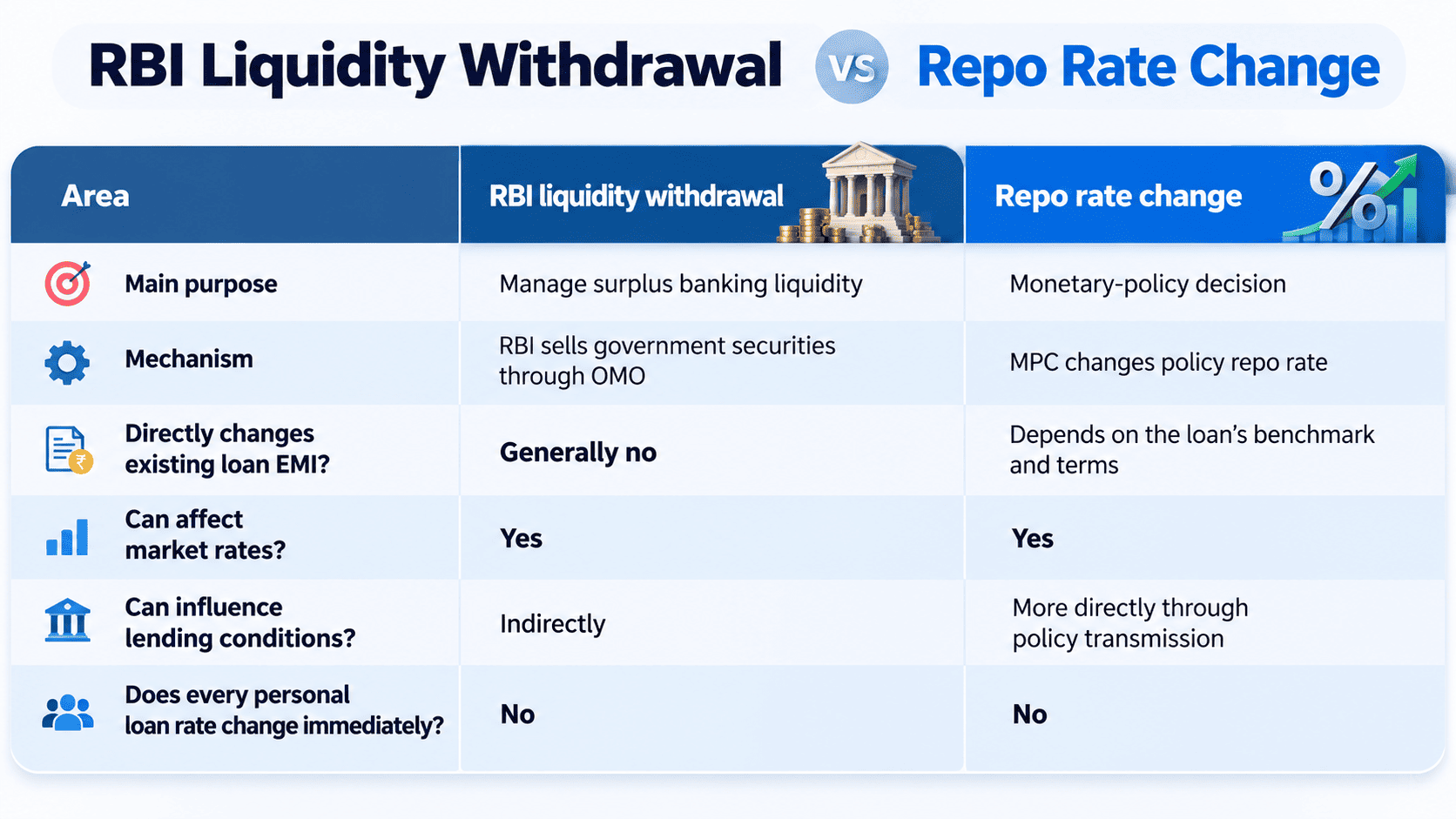
RBI liquidity withdrawal vs repo rate change
|
Area |
RBI liquidity withdrawal |
Repo rate change |
|
Main purpose |
Manage surplus banking liquidity |
Monetary-policy decision |
|
Mechanism |
RBI sells government securities through OMO |
MPC changes policy repo rate |
|
Directly changes existing loan EMI? |
Generally no |
Depends on the loan's benchmark and terms |
|
Can affect market rates? |
Yes |
Yes |
|
Can influence lending conditions? |
Indirectly |
More directly through policy transmission |
|
Does every personal loan rate change immediately? |
No |
No |
The distinction is especially relevant for borrowers following RBI news. A liquidity-management action should not automatically be interpreted as a retail lending-rate announcement.
What this means for borrowers
For someone currently repaying or planning to take a personal loan, there is no announced across-the-board change to personal loan rates solely because RBI has net sold ₹1 trillion of bonds.
Borrowers should instead monitor three things.
First is the RBI repo rate. Changes in monetary policy can influence borrowing conditions across the financial system.
Second is the individual lender's interest-rate policy. Personal loan rates can differ between lenders and borrowers based on their respective pricing and risk assessment.
Third is your loan agreement. Existing borrowers should check whether their loan carries a fixed or floating rate and what benchmark or reset provisions apply.
The OMO operation itself does not change your credit score, documentation requirements, processing fee or loan eligibility.
Does RBI's move affect existing EMIs?
There is no automatic EMI revision simply because RBI conducts an OMO bond sale.
For an existing borrower, whether an EMI or loan tenure can change depends on the structure and terms of the loan.
For example, a fixed-rate personal loan would generally follow the contracted rate subject to its terms. A floating-rate loan can respond differently depending on its benchmark, reset mechanism and lender policies.
Borrowers should therefore rely on communication from their lender rather than assuming that an RBI liquidity operation has changed their EMI.
Could personal loan interest rates change later?
They could, but a future change should not be attributed solely to the ₹1 trillion OMO sale.
Liquidity conditions form one part of the monetary environment. Inflation, RBI policy rates, lenders' cost of funds, credit conditions and borrower-specific risk can also influence lending rates.
The RBI's next monetary-policy decisions are therefore more directly relevant to anyone watching the direction of loan interest rates.
Market expectations about future policy decisions should also be distinguished from an actual RBI announcement. A forecast of a rate increase does not mean the Monetary Policy Committee has already changed the repo rate.
What should borrowers check before taking a personal loan?
A borrower comparing personal loans should look beyond RBI headlines and examine the actual cost and conditions of the loan.
Check:
-
Applicable interest rate
-
Annual Percentage Rate (APR), where provided
-
EMI
-
Loan tenure
-
Processing and other applicable charges
-
Total repayment amount
-
Late-payment or penal charges
-
Eligibility requirements
-
Key Fact Statement, where applicable
-
Lender details
-
Prepayment or foreclosure conditions
-
Complete loan terms and conditions
Pocketly users should review the applicable loan terms and disclosures shown during the application process before accepting an offer. Eligibility, pricing and availability can depend on the applicant and applicable lending criteria.
What happens next?
The ₹1 trillion net bond sale indicates that RBI is actively absorbing excess liquidity from the banking system.
Reuters reported on September 28 that market participants expected further bond sales, but those expectations should be treated as market forecasts rather than confirmed future RBI action.
For borrowers, the key developments to watch are RBI's future monetary-policy decisions and any subsequent changes announced by their respective lenders.
Key takeaway
RBI's ₹1 trillion net bond sale is primarily a liquidity-management operation.
It does not by itself mean that personal loan rates or EMIs have increased.
However, by reducing excess liquidity, RBI can strengthen the transmission of monetary policy through the banking and financial system. Borrowers should therefore watch upcoming RBI policy decisions and lender communications rather than treating the bond sale itself as a loan-rate hike.
Key takeaways
-
RBI has net sold ₹1 trillion (₹1 lakh crore) in bonds this financial year, its largest annual net bond sale in more than a decade.
-
The operation is intended to absorb excess banking-system liquidity; it is not itself a retail loan-rate announcement.
-
RBI's repo rate stood at 5.25% following the August 2026 policy review.
-
Excess liquidity can weaken monetary-policy transmission, which explains why liquidity withdrawal is relevant to future lending conditions.
-
Borrowers should watch RBI policy decisions and their own lender's pricing rather than assuming the ₹1 trillion operation automatically changes their EMI.
FAQs
1. Why did RBI withdraw ₹1 trillion?
RBI's net bond sales are intended to absorb excess liquidity from India's banking system. Excess cash had pushed overnight rates below the policy rate, making liquidity management important for monetary-policy transmission.
2. Will RBI's ₹1 trillion withdrawal increase personal loan rates?
There is no automatic personal-loan rate increase caused by the ₹1 trillion bond sale. OMO sales manage banking liquidity. Actual loan pricing depends on factors including RBI policy, lender funding costs, the type of loan and lender-specific pricing.
3. What is an RBI OMO bond sale?
An open market operation sale occurs when RBI sells government securities to market participants. Payment for those securities removes money from the banking system, helping RBI absorb surplus liquidity.
4. Will existing loan EMIs increase?
The OMO operation does not automatically change an existing EMI. Whether a borrower's interest rate or EMI can change depends on the loan agreement, benchmark, rate structure and lender policies.
5. What was the RBI repo rate before this development?
RBI's official information following the August 2026 policy review showed the policy repo rate at 5.25%.
6. Is ₹1 trillion the same as ₹1 lakh crore?
Yes. ₹1 trillion equals ₹1 lakh crore.
7. Should borrowers wait before taking a personal loan?
The OMO sale alone does not provide enough information to determine whether someone should borrow now or wait. Borrowers should compare the applicable interest rate, APR, EMI, tenure, charges, repayment amount and terms based on their financial requirements.
Need funds for an unexpected expense?
Explore personal-loan options with Pocketly and review your applicable eligibility, repayment terms, charges and loan details before accepting an offer.
Sources
Reserve Bank of India – official website and policy rates
Moneycontrol – RBI completes ₹1 trillion net debt sale for first time in a decade
Reuters – RBI completes ₹1 trillion net debt sale
Moneycontrol – RBI announces ₹1 lakh crore OMO sales in three tranches