


PF Deduction New Rule 2026: How the ₹25,000 EPFO Wage Ceiling Affects Your Salary
The PF deduction new rule 2026 raises the statutory Employees' Provident Fund Organisation (EPFO) wage ceiling from ₹15,000 to ₹25,000 per month. The revised ceiling took effect on September 17, 2026, following the Union Cabinet decision and Ministry of Labour & Employment notification.
The change expands mandatory EPFO coverage to eligible employees earning between ₹15,000 and ₹25,000 per month who could previously fall outside mandatory coverage. The government expects the revision to bring more than 51 lakh additional workers under the EPFO framework.
For employees covered by the revised ceiling, the standard employee EPF contribution rate remains 12%. What changes is the wage ceiling used for statutory coverage and contributions. The maximum employer contribution routed to the Employees' Pension Scheme (EPS) at 8.33% of the ceiling can consequently rise from ₹1,250 to about ₹2,083 per month.
What happened?
The Ministry of Labour & Employment raised the statutory EPFO wage ceiling from ₹15,000 to ₹25,000 per month, effective September 17, 2026. Eligible employees earning up to ₹25,000 can now fall within mandatory EPF, EPS and Employees' Deposit Linked Insurance (EDLI) coverage under the applicable rules.
What is the new EPFO wage ceiling in 2026?
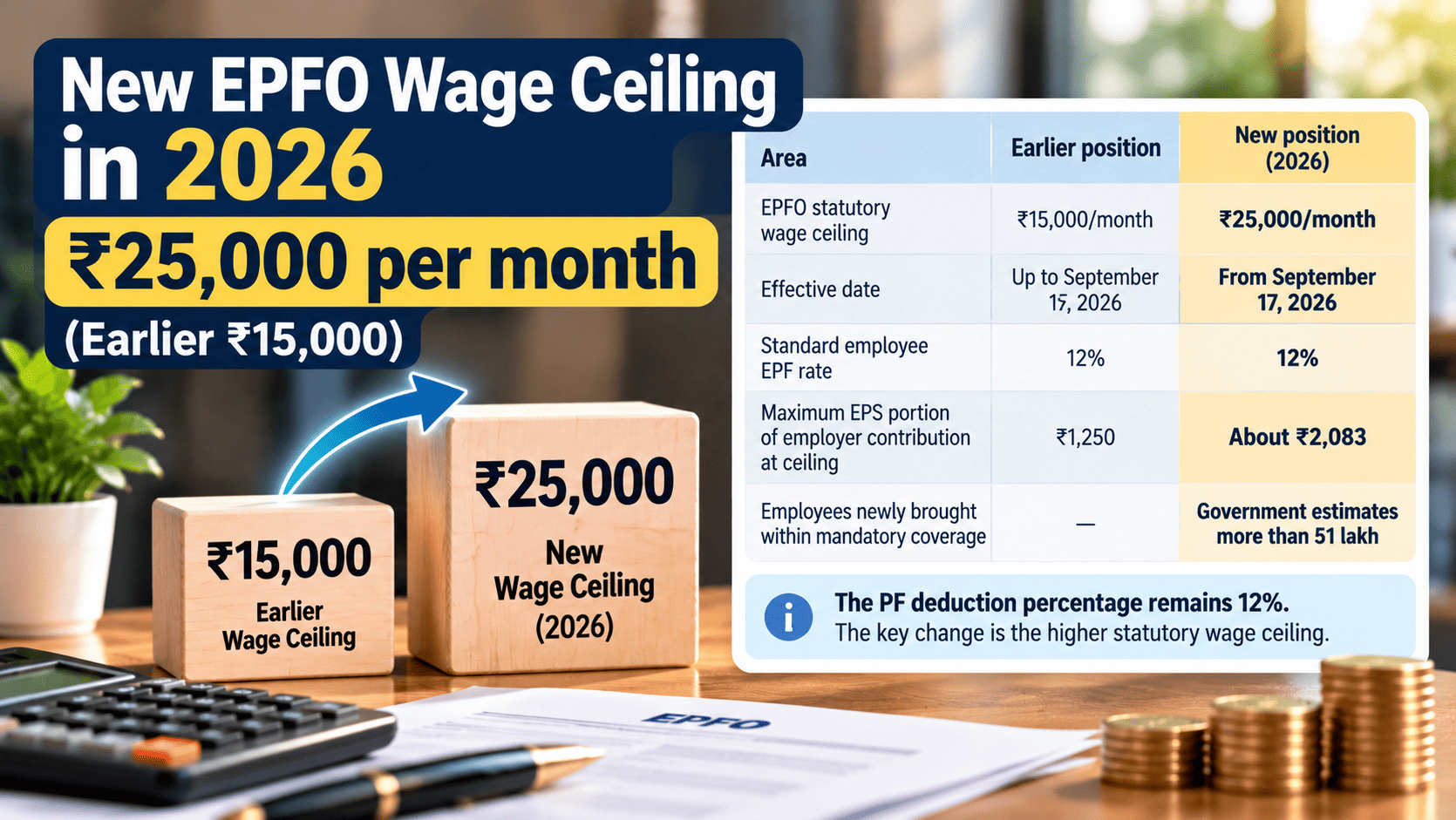
The new statutory wage ceiling is ₹25,000 per month, compared with ₹15,000 earlier.
Gazette Notification S.O. 5109(E) was issued on September 17, 2026. According to the Ministry of Labour & Employment information published by PIB, the revised ceiling became effective from that date.
|
Area |
Earlier position |
New position |
|
EPFO statutory wage ceiling |
₹15,000/month |
₹25,000/month |
|
Effective date |
Up to September 16, 2026 |
From September 17, 2026 |
|
Standard employee EPF rate |
12% |
12% |
|
Maximum EPS portion of employer contribution at ceiling |
₹1,250 |
About ₹2,083 |
|
Employees newly brought within mandatory coverage |
— |
Government estimates more than 51 lakh |
The increase therefore does not mean the PF deduction percentage has increased from 12%. The standard percentage remains the same. The important change is the higher statutory wage ceiling.
Also Read: Digital Personal Loans Jump 28% in India: What's Driving the Growth?
How does the PF deduction new rule 2026 affect your salary?
For an employee newly covered because of the higher ceiling, PF deductions can reduce monthly take-home salary compared with receiving the same amount entirely as cash salary.
Consider an employee whose applicable PF wages are ₹20,000 per month.
At a 12% employee contribution rate:
Employee EPF contribution = ₹20,000 × 12% = ₹2,400 per month
The employer also contributes ₹2,400. For an employee covered by EPS, the employer contribution can be divided between EPS and EPF.
The Economic Times illustrated the ₹20,000 case as follows:
|
Contribution |
Rate |
Monthly amount |
|
Employee contribution to EPF |
12% |
₹2,400 |
|
Employer contribution towards EPS |
8.33% |
₹1,666 |
|
Employer contribution towards EPF |
3.67% |
₹734 |
|
Total employee + employer contribution |
24% |
₹4,800 |
The ₹2,400 employee contribution is deducted from salary and credited to EPF. The employer's ₹2,400 contribution is separate from the employee deduction, although the exact impact on an individual's salary structure depends on the employer's compensation structure and applicable EPFO rules.
What happens at the ₹25,000 wage ceiling?
For PF wages of ₹25,000, a 12% employee EPF contribution works out to:
₹25,000 × 12% = ₹3,000 per month
The corresponding 12% employer contribution is also ₹3,000. For an EPS member, approximately ₹2,083 of the employer's contribution can go towards EPS at 8.33% of ₹25,000, while the remaining employer contribution goes towards EPF, subject to the applicable scheme provisions.
This compares with a statutory employee contribution of ₹1,800 on the previous ₹15,000 ceiling.
That means the maximum standard employee contribution calculated on the statutory ceiling can be ₹1,200 higher per month:
₹3,000 − ₹1,800 = ₹1,200
This comparison does not mean every employee will suddenly lose another ₹1,200 from take-home salary. Employees already contributing on actual wages, employees with different PF arrangements and workers already covered under EPFO can see different effects.
Who is most affected by the EPFO new rules 2026?
The change is particularly relevant to workers earning between ₹15,000 and ₹25,000 per month who were previously outside mandatory EPFO coverage.
Under the earlier ceiling, a new employee joining at wages above ₹15,000 could be outside mandatory EPFO coverage under the applicable provisions. Raising the threshold to ₹25,000 expands the statutory social-security net.
The government says newly covered eligible employees can receive protection through:
-
Employees' Provident Fund (EPF)
-
Employees' Pension Scheme (EPS)
-
Employees' Deposit Linked Insurance Scheme (EDLI)
The actual treatment of an individual employee depends on membership history, wages and applicable EPFO scheme provisions.
Did the PF deduction percentage increase?
No. The standard employee contribution rate remains 12%.
The PF deduction new rule 2026 primarily changes the statutory wage ceiling from ₹15,000 to ₹25,000 rather than increasing the standard employee contribution percentage.
For example:
-
12% of ₹15,000 = ₹1,800
-
12% of ₹20,000 = ₹2,400
-
12% of ₹25,000 = ₹3,000
So a higher deduction can arise because PF is being calculated on a higher applicable wage base, not because the standard 12% rate itself increased.
What happens to the employer's PF contribution?
The employer generally contributes 12% under the standard contribution structure. For eligible EPS members, part of that employer contribution is allocated to EPS and the balance to EPF.
At the new ₹25,000 pensionable wage ceiling, the maximum 8.33% employer EPS component rises to approximately ₹2,083, compared with ₹1,250 at the earlier ₹15,000 ceiling.
This is important because employees do not make a separate contribution to EPS from their employee share. EPS is funded from the applicable employer contribution.
Does the new PF rule start from October 2026?
No. The revised ₹25,000 wage ceiling officially took effect on September 17, 2026.
This date matters because some headlines refer to the impact visible from October payroll or contribution processing. However, the government notification itself made the revised ceiling effective from September 17.
October 2026 is the first full calendar month after the change.
Also Read: Salary Advance vs Salary Loan: Which One Should You Choose?
Will the new PF rule affect personal loan EMIs or interest rates?
No direct change has been announced to personal loan interest rates, existing EMIs, credit scores or loan eligibility because of the EPFO wage-ceiling revision.
This is an employment and social-security change, not a lending-rate regulation.
However, a newly applicable PF deduction may affect an employee's monthly take-home salary. Since lenders can consider income, existing obligations and other eligibility factors when evaluating a personal loan application, borrowers should use their actual post-deduction income when planning an EMI.
The EPFO change itself does not guarantee either approval or rejection of a loan application.
What this means for borrowers
Salaried borrowers should check their latest salary slip before committing to a new EMI, particularly if they have recently been brought under mandatory EPFO coverage.
Suppose someone's applicable employee PF contribution becomes ₹3,000 per month under the revised ceiling. That money is part of their retirement savings rather than normal take-home pay.
A personal-loan budget should therefore be based on actual monthly take-home income after statutory deductions, rather than CTC alone.
The EPFO change does not directly change:
-
an existing personal loan's contracted interest rate;
-
an existing EMI unless the loan agreement itself provides for a change;
-
a borrower's credit score;
-
a lender's processing fee; or
-
a lender's underwriting requirements.
What should employees check on their October salary slip?
Employees affected by the revised ceiling should check the EPF employee contribution, applicable PF wages and employer contribution shown in their payroll records.
If the deduction differs from what you expected, ask your employer's payroll or HR team how the new ₹25,000 ceiling has been applied to your salary structure.
Employees can also review their EPFO account records to verify contributions credited against their Universal Account Number (UAN).
What borrowers should check before taking a personal loan
Changes in statutory deductions are a useful reminder that CTC and take-home salary are different figures.
Before borrowing, check your current net monthly income and compare it with the proposed EMI. Review the applicable interest rate, processing charges, repayment tenure, total repayment obligation, late-payment charges and Key Fact Statement where applicable.
Pocketly provides digital access to personal-loan products subject to applicable eligibility, verification, underwriting and terms. Borrow only an amount you can reasonably repay from your regular income.
Key Takeaways
-
The EPFO statutory wage ceiling increased from ₹15,000 to ₹25,000 per month.
-
The revised ceiling became effective on September 17, 2026, not October 1.
-
The standard employee PF deduction percentage remains 12%.
-
At ₹25,000 PF wages, 12% equals ₹3,000 per month.
-
The maximum employer EPS component at 8.33% of the new ceiling is approximately ₹2,083 per month.
-
The government estimates that more than 51 lakh additional workers will come under mandatory EPFO coverage.
-
The rule does not directly change personal loan interest rates, EMIs or credit scores.
Need funds for an unexpected expense?
Check your eligibility for a personal loan through Pocketly and review the applicable interest rate, fees, tenure and total repayment amount before borrowing. Loan availability and approval are subject to eligibility, verification, underwriting and applicable terms.
Also Read: 7 Days Loan App in India: Short-Term Loan Options in 2026
FAQs
1. What is the PF deduction new rule 2026?
The government has increased the statutory EPFO wage ceiling from ₹15,000 to ₹25,000 per month. The revised ceiling became effective on September 17, 2026. It expands mandatory EPFO coverage to eligible employees within the higher wage range. The standard employee contribution rate remains 12%.
2. How much PF will be deducted on a ₹25,000 salary?
At a 12% contribution rate, PF calculated on ₹25,000 of applicable PF wages equals ₹3,000 per month. The actual deduction shown on an individual's salary slip can depend on applicable PF wages, membership and the employer's payroll arrangement.
3. Has the PF deduction percentage increased in 2026?
No. The standard employee EPF contribution remains 12%. The major 2026 change is the increase in the statutory wage ceiling from ₹15,000 to ₹25,000. A higher rupee deduction can therefore result from applying the same percentage to a higher wage base.
4. When did the ₹25,000 EPFO wage ceiling become effective?
The new ₹25,000 wage ceiling became effective on September 17, 2026, the date specified for implementation of the revised ceiling. October 2026 is the first full calendar month following the change.
5. Will the new PF rule reduce take-home salary?
It can reduce take-home pay for employees who become newly subject to mandatory PF contributions or whose applicable statutory contribution base increases. Employees already making PF contributions on comparable or higher wages may experience a different impact. Check your salary slip or payroll calculation for the amount applicable to you.
6. How much does an employer contribute to EPS under the new ceiling?
For eligible EPS members, the employer EPS component is generally calculated at 8.33% of applicable pensionable wages. At the ₹25,000 ceiling, this works out to approximately ₹2,083 per month, compared with ₹1,250 at the previous ₹15,000 ceiling.
7. Does the new PF rule affect salaried personal loan eligibility?
The EPFO wage-ceiling change does not directly alter salaried personal loan eligibility rules. However, statutory deductions can affect take-home income, which may be one factor considered during a lender's assessment. Approval remains subject to the lender's eligibility, verification and underwriting criteria.
Sources
Press Information Bureau / Ministry of Labour & Employment — Cabinet Approves Higher EPFO Wage Ceiling of Rs. 25,000, Expanding Mandatory Coverage, September 16, 2026.
PIB announcement on the ₹25,000 EPFO ceiling
Press Information Bureau / Ministry of Labour & Employment — EPFO Raises Wage Ceiling from Rs. 15,000 to Rs. 25,000; Over 51 Lakh Workers to Benefit, September 23, 2026. This PIB release identifies Gazette Notification S.O. 5109(E), the September 17 effective date and the revised EPS contribution ceiling.
PIB EPFO wage-ceiling implementation details
The Economic Times — EPF & EPS rules under new wage ceiling: Earning Rs 20,000 and not EPS member? Know how your employer's PF contribution will change from October 2026, September 29, 2026.
Economic Times EPF and EPS calculation report