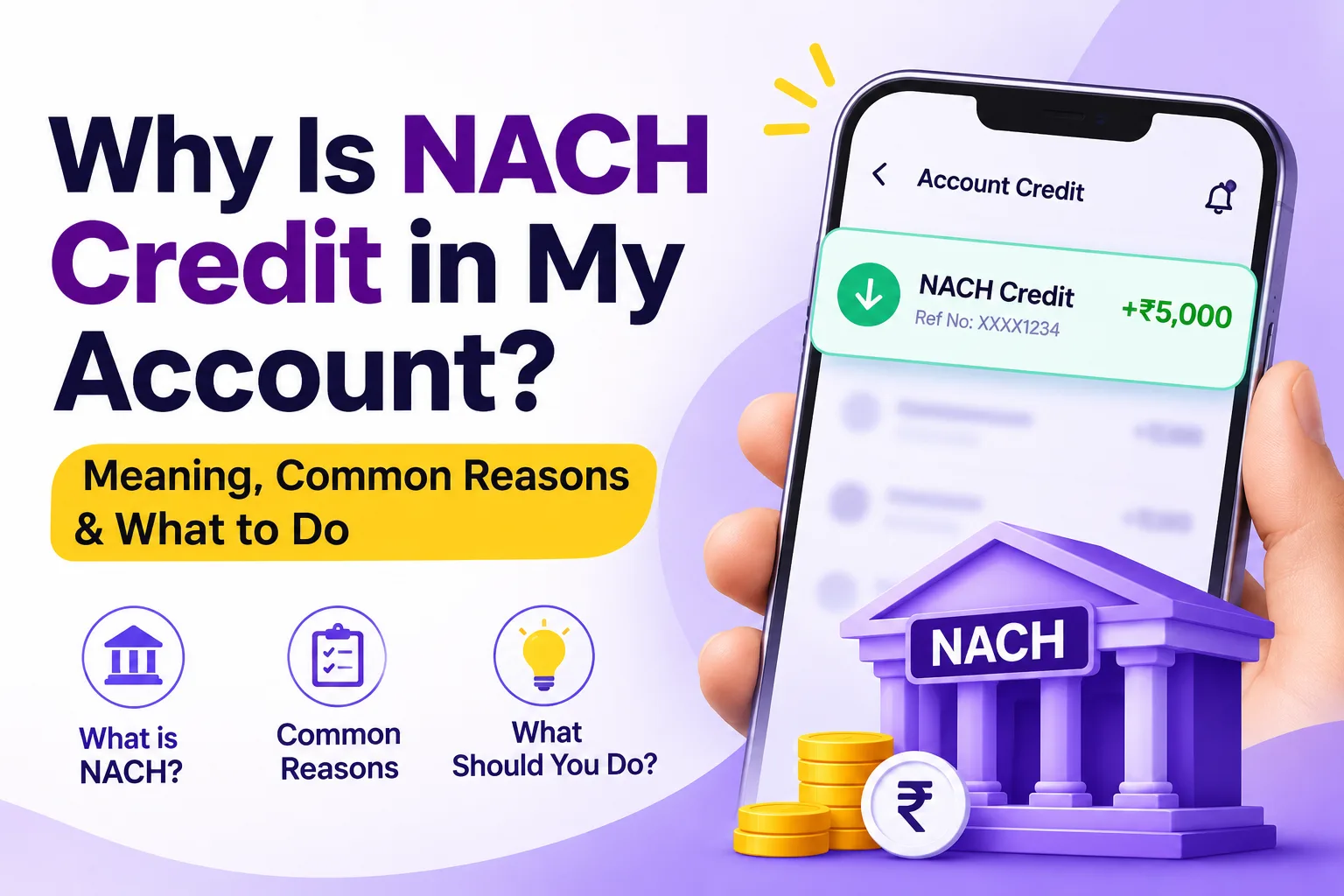


If you are asking why is NACH credit in my account, it means an organisation, bank, or government agency has deposited money directly into your savings account through the National Automated Clearing House (NACH) network operated by the National Payments Corporation of India (NPCI). Unlike a NACH debit that deducts loan EMIs or bills, a NACH credit is always an incoming deposit—such as a salary payout, stock dividend, mutual fund redemption, insurance maturity, tax refund, or Direct Benefit Transfer (DBT) subsidy. Because bank statements show truncated codes rather than full sender names, checking your statement narration helps identify the source. At Pocketly, we help young Indian earners understand banking entries clearly while offering transparent digital credit when cash inflows get delayed.
Quick Answer: NACH Credit Meaning at a Glance
-
What It Means: NACH credit meaning refers to an automated electronic fund transfer deposited into your bank account via NPCI’s centralised clearing rail.
-
Is It Safe? Yes. Only verified sponsor banks and registered institutions can initiate a NACH credit—it adds money to your balance rather than deducting funds.
-
Common Sources: Monthly salary, corporate dividends, mutual fund payouts, EPFO/pension disbursements, LPG or PM-KISAN subsidies, and merchant refunds.
-
Hindi Explanation: For readers searching nach credit in my account in hindi, इसका मतलब है कि किसी कंपनी, बैंक या सरकारी विभाग ने NPCI के NACH सिस्टम के ज़रिए आपके खाते में सीधे पैसे जमा किए हैं।
-
Cash-Flow Tip: If an expected NACH credit (like a stipend or salary) is delayed, you can explore a short-term personal loan with us at Pocketly to cover urgent bills cleanly.
What Is NACH Credit Meaning in Indian Banking?
Understanding NACH credit meaning starts with the National Automated Clearing House (NACH), a web-based electronic clearing platform administered by the National Payments Corporation of India (NPCI). NPCI designed NACH to replace legacy regional Electronic Clearing Service (ECS) systems with a single, nationwide network for high-volume, repetitive interbank transactions.
When you see credit by NACH means on an SMS alert or passbook entry, it indicates a "one-to-many" push transaction. A single user institution—such as an employer, mutual fund house, listed company, or government ministry—instructs its sponsor bank to credit thousands of beneficiary accounts simultaneously. In simple terms, NACH credit means money has been safely pushed into your bank account through an RBI-regulated clearing cycle rather than pulled out.
Why Is NACH Credit in My Account? 7 Most Common Reasons
If you spotted an unexpected deposit and wondered why is nach credit in my account, check your bank statement narration against these seven verified sources:
|
Source of NACH Credit |
Typical Bank Statement Code / Hint |
Who Initiates the Payment? |
|
1. Monthly Salary or Stipend |
NACH-CR-[Company Name]-SAL |
Employers, startups, or internship organisations paying bulk payroll. |
|
2. Government Subsidies (DBT) |
NACH-CR-DBT / PFMS / LPG |
Central or state ministries transferring welfare benefits, scholarships, or gas subsidies via PFMS/APB rails. |
|
3. Stock Dividends & Interest |
NACH-CR-DIV / RTA Name (e.g., KFintech, CAMS) |
Listed companies or Registrars and Transfer Agents paying equity dividends or bond interest. |
|
4. Mutual Fund Redemptions |
NACH-CR-MF / AMC Name |
Asset Management Companies crediting redeemed units or IDCW payouts. |
|
5. Insurance Payouts or Refunds |
NACH-CR-LIC / Insurer Name |
Life or health insurers settling maturity proceeds, survival benefits, or policy refunds. |
|
6. Tax or Merchant Refunds |
NACH-CR-ITD / Merchant Name |
Income Tax Department (via SBI refund banker) or e-commerce/utility companies processing bulk refunds. |
|
7. Pension & EPFO Settlements |
NACH-CR-EPFO / CPAO |
Employees' Provident Fund Organisation or pension authorities releasing monthly pensions or PF claims. |
NACH Credit in My Account in Hindi (सरल शब्दों में समझें)
Many first-time account holders and students look up nach credit in my account in hindi after receiving an unfamiliar bank SMS.
NACH credit ka matlab kya hota hai? NACH का पूरा नाम National Automated Clearing House है, जिसे नेशनल पेमेंट्स कॉरपोरेशन ऑफ इंडिया (NPCI) चलाती है। जब आपके बैंक स्टेटमेंट में NACH Credit लिखा आता है, तो इसका सीधा अर्थ है कि किसी रजिस्टर्ड संस्था, कंपनी या सरकारी योजना ने इलेक्ट्रॉनिक क्लियरिंग सिस्टम के माध्यम से आपके बैंक खाते में पैसे जमा (Credit) किए हैं।
इसमें घबराने की कोई बात नहीं है क्योंकि NACH credit से आपके खाते से पैसे कटते नहीं हैं, बल्कि जुड़ते हैं। यह राशि आपकी सैलरी, सरकारी सब्सिडी (जैसे LPG या छात्रवृत्ति), शेयर का डिविडेंड, म्यूचुअल फंड रिडेम्पशन या किसी रिफंड की हो सकती है। आप अपनी बैंक पासबुक या मोबाइल बैंकिंग ऐप में ट्रांजेक्शन नरेशन (Narration) देखकर भेजने वाली संस्था का नाम आसानी से जांच सकते हैं।
NACH Credit vs. NACH Debit: Key Differences You Should Know
Knowing the difference between NACH credit and NACH debit helps you track both incoming cash flows and scheduled obligations without confusion:
|
Parameter |
NACH Credit |
NACH Debit |
|
Direction of Money |
Incoming (Money enters your bank account). |
Outgoing (Money is deducted from your bank account). |
|
Transaction Model |
One-to-many bulk push by an institution. |
Many-to-one automated pull authorised by you. |
|
Prior Customer Mandate |
Not required from the recipient (sharing account/IFSC or Aadhaar seeding suffices). |
Mandatory physical NACH or digital e-NACH mandate (linked to a UMRN). |
|
Common Examples |
Salary, dividends, subsidies, PF payouts, refunds. |
Loan EMIs, SIP instalments, insurance premiums, utility bills. |
|
Impact If Account Balance Is Low |
No impact; the credit still posts to your account. |
Mandate bounces, triggering bank return charges and late fees. |
How Does a NACH Credit Transaction Work Behind the Scenes?
Under NPCI’s procedural framework, every NACH credit follows a standardized four-step settlement cycle:
-
File Submission by User Institution: The paying entity (for example, your employer or a mutual fund registrar) uploads an encrypted payment file containing beneficiary account numbers, IFSC codes, and amounts to its sponsor bank.
-
NPCI Central Clearing: The sponsor bank forwards the batch file to NPCI’s NACH clearing house, which validates routing codes and sorts transactions by destination bank.
-
Destination Bank Settlement: Your bank receives the cleared credit instructions and posts the exact amount to your savings account within the same-day settlement window.
-
SMS & Statement Narration Update: Your bank sends an automated credit alert and records an alphanumeric narration (containing the sender’s short code and batch reference) in your statement.
How to Check the Exact Sender of a NACH Credit
If you still cannot identify why is nach credit in my account, follow these four practical steps:
-
Read the Full Statement Narration: Download your detailed PDF account statement from net banking or your mobile banking app—SMS alerts often cut off the sender’s name, whereas full statements display the company or PFMS code.
-
Match the Exact Rupee Amount: Cross-check the credited figure against recent dividend emails, mutual fund redemption confirmations, tax refund intimations, or utility cancellation receipts.
-
Check Your PFMS / DBT Status: If the narration mentions PFMS, APB, or DBT, check the Public Financial Management System portal or your Aadhaar-seeded bank account mapping to confirm government benefit transfers.
-
Contact Your Bank’s Home Branch or Support: Share the transaction date, exact amount, and UTR/NACH sequence number with your bank’s customer care so they can look up the originating sponsor bank code.
What If an Expected NACH Credit Is Delayed?
Relying on a scheduled NACH credit—such as a delayed freelance retainer, stipend, or salary—can create a sudden month-end cash crunch right before your own NACH debit mandates (like rent or EMIs) hit your account. Missing a scheduled repayment can trigger bank bounce fees and hurt your credit bureau record, as explained in our guide on what happens when an EMI is missed or paid late.
At Pocketly, we help young Indians bridge temporary cash-flow gaps responsibly without turning to unverified apps:
-
For Salaried Employees: If a payroll cycle or reimbursement is delayed, you can explore our personal loan for salaried applicants for short-term liquidity from ₹1,000 to ₹50,000, subject to verification and underwriting criteria.
-
For Self-Employed Professionals & Freelancers: When client payouts take longer than expected, our personal loan for self employed option provides flexible short-term support without branch paperwork.
-
For Students & Non-Salaried Earners: If you receive stipends or regular allowances without corporate salary slips, check our personal loan for non salaried category—we do not require a prior CIBIL score to apply.
Before borrowing, always calculate your monthly repayment comfort using our personal loan EMI calculator and check your safe debt-to-income ratio with our FOIR calculator so your budget stays balanced.
Common Mistakes & Security Checks Around NACH Transactions
While NACH credit itself is a secure, regulated clearing mechanism, keeping these safeguards in mind protects your bank account:
-
Do Not Confuse NACH Credit With UPI Collect Fraud: Scammers often send fake UPI "collect" requests claiming you will receive a prize or refund once you enter your UPI PIN. A genuine NACH credit never requires you to enter an OTP, UPI PIN, or net banking password to receive money.
-
Keep Track of NACH Debit Dates: If you have active loan EMIs or SIPs on NACH debit, maintain sufficient funds at least one day before the due date—especially ahead of scheduled banking events like the upcoming IDBI Bank strike on December 3, 2026 or when reviewing proposed fraud-protection tools under the RBI's November 2026 digital payment rules.
-
Avoid Unregulated 7-Day Loan Apps During Cash Crunches: If a delayed payout leaves you short on cash, avoid predatory APK apps that trap borrowers in weekly debt cycles. Read our breakdown on 7 days loan vs 30 days loan and our checklist for identifying fake loan apps in India before sharing KYC details online.
-
Check Regulated Lending Terms Upfront: Whether you apply with us or compare platforms to find the best loan app in India for your profile, ensure the lender is an RBI-registered NBFC or bank (all loans on Pocketly are underwritten and disbursed by our RBI-registered NBFC partner, Speel Finance Company Private Limited) and review the Key Fact Statement (KFS) for interest rates (2%–3% per month on Pocketly), processing fees (0%–9.4% inclusive of GST), and APR before accepting.
Final Takeaway: Track Your NACH Credits & Manage Cash Flow Smartly
Spotting why is nach credit in my account is almost always good news—it signals an incoming salary, dividend, subsidy, or refund cleared safely through NPCI’s banking network. Regularly checking your full bank statement narration ensures you know exactly where every deposit comes from and helps you plan around upcoming auto-debits.
If an expected payout ever gets delayed and leaves you with a temporary cash gap, we are here to help you bridge it transparently without hidden charges.
Also Read: Latest Guides & News on Pocketly
-
https://pocketly.in/news/sahamati-account-aggregator-charges-small-loan-apps-borrower-impact
-
https://pocketly.in/news/rbi-new-rules-stop-switch-trusted-person-bank-fraud
-
https://pocketly.in/article/personal-loan-for-18-year-olds-in-india
-
https://pocketly.in/news/idbi-bank-strike-3-december-2026-will-banks-be-closed
-
https://pocketly.in/news/rbi-cancels-49-nbfc-licences-full-list-2026
-
https://pocketly.in/news/onDC-plans-bnpl-business-loans-and-loans-against-mutual-funds
-
https://pocketly.in/article/rbi-guidelines-for-loan-recovery-in-india
-
https://pocketly.in/article/instant-personal-10-minute-loan-online
Frequently Asked Questions (FAQs)
1. Why is NACH credit in my account when I did not initiate any transfer?
You see why is nach credit in my account because an institution—such as an employer, mutual fund house, dividend-paying company, insurer, or government department—pushed a scheduled bulk payment into your bank account through NPCI’s clearing system. You do not need to initiate anything to receive a NACH credit.
2. What does credit by NACH means in a bank passbook?
In banking terminology, credit by NACH means an electronic deposit cleared via the National Automated Clearing House operated by NPCI. It confirms that a verified sponsor bank transferred funds into your account as part of a bulk credit batch such as salary, subsidy, dividend, or refund.
3. What is NACH credit in my account in Hindi?
अगर आप nach credit in my account in hindi का अर्थ जानना चाहते हैं, तो इसका मतलब है कि NPCI के नेशनल ऑटोमेटेड क्लियरिंग हाउस (NACH) सिस्टम के माध्यम से किसी कंपनी, बैंक या सरकारी योजना ने आपके खाते में सीधे पैसे जमा किए हैं। यह सैलरी, सब्सिडी, डिविडेंड या रिफंड की राशि हो सकती है।
4. Is NACH credit safe, or can a fraudster use it to deduct money from my account?
A NACH credit is completely safe because it only deposits funds into your account and cannot debit money. Fraudsters cannot withdraw funds using a NACH credit; however, never share your OTP or UPI PIN with anyone claiming you must "approve" an incoming credit.
5. How long does a NACH credit take to reflect in my bank account?
Under NPCI’s NACH clearing schedule, bulk credit batches settle on the designated settlement date during banking hours, usually reflecting in your savings account within the same working day once processed by your destination bank.
6. Can I get an instant personal loan online in 2 minutes if my salary NACH credit is delayed?
Completing our 100% digital application and Video KYC on Pocketly takes just a few minutes on your smartphone, though phrases like instant personal loan online in 2 minutes describe rapid application submission rather than guaranteed approval or two-minute disbursal. Final sanction and bank transfer depend on real-time KYC verification and underwriting review by our RBI-registered NBFC partner, Speel Finance Company Private Limited.
7. Which borrowers can apply for a short-term personal loan with Pocketly?
At Pocketly, Indian residents aged 18 to 40 can apply for personal loans from ₹1,000 to ₹50,000 with tenures from 61 days to 9 months across our personal loan for salaried, personal loan for self employed, and personal loan for non salaried categories, without requiring a prior CIBIL score.
8. How can I estimate my monthly EMI before applying with Pocketly?
Before choosing your loan amount, use our free personal loan EMI calculator to check your monthly instalment and total repayment obligation, and review your Key Fact Statement upfront under our responsible lending standards.