

Capital gains are one of the five heads of income under the Income-tax Act, 1961, with their taxation governed by the provisions of Part E of Chapter IV. When a capital asset, such as shares, mutual funds, property, or gold, is sold within a specified holding period, the profit is treated as a Short-Term Capital Gain (STCG).
Since holding periods and tax rates differ across asset classes, understanding STCG is important for calculating your actual post-tax returns.
This guide explains how short-term capital gains are taxed in India for FY 2025–26, including holding periods for different assets, applicable tax rates under Section 111A, slab-based taxation rules, calculation methods, available exemptions, and common mistakes taxpayers should avoid while filing their returns.
Key Takeaways
-
Short-Term Capital Gains (STCG) apply when assets like shares, mutual funds, property, gold, or bonds are sold within specific holding periods defined under Indian tax laws.
-
STCG tax rates vary by asset type: listed equity shares and equity mutual funds are taxed at 20% under Section 111A, while assets like property, gold, and debt funds are taxed according to your income slab.
-
Correctly calculating STCG requires factoring in acquisition cost, improvement expenses, brokerage, legal fees, and other transfer-related charges to avoid overpaying tax.
-
Common mistakes such as incorrect holding period calculation, ignoring exemptions, missing transfer expenses, or wrong ITR reporting can increase tax liability or trigger notices.
-
Proper tax planning, understanding exemptions, and tracking investment records can help improve post-tax returns and reduce unexpected financial stress.
Understanding Short-Term Capital Gains (STCG)
Short-term capital gains (STCG) apply when you sell assets (such as shares, mutual funds, property, or gold) within a specified holding period. Since holding periods and tax rates differ across asset classes in India, understanding STCG is crucial since it directly impacts your post-tax investment returns.
-
Small profits aren't automatically tax-free; you must understand applicable exemptions and tax slabs before filing returns
-
A shorter holding period means higher tax liability (e.g., selling equity shares within six months attracts more tax than holding them longer)
Understanding STCG and its implications on different asset types is essential for optimising your investment strategy and maximising post-tax returns.
Also read: Income Tax Basic Concepts: A Beginner’s Guide 2025-26
Holding Periods for Different Assets Under Short-Term Capital Gain Tax
The holding period decides whether your profit is treated as a short-term or long-term capital gain. This directly impacts how much tax you pay. For salaried professionals and self-employed individuals managing multiple investments, knowing these timelines helps avoid unexpected tax liability.
|
Asset Type |
Holding Period for STCG |
|
Equity shares & equity-oriented mutual funds |
Less than 12 months |
|
Immovable property & land |
Less than 24 months |
|
Unlisted shares |
Less than 24 months |
|
Gold & jewelry |
Less than 36 months |
|
Debt mutual funds (purchased before April 1, 2023) |
Less than 36 months |
|
Debt mutual funds (purchased on/after April 1, 2023) |
All gains are treated as STCG regardless of holding period |
|
Equity Mutual Funds |
Held < 12 months = STCG (20% rate); > 12 months = Long-Term Capital Gains (LTCG) (12.5% rate). |
|
Listed debentures & bonds |
Less than 12 months |
|
ULIPs (annual premium >₹2.5 lakh)* |
Depends on policy structure; subject to LTCG tax from April 1, 2026 |
Short-Term Capital Gains Tax Rates for FY 2025–26
Short-term capital gain tax rates in India depend on the type of asset sold. For salaried professionals and self-employed individuals, understanding these rates is important because the final tax outgo can vary significantly across investments.
Assets Taxed Under Section 111A
Certain market-linked investments attract a flat 20% short-term capital gain tax rate for FY 2025–26.
|
Asset Type |
STCG Tax Rate |
|
Listed equity shares |
20% |
|
Equity-oriented mutual funds |
20% |
|
Units of business trusts |
20% |
To qualify under Section 111A, Securities Transaction Tax (STT) must be paid during the transaction.
Some assets do not get a special flat tax rate. Their gains are added to your total income and taxed according to your slab.
These typically include:
-
Property and land
-
Debt mutual funds
-
Gold and silver
-
Unlisted shares
-
Debentures and bonds
For example, a freelancer in the 30% tax slab selling gold within three years may pay tax at the applicable slab rate instead of a fixed STCG rate.
How to Calculate Short-Term Capital Gains
Calculating short-term capital gain tax correctly helps avoid filing errors and unexpected tax dues.
STCG Calculation Formula
STCG = Sale Price − (Cost of Acquisition + Cost of Improvement + Transfer Expenses)
Components Explained
|
Component |
Meaning |
|
Sale Price |
Final amount received after selling the asset |
|
Cost of Acquisition |
Original purchase price of the asset |
|
Cost of Improvement |
Money spent improving the asset, mainly for property |
|
Transfer Expenses |
Brokerage, legal fees, or selling charges |
|
Allowable Deductions |
Eligible expenses directly linked to the transfer |
Step-by-Step Process
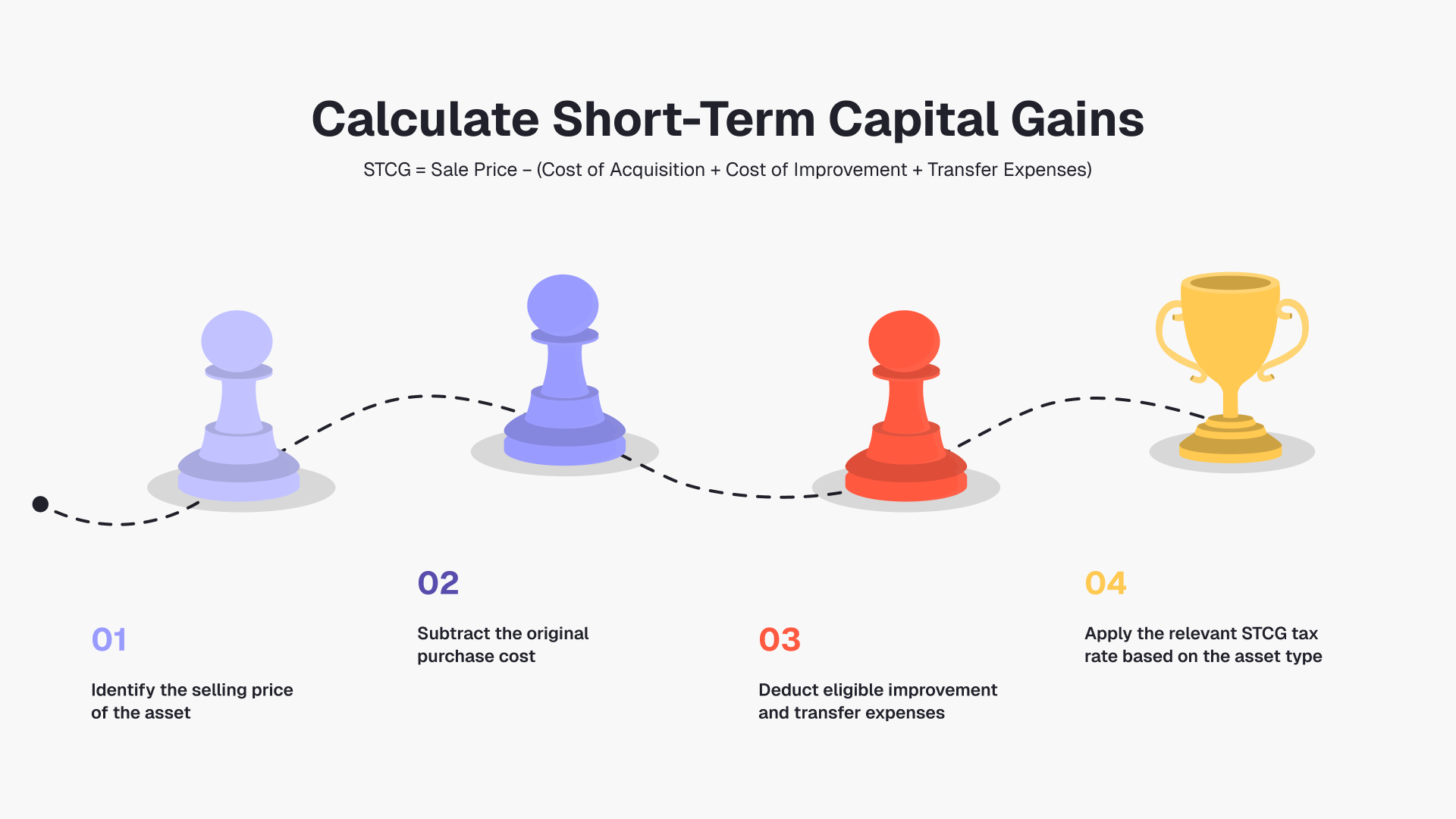
-
Identify the selling price of the asset.
-
Subtract the original purchase cost.
-
Deduct eligible improvement and transfer expenses.
-
Apply the relevant STCG tax rate based on the asset type.
Practical Examples
-
Equity Shares: Bought at ₹80,000 and sold at ₹1,00,000 within 12 months. STCG = ₹20,000, taxed at 20% under Section 111A.
-
Property: A shop purchased for ₹20 lakh and sold within 24 months for ₹24 lakh may attract slab-based taxation after deductions.
-
Debt Mutual Funds: Gains from units sold before 36 months are added to taxable income as per your slab.
Indexation benefit is generally not available for short-term capital gains. This means inflation adjustment cannot reduce your taxable gain.
Exemptions and Deductions Available on Short-Term Capital Gains
Some exemptions may apply if the gains are linked to specific asset sales and reinvestment conditions are met.
|
Section |
Applicable Asset |
Key Condition |
|
Section 54B |
Agricultural land |
Reinvest in new agricultural land within the prescribed period |
|
Section 54D |
Industrial property |
Reinvest the compensation amount into another industrial asset |
These exemptions are subject to eligibility rules and documentation requirements.
Basic Exemption Limit Benefits
If your total taxable income falls below the exemption threshold, the unused portion may be adjusted against short-term capital gains taxable at slab rates.
|
Category |
Old Tax Regime |
New Tax Regime |
|
Resident individuals below 60 years |
₹2.5 lakh |
₹4 lakh |
|
Senior citizens (60–80 years) |
₹3 lakh |
₹4 lakh |
|
Super senior citizens (80+ years) |
₹5 lakh |
₹4 lakh |
Short-Term Capital Gains (STCG) vs Long-Term Capital Gains (LTCG): Key Differences Investors Should Know
Understanding the difference between short-term capital gain tax and long-term capital gains tax helps investors make smarter exit decisions. Even a few months’ difference in holding period can significantly impact post-tax returns.
|
Factor |
STCG |
LTCG |
|
Holding Period |
Shorter holding duration |
Longer holding duration |
|
Equity Tax Rate |
20% under Section 111A |
~10% above the applicable exemption limit |
|
Other Assets |
Taxed as per slab |
Usually 20% with indexation |
|
Indexation Benefit |
Not available |
Available for certain assets |
|
Exemptions |
Limited |
Wider exemptions available |
Advantages and Disadvantages of Short-Term Capital Gains Tax
Short-term capital gains can help investors access funds quickly, but they also come with higher tax exposure. For salaried professionals and self-employed individuals in India, understanding both sides is important before making short-term investment decisions.
Advantages of Short-Term Capital Gains
|
Advantage |
Benefit |
|
Faster Access to Liquidity |
Allows investors to convert investments into cash quickly during emergencies, business expenses, or month-end financial gaps |
|
Supports Active Trading |
Short-term taxation suits traders and investors who frequently buy and sell equity shares or mutual funds based on market movements |
|
Useful for Short-Term Financial Goals |
Enables investment for goals like insurance payments, equipment purchases, or urgent personal expenses within a one-to-three-year horizon |
|
Loss Offset Benefits |
Short-term capital losses can be adjusted against both short-term and long-term capital gains, helping reduce overall tax liability |
Disadvantages of Short-Term Capital Gains
|
Disadvantage |
Impact |
|
Higher Tax Rates |
Reduces net investment returns compared to long-term gains |
|
Limited Exemptions |
Fewer tax-saving opportunities available to investors |
|
No Indexation Benefit |
Inflation cannot be used to reduce taxable gains |
|
Frequent Taxation |
Active trading may increase tax burden due to multiple transactions |
Common Mistakes to Avoid While Calculating Short-Term Capital Gain Tax
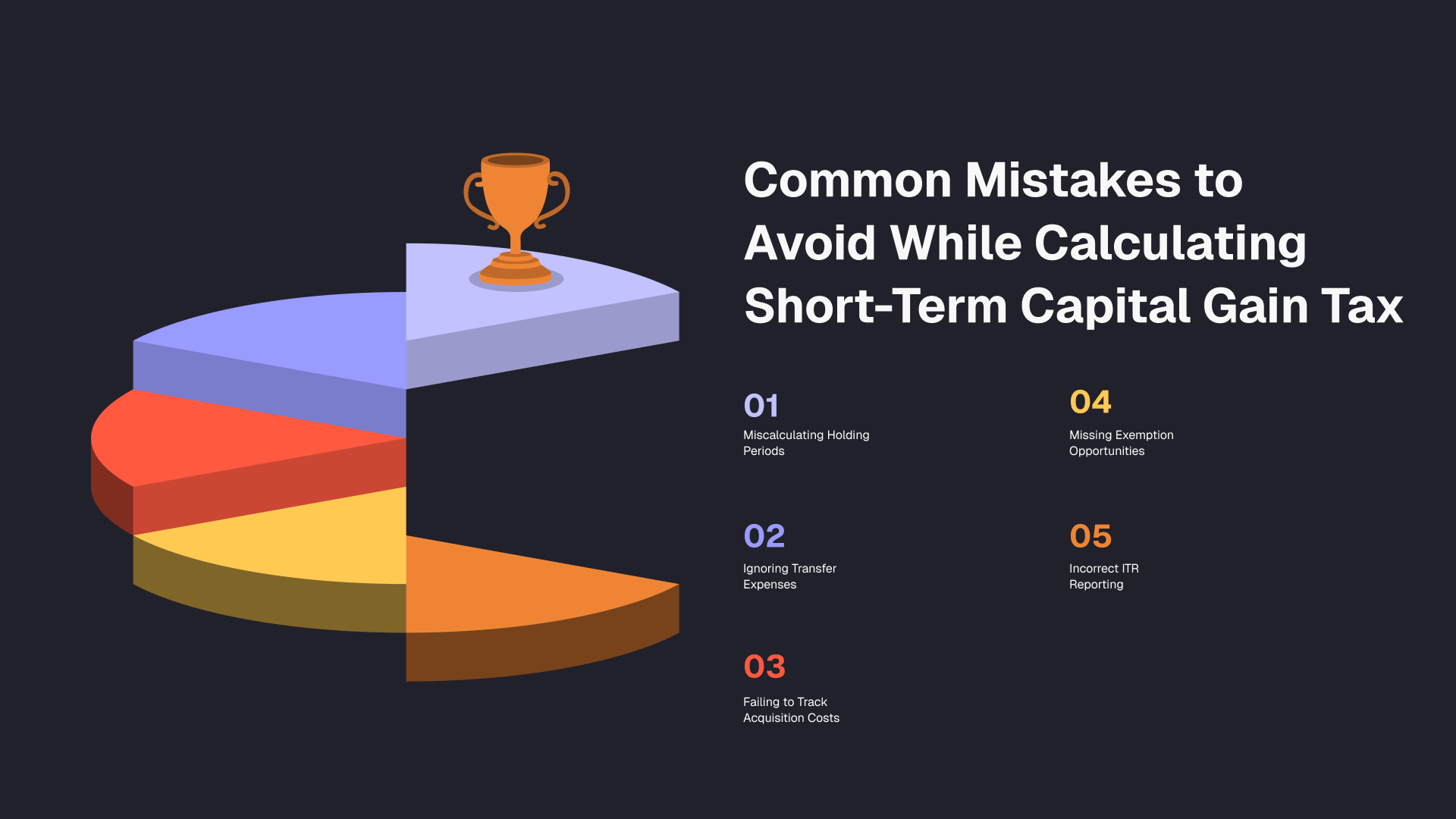
Many taxpayers end up paying extra tax or receiving notices because of avoidable reporting errors. Even small mistakes in capital gains calculation can affect overall tax liability.
Miscalculating Holding Periods
Many investors incorrectly calculate the holding duration based on financial years instead of actual purchase and sale dates. This can wrongly classify gains as short-term instead of long-term.
Ignoring Transfer Expenses
Expenses directly related to the sale are often missed, such as:
-
Brokerage charges
-
Legal fees
-
Stamp duty-related expenses
-
Transaction charges
Ignoring these costs can increase taxable gains unnecessarily.
Failing to Track Acquisition Costs
Without proper purchase records, calculating accurate gains becomes difficult. Always maintain:
-
Purchase invoices
-
Broker statements
-
Mutual fund account statements
-
Property purchase documents
Missing Exemption Opportunities
Some taxpayers fail to check eligibility for exemptions under sections like:
-
Section 54B
-
Section 54D
-
Basic exemption limit adjustments
This may result in higher taxes than necessary. Individuals with lower taxable income sometimes forget they can partially adjust slab-based short-term gains against the basic exemption threshold.
Incorrect ITR Reporting
Reporting capital gains under the wrong schedule or selecting the incorrect asset category can trigger scrutiny or refund delays.
Also read: Risk Management Process of Income Tax: ITR Flags Explained
Manage Unexpected Expenses with Pocketly
Short-term financial needs like tax payments and emergency expenses can create cash flow challenges. Pocketly is a digital lending platform offering quick, transparent short-term loans ranging from ₹1,000 to ₹25,000 to help bridge these gaps.
Why Pocketly?
-
Fast & Digital: Minimal paperwork, simplified KYC, and quick approvals
-
Loan Range: ₹1,000 to ₹25,000 with interest rates starting from 2% per month
-
No Collateral: Unsecured loans with transparent fees (1-8%)
-
Direct Transfer: Funds disbursed straight to your bank account
-
Flexible Repayment: Early closure option available
Pocketly is designed for students, salaried professionals, self-employed individuals, and entrepreneurs facing unexpected expenses like tax payments, emergency costs, business cash flow gaps, or month-end financial commitments.
Pocketly provides a faster, hassle-free alternative to traditional lending for eligible borrowers managing temporary financial needs.
Get started today. Visit Pocketly and apply for your loan in minutes.
Conclusion
Short-term capital gains tax can significantly reduce your actual returns if you overlook holding periods, tax rates, or reporting rules. Before selling any investment, calculate the post-tax profit carefully, track all eligible expenses, and check whether exemptions or slab benefits apply to you. A little tax planning can help you avoid unnecessary liabilities and improve overall returns.
If you’re facing a temporary cash flow crunch due to tax payments or urgent expenses, download the Pocketly app. It offers quick short-term loans with fast approvals, minimal paperwork, and direct bank transfers for eligible borrowers.
Frequently Asked Questions (FAQs)
1. Is there a tax-free STCG limit?
Unlike Long-Term Capital Gains (LTCG) on equity, which has an annual exemption limit of ₹1.25 lakh, there is no specific tax-free limit for Short-Term Capital Gains. Every rupee of profit is taxable. However, if your total annual income (including STCG taxed at slab rates) is below the basic exemption limit of the tax regime you have chosen, you may not have to pay tax on that portion.
2. How does STT payment affect taxation?
The payment of Securities Transaction Tax (STT) is the primary factor that determines whether your equity gains fall under Section 111A. If you sell listed equity shares or equity-oriented mutual funds on a recognised stock exchange and pay STT, you qualify for the flat 20% tax rate. If STT is not paid (such as in off-market transfers), the gains are added to your income and taxed at your applicable slab rate.
3. Can STCG losses be carried forward indefinitely?
No, short-term capital losses cannot be carried forward indefinitely. You can carry forward these losses for up to eight assessment years immediately succeeding the year in which the loss was first incurred. To avail of this benefit, you must file your Income Tax Return (ITR) before the original due date. It is important to note that STCG losses can be set off against both short-term and long-term capital gains.
4. Are corporate gains taxed differently from individual gains?
Yes, companies are taxed differently. While individuals benefit from basic exemption limits and progressive tax slabs for certain assets, domestic companies generally pay a flat tax rate on their short-term capital gains. The specific rate for companies depends on their turnover and the tax regime they have opted for (such as Section 115BAA or 115BAB), along with applicable surcharges and cess.
5. How does the new tax regime affect STCG?
The new tax regime primarily affects assets that are taxed at slab rates, such as debt mutual funds or gold. Under the new regime for FY 2025–26, the basic exemption limit is higher (₹4 lakh) compared to the old regime. This means individuals with lower overall income might pay less tax on slab-based STCG. However, for assets like listed equity shares under Section 111A, the flat rate of 20% remains the same regardless of which tax regime you choose.
6. What happens to STCG for non-residents?
For Non-Resident Indians (NRIs), Short-Term Capital Gains are generally taxed at the same rates as residents (e.g., 20% for equity under Section 111A). However, a key difference is that Tax Deducted at Source (TDS) is applied at the highest applicable rate at the time of the sale. Furthermore, NRIs are typically not allowed to adjust STCG against the basic exemption limit, meaning they may pay tax on the full gain even if their total Indian income is very low.