

Most people earn consistently, save a little, and yet at the end of the year wonder why their money hasn’t grown. The real issue isn’t income; it’s what you do with it. Without understanding the basic principles of investing, savings often stay in low‑yield accounts while inflation quietly erodes purchasing power, leaving long‑term goals like retirement, homeownership, or financial independence just out of reach.
This problem is especially stark in India, where only about 9.5 % of households actually invest in market-linked assets like stocks and mutual funds despite widespread awareness of them.
Learning fundamental investing principles such as risk and return, diversification, time horizon, and asset allocation helps you make clearer decisions, avoid costly mistakes, and grow wealth over time.
In this blog, you’ll discover the essential concepts every beginner investor needs to build confidence and start investing smartly in 2026 and beyond.
Key Takeaways
-
Wealth doesn’t grow from saving alone. Without investing, inflation quietly reduces your money’s real value.
-
The fundamentals like compounding, diversification, risk, and costs are what separate consistent investors from reactive ones.
-
You don’t need perfect timing. Starting early, staying consistent, and thinking long-term drive the biggest results.
-
Most beginner losses come from avoidable mistakes like emotional decisions, trend chasing, or ignoring risk.
-
Consistency is everything. If short-term expenses interrupt it, solutions like Pocketly help you stay invested without setbacks.
Why Understanding Basic Investing Principles Matters
Investing without a solid foundation is like navigating a city blindfolded—you might get somewhere, but it won’t be efficient or safe. Learning basic investing principles helps you make smarter choices, reduce risk, and grow your wealth steadily over time.
Here’s why mastering the basics is essential:
-
Avoid costly mistakes: Investing based on trends, tips, or hype can derail your financial goals.
-
Invest with confidence: Knowing the rules of risk, return, and diversification keeps panic at bay during market swings.
-
Align money with goals: Principles help you plan for milestones like buying a home, funding education, or building retirement savings.
-
Save time and effort: A clear framework reduces guesswork and prevents constant reactive decisions.
-
Maximise long-term growth: A disciplined approach ensures steady compounding and better returns over time.
Key Investing Principles Every Beginner Should Know
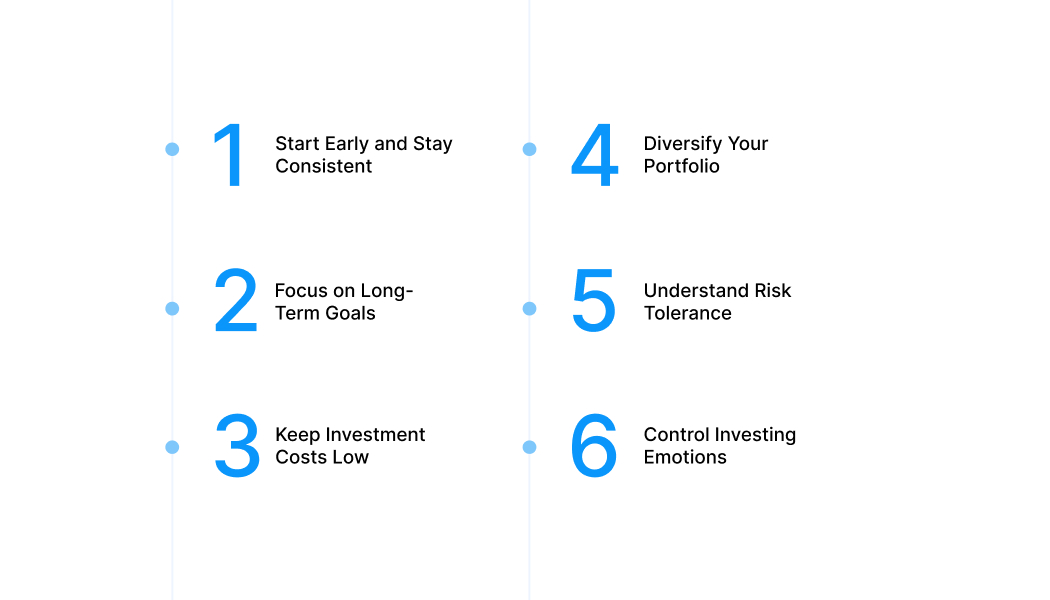
Investing can seem intimidating at first, but focusing on a few fundamental principles helps you make smart decisions, avoid common pitfalls, and steadily grow your wealth. These principles aren’t just rules; they’re habits that set you up for long-term financial success.
1. Start Early and Stay Consistent
One of the most important investing principles for beginners is starting as early as possible and contributing regularly. The earlier you begin, the more time your money has to grow through compounding, where your returns generate their own returns, turning small amounts into significant wealth over time.
Why it matters:
-
Early investing reduces the pressure to save huge sums later.
-
Regular contributions build discipline and reduce emotional decisions during market ups and downs.
-
Compounding accelerates growth. Long-term patience often beats short-term gains.
How to do it:
-
Decide on a monthly investment amount based on your budget. It could be as low as ₹1,000 to ₹5,000.
-
Automate investments in mutual funds, ETFs, or retirement accounts to make consistency effortless.
-
Avoid pausing contributions during market fluctuations. Staying invested matters more than perfect timing.
Example: Investing ₹5,000 monthly from age 25 at an average annual return of 10% can grow to over ₹10 lakh by age 35. If you delay and start investing ₹10,000 monthly at 35, after 10 years, it grows to roughly ₹20 lakh. Starting early gives you flexibility and a lower financial burden.
2. Focus on Long-Term Goals
Investing is most effective when approached with a long-term perspective. Short-term market fluctuations are normal, but a disciplined focus on your financial goals allows your investments to grow steadily over time through compounding.
Why it matters:
-
Reduces the temptation to react impulsively to daily market movements.
-
Maximises the power of compounding, turning small regular investments into significant wealth over the years.
-
Helps you align your portfolio with life goals like buying a home, funding education, or retirement planning.
How to do it:
-
Set clear, measurable financial goals with target timelines.
-
Match your investments to the time horizon of each goal. For example, equity-heavy portfolios for long-term goals and safer instruments for short-term needs.
-
Maintain discipline by investing regularly through methods like SIPs (Systematic Investment Plans) or recurring deposits.
-
Review your progress annually, but avoid knee-jerk changes based on market noise.
Example: Investing ₹5,000 per month in a diversified equity fund for 20 years could grow substantially due to compounding, while reacting to market dips by withdrawing could reduce the final corpus dramatically.
3. Keep Costs Low
Investment costs, including fees, commissions, and fund management charges, may seem small initially but can significantly impact your returns over time. Minimising these costs ensures more of your money stays invested and benefits from compounding.
Why it matters:
-
High fees can erode long-term returns, especially in equity or mutual fund investments.
-
Lower costs allow your investments to grow faster without unnecessary deductions.
-
Cost-conscious investing encourages disciplined, smarter decision-making.
How to do it:
-
Assess the expense ratios of mutual funds or ETFs before investing; choose lower-cost options with a strong track record.
-
Avoid frequent buying and selling that incur brokerage fees.
-
Consider passive investment options like index funds that generally have lower management costs than actively managed funds.
-
Factor in any hidden charges such as exit loads or account maintenance fees.
Example: Investing ₹50,000 in a mutual fund with a 2% annual expense ratio versus a similar fund at 0.5% over 20 years can result in a difference of several lakhs in returns, even if both funds perform similarly in the market.
Also Read: 10 Essential Financial Habits For Success
4. Diversify Your Portfolio
Diversification means distributing your investments across different asset classes, industries, and geographies to reduce risk. It prevents your entire portfolio from being heavily affected by the low performance of a single investment.
Why it matters:
-
Reduces the impact of market volatility on your overall wealth.
-
Balances risk and reward by combining high-risk, high-return assets with stable, low-risk options.
-
Helps achieve more consistent long-term growth while protecting against unexpected downturns.
How to do it:
-
Invest in a mix of equities, bonds, and cash or fixed-income instruments based on your risk tolerance.
-
Within equities, diversify across sectors (IT, FMCG, pharma, etc.) and market caps (large, mid, small).
-
Consider international diversification to reduce dependency on the domestic market.
-
Rebalance your portfolio periodically to maintain your desired risk allocation.
Example: If you invest only in one IT stock and the sector underperforms, your portfolio may suffer heavy losses. But a portfolio split across IT, FMCG, and pharma stocks, along with bonds, is likely to remain more stable even during sector-specific downturns.
5. Understand Risk and Your Risk Tolerance
Every investment carries some level of risk, from fluctuations in stock prices to inflation eroding returns. Understanding your personal risk tolerance—the amount of uncertainty you can comfortably handle—helps you choose investments that align with your financial goals and emotional comfort.
Why it matters:
-
Investing beyond your risk comfort can lead to panic selling during market downturns.
-
Underestimating risk may result in missed growth opportunities.
-
Matching risk with your investment horizon ensures your portfolio can weather short-term volatility without derailing long-term goals.
How to do it:
-
Assess your risk tolerance based on factors like age, income stability, financial goals, and emotional comfort with market swings.
-
Categorise investments: equities for higher risk and growth potential, and bonds or fixed deposits for lower risk and stability.
-
Use tools like risk assessment questionnaires offered by financial platforms to quantify your risk profile.
-
Revisit your risk tolerance periodically, especially after life changes like marriage, home purchase, or career shifts.
Example: A 28-year-old investor planning to buy a house in 10 years may take moderate risks with a mix of equities and bonds. Meanwhile, a 50-year-old nearing retirement may prioritise low-risk fixed-income assets to protect capital.
6. Keep Emotions in Check While Investing
Investing is as much a mental game as it is about money. Emotional decisions driven by fear, greed, or hype can lead to buying high and selling low, undermining long-term returns. Staying rational and sticking to a plan is key to consistent growth.
Why it matters:
-
Emotional investing often results in panic selling during market dips.
-
Chasing trends can lead to overexposure in risky assets.
-
Discipline helps maintain a balanced portfolio aligned with long-term goals.
How to do it:
-
Create a written investment plan and follow it strictly, avoiding impulsive trades.
-
Diversify across asset classes to reduce anxiety from market volatility.
-
Focus on long-term goals rather than short-term market fluctuations.
-
Set periodic reviews instead of reacting to daily market news.
Example: During a sudden market crash, a beginner investor might panic and sell their stocks at a loss. In contrast, an investor who planned for volatility and stuck to their allocation might hold or even buy more at lower prices, benefiting when the market recovers.
Also Read: 10 Smart Spending Tips For Financial Wellness
Common Beginner Mistakes to Avoid
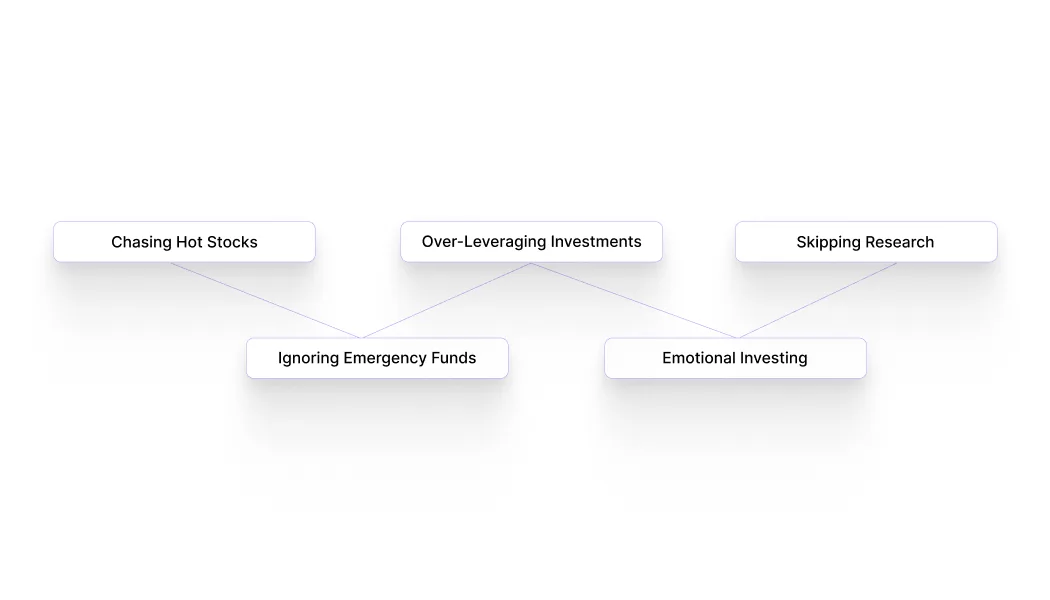
Investing can feel exciting, but beginners often make avoidable mistakes that can cost both time and money. Being aware of these pitfalls helps you stay on track and build wealth steadily.
1. Chasing Hot Stocks or Trends
Risk: Focusing on short-term market hype rather than fundamentals can lead to inconsistent returns and unnecessary losses. Many beginners are tempted by trending stocks or funds that promise high gains, but such moves often expose them to volatility and unpredictable market swings.
Mitigation: Develop a long-term investment strategy based on research, diversification, and your financial goals. Avoid making decisions solely on market chatter or social media trends.
2. Ignoring Emergency Funds Before Investing
Risk: Diving into investments without having a financial cushion increases vulnerability to unexpected expenses. Without liquid savings, investors may be forced to sell assets prematurely, locking in losses or disrupting long-term plans.
Mitigation: Build a 3–6 month emergency fund in a low-risk, easily accessible account before allocating money to investments. This ensures financial stability even when markets fluctuate.
4. Over-Leveraging or Borrowing to Invest
Risk: Using borrowed money magnifies both gains and losses. Beginners who over-leverage can face financial stress or even debt if their investments underperform. This can create a cycle of risk that undermines the purpose of investing in the first place.
Mitigation: Only invest money that you can afford to leave untouched for the long term. Avoid borrowing for market exposure unless you fully understand the risks involved.
5. Emotional Decision-Making During Market Volatility
Risk: Emotional reactions to market fluctuations, panic selling during dips, or impulsive buying during rallies can drastically reduce long-term returns. Investing driven by fear or FOMO disrupts planned strategies and increases stress.
Mitigation: Stick to your pre-defined investment plan and maintain a long-term perspective. Periodically review your portfolio without letting short-term market movements dictate your decisions.
6. Ignoring Research and Due Diligence
Risk: Investing without proper knowledge about products, fees, or risk profiles can lead to poor decisions and suboptimal outcomes. Many beginners rely on hearsay or superficial performance metrics rather than understanding the underlying fundamentals.
Mitigation: Conduct thorough research before committing funds. Understand each investment’s structure, associated risks, and alignment with your financial goals. Continuous learning ensures informed, confident decisions.
How Pocketly Supports Consistent Investing Without Disruptions
Starting your investing journey requires consistency, but unexpected expenses can often force you to pause SIPs, withdraw investments early, or delay contributions altogether. These interruptions may seem small in the moment, but they can impact long-term wealth creation.
Pocketly operates in the short-term digital credit space, helping users manage temporary cash flow gaps without disturbing their investment plans.
As a regulated digital lending platform, Pocketly supports users by:
-
Offering small ticket loans from ₹1,000 to ₹25,000, making it easier to handle short-term expenses without dipping into your investments.
-
Providing fast, fully digital access with quick KYC verification and minimal paperwork, so urgent financial needs can be addressed without delay.
-
Maintaining transparent pricing, with interest starting from 2% per month and clearly defined processing fees between 1% and 8%, depending on profile and loan amount.
-
Ensuring no collateral or guarantor requirements, making it accessible for young professionals and first-time investors.
-
Enabling quick bank transfers after approval allows you to manage emergencies without interrupting your financial routine.
-
Allowing flexible repayment options that align with your monthly budget, so you can continue investing without added financial pressure.
-
Helping manage urgent expenses such as medical costs, travel needs, or temporary cash shortages without liquidating long-term assets.
By focusing on accessibility, speed, and responsible borrowing, Pocketly supports your investing journey by acting as a short-term financial buffer. It helps you stay consistent with your investments while managing unexpected expenses without disrupting your long-term plans.
Download the Pocketly app today on [Android] or [iOS] to access funds when you need them and stay consistent with your financial goals.
FAQs
1. What are the basic investing principles?
Basic investing principles include starting early, staying consistent, diversifying your investments, understanding risk, keeping costs low, and maintaining a long-term perspective. These fundamentals help reduce risk and improve returns over time.
2. How much money do I need to start investing?
You can start investing with as little as ₹500 to ₹1,000 through SIPs in mutual funds or investment apps. The key is consistency, not the initial amount.
3. What is diversification in investing?
Diversification means spreading your money across different types of investments like stocks, mutual funds, and fixed-income assets. This reduces risk because poor performance in one area can be balanced by better performance in another.
4. Is investing risky for beginners?
All investments carry some level of risk, but beginners can reduce risk by choosing diversified options like mutual funds, investing regularly, and focusing on long-term goals instead of short-term gains.
5. What is the best investment option for beginners in India?
For beginners, mutual funds (especially index funds or SIPs) are often a good starting point because they offer diversification, professional management, and lower risk compared to individual stocks.