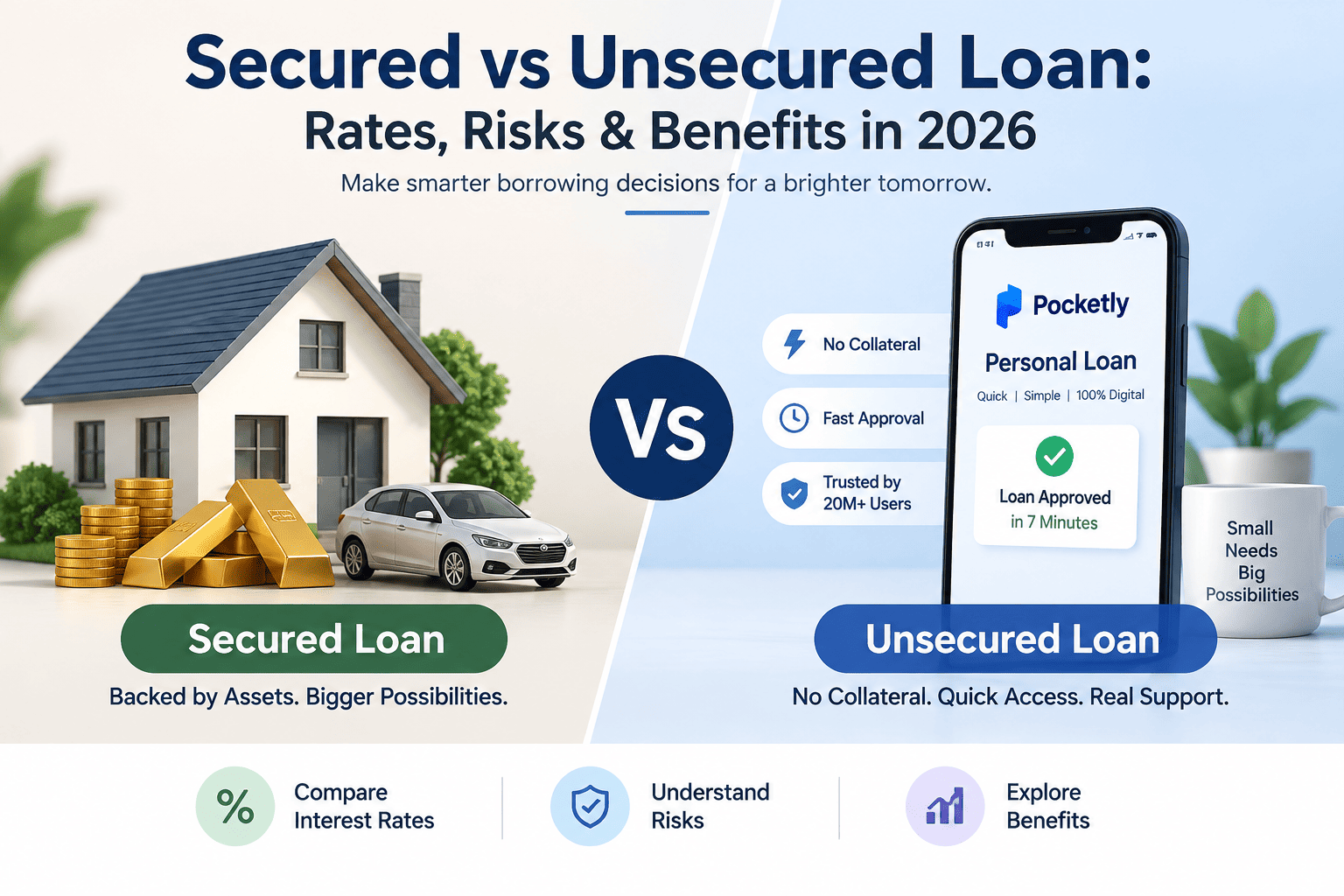


Secured vs Unsecured Loan: Which One Do You Need?
Need money urgently but unsure whether to choose a secured or unsecured loan?
This is one of the first questions borrowers should ask before taking credit. A home loan, gold loan or loan against property works differently from an unsecured personal loan. The biggest difference is simple: collateral.
If you are a student, first-jobber, salaried professional, freelancer or self-employed individual, understanding this difference can help you avoid borrowing more than you need and choosing a loan structure that doesn't fit your financial situation.
So, what is secured and unsecured loan? Let's break it down with practical examples.
Quick Answer: Secured vs Unsecured Loan
A secured loan requires collateral such as property, gold or another eligible asset. An unsecured loan does not require collateral and is generally assessed using the borrower's eligibility, income, repayment capacity and other lender criteria. Secured loans may offer lower rates, while unsecured loans can offer simpler and faster access to funds.
What Is a Secured Loan?
A secured loan is a loan backed by collateral.
In simple terms:
Asset → Security → Loan → Repayment → Asset released
Depending on the product, collateral could include:
-
Property
-
Gold
-
Vehicle
-
Certain financial assets
Examples of secured loans
|
Loan Type |
Typical Collateral |
|
Home Loan |
Property |
|
Gold Loan |
Gold |
|
Loan Against Property |
Property |
|
Vehicle Loan |
Vehicle |
The major advantage is that collateral can reduce the lender's risk. Depending on the product and borrower profile, this can result in a lower interest rate or access to a larger loan amount.
However, there is an important trade-off: your pledged asset is connected to the loan.
That means borrowers must understand the consequences of default before signing the agreement.
What Is an Unsecured Loan?
An unsecured loan is a loan that doesn't require the borrower to pledge an asset as collateral.
A personal loan is one of the most common examples.
Instead of securing the loan against a specific asset, the lender evaluates factors such as:
-
Income
-
Repayment capacity
-
Age
-
Employment or income profile
-
KYC information
-
Credit history, where applicable
-
Internal eligibility criteria
This structure can be particularly useful for people who don't own property or don't want to pledge an asset.
For a young professional who suddenly needs ₹10,000 or ₹20,000 for an urgent expense, an unsecured personal loan may be more relevant than arranging collateral.
Secured vs Unsecured Loan: Key Differences
|
Feature |
Secured Loan |
Unsecured Loan |
|
Collateral |
Required |
Not normally required |
|
Asset at risk |
Yes, pledged asset |
No pledged collateral |
|
Interest rate |
May be lower |
May be higher |
|
Loan amount |
Can be higher depending on asset |
Depends on eligibility |
|
Processing |
Can involve asset verification |
Often simpler |
|
Documentation |
May include asset documents |
KYC/income-related documents |
|
Common examples |
Home, gold, vehicle loans |
Personal loans |
|
Best suited for |
Asset-backed borrowing |
Personal/short-term needs |
Remember: Interest rates, fees, tenure and eligibility vary between lenders and loan products. Always check the actual offer before accepting credit.
Secured and Unsecured Loan: Why Is the Interest Different?
Think about lending from the lender's perspective.
If an asset secures a loan, the lender has additional security. With an unsecured loan, there is no specific asset pledged against the borrowing.
This difference can affect pricing.
But don't make the mistake of comparing loans using interest rate alone.
Consider:
-
Interest rate
-
APR
-
Processing fee
-
Applicable taxes
-
Tenure
-
Total repayment amount
-
Foreclosure/prepayment charges
-
Late-payment consequences
Example
Suppose you borrow ₹50,000.
A loan with a lower advertised interest rate could still cost more overall if it has significant fees or a longer tenure.
That's why experienced borrowers compare the total cost of borrowing, not just the number displayed next to "interest rate."
Secured vs Unsecured Loan: Benefits and Risks
Benefits of Secured Loans
-
Potentially lower borrowing cost
-
Can support larger loan amounts
-
Longer repayment periods may be available
-
Collateral can reduce lender risk
Risks of Secured Loans
-
Collateral is involved
-
Asset-related documentation may be required
-
Default can have serious financial consequences
-
Processing may take longer depending on the asset
Benefits of Unsecured Loans
-
No collateral required
-
Simpler application process
-
Convenient for personal expenses
-
Suitable when you don't own an acceptable asset
-
Digital lenders may provide faster application journeys
Risks of Unsecured Loans
-
Interest rates can be higher
-
Smaller loan amounts may be available
-
Eligibility can be stricter for some borrowers
-
Missed repayments can create additional financial stress
Secured or Unsecured Loan Kya Hota Hai?
Searching “secured or unsecured loan kya hota hai”?
Here's the simplest explanation:
Secured Loan
Asset ke against liya gaya loan = Secured Loan.
For example, gold can be pledged for a gold loan.
Unsecured Loan
Bina collateral ke liya gaya loan = Unsecured Loan.
For example, a personal loan generally doesn't require you to pledge your house or gold.
The important point is that unsecured doesn't mean risk-free.
You still have a contractual obligation to repay the borrowed amount, interest and applicable charges.
Which Loan Should You Consider?
Instead of asking, "Which is better?", ask these five questions:
1. How much money do I need?
Don't borrow ₹50,000 if your actual requirement is ₹10,000.
2. Do I have collateral?
If you don't have an asset—or don't want to pledge one—an unsecured product may be more relevant.
3. How quickly do I need the money?
For urgent expenses, application speed and documentation may matter.
4. Can I comfortably repay?
Calculate your expected repayment against your monthly income and essential expenses.
5. What's the total cost?
Compare the complete borrowing cost before accepting an offer.
Real-Life Example: A Salary-Gap Emergency
Imagine Rahul, a first-jobber, receives his salary on the 30th.
On the 22nd, an unexpected medical or household expense of ₹15,000 arrives.
Rahul has no property or gold available to pledge.
His practical checklist should be:
-
Confirm the exact amount required.
-
Check whether an unsecured personal loan is available.
-
Compare interest and applicable fees.
-
Check the repayment date.
-
Calculate whether repayment fits his upcoming income.
-
Read the loan terms before accepting.
The objective isn't simply to get money quickly.
The objective is to solve the immediate cash-flow problem without creating a larger one next month.
Pocketly: Instant Personal Loans for Young India
When a relatively small financial requirement comes up, collateral isn't always practical.
That's where Pocketly's digital personal loan offering can be relevant for eligible borrowers.
Pocketly's personal loans range from ₹1,000 to ₹50,000, with a 100% digital application journey and repayment periods ranging from 61 days to 9 months.
Pocketly is designed around the needs of young Indians, including students, first-jobbers, freelancers and salaried professionals, according to its supplied website content.
Why borrowers may consider Pocketly
-
Loans up to ₹50,000
-
100% digital process
-
No collateral
-
Fast loan application journey
-
Flexible repayment options
-
Minimum KYC
-
Online loan management
-
Suitable for eligible salaried and self-employed borrowers
Pocketly's Speel Finance Company Private Ltd. is an RBI-registered NBFC that lends through its Pocketly technology platform. It also describes a responsible-lending approach involving transparent disclosure of borrowing costs, fees and lending terms.
Pocketly's interest range of 2%–3% per month, processing fees of 0%–7.5% plus applicable GST, and an APR range of 30%–121%. Because the actual cost can vary by offer, borrowers should review their specific loan terms and applicable disclosures before accepting.
Need a quick personal loan?
If you meet Pocketly's eligibility requirements, you can explore its digital personal-loan options without pledging property or gold.
7 Mistakes to Avoid Before Taking a Loan
1. Borrowing more than necessary
A larger loan means a larger repayment obligation.
2. Looking only at the interest rate
Always examine the complete cost.
3. Ignoring processing fees
Even a small fee can matter significantly on short-term borrowing.
4. Choosing a tenure without checking affordability
A repayment schedule should fit your actual cash flow.
5. Assuming "instant" means guaranteed approval
Loan applications remain subject to eligibility and lender assessment.
6. Taking a new loan to repeatedly cover old debt
This can create a difficult cycle of borrowing.
7. Skipping the agreement
Read the applicable terms, charges, repayment schedule and disclosures before accepting credit.
Quick Decision Checklist
|
Your Situation |
What to Consider |
|
Need a large amount |
Secured products may be worth exploring |
|
Own property/gold |
Compare secured options |
|
Don't want collateral |
Consider unsecured products |
|
Need a small personal expense loan |
Compare unsecured personal loans |
|
Need funds quickly |
Compare digital application processes |
|
Worried about repayment |
|
|
Check APR + fees + total repayment |
FAQs
1. What is secured and unsecured loan?
A secured loan uses collateral, while an unsecured loan doesn't normally require a pledged asset.
2. Is a personal loan secured or unsecured?
A conventional personal loan is generally an unsecured loan.
3. Which has a lower interest rate: secured or unsecured?
Secured loans may have lower rates because collateral can reduce lender risk, but actual rates vary by lender and borrower.
4. Can I get an unsecured loan without collateral?
Yes. Personal loans are a common form of unsecured borrowing, subject to eligibility.
5. Is an unsecured personal loan safe?
It can be a useful financial product when borrowed responsibly. Always check the lender, terms, fees, APR and repayment obligations.
6. Does unsecured mean there is no risk?
No. The borrower remains responsible for repayment, and missed payments can have financial consequences.
7. What documents are required for a personal loan?
Requirements vary by lender. Pocketly's supplied information lists personal details, address proof, verified email, Video KYC and PAN-related identity verification among its requirements.
8. What is the biggest difference between secured and unsecured loans?
Collateral. A secured loan is backed by an asset; an unsecured loan generally isn't.
9. Secured or unsecured loan kya hota hai?
Secured loan mein collateral/asset security hoti hai. Unsecured loan mein normally collateral nahi hota.
10. What should I check before taking an unsecured loan?
Check the interest rate, APR, processing fee, tenure, total repayment, repayment dates and applicable charges.