

7 Personal Loan Scams to Watch Out for in 2026-2027
Personal loan scams can start with a fake loan app, WhatsApp message, phone call, website or an offer that promises easy approval and asks you to act immediately. In India, borrowers should verify who is providing the loan, check whether the lender is regulated, read the Key Fact Statement (KFS), understand all charges and avoid sharing OTPs, PINs or banking credentials.
At Pocketly, we want you to understand who you are borrowing from and what you will repay before accepting a loan. Our responsible-lending approach includes displaying borrowing costs, fees, charges and lending terms so borrowers can make an informed decision.
Quick Answer: How Can You Spot a Personal Loan Scam?
|
Check |
Genuine lending process |
Possible scam warning |
|
Lender details |
Regulated lender can be identified |
Lender identity is hidden |
|
Loan offer |
Eligibility is assessed |
"100% guaranteed approval" |
|
Charges |
Costs are disclosed |
Unexpected upfront payment demanded |
|
Loan terms |
Repayment terms are available |
Terms are hidden or vague |
|
App source |
Official website/app-store source |
APK sent through WhatsApp/SMS |
|
Communication |
Verifiable official channel |
Random number creates urgency |
|
KYC |
Proper verification process |
"No verification needed" |
|
Personal data |
Relevant information requested |
OTP, UPI PIN or banking password requested |
|
Repayment |
Official repayment channel |
Money requested in a personal account |
|
Pressure |
Time to review terms |
Threats or extreme urgency |
The RBI advises borrowers to verify whether a digital lending app is associated with an RBI-regulated bank or NBFC through the bank/NBFC's website and to avoid loan apps received through SMS or social-media links.
What Are Personal Loan Scams?
Personal loan scams are fraudulent schemes where criminals pretend to be lenders, loan agents or digital lending platforms to steal money, banking information, identity documents or other personal information.
A personal loan fraud may involve:
-
Fake loan apps
-
Fake lender websites
-
Fraudulent WhatsApp loan offers
-
Personal loan scam calls
-
Advance-fee demands
-
Fake customer-care numbers
-
Phishing links
-
APK files sent outside official app stores
-
Fake KYC requests
-
Fraudulent repayment accounts
-
Identity theft
-
Threats or harassment
-
False promises of guaranteed approval
An online loan scam can look convincing because fraudsters may copy logos, lender names, website designs or app interfaces.
That is why you should verify the regulated lender instead of judging an offer only by its branding.
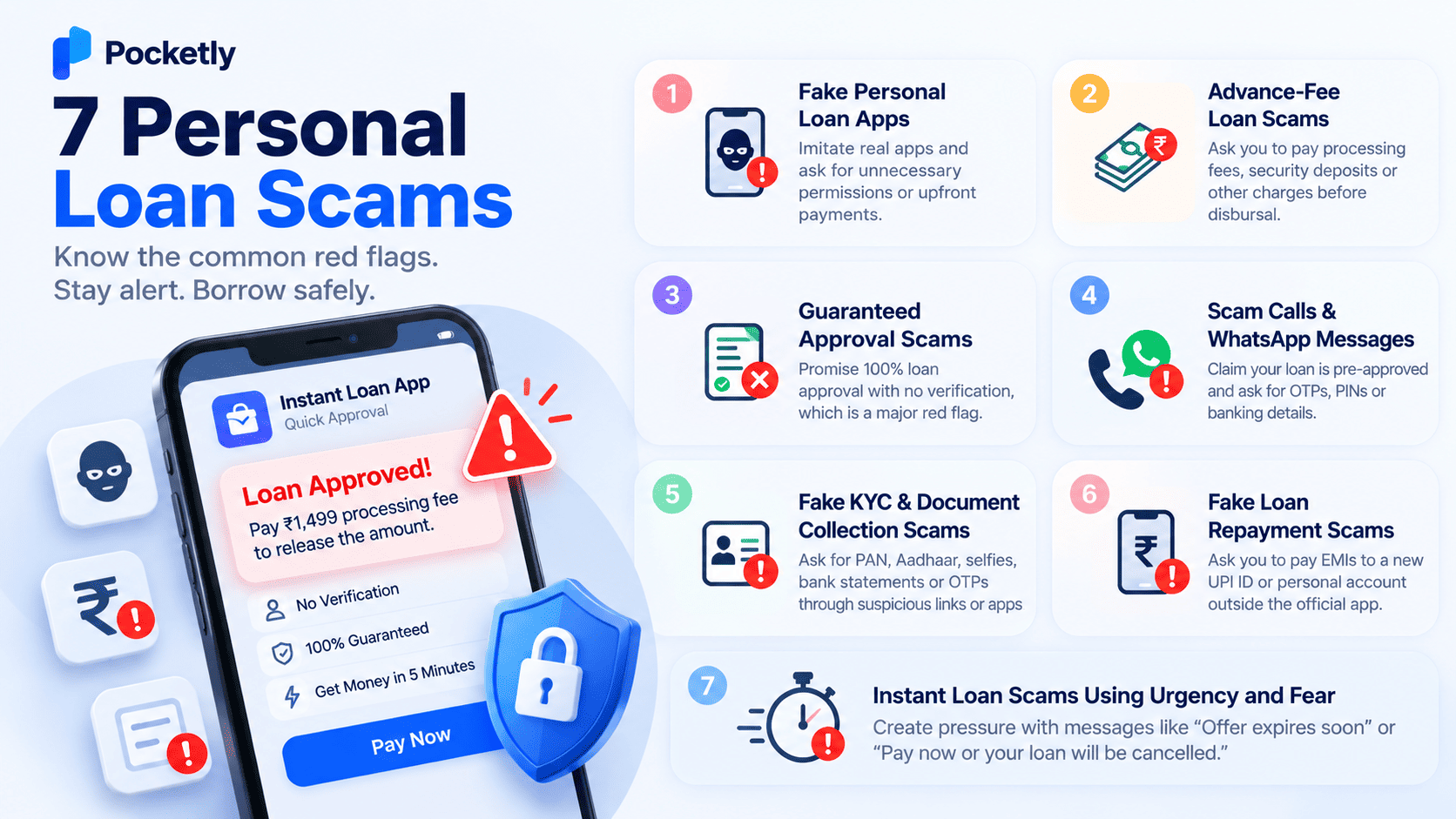
7 Personal Loan Scams You Should Watch Out For
1. Fake Personal Loan Apps
Fake personal loan apps may imitate legitimate lending apps or use names that sound similar to known financial brands.
The RBI explains that borrowers can verify whether a digital lending app has an association or outsourcing arrangement with an RBI-regulated bank or NBFC through that regulated entity's website. It also advises people to avoid apps received as links through SMS or social-media channels.
Red flags of a fake loan app
Watch for:
-
No clear regulated lender information
-
No official company details
-
Missing privacy information
-
APK files sent through WhatsApp or Telegram
-
Requests for unnecessary phone permissions
-
Guaranteed loan claims
-
No proper loan agreement
-
No clear repayment information
-
Hidden charges
-
Suspicious payment accounts
-
Poor or unverifiable customer support
-
Pressure to borrow immediately
Fake loan app vs genuine lending app
|
Factor |
What you should expect |
Warning sign |
|
Regulated lender |
Clearly identifiable |
Not disclosed |
|
App source |
Verifiable official source |
Random APK/link |
|
KYC |
Appropriate verification |
No verification |
|
Charges |
Disclosed before acceptance |
Hidden until later |
|
Loan agreement |
Available for review |
Missing |
|
Repayment |
Official channel |
Personal UPI/account |
|
Support |
Verifiable contact channel |
WhatsApp-only support |
|
Privacy |
Clear data practices |
Excessive permissions |
At Pocketly, Speel Finance Company Private Limited is identified as the RBI-registered NBFC lending through its technology platform, Pocketly.
2. Advance-Fee Loan Scams
Someone contacts you and claims:
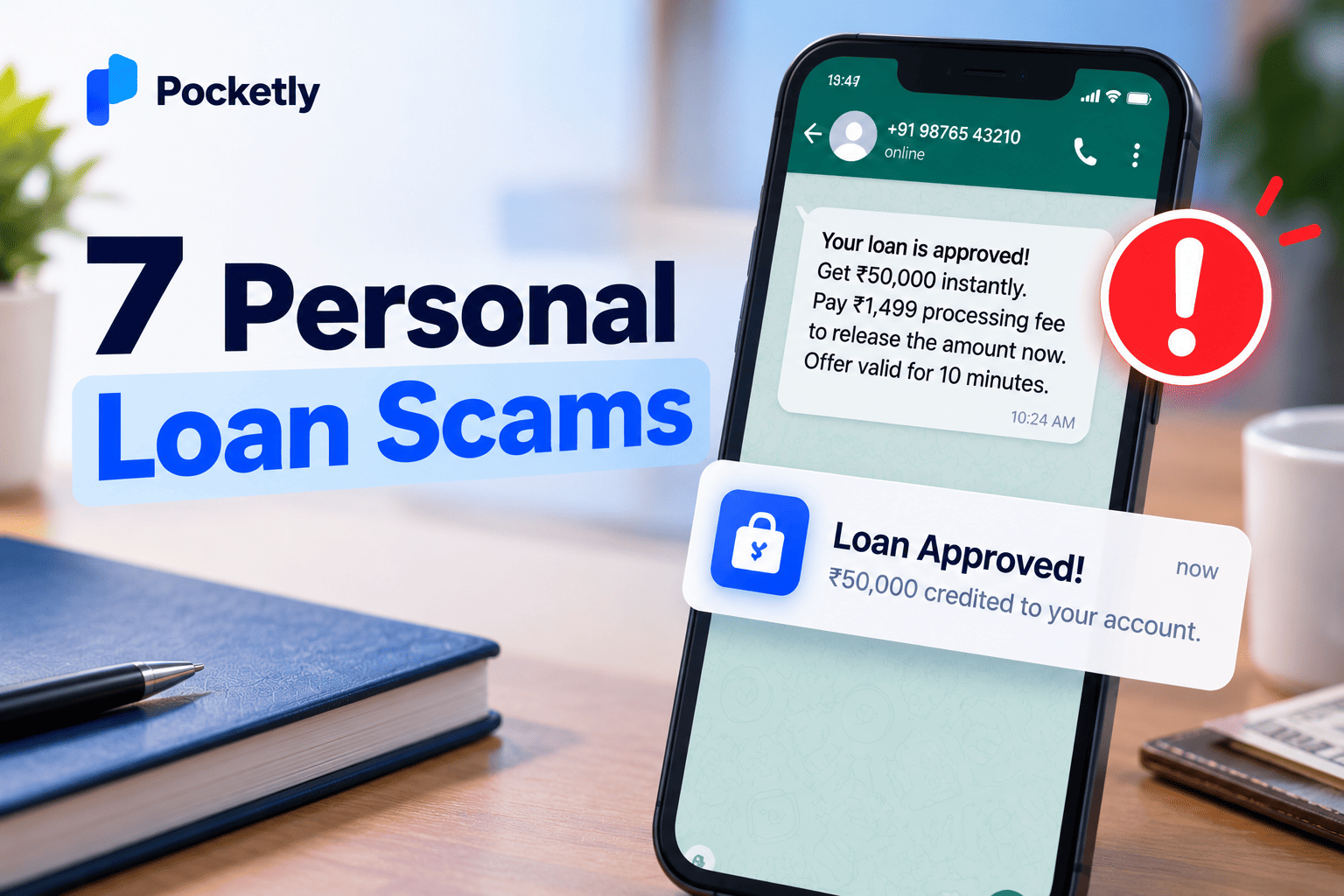
"Your ₹50,000 loan is approved. Pay ₹1,499 to release the amount."
That should immediately trigger further verification.
Fraudsters may describe the payment as:
-
Processing charge
-
Security deposit
-
GST payment
-
File-opening fee
-
Insurance fee
-
Verification fee
-
Loan-release charge
-
Refundable deposit
RBI consumer-awareness material warns about fake loan websites/apps and advises borrowers to verify the lender and be cautious about demands for payment before loan processing.
Before paying any loan-related charge
-
Stop and verify the lender.
-
Check whether the charge appears in the official loan documentation.
-
Read the KFS and loan agreement.
-
Verify the payment destination.
-
Contact the lender through an independently verified official channel.
-
Do not rely on a phone number supplied only by the person demanding payment.
-
Never transfer money because someone says the offer will "expire in 10 minutes."
3. Guaranteed Approval Scams
Claims such as these deserve caution:
-
"100% loan approval"
-
"Guaranteed ₹50,000 loan"
-
"No verification required"
-
"Everyone gets approved"
-
"Loan guaranteed despite any profile"
-
"Pay first and approval is confirmed"
A legitimate credit application can involve eligibility checks, KYC, documentation and underwriting.
Approval cannot be assumed simply because an application has been submitted.
Understand these differences
|
Term |
What it means |
|
Application submitted |
Your loan request has been sent |
|
KYC completed |
Identity verification has been completed |
|
Eligible |
You meet applicable eligibility requirements |
|
Approved |
The lender has accepted the application |
|
Disbursed |
Approved funds have been transferred |
|
EMI/repayment |
Amount due according to agreed repayment terms |
These stages should not be treated as the same thing.
At Pocketly, eligible borrowers can explore personal loans, but approval remains subject to applicable eligibility and underwriting criteria. Our current product information lists loan amounts from ₹1,000 to ₹50,000, with the applicable costs and repayment terms disclosed separately.
4. Personal Loan Scam Calls and WhatsApp Messages
A personal loan scam call may start with:
"Your pre-approved loan is ready."
The caller may already know your name or mobile number. That alone does not prove that the caller represents a genuine lender.
Never share these details because of an unsolicited call
-
OTP
-
UPI PIN
-
Debit-card PIN
-
Credit-card PIN
-
Internet-banking password
-
Banking login credentials
-
CVV
-
Screen-sharing access
-
Remote-control access to your phone
Also be cautious if someone asks you to install an unknown app to "complete KYC" or "receive your loan."
Questions to ask before trusting a loan call
-
What is the full legal name of the lender?
-
Is the lender regulated?
-
Where can I independently verify the company?
-
What is the official website?
-
Where is the KFS?
-
What is the applicable APR?
-
What processing fees apply?
-
What is the repayment period?
-
What is the total repayment obligation?
-
Why is this payment or information required?
If the caller refuses to answer basic questions, do not proceed.
5. Fake KYC and Document Collection Scams
KYC is a legitimate part of financial services, but criminals can use fake KYC requests to collect identity information.
They may ask for:
-
PAN details
-
Aadhaar details
-
Selfies
-
Bank statements
-
Salary documents
-
Bank-account details
-
Video verification
-
OTPs
The presence of a KYC request does not automatically make an app genuine.
Before uploading KYC documents
Check:
-
Who is collecting the information?
-
Why is each document required?
-
Is the app or website official?
-
Who is the regulated lender?
-
Is there a privacy policy?
-
Is the connection secure?
-
Does the request match the normal application process?
-
Are you being asked for credentials that should remain secret?
For our applicable loan process, Pocketly's product pages list information such as personal details, address proof based on Aadhaar, verified email, video KYC and PAN information among applicable verification requirements.
Self-employed applicants can also check the applicable documentation and eligibility requirements through our dedicated self-employed loan information before applying.
6. Fake Loan Repayment Scams
Fraud does not always happen before disbursal.
A scammer may contact an existing borrower and claim:
"Your repayment account has changed. Send your EMI to this UPI ID."
Or:
"Pay today to avoid legal action."
Repayment red flags
|
Situation |
What you should do |
|
New UPI ID sent on WhatsApp |
Verify through the official app/channel |
|
Personal bank account provided |
Do not transfer without verification |
|
Unknown QR code |
Do not scan and pay |
|
Threatening caller |
Verify independently |
|
"Settlement" offered by stranger |
Contact official support |
|
Payment link from unknown domain |
Avoid opening it |
|
Unexpected penalty demand |
Check your agreement/account |
|
Request for OTP/PIN |
Never provide it |
Always use the repayment method shown through verified official channels.
7. Instant Loan Scam Using Urgency and Fear
An instant loan scam often tries to stop you from checking the details.
Common messages include:
-
"Offer expires in 5 minutes"
-
"Pay now or your loan will be cancelled"
-
"Your CIBIL will be blocked today"
-
"Police complaint will be filed immediately"
-
"Final chance to release your loan"
-
"Complete payment before account closure"
-
"Send OTP now"
Urgency can push borrowers into making a payment before checking who is requesting it.
Use the 5-minute verification rule
Before responding to an unexpected loan demand:
-
Stop communicating with the caller temporarily.
-
Do not click the supplied link.
-
Open the lender's official website independently.
-
Check your account through the official app.
-
Contact verified customer support.
-
Compare the request with your KFS or loan agreement.
-
Continue only after the request has been verified.
How to Identify Fake Loan Apps in India
If you're wondering how to identify fake loan apps, use this checklist before applying.
12-point loan app safety checklist
-
Identify the actual regulated lender.
-
Verify the lender independently.
-
Check the lender's official website.
-
Confirm its relationship with the lending app.
-
Download the app only from a verified source.
-
Avoid APK files received through messages.
-
Read the privacy policy.
-
Review permissions requested by the app.
-
Read the KFS before accepting credit.
-
Check APR, fees and repayment terms.
-
Verify customer-support details.
-
Never share OTP, PIN or banking password.
RBI guidance specifically recommends checking the regulated bank/NBFC's website to establish whether a digital lending app is associated with that entity.
How to Check If a Loan App Is Genuine
People searching how to check if a loan app is genuine should verify the lender behind the app rather than relying only on the app's name or appearance.
Follow these steps.
Step 1: Find the lender's legal name
Look for the entity that is actually providing the credit.
Step 2: Check regulatory information
Verify the bank or NBFC through official sources.
Step 3: Verify the app-lender relationship
Check the regulated lender's official website rather than relying only on information displayed inside the app.
Step 4: Check the official website
Look for:
-
Legal company information
-
Customer support
-
Privacy policy
-
Terms and conditions
-
Grievance information
-
Loan disclosures
Step 5: Review the Key Fact Statement
Before accepting a loan, understand applicable:
-
Interest
-
APR
-
Processing fees
-
GST
-
Repayment period
-
EMI or repayment schedule
-
Other charges
-
Total repayment obligation
Step 6: Verify the app source
Avoid unknown APK files and links sent through random messages.
Step 7: Check what permissions are requested
Be cautious when an app asks for information or device permissions that appear unrelated to the lending process.
Step 8: Verify before paying
Do not send money to a personal bank account or UPI ID simply because someone claims to represent the lender.
What Should You Check Before Taking an Online Personal Loan?
|
Check |
Why it matters |
|
Regulated lender |
Shows who is legally providing the credit |
|
KFS |
Summarises important loan information |
|
Interest rate |
Shows borrowing cost |
|
APR |
Helps compare the annualised cost |
|
Processing fee |
Affects how much the loan costs |
|
GST |
May apply to relevant charges |
|
Repayment period |
Determines how long you repay |
|
EMI/payment amount |
Helps assess affordability |
|
Total repayment |
Shows total financial obligation |
|
Late-payment terms |
Shows consequences of delayed payment |
|
Grievance channel |
Gives you an official route for complaints |
|
Privacy policy |
Explains handling of personal information |
At Pocketly, our responsible-lending policy says borrowers should be given information needed to understand loan products, including borrowing costs, fees, charges and lending terms.
What Should You Do If You Have Already Paid a Loan Scammer?
Act quickly.
1. Call 1930
The National Cyber Crime Reporting Portal identifies 1930 as the helpline for immediate reporting of cyber financial fraud.
2. Report the incident online
Use the Government of India's National Cyber Crime Reporting Portal.
National Cyber Crime Reporting Portal
The portal allows people to report financial fraud and other cybercrime complaints.
3. Contact your bank
Inform your bank or payment provider immediately if money has been transferred.
Keep the transaction ID and payment information ready.
4. Preserve evidence
Save:
-
Screenshots
-
Phone numbers
-
WhatsApp conversations
-
SMS messages
-
Email messages
-
Website URLs
-
App details
-
UPI IDs
-
Bank-account details
-
Transaction IDs
-
Payment receipts
-
Call records where available
5. Secure compromised accounts
If sensitive credentials may have been exposed:
-
Change relevant passwords.
-
Secure banking access.
-
Remove unknown applications.
-
Review recent transactions.
-
Contact the relevant financial institution.
-
Never share a new OTP with anyone claiming to "reverse" the fraud.
6. Report suspicious identifiers
The National Cyber Crime Reporting Portal's Report Suspect facility accepts suspicious website URLs, WhatsApp/Telegram identifiers, phone numbers, email IDs, SMS identifiers and social-media URLs.
Before You Apply: 10 Questions to Ask Yourself
Before taking any personal loan, ask:
-
Do I know which regulated lender is providing the credit?
-
Have I verified the app through an official source?
-
Have I read the KFS?
-
Do I know the interest rate?
-
Have I checked the APR?
-
Do I understand all processing fees and applicable taxes?
-
Do I know my total repayment obligation?
-
Can my monthly budget handle the repayment?
-
Do I know the consequences of delayed repayment?
-
Am I borrowing for a necessary and manageable expense?
If several answers are "no", review the loan again before accepting it.
Borrowing Safely With Pocketly
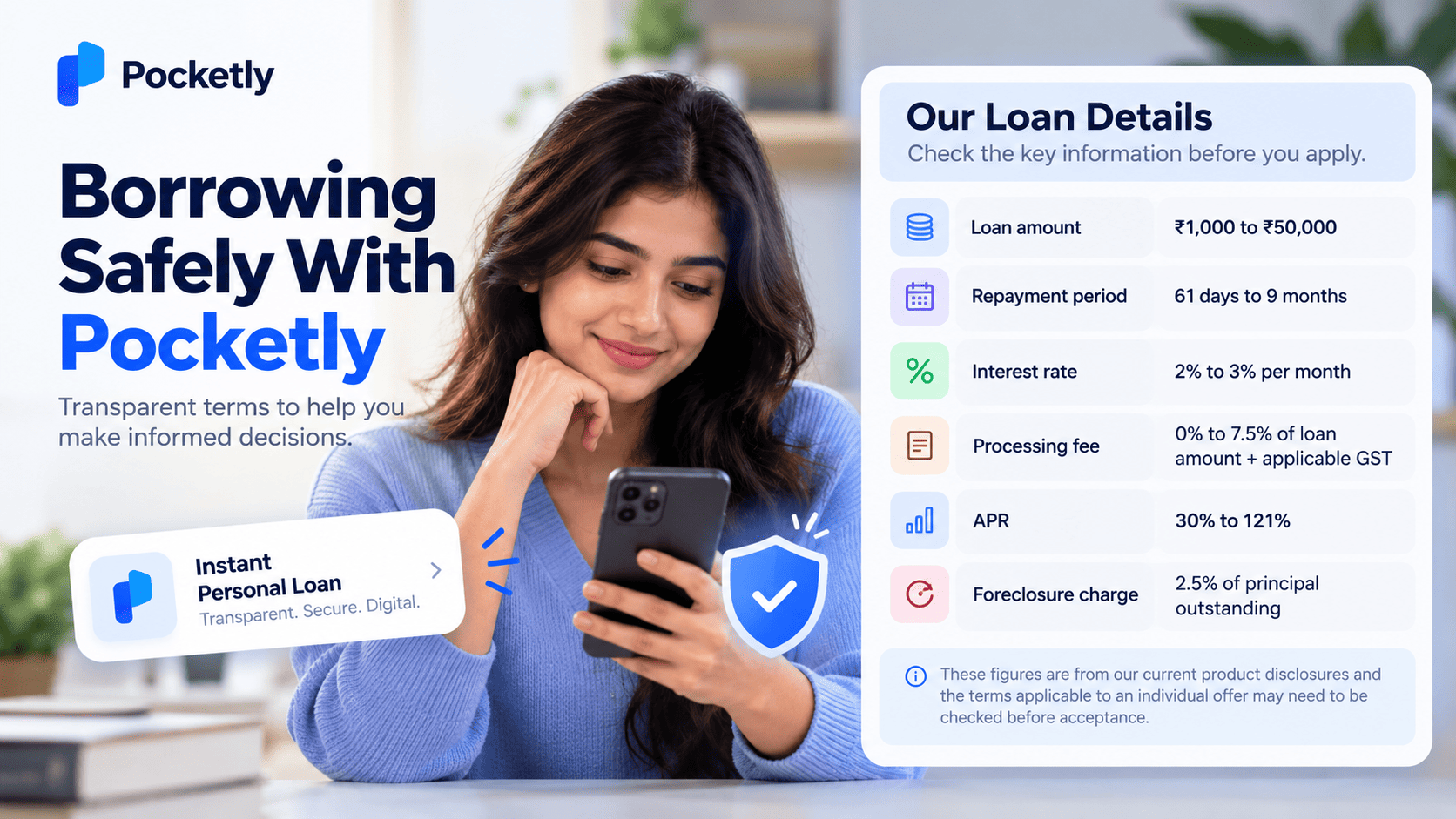
When you apply with us, check the applicable terms shown for your loan before proceeding.
Our current general product information lists:
|
Pocketly loan information |
Current disclosed range/details |
|
Loan amount |
₹1,000 to ₹50,000 |
|
Repayment period |
61 days to 9 months |
|
Interest rate |
2% to 3% per month |
|
Processing fee |
0% to 7.5% of loan amount + applicable GST |
|
APR |
30% to 121% |
|
Foreclosure charge |
2.5% of principal outstanding |
These figures come from our current product disclosures and the terms applicable to an individual offer may need to be checked before acceptance.
Depending on your income profile, you can also explore our dedicated options for:
-
Personal loan for salaried applicants
-
Personal loan for self-employed applicants
-
Personal loan for non-salaried applicants
If you're comparing options using searches such as best loan app in India, don't decide based only on an app's marketing claim. Compare the regulated lender, APR, processing fees, repayment period, KFS, eligibility requirements and total repayment obligation.
Similarly, an instant personal loan online in 2 minutes search should not be interpreted as guaranteed approval or guaranteed disbursal within two minutes. Application speed, approval and disbursal are separate stages.
Personal Loan Scam Prevention Checklist
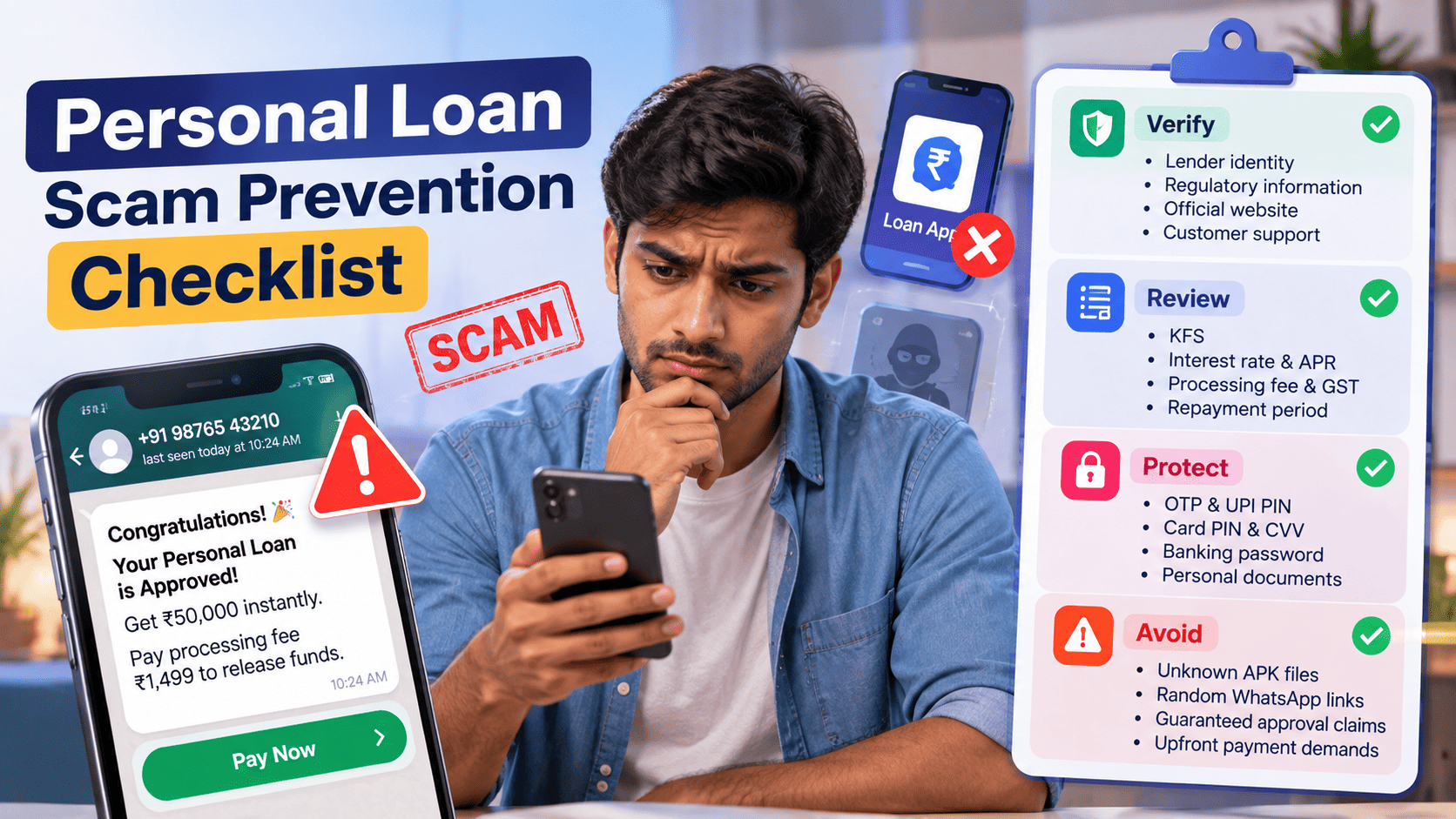
Before tapping "Apply", run through this final check:
Verify
-
Lender identity
-
Regulatory information
-
Official website
-
App-lender relationship
-
Customer support
-
Grievance channel
Review
-
KFS
-
Interest rate
-
APR
-
Processing fee
-
GST
-
Repayment period
-
Total repayment
-
Late-payment conditions
Protect
-
OTP
-
UPI PIN
-
Card PIN
-
CVV
-
Banking password
-
Personal documents
-
Device access
Avoid
-
Unknown APK files
-
Random WhatsApp loan links
-
Guaranteed approval claims
-
Upfront payment demands from unverified people
-
Personal UPI repayment requests
-
Unknown QR codes
-
Screen-sharing requests
-
Pressure-based decisions
Final Takeaway
Personal loan scams are easier to avoid when you verify the lender before sharing documents, paying charges or accepting a loan.
Remember these five rules:
-
Verify the regulated lender.
-
Never trust guaranteed approval claims blindly.
-
Read the KFS and understand the total borrowing cost.
-
Never share OTPs, PINs or banking passwords.
-
Report financial cyber fraud quickly through 1930 and the National Cyber Crime Reporting Portal.
If you're considering a personal loan with us, review the applicable eligibility criteria, KFS, interest, APR, processing fees, repayment period and total repayment obligation before accepting your offer.
Check Your Eligibility With Pocketly
FAQs
1. What are the most common personal loan scams?
Common personal loan scams include fake loan apps, advance-fee fraud, guaranteed-approval scams, fake KYC requests, fraudulent loan calls, fake repayment requests and phishing links.
2. How can I identify a fake loan app?
Check which regulated bank or NBFC is behind the app, verify the relationship through the regulated entity's official website, review loan disclosures and avoid apps received through SMS or social-media links. The RBI recommends these verification steps for digital lending apps.
3. How do I check if a loan app is genuine?
Identify the lender, independently verify its regulatory status, confirm its association with the app, review the KFS and check official customer-support and grievance information.
4. What should I do if I lose money in a loan app fraud?
Immediately report cyber financial fraud through 1930 and the National Cyber Crime Reporting Portal, and contact your bank or payment provider. Preserve transaction details and other evidence.
5. Is every instant loan app a scam?
No. Digital lending itself is legitimate. RBI guidance recognises digital lending apps operated by regulated entities or lending service providers associated with regulated entities. The important step is verifying who is behind the app.
6. Can a loan app guarantee approval?
You should be cautious about unconditional guaranteed-approval claims. Loan applications can be subject to eligibility, verification and underwriting requirements.
7. Should I pay a fee before receiving a personal loan?
Check the lender's official documentation and KFS for applicable charges. Be suspicious when an unknown person demands an upfront transfer to a personal account or UPI ID to "unlock" a loan.
8. Can salaried applicants apply with Pocketly?
Yes. If you're salaried, you can explore our personal loan for salaried applicants, subject to applicable eligibility and underwriting criteria. Our salaried-loan information currently lists applicable verification requirements including personal details, address proof, verified email, video KYC and PAN information.
9. Can self-employed applicants explore a loan with Pocketly?
Yes. If you're self-employed, you can explore our personal loan for self-employed applicants, subject to applicable eligibility and underwriting criteria.
10. What about applicants without a conventional salary?
Applicants with other eligible income sources can review our personal loan for non-salaried applicants. The applicable page includes its own eligibility and verification information.
11. Is Pocketly an RBI-registered NBFC?
Pocketly is the technology platform/brand. Speel Finance Company Private Limited is identified in our responsible-lending information as the RBI-registered NBFC that lends personal loans through its own technology platform, Pocketly.
12. What should I compare before choosing a personal loan app?
Compare the regulated lender, APR, interest rate, processing fees, repayment period, total repayment obligation, eligibility criteria, KFS, privacy practices and customer-support channels rather than choosing solely based on claims such as "fastest" or "best loan app in India."