

NPCI UPI Charges Above ₹2,000: 0.4% MDR Explained
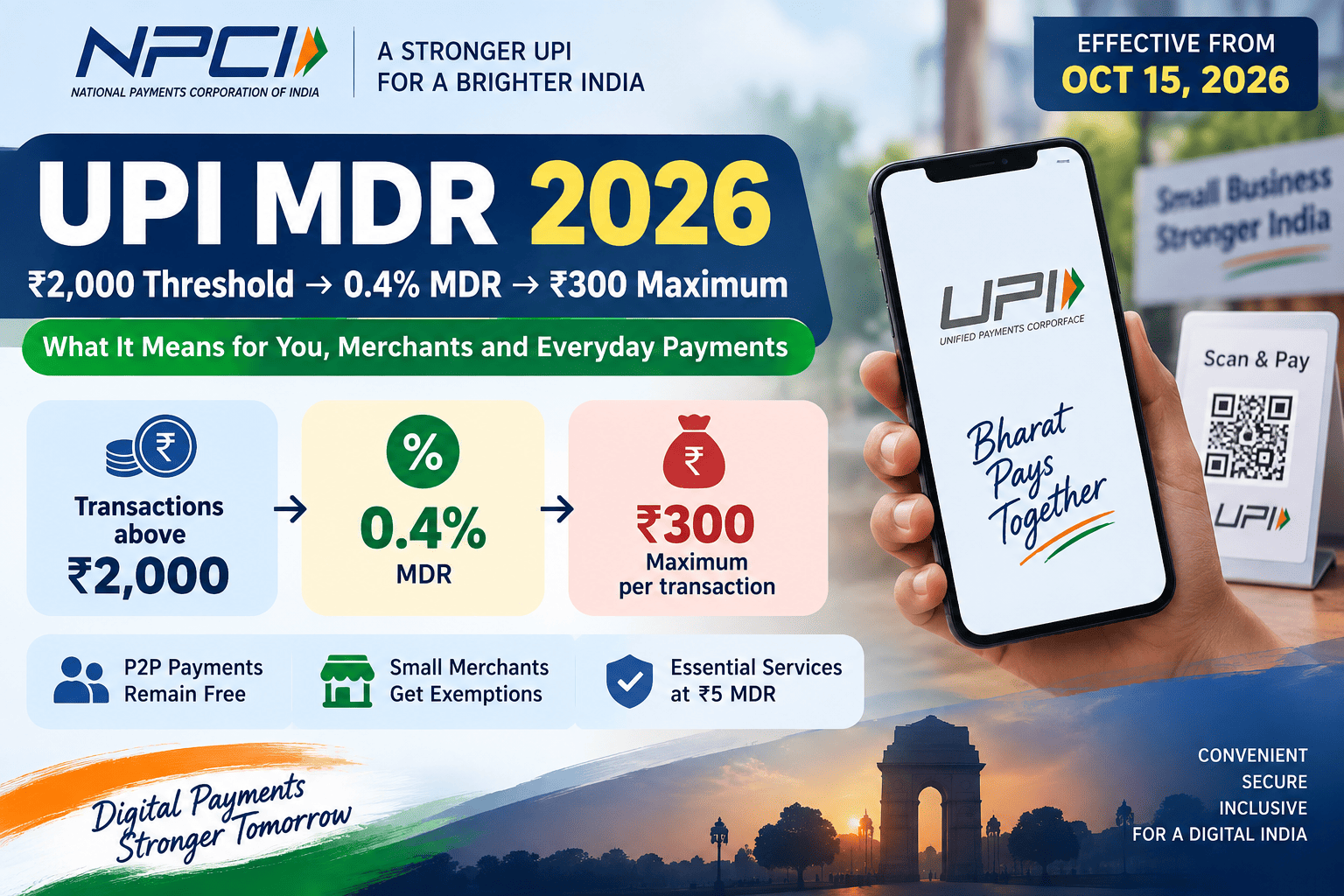
NPCI has announced a revised Merchant Discount Rate (MDR) framework for select UPI merchant transactions. The new framework takes effect October 15, 2026.
UPI Charges Above ₹2,000: What Changed in 2026?
For years, UPI has felt almost invisible in everyday spending. Scan a QR code, enter ₹2,500, authenticate, and the payment is done.
Now there is a new question making the rounds: “Is UPI charged above ₹2,000?”
The short answer is more nuanced than the headlines suggest.
NPCI's revised framework introduces a 0.4% Merchant Discount Rate (MDR) on specified Person-to-Merchant (P2M) UPI transactions above ₹2,000, effective October 15, 2026. But this is not a blanket charge on every UPI user. Person-to-person payments remain free, while payments up to ₹2,000 to merchants remain outside the MDR framework.
That distinction matters especially for students, salaried professionals, freelancers and small-business customers who use UPI every day.
Quick Answer: Is UPI Charged Above ₹2,000?
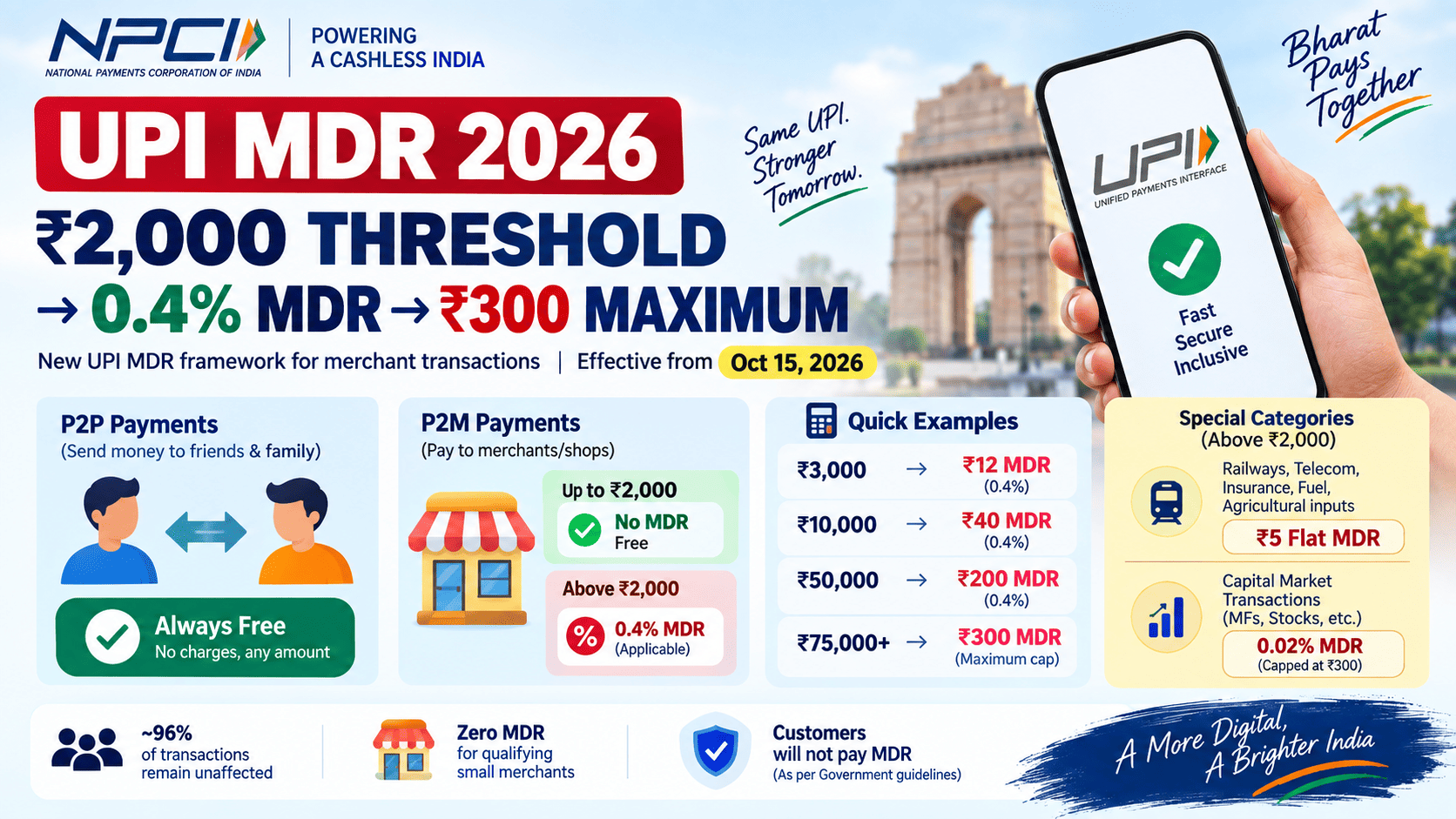
Specified UPI merchant payments above ₹2,000 will attract a 0.4% MDR from October 15, 2026. The charge applies within the merchant payment ecosystem, not as a direct fee to consumers. P2P UPI payments remain free regardless of amount, while payments to merchants up to ₹2,000 remain free.
What Is UPI MDR?
Merchant Discount Rate (MDR) is a fee associated with accepting digital payments. Under the new framework, MDR applies to specified merchant-facing UPI transactions rather than functioning as a general consumer transaction fee.
The government has clarified that MDR is not a tax collected by the government or NPCI. Instead, it is distributed among participants in the payments ecosystem, including banks, payment service providers and UPI application providers.
In simple words
Think about a ₹10,000 UPI payment at a merchant:
Customer → UPI app → banks/payment ecosystem → merchant
The new MDR operates within that payment chain.
It does not mean that the customer automatically sees a ₹40 “UPI fee” added to the bill.
UPI Charges Above ₹2,000: The New Rule at a Glance
|
Transaction type |
New treatment |
|
P2P UPI payment |
Free |
|
Merchant payment up to ₹2,000 |
Free |
|
Specified merchant payment above ₹2,000 |
0.4% MDR |
|
₹75,000+ applicable merchant transaction |
MDR capped at ₹300 |
|
Railways, telecom, insurance, fuel and certain essential sectors above ₹2,000 |
₹5 flat MDR |
|
Capital-market transactions |
0.02%, capped at ₹300 |
The framework is scheduled to take effect October 15, 2026.
How Much Is the 0.4% UPI Charge?
The mathematics is straightforward:
MDR = Transaction amount × 0.4%
For example:
|
UPI merchant payment |
0.4% MDR |
|
₹2,500 |
₹10 |
|
₹3,000 |
₹12 |
|
₹5,000 |
₹20 |
|
₹10,000 |
₹40 |
|
₹25,000 |
₹100 |
|
₹50,000 |
₹200 |
|
₹75,000 |
₹300 |
|
₹1,00,000 |
₹300 cap |
For transactions of ₹75,000 and above, the MDR is capped at ₹300 per transaction.
A useful distinction
A ₹2,001 transaction does not mean the consumer suddenly pays ₹8.004 as a separate UPI fee.
The relevant issue is whether the transaction falls within the specified P2M MDR framework and how the merchant/payment ecosystem handles the cost.
Who Pays UPI MDR?
This is probably the biggest misconception surrounding the announcement.
MDR is applicable to the merchant/payment ecosystem, not directly to the consumer.
The Ministry of Finance has specifically stated that customers will not pay MDR, and banks have been advised to ensure that merchants do not pass the newly introduced charges on to customers.
So, if you pay ₹5,000 to a shop using UPI:
-
You authorize ₹5,000.
-
The transaction is processed through UPI.
-
The applicable MDR is handled within the merchant payment ecosystem.
-
The framework does not create a standard consumer-facing ₹20 UPI fee.
That is why saying “UPI now costs 0.4%” is misleading.
The more accurate statement is:
Specified merchant UPI payments above ₹2,000 will attract 0.4% MDR.
Is UPI Still Free?
Yes, for many common use cases.
The government says UPI will continue to be completely free for P2P transactions regardless of transaction value. Merchant payments up to ₹2,000 also remain free, along with transactions covered by the zero-MDR framework for small merchants.
The government estimates that approximately 96% of P2M transactions will remain unaffected under the framework.
Example
Suppose you send:
₹10,000 → friend: No MDR.
But:
₹10,000 → specified merchant: 0.4% MDR framework applies.
The difference is who receives the money, not simply how much you send.
What About Small Merchants?
This is one of the most important parts of the policy.
The revised framework includes protections for small merchants, including a zero-MDR framework for qualifying small merchants. Reports on the announcement also note an exemption for small vendors receiving up to ₹1 lakh per month through QR-based UPI payments directly into their accounts.
This matters because a neighbourhood tea shop and a large retail chain do not have the same economics.
For a high-volume business, payment infrastructure costs may be manageable. For a low-margin small vendor, even small deductions can affect operating economics.
The policy therefore attempts to distinguish between transaction value, merchant category and merchant scale.
Special ₹5 UPI MDR Categories
Not every transaction above ₹2,000 follows the standard 0.4% rate.
Certain essential and thin-margin categories including:
-
Railways
-
Telecommunications
-
Insurance
-
Fuel
-
Agricultural inputs
will attract a flat ₹5 MDR on applicable transactions above ₹2,000.
This is significant because a percentage-based fee can become relatively expensive on essential-service payments.
What About Stock Market and Capital-Market Payments?
There is another interesting distinction.
The new framework provides for a 0.02% MDR, capped at ₹300, for payments relating to capital-market transactions such as mutual funds, securities, stockbrokers and dealers.
For investors, this means the phrase “UPI MDR 2026” cannot be understood through a single 0.4% number.
Transaction category matters.
When Will UPI Charges Start?
The revised MDR framework is scheduled to become effective on:
October 15, 2026
NPCI announced the framework on September 15, 2026.
So when someone asks “When will UPI charges start?”, the more precise answer is:
Specified P2M UPI transactions above ₹2,000 are scheduled to come under the revised MDR framework from October 15, 2026.
Why This Matters for Your Personal Finances
For most individuals, the immediate takeaway is not “stop using UPI.”
Instead, understand the distinction between:
payment amount + payment type + merchant category + applicable MDR
This is especially relevant when managing monthly expenses.
A student paying a friend ₹6,000 for shared rent is different from a customer paying a merchant ₹6,000.
Similarly, a freelancer receiving money from a client and a consumer purchasing a product through a merchant QR are economically different transactions even though both may use UPI.
UPI Charges and Borrowing: A Practical Money Lesson
News about payment charges is also a useful reminder about a broader financial principle:
Don't borrow simply because digital payments make spending effortless.
When an unexpected bill arrives before payday, some people consider short-term credit.
If you genuinely need emergency funds, compare:
-
Total borrowing cost
-
Interest rate
-
Processing fee
-
GST and applicable charges
-
Repayment tenure
-
Foreclosure terms
-
Late-payment consequences
-
Whether the lender is regulated
For example, Pocketly offers personal loans from ₹1,000 to ₹50,000, with repayment periods from 61 days to 9 months, and publishes interest, processing-fee and APR information.
Pocketly’s Speel Finance Company Private Ltd. is an RBI-registered NBFC and that Pocketly operates as its own technology platform for personal lending. Its responsible-lending policy emphasizes disclosure of borrowing costs, fees and lending terms.
For salaried professionals, Pocketly's loans of up to ₹50,000 for eligible applicants and a fully digital application journey. Self-employed users are also presented with personal-loan options subject to eligibility and documentation.
The important point is to borrow only when repayment is comfortably affordable not simply because funds are available quickly.
Download Pocketly & Get Started With Your Loan →
Common Mistakes People Make After Seeing “UPI Charges Above ₹2,000”
1. Assuming every ₹2,000+ UPI payment is charged
Wrong. The framework concerns specified P2M merchant transactions.
2. Assuming P2P payments will become paid
They remain free under the announced framework.
3. Thinking MDR is a government tax
The government has explicitly clarified that MDR is not a government/NPCI tax.
4. Assuming 0.4% means the consumer automatically pays 0.4%
MDR operates within the merchant payment ecosystem.
5. Ignoring the transaction category
Essential services and capital-market transactions have separate treatment.
Expert Takeaway: Don't Read the Headline Read the Transaction Type
The most useful way to understand the 2026 UPI announcement is not:
“UPI is no longer free.”
It is:
“NPCI is introducing MDR for specified merchant transactions above ₹2,000 while retaining free P2P payments and free low-value merchant transactions.”
That distinction changes the practical impact considerably.
UPI has become deeply embedded in India's financial life. The policy discussion is therefore less about whether people will suddenly stop using UPI and more about how the ecosystem can fund infrastructure, payment applications, banks and merchant acceptance while keeping everyday digital payments accessible. The government says the new framework is intended to support the long-term sustainability and expansion of UPI while protecting individuals and small merchants.
Source note: This article is based on the September 15–16, 2026 government/NPCI announcement and current reporting, with the Government of India's PIB clarification used for the key consumer-impact details.
FAQ’S
Is UPI charged above ₹2,000?
Specified Person-to-Merchant UPI transactions above ₹2,000 will attract 0.4% MDR from October 15, 2026. This is not a blanket consumer fee.
Who pays UPI MDR?
MDR applies within the merchant payment ecosystem. The government has stated that customers will not pay MDR.
Is UPI still free?
Yes. P2P UPI remains free, and merchant payments up to ₹2,000 remain outside the new MDR framework.
What is UPI MDR?
UPI MDR is the Merchant Discount Rate associated with applicable merchant transactions processed through UPI.
When will UPI charges start?
The revised framework is scheduled to take effect on October 15, 2026.
What is the maximum UPI MDR?
For standard applicable transactions, MDR is capped at ₹300 per transaction from ₹75,000 upward.
Will sending ₹10,000 to a friend cost money?
No. P2P UPI transactions remain free irrespective of transaction value.
Will a ₹2,000 UPI merchant payment attract MDR?
No. Merchant payments up to ₹2,000 remain outside the new MDR framework.