

After every RBI policy announcement, many borrowers start wondering whether their EMIs or loan interest rates will increase. This happens because RBI policy rates directly influence how expensive borrowing becomes for banks and, eventually, for customers taking loans.
In April 2026, the RBI kept the repo rate unchanged at 5.25%, while the reverse repo rate remained at 3.35%. Although these terms appear regularly in financial news, many borrowers still confuse how repo rate and reverse repo rate actually work and why these changes matter for personal loans and borrowing costs.
This guide explains the difference between repo rate and reverse repo rate, how the RBI uses both tools, and how changes in these rates can affect loans, EMIs, and borrowing decisions in India.
Key Takeaways
-
Repo rate is the interest rate at which the RBI lends money to commercial banks, while reverse repo rate is the rate at which banks deposit surplus funds with the RBI.
-
Changes in the repo rate can influence loan interest rates, EMIs, and overall borrowing costs across personal, home, and business loans.
-
Reverse repo rate mainly helps the RBI manage excess liquidity in the banking system and does not directly affect personal loan EMIs.
-
Floating-rate loans are more likely to reflect RBI repo rate changes, while fixed-rate loans may remain unchanged for a specific period.
-
Understanding repo rate and reverse repo rate can help borrowers plan repayments better and make informed borrowing decisions during changing interest rate cycles.
What Is the Repo Rate?
Many borrowers hear about repo rate changes during RBI policy announcements but do not fully understand how these updates affect their loans or monthly repayments. This often creates confusion around rising EMIs, changing interest rates, and overall borrowing costs.
The repo rate is the interest rate at which the Reserve Bank of India (RBI) lends money to commercial banks for short-term funding needs. Banks borrow money from the RBI when they need additional liquidity to manage lending and daily banking operations.
When the RBI increases the repo rate, borrowing becomes more expensive for banks. In many cases, banks may pass a part of this increased cost to customers by raising interest rates on loans such as:
-
Personal loans
-
Home loans
-
Vehicle loans
-
Business loans
On the other hand, when the RBI reduces the repo rate, borrowing costs may gradually become lower, depending on the lender’s policy and the type of loan.
For example, a borrower with a floating-rate personal loan may notice higher EMIs or a longer repayment tenure after a repo rate hike. This happens because lending rates linked to RBI benchmarks can change when the repo rate changes.
If rising borrowing costs create temporary financial pressure, review the repayment terms carefully before taking any short-term loan.
What Is the Reverse Repo Rate?
Many people confuse the reverse repo rate with the interest banks offer on savings accounts or fixed deposits. However, the reverse repo rate is a monetary policy tool used by the RBI to manage liquidity in the banking system.
The reverse repo rate is the interest rate the Reserve Bank of India pays commercial banks when they deposit surplus funds with the RBI for short periods. Instead of lending excess money to customers or other institutions, banks may choose to park those funds safely with the RBI.
This helps the RBI control excess liquidity in the economy. When too much money circulates in the banking system, inflation and unnecessary lending risks can increase. By adjusting the reverse repo rate, the RBI can influence how much money banks keep with the central bank instead of lending into the market.
For example, during uncertain economic conditions, banks may prefer parking excess funds with the RBI because it offers a safer and lower-risk option compared to aggressive lending. This can reduce excess liquidity and help stabilise the financial system.
Repo Rate vs Reverse Repo Rate: Key Differences
Although repo rate and reverse repo rate are both RBI monetary policy tools, they serve different purposes in the banking system.
Understanding this difference helps borrowers better understand how liquidity, lending activity, and borrowing costs are managed in India.
|
Factor |
Repo Rate |
Reverse Repo Rate |
|
Meaning |
RBI lends money to commercial banks |
Commercial banks deposit surplus funds with the RBI |
|
Purpose |
Increase liquidity in the banking system |
Reduce excess liquidity from the banking system |
|
Impact on Loans |
Directly affects borrowing and loan interest rates |
Indirect impact on lending activity |
|
Used During |
Higher credit demand or liquidity shortage |
Excess cash availability in the banking system |
|
RBI’s Role |
Charges interest to banks |
Pays interest to banks |
|
Effect on Borrowers |
Can influence EMIs and borrowing costs |
Usually affects lending conditions indirectly |
The repo rate mainly affects how expensive borrowing becomes for banks and customers. The reverse repo rate, on the other hand, helps the RBI manage excess money circulating in the financial system.
Even small changes in RBI rates can influence lending costs across personal loans, business credit, and short-term borrowing products.
How Repo Rate Changes Affect Borrowers
Many borrowers follow loan offers and EMI amounts closely but ignore RBI policy announcements. However, repo rate changes can directly influence borrowing costs, especially for loans linked to floating interest rates.
When the RBI increases the repo rate, borrowing becomes more expensive for banks. In response, many lenders may increase interest rates on loans such as:
-
Personal loans
-
Home loans
-
Business loans
-
Vehicle loans
This can increase monthly EMIs or extend the repayment tenure for borrowers with floating-rate loans. Even a small rise in interest rates can increase the total repayment amount over time.
On the other hand, when the RBI reduces the repo rate, lenders may gradually lower lending rates. This can reduce EMI pressure or improve loan affordability for some borrowers, depending on the loan agreement and lender policy.
Repo rate changes also affect borrowing decisions. During higher interest rate cycles, borrowers may need to:
-
Recalculate monthly budgets
-
Avoid unnecessary borrowing
-
Compare fixed and floating interest options
-
Review repayment capacity carefully
For example, a salaried employee managing rent, bills, and existing EMIs may feel additional pressure after a repo rate hike increases monthly loan repayments. In such situations, repayment planning becomes more important to avoid financial stress.
For short-term gaps caused by changing EMI costs, borrowers should review the total repayment amount and loan terms carefully before applying for any loan. If the expense is temporary, borrowers can also check short-term borrowing options on Pocketly based on their repayment capacity and immediate financial needs.
Why RBI Changes Repo and Reverse Repo Rates
The RBI changes repo and reverse repo rates to manage inflation, liquidity, and overall borrowing activity in the economy. Without these adjustments, excessive spending or reduced lending activity can create financial imbalance over time.
When inflation rises sharply, the cost of goods and services increases across the market. In such situations, the RBI may increase the repo rate to make borrowing more expensive for banks and customers. Higher borrowing costs can reduce excessive spending and help control inflation gradually.
On the other hand, during periods of slower economic activity, the RBI may reduce the repo rate to encourage borrowing and spending. Lower interest rates can improve loan affordability for individuals and businesses, which may support economic growth.
The reverse repo rate also helps the RBI manage liquidity in the banking system. If too much money circulates in the market, banks may increase lending aggressively. By adjusting the reverse repo rate, the RBI can encourage banks to deposit surplus funds with the central bank instead of increasing risky lending activity.
For example, during periods of high inflation, the RBI may increase the repo rate to reduce borrowing demand and slow excessive liquidity in the economy. These policy changes can eventually influence loan interest rates, EMIs, and borrowing decisions across different financial products.
Common Misunderstandings About Repo and Reverse Repo Rates
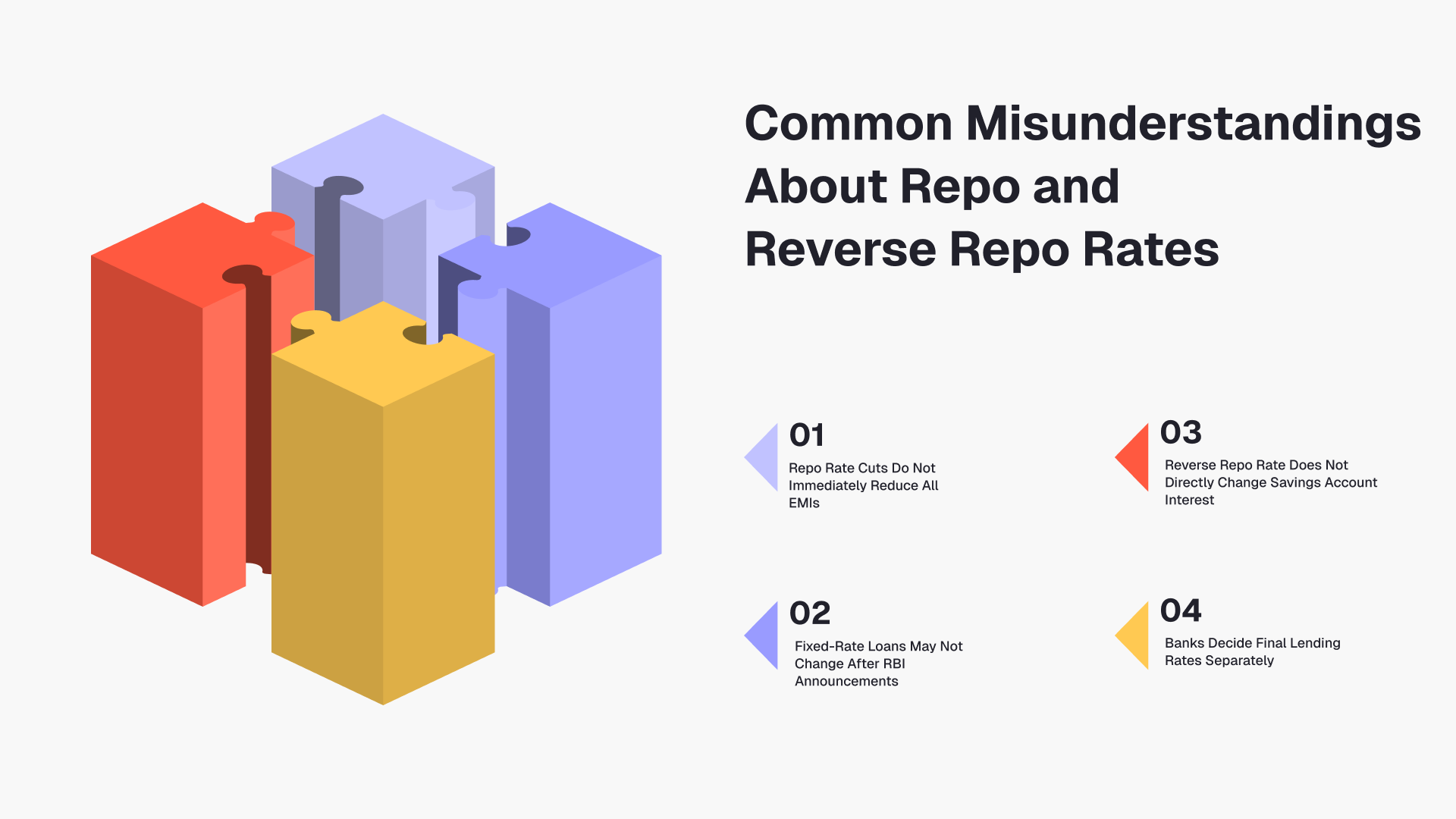
Repo rate and reverse repo rate are often discussed during RBI announcements, but many borrowers misunderstand how these changes actually affect loans and borrowing costs. This confusion can lead to incorrect expectations around EMIs, loan affordability, and interest rate changes.
1. Repo Rate Cuts Do Not Immediately Reduce All EMIs
Many borrowers expect lower EMIs as soon as the RBI reduces the repo rate. In reality, banks may take time to revise lending rates depending on their internal policies, loan structure, and funding costs. Some floating-rate loans may reflect changes faster than others.
2. Fixed-Rate Loans May Not Change After RBI Announcements
Fixed-rate loans usually remain unchanged for a specific tenure because the interest rate is locked at the time of borrowing. Even if the RBI changes the repo rate, borrowers with fixed-rate loans may not see immediate changes in their EMIs.
3. Reverse Repo Rate Does Not Directly Change Savings Account Interest
Another common misunderstanding is that reverse repo rate changes directly affect savings account returns or fixed deposit interest rates. The reverse repo rate mainly helps the RBI manage liquidity by encouraging banks to park excess funds with the central bank.
4. Banks Decide Final Lending Rates Separately
Even after RBI policy changes, banks still decide final lending rates based on:
-
Liquidity conditions
-
Credit demand
-
Operational costs
-
Internal lending policies
This is why loan interest rates may vary across lenders even when the repo rate remains the same.
Understanding how borrowing costs work can help borrowers avoid taking larger loans than they can comfortably repay.
A Structured Way to Manage Short-Term Borrowing Needs with Pocketly
Rising borrowing costs and changing EMIs can sometimes create temporary cash flow pressure, especially for salaried professionals, students, and small business owners managing multiple monthly expenses. In such situations, structured short-term borrowing may help cover urgent gaps without relying on larger long-term loans.
Pocketly is a digital lending platform working with RBI-registered NBFCs. It is designed for young Indians looking for short-term personal loans between ₹1,000 and ₹25,000 for urgent financial needs and temporary liquidity gaps.
Instead of borrowing larger amounts unnecessarily, structured short-term credit can help borrowers manage expenses such as:
-
Utility bill payments
-
Emergency travel costs
-
Medical expenses
-
Rent gaps
-
Minor business cash flow shortages
-
Unexpected monthly expenses
Here’s how Pocketly supports short-term borrowing in a more transparent and flexible way:
-
Loan amounts from ₹1,000 to ₹25,000 based on profile and eligibility
-
Interest rates starting from 2% per month
-
Processing fees ranging between 1% and 8%
-
No collateral or guarantor requirement
-
Quick digital KYC process
-
Direct transfer to eligible borrowers’ bank accounts
-
Fully digital application and repayment experience
How to Apply
-
Download the Pocketly app or visit the website.
-
Complete the digital KYC process.
-
Select the required loan amount.
-
Review the repayment details carefully.
-
Receive approval and disbursal for eligible applications.
If you need a small amount for an urgent expense, you can check your eligibility on Pocketly in a few minutes.
Before taking any short-term loan, review the repayment timeline, total borrowing cost, and monthly affordability carefully to avoid unnecessary financial pressure later.
FAQs
1. What is the current repo rate in India?
As of April 2026, the Reserve Bank of India kept the repo rate unchanged at 5.25%. The reverse repo rate remained at 3.35%. RBI reviews these rates periodically during its monetary policy meetings based on inflation, liquidity, and economic conditions.
2. Is reverse repo rate always lower than repo rate?
Yes, the reverse repo rate is generally lower than the repo rate. The repo rate is the interest charged by the RBI when lending money to banks, while the reverse repo rate is the interest paid by the RBI when banks deposit surplus funds with the central bank.
3. How does repo rate affect personal loans?
Repo rate changes can influence interest rates on floating-rate personal loans. When the RBI increases the repo rate, borrowing costs for banks may rise, which can lead to higher loan interest rates or EMIs for borrowers. Repo rate cuts may gradually reduce borrowing costs depending on the lender’s policy.
4. Does repo rate affect fixed-rate loans?
Fixed-rate loans usually do not change immediately after RBI repo rate revisions because the interest rate remains locked for a specified tenure. However, new fixed-rate loans offered by lenders may reflect changing interest rate conditions over time.
5. Why does RBI change repo and reverse repo rates?
The RBI changes repo and reverse repo rates to manage inflation, liquidity, borrowing activity, and overall economic stability. Higher rates may help control inflation, while lower rates may encourage borrowing and spending during slower economic periods.
6. Can repo rate changes increase EMIs immediately?
Not always. The impact depends on the type of loan and the lender’s interest rate revision policy. Floating-rate loans linked to external benchmarks may reflect changes faster, while some lenders may revise rates after a delay.