

Indirect spend is where most organisations lose money without realising it. Software renewals auto-renew quietly. Marketing retainers grow year after year. Departments onboard vendors independently. None of it feels urgent, yet the cumulative impact erodes margins quarter after quarter.
The real challenge is invisibility. When spend data is fragmented across systems and teams, leaders cannot see duplication, price inconsistencies, or contract leakage. Procurement reacts instead of strategising. Finance controls costs on paper, but not in practice. Over time, uncontrolled indirect spend limits agility, strains working capital, and weakens profitability.
Indirect spend optimisation solves this by bringing structure, visibility, and accountability to non-core expenses. With the right framework, businesses can reduce supplier sprawl, negotiate smarter contracts, and implement policy-driven purchasing without slowing operations.
In this blog, you will learn how to turn indirect spend from a hidden drain into a measurable source of savings and strategic advantage in 2026.
TL;DR
- Hidden Cost Drain: Indirect spend, including SaaS, marketing, travel, and office supplies, often quietly erodes margins when unmanaged.
- Visibility is Key: Fragmented data across departments and systems prevents leaders from spotting duplicates, overpriced contracts, and maverick spending.
- Structured Optimisation Works: Centralising spend, standardising vendors, enforcing procurement policies, and monitoring usage transforms indirect spend into a controllable lever for savings.
- Strategic Benefits: Optimised indirect spend improves cost control, strengthens supplier negotiation, enhances budgeting, reduces compliance risks, and drives operational efficiency.
- Continuous Improvement: Regular benchmarking, monitoring, and technology support, such as spend analytics or apps, ensure sustainable savings and financial resilience.
What Is Indirect Spend Optimisation?
Indirect spend optimisation is the process of improving how your organisation manages and controls non-core business expenses. These are costs that support operations but do not directly go into producing your product or service.
In simple terms, it is about bringing structure, visibility, and accountability to spending that often happens in the background.
Indirect spend typically includes:
- IT software and SaaS subscriptions
- Marketing and advertising services
- Consulting and professional services
- Office supplies and facilities management
- Travel and employee expenses
- HR tools and recruitment services
While each purchase may seem small or routine, together they represent a significant portion of operational costs.
Optimisation does not simply mean cutting budgets. It involves:
- Gaining full visibility into spending
- Eliminating duplicate vendors
- Standardizing procurement processes
- Improving contract compliance
- Negotiating better pricing
When managed strategically, indirect spend shifts from being a cost leak to becoming a controllable lever for improving margins and operational efficiency.
Why Does Indirect Spend Optimisation Matter for Businesses?
Indirect spend may not be tied to production, but it plays a critical role in overall financial performance. When unmanaged, it creates inefficiencies that quietly impact margins and operational clarity.
Here’s why indirect spend optimisation is essential:
- Improves Cost Visibility and Control: When businesses have a consolidated view of all indirect expenses across departments, they can identify duplicate vendors, unnecessary subscriptions, and inconsistent pricing. This prevents cost leakage and strengthens financial oversight.
- Strengthens Negotiation Power: Centralising spend data allows procurement teams to consolidate vendors and negotiate better contracts. Larger volume commitments and standardised agreements often result in improved pricing and terms.
- Enhances Budgeting and Forecasting Accuracy: Clear insights into recurring and variable indirect costs help finance teams build more accurate budgets and reduce unexpected overruns. This improves financial predictability.
- Reduces Compliance and Policy Risks: Standardised procurement processes and approval workflows limit maverick spend, improve contract adherence, and reduce regulatory or audit exposure.
- Drives Operational Efficiency: Streamlined purchasing systems, automated approvals, and structured vendor management reduce manual effort, shorten procurement cycles, and allow teams to focus on strategic initiatives rather than administrative tasks.
Also Read: Minimum Credit Score Required For Personal Loan
Key Categories of Indirect Spend (Where Money Quietly Leaks)
 Indirect spend rarely explodes in one dramatic line item. It erodes margins slowly, across multiple departments, through fragmented purchasing decisions. Below are the most common categories where organisations lose visibility and negotiating power.
IT Software and SaaS Subscriptions
IT and SaaS spending is one of the fastest-growing indirect spend categories. With multiple teams independently purchasing tools for productivity, marketing automation, analytics, HR, and collaboration, subscription overlap becomes common.
Unused licences, auto-renewals, duplicate tools serving similar purposes, and tier upgrades without review quietly inflate costs. In many organisations, no single stakeholder owns SaaS governance, which results in low utilisation and high vendor fragmentation.
Without centralised tracking and renewal audits, SaaS can become a recurring cost centre rather than a strategic investment.
Marketing and Advertising Services
Marketing teams often work with multiple agencies, freelancers, media platforms, and technology vendors. Campaign urgency sometimes leads to rushed vendor onboarding and minimal price benchmarking.
Spend leakage typically occurs through:
- Non-standardised agency contracts
- Scope creep in retainers
- Fragmented media buying
- Untracked performance-based fees
When procurement is not involved early, marketing spend becomes decentralised, making cost control and ROI tracking significantly harder.
Office Supplies and Facilities Management
Though individually small, purchases such as office supplies, utilities, cleaning services, security contracts, and facility maintenance accumulate into substantial annual expenses.
Common inefficiencies include:
- Multiple vendors for similar services
- Lack of consolidated purchasing agreements
- Limited benchmarking against market rates
- Poor demand forecasting
Because these costs feel operational and routine, they are often reviewed less rigorously, creating long-term inefficiencies.
Professional Services and Consulting
Consulting, legal, audit, HR advisory, and specialised technical services fall under this category. These engagements are usually high value but short-term, which reduces pricing transparency.
Cost risks often arise from:
- Undefined scope of work
- Time and material billing without caps
- Duplicate consulting engagements across departments
- Limited post-engagement performance review
Without standardised contracts and rate cards, professional services can become inconsistent and expensive.
Travel and Employee Expenses
Corporate travel, reimbursements, client entertainment, and mobility allowances represent another significant leakage point, especially in distributed or fast-growing companies.
Common issues include:
- Out-of-policy bookings
- Last-minute premium travel purchases
- Manual expense claims
- Inconsistent approval processes
Lack of real-time monitoring makes it difficult to control or forecast travel-related costs effectively.
MRO (Maintenance, Repair, and Operations)
MRO includes spare parts, repair services, equipment maintenance, and operational consumables. In manufacturing and asset-heavy industries, this category can represent a large portion of indirect spend.
Challenges typically involve:
- Emergency purchases at premium pricing
- Overstocking due to poor inventory visibility
- Multiple local suppliers with varied pricing
- Limited contract standardisation
Without data-driven demand planning and supplier consolidation, MRO spending becomes reactive rather than optimised.
Common Challenges in Managing Indirect Spend
Managing indirect spend is complex because it is scattered across departments, systems, and decision-makers. Unlike direct procurement, it often lacks centralised oversight and structured controls.
1. Limited Spend Visibility
Risk: When indirect expenses are scattered across multiple systems, departments, and spreadsheets, organisations lack a single source of truth. This makes it difficult to identify duplication, track category-level spend, or detect cost overruns early.
Mitigation: Consolidate spend data into a centralised analytics platform or integrated procurement system. Standardise expense categorisation to create consistent reporting and enable accurate spend analysis.
2. Decentralised Purchasing
Risk: Departments independently selecting vendors and tools can lead to inconsistent pricing, overlapping services, and reduced negotiation influence. This fragmentation increases the total cost of ownership.
Mitigation: Establish clear procurement policies and approval workflows. Encourage cross-functional coordination before onboarding new vendors to prevent duplication and strengthen bargaining power.
3. Vendor Fragmentation
Risk: Engaging multiple suppliers for similar services increases administrative burden and weakens contract oversight. It also limits opportunities for volume-based discounts.
Mitigation: Conduct periodic vendor rationalisation exercises. Consolidate suppliers where possible and renegotiate contracts based on aggregated spend.
4. Maverick Spend
Risk: Off-contract or unauthorised purchases bypass procurement controls, leading to compliance risks and unplanned expenses.
Mitigation: Implement structured approval systems and educate employees on procurement policies. Automated controls can flag non-compliant purchases in real time.
5. Auto Renewals and Contract Lock-Ins
Risk: Subscription and service contracts that renew automatically may continue at outdated pricing or for underutilised tools, creating avoidable financial leakage.
Mitigation: Maintain a centralised contract repository with renewal alerts. Conduct regular contract reviews to assess utilisation and renegotiate terms where necessary.
Also Read: Understanding the Process And Meaning of Credit Control
5 Proven Frameworks for Indirect Spend Optimization
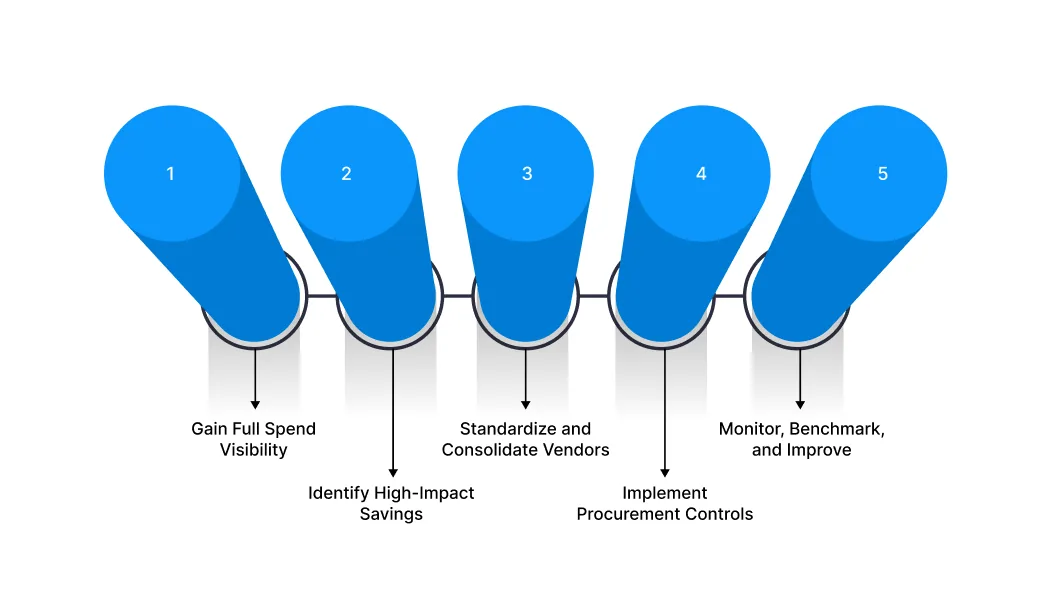 Optimising indirect spend requires more than occasional cost-cutting. It demands a structured approach that improves visibility, strengthens supplier control, and creates sustainable savings across departments.
1. Gain Full Spend Visibility
Indirect spend is often distributed across teams, systems, and cost centres, making it difficult to see the full financial picture. Without consolidated data, organisations make decisions based on partial information, which limits savings potential.
Start by centralising spend data from finance, procurement, IT, HR, and other departments. Include ERP systems, expense tools, corporate cards, and contract repositories. Then categorise vendors and contracts clearly so you understand where money is going and under what terms.
For example, a company may discover that marketing, HR, and sales are each using separate agencies for similar services, with no centralized contract visibility. Consolidating this data reveals duplication and opens up negotiation opportunities.
2. Identify High-Impact Savings Opportunities
Once you have visibility, the next step is identifying where meaningful savings can be generated. Not all spend categories carry equal impact, so focus on areas with high value or high fragmentation.
Analyse spending patterns to uncover tail spend, frequent small purchases, auto-renewals, and inconsistent pricing. Look for duplicate vendors offering similar services at different rates across departments.
For example, an organisation might find three different SaaS tools serving overlapping functions, each purchased independently by separate teams. Eliminating redundancy could immediately reduce costs without affecting productivity.
3. Standardize and Consolidate Vendors
Managing too many suppliers increases administrative overhead and weakens negotiation power. Standardising vendor relationships improves efficiency and strengthens commercial leverage.
Reduce supplier fragmentation by selecting preferred vendors within key categories. Consolidating spend allows you to negotiate better pricing, rebates, or longer-term agreements based on higher aggregated volumes.
For example, instead of sourcing office supplies from multiple small vendors, consolidating with one national supplier could result in volume discounts and simplified invoicing.
4. Implement Procurement Controls
Savings achieved through analysis can quickly disappear without proper governance. Strong procurement controls ensure compliance and reduce unauthorised spending.
Introduce structured approval workflows based on spend thresholds and risk levels. Define clear policies for vendor onboarding, renewals, and contract management. Automation tools can help enforce these rules consistently and reduce manual errors.
For example, implementing automated approval rules for software subscriptions may prevent teams from purchasing duplicate licences without oversight.
5. Monitor, Benchmark, and Continuously Improve
Indirect spend optimisation is not a one-time initiative. Continuous monitoring ensures that savings are maintained and new opportunities are identified.
Track key performance indicators such as realised savings, contract compliance rates, supplier count reduction, and procurement cycle times. Conduct regular supplier performance reviews to assess quality, pricing competitiveness, and risk exposure.
For example, quarterly reviews may reveal that a supplier’s pricing has drifted above market benchmarks, creating an opportunity to renegotiate terms before renewal.
How Pocketly Supports Your Financial Stability When Budgets Fall Short
Even with a well-structured budget, unexpected expenses can create temporary pressure. Medical bills, urgent travel, or sudden repairs can disrupt your monthly plan and strain your savings. During these moments, access to quick, responsible financial support can make all the difference. That is where Pocketly steps in.
Here is how Pocketly helps you stay financially steady:
- Borrow Only What You Need: Loan amounts range from ₹1,000 to ₹25,000, allowing you to cover immediate expenses without taking on unnecessary debt. This keeps repayments manageable and aligned with your budget.
- Fast and Simple Application Process: Complete a quick KYC verification directly through the app. The approval process is streamlined, removing the need for lengthy paperwork or branch visits.
- Instant Fund Transfer: Once approved, funds are credited directly to your bank account, often within minutes. This makes Pocketly especially useful during urgent situations when time matters.
- No Collateral or Guarantor Required: Pocketly offers completely collateral-free loans, making it accessible for students and young professionals who may not have assets or a co-signer.
- Flexible Repayment Options: Choose a repayment tenure that suits your financial comfort. This flexibility ensures that EMIs fit within your monthly budget rather than disrupting it.
- Transparent Pricing: Interest rates start from 2% per month, with processing fees typically between 1% and 8%, depending on your profile and loan amount. Clear terms mean no hidden surprises.
Pocketly works best as a short-term financial bridge, helping you manage temporary cash gaps without derailing your broader budgeting goals.
Conclusion
Indirect spend optimisation is a key lever for improving profitability in 2026. By gaining visibility into non-core purchases, standardising vendor management, and enforcing procurement policies, organisations can reduce hidden costs and unlock measurable savings.
This isn’t just about cutting expenses; it’s about making informed spending decisions, improving compliance, and ensuring every purchase supports operational goals. When businesses track indirect spend proactively, they turn reactive cost control into strategic value creation.
Unexpected needs and urgent purchases will always arise, but a structured optimisation approach ensures these do not derail budgets or margins. With clear data, strong policies, and ongoing monitoring, companies can manage short-term pressures while building long-term financial resilience.
Download the Pocketly app today on [Android] or [iOS] to access funds instantly and keep your finances steady, no matter what comes your way.
FAQs
1. What is indirect spend optimisation?
Indirect spend optimisation is the process of analysing and managing non-core business expenses, such as office supplies, marketing services, IT subscriptions, and professional services, to reduce costs, improve procurement efficiency, and increase ROI.
2. How is indirect spend different from direct spend?
Direct spend refers to costs directly tied to manufacturing or delivering products/services (like raw materials). Indirect spend covers non-core operational expenses that support business functions but are not part of the final product.
3. Why is optimising indirect spend important?
Indirect spend often accounts for 20–40% of total company expenses. Without optimisation, costs can leak through fragmented vendors, duplicate contracts, or maverick spending, impacting profitability and operational efficiency.
4. What are the main challenges in managing indirect spend?
Common challenges include a lack of centralised data, multiple small suppliers, inconsistent contracts, decentralised purchasing, and weak procurement policies.
5. How can technology help with indirect spend optimisation?
Spend analytics platforms, AI-driven procurement tools, automated sourcing systems, and contract lifecycle management software provide real-time visibility, detect inefficiencies, and enable data-driven decision-making.