

Accounting and finance teams are under constant pressure to do more with less. Volumes are rising, compliance is getting tighter, and manual processes still eat up hours every week. Closing books takes longer than it should. Errors creep in. Forecasts rely too heavily on spreadsheets that break the moment assumptions change.
This friction doesn’t just slow teams down. It affects decision-making, cash flow visibility, audit readiness, and even trust in financial data. When numbers arrive late or feel unreliable, leaders hesitate. Opportunities get missed. Risks surface too late to be managed properly.
That’s where AI starts to change the equation. By automating repetitive work, spotting patterns humans miss, and turning raw financial data into usable insights, AI is reshaping how accounting and finance functions operate.
In this blog, we’ll break down what AI in accounting and finance actually means, where it’s being used today, and how it’s helping teams move from manual execution to faster, more informed financial decisions.
TL;DR
- Accounting and finance teams are stretched by rising volumes, tighter compliance, and slow manual workflows that delay insights and increase risk.
- AI replaces rule-heavy processes with learning systems that automate accounting tasks and surface patterns humans often miss.
- Core use cases include automated data entry, intelligent reconciliations, continuous error detection, faster reporting, and predictive forecasting.
- AI improves speed, accuracy, and financial visibility, but it depends on clean data, system integration, and human oversight to work effectively.
- As finance becomes more proactive and data-driven, individuals still need flexibility, and Pocketly helps bridge short-term cash gaps when timing matters.
What is AI in Accounting and Finance?
AI in accounting and finance refers to the use of intelligent systems that can analyse financial data, recognise patterns, and assist with decision-making across accounting and finance functions. It goes beyond basic automation by learning from data and improving accuracy over time.
At its core, AI helps finance teams move away from manual, rule-heavy processes and towards faster, data-driven operations that scale with business complexity.
Why AI Is Becoming Central to Modern Finance?
AI is no longer an optional efficiency tool; it is becoming the operating layer of modern accounting and finance. As transaction volumes grow and compliance tightens, human-only processes struggle to keep up.
- Financial data is growing faster than teams can manually process or review
- Real-time visibility is now expected for cash flow, risk, and performance
- Errors and delays in reporting directly affect business decisions
- AI systems surface insights that are difficult to identify through spreadsheets alone
- Continuous learning improves accuracy and consistency over time
Without AI, finance teams remain reactive and overloaded. With AI, accounting and finance are shifting towards speed, clarity, and informed decision-making.
Core Technologies Powering AI in Accounting and Finance
AI in accounting and finance is built on a combination of technologies that work together to process data, detect patterns, and support decisions at scale.
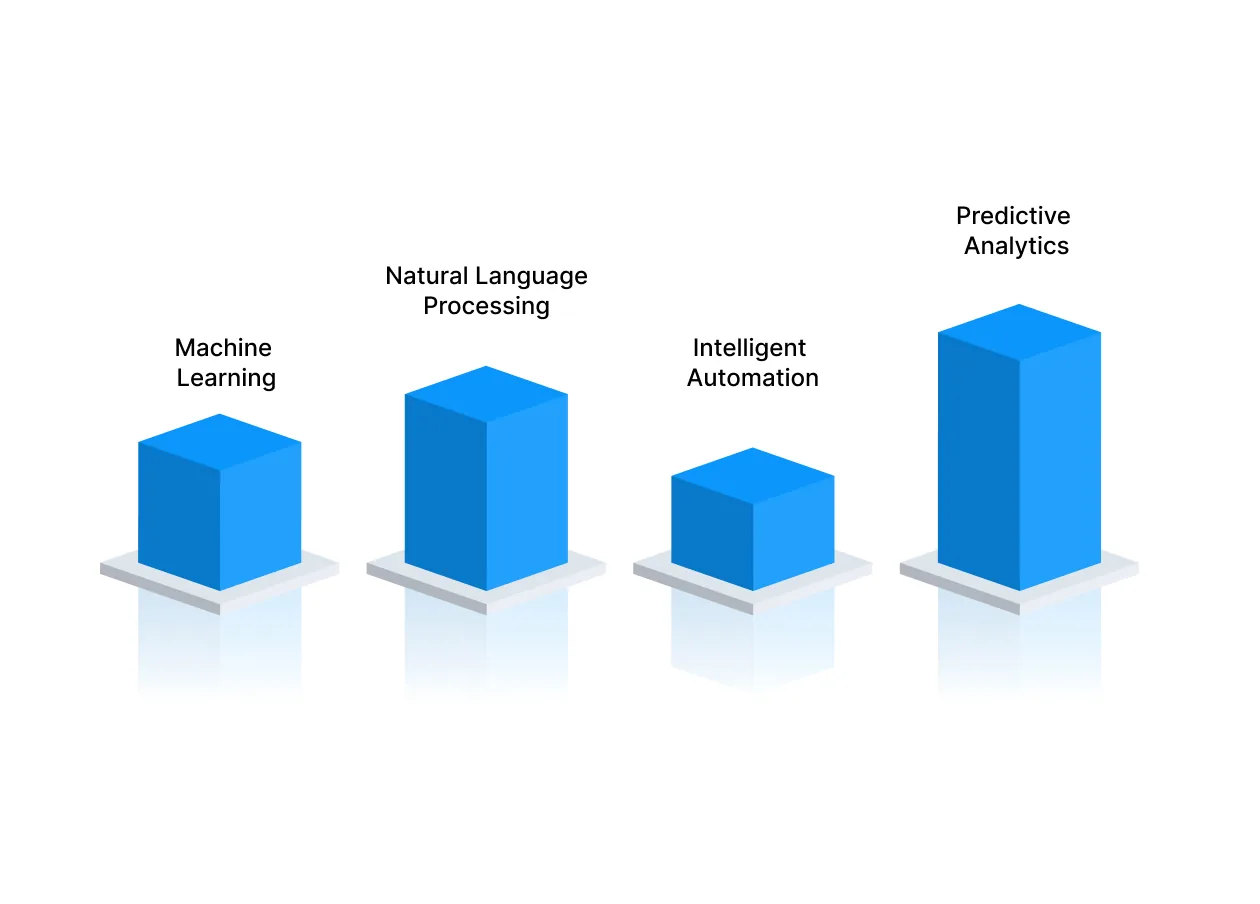 Machine Learning (ML)
Machine learning enables accounting and finance systems to improve accuracy by learning from historical financial data rather than relying on fixed rules. As more data flows in, these models adapt and refine outcomes automatically.
- Classifies transactions and expenses with higher accuracy over time
- Improves forecasting for cash flow, revenue, and budget planning
- Detects anomalies such as duplicate entries, unusual spending, or mismatches in ledgers
- Reduces dependency on manual reviews and post-close corrections
By learning from patterns across periods, machine learning helps teams trust their numbers earlier in the reporting cycle.
Natural Language Processing (NLP)
Natural language processing allows AI systems to understand and work with unstructured financial information that doesn’t fit neatly into spreadsheets or databases.
- Reads invoices, contracts, audit notes, and policy documents
- Extracts key fields like amounts, dates, clauses, and vendor details
- Supports faster compliance checks and audit preparation
- Enables automated summaries of financial reports and disclosures
NLP removes the bottleneck created by document-heavy workflows and speeds up reviews that typically slow finance teams down.
Intelligent Automation (RPA + AI)
Intelligent automation combines traditional robotic process automation with AI-driven decision logic. Instead of breaking when exceptions occur, these systems adapt to real-world variations.
- Automates repetitive workflows like reconciliations, journal entries, and approvals
- Handles exceptions without constant manual intervention
- Shortens month-end and quarter-end close cycles
- Improves consistency across financial operations
This reduces operational friction while maintaining control and accuracy in high-volume processes.
Predictive Analytics
Predictive analytics uses historical trends and real-time financial data to anticipate future outcomes instead of reacting after issues appear.
- Forecasts cash flow gaps, delayed receivables, or liquidity risks
- Identifies early signs of budget overruns or margin pressure
- Supports scenario planning and stress testing
- Helps finance leaders make informed decisions with forward-looking data
With predictive insights, finance teams move from reactive reporting to proactive financial management.
Also Read: Simple Money Management Tips for Personal Finances
How AI Is Used in Day-to-Day Accounting Operations?
AI shows up most clearly in the everyday tasks that consume the bulk of accounting time. These are practical, operational uses rather than experimental ones.
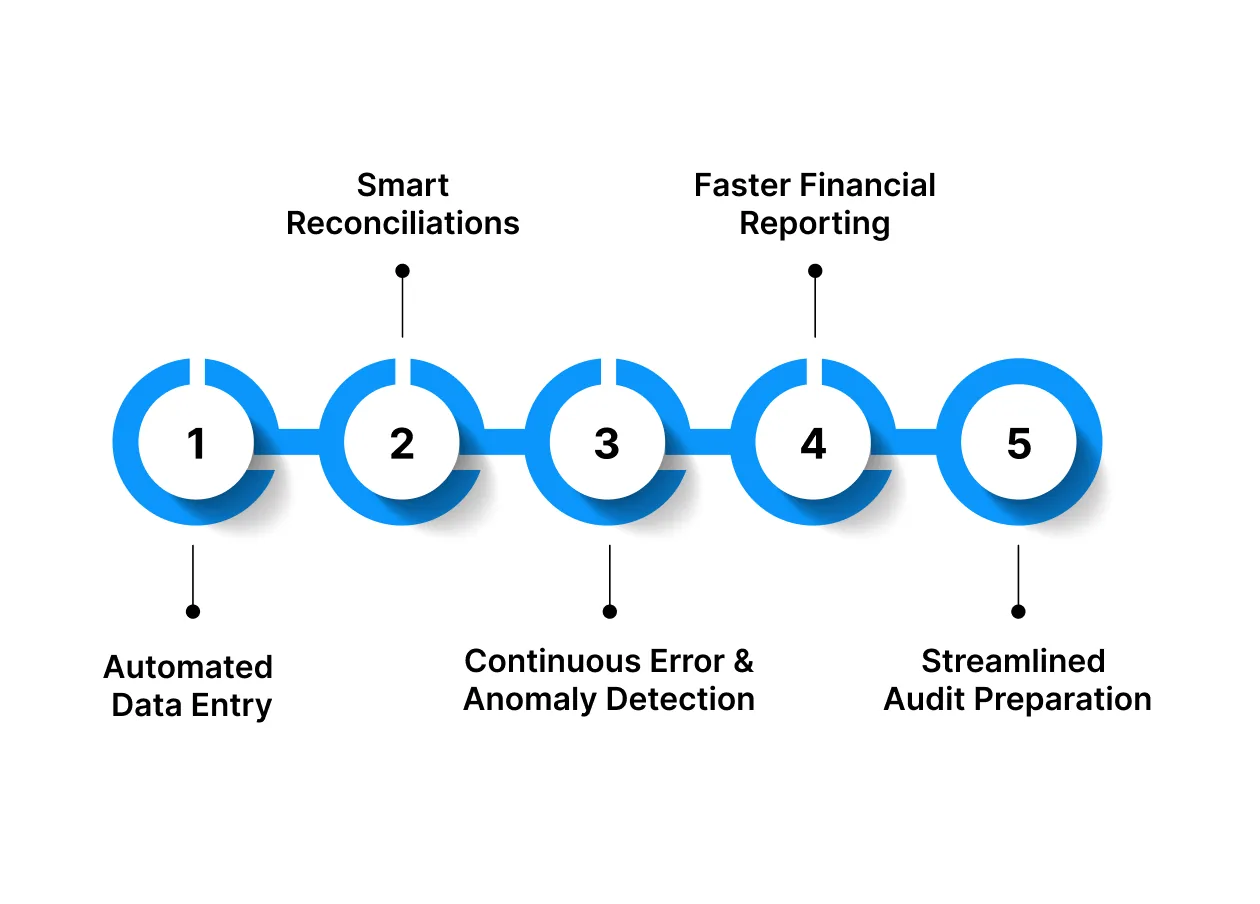 Automated Data Entry and Transaction Processing
Data entry has always been one of the most time-consuming parts of accounting. Invoices, receipts, bank statements, and expense records often arrive in different formats, forcing teams to manually extract and record information. This not only slows things down but also increases the risk of errors.
AI changes this by automatically reading and processing financial documents. It can extract relevant details such as amounts, dates, vendors, and categories, and post them directly into accounting systems.
For example, when an invoice is uploaded, AI can capture the data, classify the expense, and record it without manual intervention. This speeds up daily operations and allows accountants to focus on review and analysis instead of repetitive input work.
Smart Reconciliations
Reconciliations are critical but often frustrating. Matching bank statements with ledger entries becomes complex when transaction descriptions differ or volumes increase. Traditional systems rely on exact matches, which leads to delays and manual follow-ups.
AI improves this process by recognising patterns rather than exact text. It can match transactions even when descriptions vary, learn from past reconciliations, and flag only the entries that truly need attention.
For instance, AI can automatically reconcile hundreds of transactions and highlight just a few exceptions for review. This significantly reduces reconciliation time and helps teams close accounts faster with greater confidence.
Continuous Error and Anomaly Detection
Manual reviews usually happen at fixed intervals, which means errors can go unnoticed for days or even weeks. Small issues then compound into larger problems by the time reports are prepared.
With AI, financial data is monitored continuously. The system learns what “normal” looks like based on historical data and flags anything that falls outside expected patterns. This could include duplicate invoices, unusual spending spikes, or incorrect postings.
For example, if a vendor invoice is accidentally recorded twice, AI can detect the duplication immediately and alert the team. Early detection reduces rework, improves data quality, and lowers audit risk.
Faster Financial Reporting
Financial reporting often involves pulling data from multiple systems, validating numbers, and manually building reports. This process can delay insights and limit the ability to act quickly.
AI streamlines reporting by consolidating data automatically and generating real-time views of financial performance. It can summarise trends, highlight variances, and even explain changes based on historical context.
For example, instead of waiting for month-end reports, finance teams can access up-to-date dashboards that reflect current revenue, expenses, and cash position. This supports quicker decision-making and more responsive financial management.
Streamlined Audit Preparation
Audits usually bring added pressure, with teams scrambling to collect documents and explain discrepancies. Much of this stress comes from disorganised data and incomplete audit trails.
AI helps by maintaining structured records throughout the year. Transactions are logged consistently, supporting documents are linked automatically, and risk areas are flagged in advance.
For example, when auditors request specific invoices or approvals, the system can surface them instantly. This reduces disruption during audits and allows teams to approach compliance with greater clarity and control.
Also Learn: Understanding the Ideal CIBIL Score Range for Personal Loan Applications
Challenges and Limitations of AI Adoption
AI brings clear gains, but adopting it in accounting and finance comes with real constraints that teams need to plan for. Here are the challenges and their solutions:
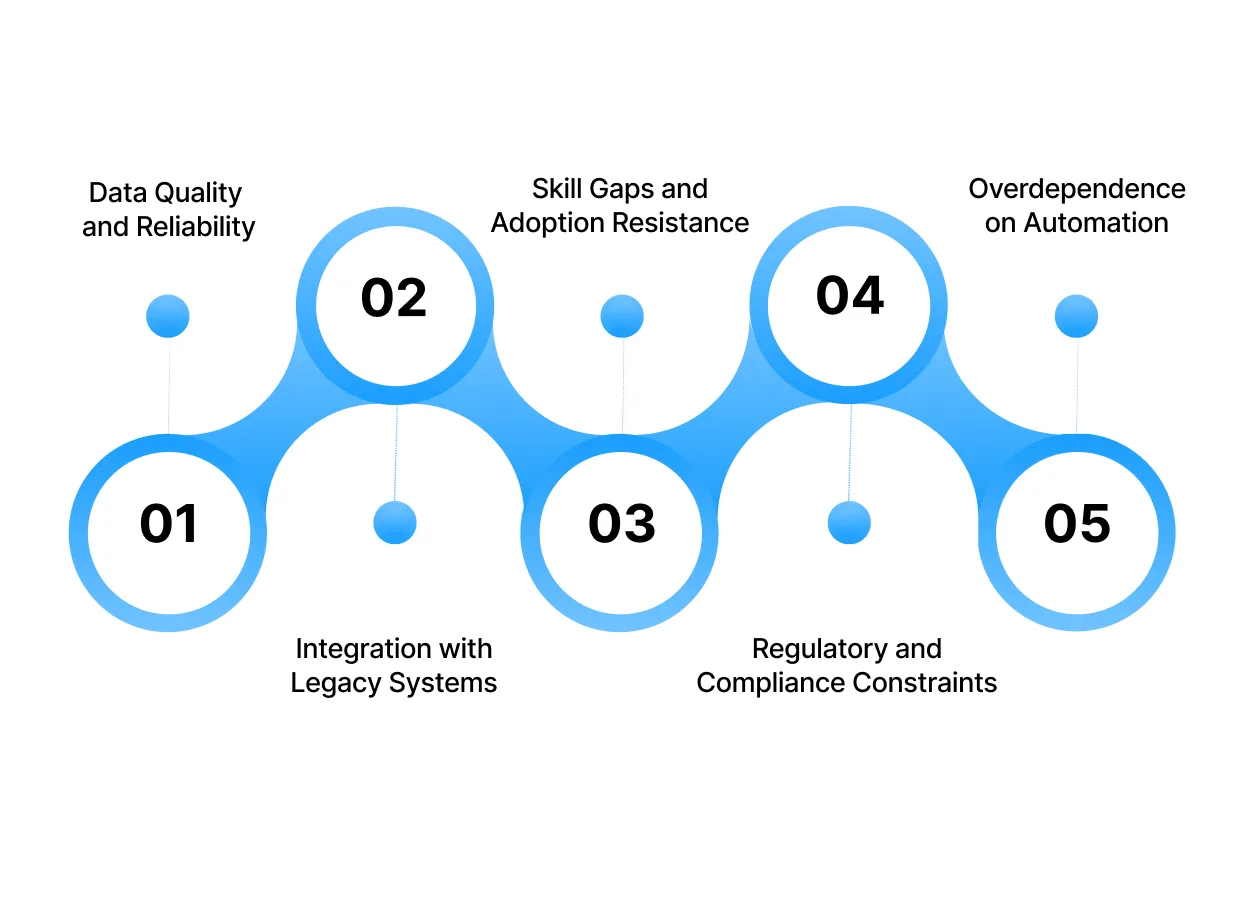 Data Quality and Reliability
Risk: AI models rely heavily on historical financial data. Incomplete, inconsistent, or inaccurate data can lead to incorrect classifications, forecasts, or compliance flags.
Mitigation: Standardise data entry processes, clean historical records, and introduce validation checks before feeding data into AI systems.
Integration with Legacy Systems
Risk: Many accounting and finance teams still operate on older ERP or accounting software that may not integrate smoothly with AI tools.
Mitigation: Use APIs, phased integrations, or middleware solutions to connect AI tools gradually without disrupting core financial systems.
Skill Gaps and Adoption Resistance
Risk: Teams may struggle to understand or trust AI-driven outputs, leading to underuse or misuse of the technology.
Mitigation: Provide targeted training, clear documentation, and explainable AI outputs so teams understand how decisions are generated.
Regulatory and Compliance Constraints
Risk: AI systems handling financial data must comply with strict regulatory requirements, and gaps can lead to audit or legal issues.
Mitigation: Embed audit trails, access controls, and regular compliance reviews into AI workflows to meet regulatory standards.
Overdependence on Automation
Risk: Relying entirely on AI without human oversight can amplify errors, especially in edge cases or unusual transactions.
Mitigation: Maintain human review checkpoints for critical decisions and treat AI as decision support, not a final authority.
Future Trends in AI for Accounting and Finance
AI in accounting and finance is shifting from task automation to decision support. The next phase focuses less on speed alone and more on judgment, control, and forward-looking intelligence. Here's what can happen:
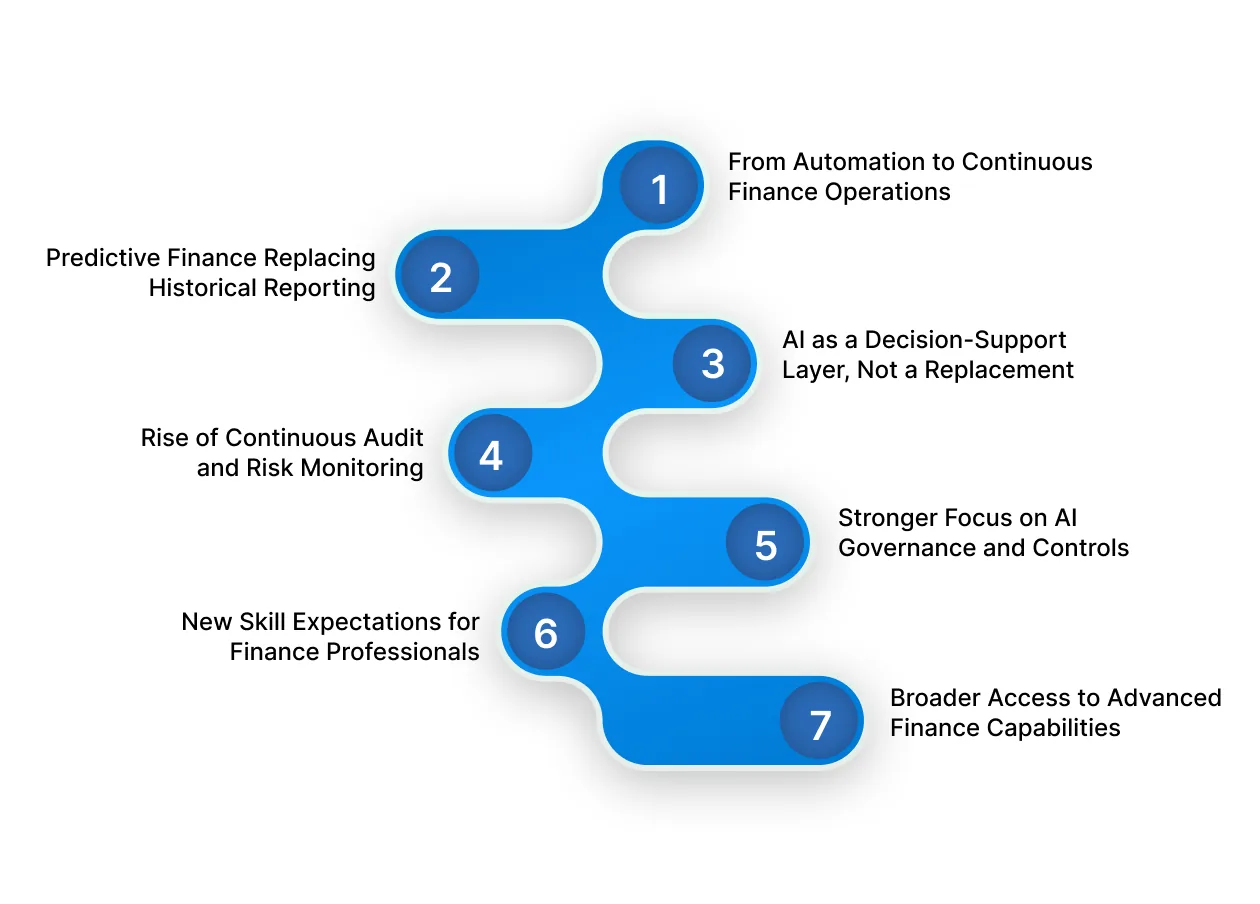 From Automation to Continuous Finance Operations
AI is moving accounting teams away from periodic, batch-based processes. Continuous reconciliation, rolling forecasts, and near-real-time financial close cycles are becoming achievable as AI systems monitor transactions as they occur. This reduces month-end pressure and improves visibility throughout the reporting period.
Predictive Finance Replacing Historical Reporting
Traditional finance looks backward. AI enables finance teams to model future outcomes using live data. Cash flow forecasts, revenue projections, and expense trends are increasingly driven by machine learning models that update as conditions change, allowing faster course correction.
AI as a Decision-Support Layer, Not a Replacement
AI tools are being designed to explain outputs, flag risks, and surface patterns rather than make final decisions. Accountants and finance leaders retain accountability while AI highlights anomalies, forecasts scenarios, and suggests options based on historical and real-time data.
Rise of Continuous Audit and Risk Monitoring
Instead of periodic audits, AI enables ongoing risk detection. Systems can continuously scan transactions, contracts, and controls to identify compliance gaps, fraud indicators, or policy breaches early, reducing financial and regulatory exposure.
Stronger Focus on AI Governance and Controls
As AI becomes embedded in financial processes, organisations are building governance frameworks around model accuracy, data quality, auditability, and bias prevention. Finance teams are increasingly involved in defining guardrails rather than just consuming AI outputs.
New Skill Expectations for Finance Professionals
The role of accountants is shifting toward interpretation, oversight, and strategic analysis. Understanding AI outputs, validating assumptions, and translating insights into business decisions are becoming core skills alongside technical accounting knowledge.
Broader Access to Advanced Finance Capabilities
AI tools are no longer limited to large enterprises. Smaller firms are adopting AI-driven accounting, forecasting, and compliance tools that previously required large teams, narrowing the capability gap across organisations.
How Pocketly Helps You Stay Financially Prepared?
Even with careful planning and smarter financial decisions, unexpected expenses can still arise. A delayed salary, sudden medical cost, or an unplanned payment can quickly strain your cash flow, especially when timing matters. In such moments, having access to quick, reliable financial support makes all the difference.
Pocketly is built for exactly these situations. As a digital lending platform, it helps you manage short-term financial gaps without the friction of traditional loans. Whether you’re a student, a salaried professional, or self-employed, Pocketly gives you fast access to funds when you need them most.
Here’s how Pocketly supports you during unforeseen financial needs:
- Small, need-based loans: Borrow amounts from ₹1,000 to ₹25,000, so you take only what’s necessary.
- Transparent pricing: Interest starts at 2% per month, with processing fees ranging from 1% to 8%, clearly disclosed upfront.
- Fully digital experience: Complete your KYC online with no physical paperwork and minimal steps.
- Flexible repayment options: Choose a repayment structure that aligns with your cash flow, whether you prefer instalments or early closure.
Steps to Apply for a Pocketly Loan
1. Download the Pocketly app from Google Play or the Apple App Store.
2. Complete a quick digital KYC using your basic details.
3. Select the loan amount that suits your requirement, up to ₹25,000.
4. Get instant approval and receive funds directly in your bank account.
With Pocketly, managing sudden expenses becomes simpler, faster, and far less stressful, helping you stay in control even when finances take an unexpected turn.
Conclusion
AI is steadily changing how accounting and finance teams operate. By automating routine tasks, improving accuracy, and supporting better forecasting and risk management, AI allows professionals to focus more on analysis and strategic decision-making.
The value of AI goes beyond efficiency. It brings clearer financial visibility, faster insights, and stronger control across financial processes. As adoption grows, responsible use, data quality, and governance will remain key to realising its full potential.
On an individual level, managing finances also calls for flexibility. When short-term cash needs arise, Pocketly offers quick and transparent personal loans to help you stay on track. Download the Pocketly app on iOS or Android to access fast funds when you need them.
FAQs
1. What does AI in accounting and finance mean?
AI in accounting and finance refers to the use of technologies like machine learning, natural language processing, and intelligent automation to manage financial data, automate routine tasks, and generate insights for better decision-making.
2. How is AI used in accounting today?
AI is commonly used for tasks such as automated data entry, invoice processing, reconciliation, financial reporting, and identifying errors or anomalies in accounts.
3. What are the main benefits of using AI in finance functions?
AI improves accuracy, reduces manual effort, speeds up reporting, lowers operational costs, and provides real-time insights that support strategic financial decisions.
4. Can AI help in fraud detection and risk management?
Yes, AI systems can analyse large volumes of transaction data to detect unusual patterns, flag potential fraud, and assess financial risks more effectively than manual methods.
5. Will AI replace accountants and finance professionals?
No. AI supports professionals by automating repetitive work, allowing accountants and finance teams to focus more on analysis, compliance, advisory, and strategic planning rather than routine tasks.