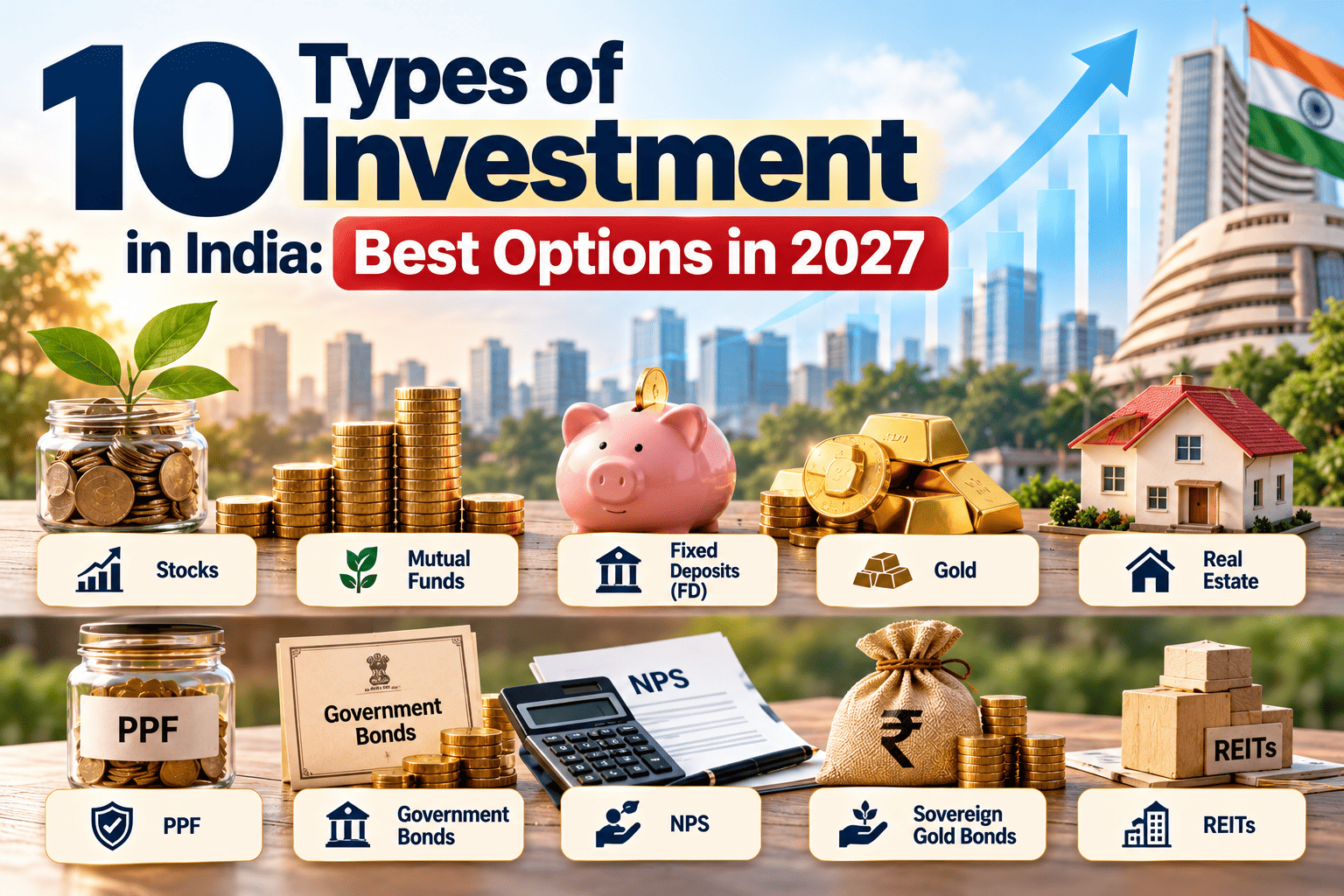


The first step to creating a sustainable personal wealth in India, avoiding retail inflation and securing your future is choosing among the different kinds of investments. From direct equity to mutual funds, to market-linked instruments, to bank deposits and to sovereign fixed-income such as Public Provident Fund, there is an array of choices in India's growing financial system. Nevertheless, investing means there are liquidity considerations and risks in the marketplace none of this should ever be part of your emergency savings. At Pocketly, we foster good investing habits in young earners, students, and professionals without sacrificing their ability to maintain liquidity for everyday needs in case of a short-term emergency.
At a Glance: Different Types of Investments in India (2027 Outlook)
Understanding how many types of investment exist and where they fit across risk-return profiles helps you allocate your monthly surplus efficiently:
|
Investment Avenue |
Risk Level |
Expected Return Range (Illustrative) |
Minimum Lock-in |
Best Suited For |
Primary Regulator |
|
Direct Equity (Stocks) |
High |
12% – 15%+ (Market-driven) |
Nil (Demat liquid) |
Long-term capital growth (5+ yrs) |
SEBI |
|
Mutual Funds (SIP / Lump sum) |
Moderate to High |
10% – 14% (Asset-dependent) |
Nil (3 yrs for ELSS) |
Disciplined monthly wealth compounding |
SEBI / AMFI |
|
Fixed Deposits (FDs) |
Very Low |
6.5% – 7.8% |
7 days to 10 years |
Capital preservation & short-term goals |
RBI |
|
Public Provident Fund (PPF) |
Zero (Sovereign) |
7.1% (Govt. set quarterly) |
15 years |
Tax-free retirement & debt stability |
Ministry of Finance |
|
National Pension System (NPS) |
Low to Moderate |
9% – 12% (Asset allocation) |
Till age 60 |
Dedicated retirement pension corpus |
PFRDA |
|
Digital Gold & Sovereign Gold |
Low to Moderate |
In line with spot bullion prices |
Nil (Digital) / 8 yrs (SGB) |
Inflation hedge & portfolio hedge |
Regulated vault / RBI |
|
Real Estate & REITs |
Moderate to High |
7% – 11% (Rental + Capital) |
High (Physical) / Nil (REIT) |
Passive income & asset appreciation |
RERA / SEBI |
|
Recurring Deposits (RDs) |
Very Low |
6.0% – 7.2% |
6 months to 10 years |
Building savings discipline from salary |
RBI |
|
Corporate Bonds & Debentures |
Moderate |
8.0% – 11.0% |
1 to 5+ years |
Predictable income above bank FDs |
SEBI / RBI |
|
Govt. Small Savings (SCSS/NSC) |
Zero (Sovereign) |
7.4% – 8.2% |
5 years |
Guaranteed risk-free sovereign returns |
Ministry of Finance |
What Are the Primary Types of Investment in India?
An investment is an asset or instrument acquired with the primary goal of generating income or capital appreciation over time. In India, investment classes are broadly categorized into three core buckets: equity-oriented instruments (growth assets), fixed-income instruments (capital preservation assets), and store-of-value commodities like gold and real estate.
Selecting the right mix among these different types of investments depends entirely on three foundational variables:
-
Investment Horizon: How long your capital can remain untouched (e.g., 6 months vs. 15 years).
-
Risk Tolerance: Your emotional and financial ability to withstand temporary market downturns.
-
Liquidity Requirements: The speed and cost of converting your invested asset into immediate bank cash during emergencies.
10 Types of Investment in India for 2027
1. Direct Equities (Stock Market)
Investing directly in listed equities through stock exchanges (NSE and BSE) makes you a partial owner of the underlying company. Over long historical periods, Indian equity markets have consistently outpaced retail inflation.
-
Return Mechanism: Capital appreciation through rising share prices and quarterly/annual cash dividends.
-
Risk Profile: High. Individual stock prices fluctuate daily based on corporate earnings, economic conditions, and global capital flows.
-
Who It Is For: Investors with active analytical interest and a 5- to 10-year holding horizon.
2. Mutual Funds (Systematic Investment Plans - SIP)
Mutual funds pool money from retail and institutional investors to purchase diversified baskets of equities, debt securities, or hybrid instruments, managed by professional Asset Management Companies (AMCs).
-
Return Mechanism: Growth in Net Asset Value (NAV) and dividend distribution.
-
Systematic Investing: You can automate investments using a monthly SIP starting as low as ₹100 to ₹500, avoiding the challenge of trying to time the market.
-
Who It Is For: Students, salaried professionals, and beginners looking for professional management and portfolio diversification.
3. Bank Fixed Deposits (FDs)
A traditional cornerstone of Indian household finance, bank fixed deposits allow you to deposit a lump sum with a Scheduled Commercial Bank or cooperative bank for a fixed period at a guaranteed interest rate.
-
Capital Protection: Deposits in scheduled banks are insured up to ₹5,00,000 per depositor by the Deposit Insurance and Credit Guarantee Corporation (DICGC), a wholly owned subsidiary of the Reserve Bank of India (RBI).
-
Who It Is For: Conservative investors seeking predictable income and capital security without market volatility.
4. Public Provident Fund (PPF)
The Public Provident Fund is a government-backed, long-term savings instrument with a 15-year tenure. The interest rate is reviewed and set quarterly by the Ministry of Finance.
-
Tax Efficiency: PPF operates under the Exempt-Exempt-Exempt (EEE) tax regime, meaning the amount deposited, the interest earned, and the maturity proceeds are entirely exempt from income tax.
-
Contribution Limits: Minimum ₹500 and maximum ₹1,50,000 per financial year.
-
Who It Is For: Risk-averse individuals building a guaranteed retirement or long-term corpus.
5. National Pension System (NPS)
Regulated by the Pension Fund Regulatory and Development Authority (PFRDA), NPS is an organized, voluntary retirement-savings scheme that combines equity, corporate debt, and government securities based on your chosen risk preference.
-
Retirement Structure: Upon turning 60, up to 60% of the accumulated corpus can be withdrawn tax-free as a lump sum, while the remaining 40% must be used to purchase an annuity providing a regular pension.
-
Who It Is For: Salaried workers and self-employed professionals aiming to build structured, low-cost retirement security.
6. Digital Gold and Bullion
Gold has traditionally served Indian families as an inflation hedge and store of value. Beyond physical jewellery and coins, modern Indian investors allocate capital to Digital Gold, Gold ETFs, and Sovereign Gold Bonds (SGBs).
-
Cost Efficiency: Digital Gold eliminates locker fees, storage concerns, and jeweller making-charge deductions.
-
Liquidity: You can accumulate fractional weights starting at just ₹100 and liquidate directly to your verified bank account.
-
Who It Is For: Anyone seeking a tangible hedge against currency depreciation and geopolitical market stress.
7. Real Estate & Real Estate Investment Trusts (REITs)
Physical real estate involves buying residential plots, commercial units, or apartments to generate rental yields and long-term land appreciation. For investors wanting real-estate exposure without large capital outlays, listed REITs offer a liquid, accessible route.
-
REIT Mechanics: REITs trade on the stock exchange like regular shares, pooling capital to own and manage rent-generating grade-A commercial assets and distributing at least 90% of net taxable cash flows as dividends/interest to unit holders under SEBI regulations.
-
Who It Is For: Investors seeking steady quarterly dividend yields and property diversification starting from small fractional tickets.
8. Recurring Deposits (RDs)
A Recurring Deposit lets you save a fixed amount each month over a predetermined tenure (ranging from 6 months to 10 years) at a guaranteed interest rate set at the time of opening.
-
Savings Discipline: Ideal for individuals transitioning from casual spending to structured monthly budgeting.
-
Predictability: Eliminates the need for a large initial lump sum while offering the certainty of traditional fixed-income returns.
-
Who It Is For: First-jobbers and students setting aside small, regular amounts toward short-term goals.
9. Corporate Bonds and Non-Convertible Debentures (NCDs)
Corporate bonds and NCDs are debt securities issued by private and public companies to raise capital from investors. In exchange, the issuing firm pays a predetermined coupon (interest rate) periodically until returning the principal upon maturity.
-
Yield Potential: Typically offers 1% to 3% higher interest rates than standard commercial bank FDs.
-
Credit Rating Due Diligence: Always check credit ratings issued by SEBI-registered rating agencies (e.g., CRISIL, ICRA, CARE). Instruments rated AAA carry the lowest default risk, whereas speculative paper below AA- requires thorough scrutiny.
-
Who It Is For: Moderate-risk investors looking to boost their portfolio's fixed yield.
10. Government Small Savings Schemes (SCSS, NSC, SBY)
The Government of India sponsors specialized savings avenues including the Senior Citizens Savings Scheme (SCSS), National Savings Certificate (NSC), and Sukanya Samriddhi Yojana (SSY).
-
Sovereign Guarantee: These programs carry sovereign backing with zero default risk, providing quarterly interest payouts or compounded maturity accumulation.
-
Who It Is For: Senior citizens, parents saving for their daughter's future, and taxpayers seeking Section 80C exemptions without equity risk.
How to Build a Balanced Investment Portfolio
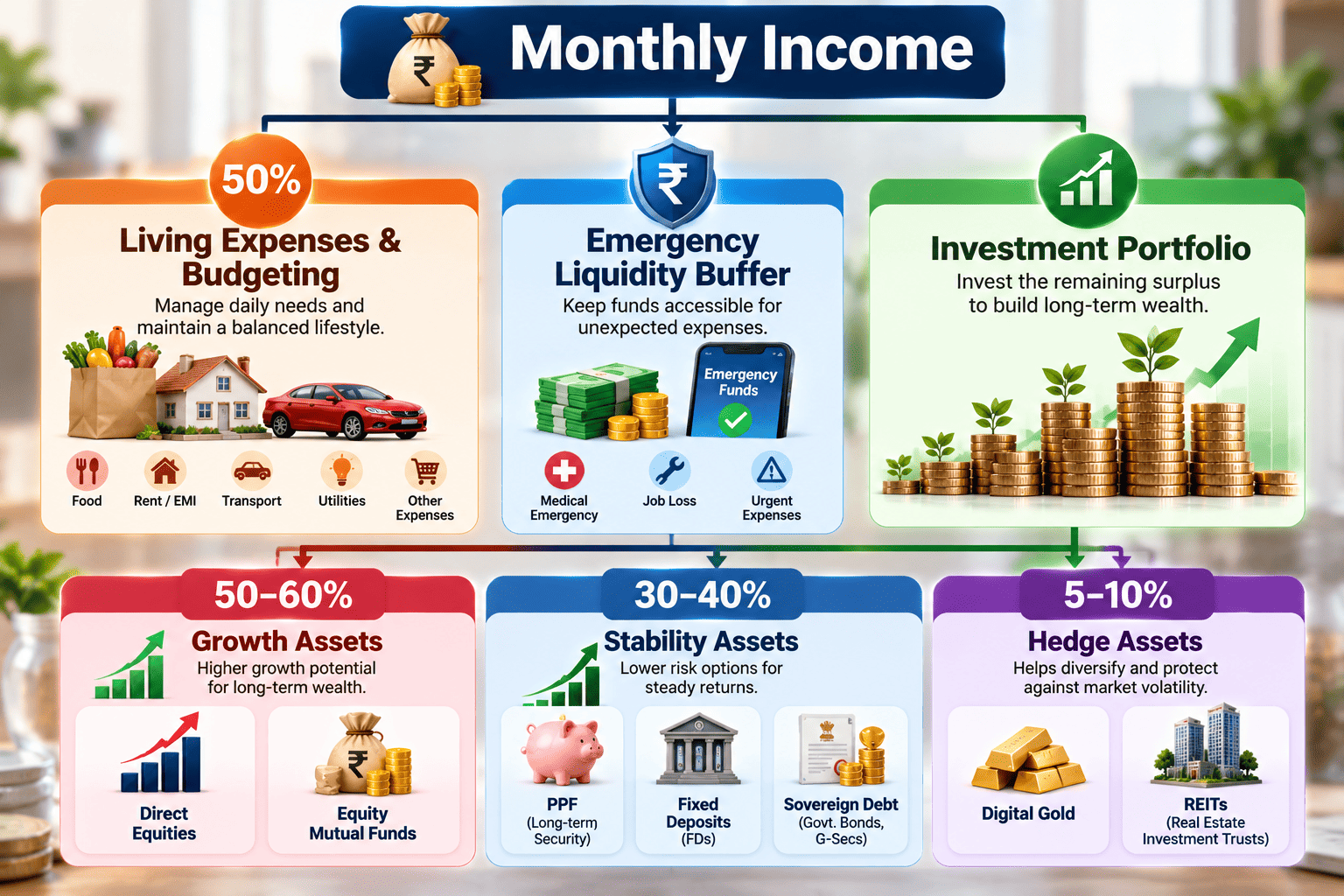
A successful investment portfolio balances capital growth with safety and liquidity. Rather than placing all your money into a single asset class, apply structured allocation rules:
-
Calculate Your Baseline Debt and Expenses: Before locking capital into multi-year investments, evaluate your monthly loan obligations. Check your debt-to-income balance using our FOIR Calculator and structure your baseline budget using our 50 30 20 Rule Calculator.
-
Do Not Lock Emergency Cash into Illiquid Investments: A common financial mistake is committing every rupee of monthly savings into locked mutual fund SIPs, PPF, or real estate, leaving zero cash for sudden medical bills or rent advances.
-
Understand Interest vs. Return Models: When comparing investment gains against borrowing costs, track the actual compounding impact. Run your repayment numbers through our Flat vs Reducing Rate Calculator to evaluate how interest models truly function.
How Different Earners Should Approach Investment Decisions
Different career stages call for different asset allocation strategies:
|
Investor Profile |
Dominant Financial Goal |
Suggested Asset Allocation |
Recommended Financial Safeguard |
|
Students & Young Learners |
Building early savings discipline & financial literacy |
70% Equity Index Funds / SIPs, 30% Liquid FDs / Gold |
Avoid tying up academic fees in volatile assets; rely on flexible options for short-term liquidity |
|
Salaried Professionals |
Wealth creation, tax optimization & milestone planning |
60% Equity Funds, 25% PPF / Debt Funds, 15% Real Assets |
Explore our personal loan for salaried applicants for short-term cash flow gaps |
|
Self-Employed & Traders |
Managing working capital cycles alongside long-term growth |
40% Large-Cap Equities, 50% Liquid Debt/FDs, 10% Gold |
Explore our personal loan for self employed individuals to maintain cash flexibility |
|
Freelancers & Gig Workers |
Buffering irregular income against monthly overheads |
50% Flexible Liquid Assets, 40% SIPs, 10% Digital Assets |
Explore our loan for non salaried applicants when invoices are delayed |
Managing Short-Term Liquidity Without Breaking Long-Term Investments
When unexpected financial emergencies strike such as sudden medical bills, exam fees, or delayed client payments breaking your long-term compounding investments (like liquidating equity funds or forfeiting FD interest) can set back your financial progress.
At Pocketly, we provide a digital safety net for eligible borrowers navigating temporary cash-flow crunches:
-
Small-Ticket Flexibility: Access digital personal credit lines from ₹1,00,0 to ₹50,000 without disturbing your compounding investments.
-
100% Digital Journey: Paperless verification with fast processing directly from your smartphone.
-
Transparent Pricing: Clear disclosures under our commitment to Responsible Lending. All loans are extended exclusively through Speel Finance Company Private Limited, an RBI-registered Non-Banking Financial Company (NBFC).
-
Repayment Clarity: Flexible tenures from 61 days to 9 months with interest rates between 2% and 3% per month (APR ranges from 30% to 121%).
Before borrowing, always plan your monthly repayment schedule using our Personal Loan EMI Calculator to verify that the instalment fits comfortably within your monthly budget.
What Should You Check Before Investing?
-
Expense Ratios and Management Fees: In mutual funds and REITs, high fund-management charges slowly erode net returns over compounding periods.
-
Exit Loads and Lock-ins: Check whether withdrawing funds before 1 year incurs a 1% exit penalty or if your capital is legally locked (e.g., 3 years for ELSS tax-saving funds, 15 years for PPF).
-
Taxation on Capital Gains: Equity held over 12 months is classified as Long-Term Capital Gains (LTCG), taxed at 12.5% on gains exceeding ₹1.25 lakh, whereas short-term equity gains (STCG) are taxed at 20%. Debt mutual funds and bank FDs are taxed at your applicable slab rate.
-
Inflation Drag: Assets yielding 6% in an environment where living costs rise by 6% provide zero real purchasing-power growth. Make sure a meaningful portion of your portfolio is in inflation-beating growth assets.
Common Mistakes Investors Make in India
-
Mistaking Insurance for Investment: Purchasing traditional endowment or money-back life insurance policies that deliver low 4% to 5% returns while offering subpar insurance coverage. Keep pure-term insurance separate from your investments.
-
Chasing Unrealistic Guaranteed Returns: Falling prey to unregulated high-yield schemes or unregulated peer-to-peer platforms promising "24% guaranteed gains." Legitimate market investments never guarantee high risk-free profits.
-
Liquidating Long-Term Investments for Short-Term Cash Needs: Redeeming mutual funds prematurely during temporary liquidity crunches, triggering taxes and exit loads while halting compounding. Read our guide on Lifestyle Inflation: Why Higher Income Does Not Always Mean More Savings to strengthen your budgeting discipline.
-
Ignoring Credit Discipline While Investing: Accumulating credit card debt at 40%+ interest while earning 12% in stock investments destroys net worth. Repaying high-cost debt should always precede investing. If you ever face payment delays, see our practical advice in Loan Ki Kissht Nahi Bhar Pa Rahe? EMI Late Hone Par Kya Hoga? to protect your credit profile.
Final Takeaway: Grow Your Wealth and Borrow Responsibly
Building long-term wealth through different types of investment requires consistency, patience, and realistic expectations. Whether you allocate monthly surpluses to mutual fund SIPs, build an emergency buffer in bank FDs, or lock away tax-free savings in PPF, starting early gives your portfolio the benefit of compounding.
When an unexpected emergency creates a temporary cash gap, protect your long-term investments from premature redemption. Explore sensible, transparent short-term options with Pocketly to keep your financial journey moving forward.
Also Read: Financial Risk Management: 7 Ways to Protect Your Money
Frequently Asked Questions (FAQs)
1. What are the best types of investment in India for beginners?
Mutual fund Systematic Investment Plans (SIPs) in diversified broad-market index funds, paired with bank Fixed Deposits and the Public Provident Fund (PPF), are generally the most effective starting investments for beginners. They teach savings discipline while balancing capital protection and market-driven compounding.
2. How many types of investment options exist in India?
There are primarily three broad categories equity (growth), fixed income (debt/preservation), and store-of-value commodities (gold, real estate) which break down into 10+ accessible retail assets including stocks, mutual funds, FDs, PPF, NPS, digital gold, bonds, REITs, RDs, and small savings schemes.
3. Can I get an instant personal loan online in 2 minutes if my cash is locked in investments?
An instant personal loan online in 2 minutes reflects an automated digital application process, but approval and disbursal depend on KYC checks, internal underwriting, and verification by our regulated lending partner, Speel Finance Company Private Limited. A fast application experience does not mean guaranteed approval.
4. How can I compare loan options to find the best loan app in India?
If you are comparing digital credit platforms to find the best loan app in India for your needs, always check that the provider partners with an RBI-registered NBFC, provides a clear upfront Key Fact Statement (KFS), caps total APR and processing fees transparently, and adheres strictly to RBI digital lending guidelines.
5. Can salaried employees apply for a personal loan with Pocketly?
Yes. If you receive regular monthly compensation, you can explore our personal loan for salaried applicants, subject to verification and eligibility criteria.
6. Can self-employed individuals apply for a personal loan with Pocketly?
Yes. If you run a business, freelance, or earn consulting fees, you can explore our personal loan for self employed profile, subject to our applicable underwriting terms.
7. Are there credit options for students and gig workers on Pocketly?
Yes. If you have an eligible, recurring source of income or allowance but do not have conventional corporate pay slips, our loan for non salaried category provides accessible short-term credit from ₹1,000 to ₹50,000 following digital KYC.
8. How should I calculate my EMI before applying for personal credit?
You should use our personal loan EMI calculator to test your desired loan amount, tenure, and applicable interest rate. This ensures you understand your monthly repayment commitment before accepting an offer.
9. What is the difference between investing in Digital Gold versus physical gold?
Digital gold allows fractional investment starting from as low as ₹100 without locker fees, making charges, or purity risks. Physical gold involves retail purchase premiums (jewellery making charges of 8%–25%) and requires safe physical storage.
10. Does taking a small short-term loan impact my investment portfolio?
Taking a small personal loan does not directly impact your investments, provided repayments are made on time. In fact, using a manageable short-term loan to handle a temporary emergency can prevent you from liquidating long-term investments prematurely, keeping your compounding intact.