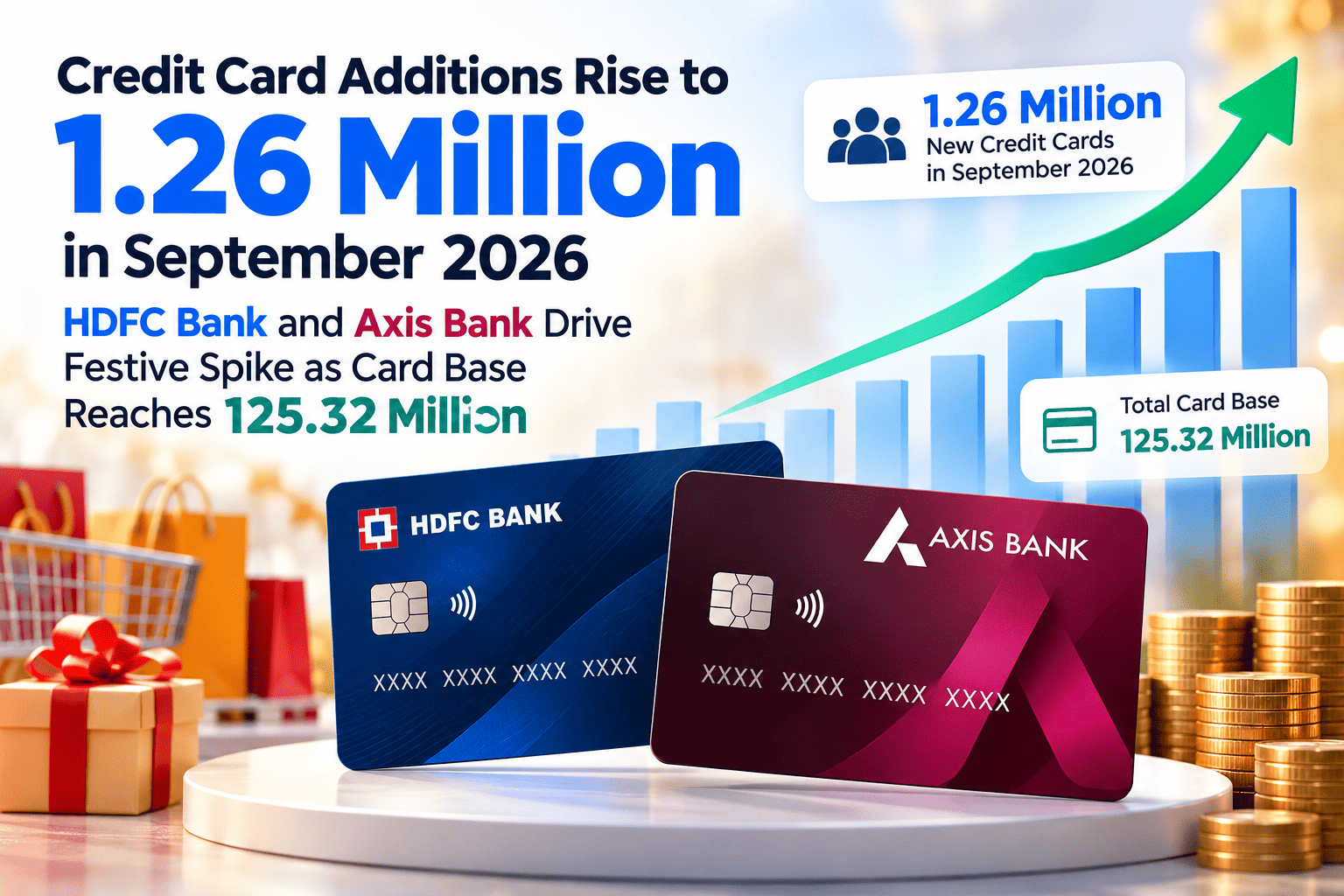


Indian banks registered a sharp acceleration in card acquisition, as net credit card additions jumped to 1.26 million in September 2026, marking the second-highest monthly volume recorded this calendar year, according to banking deployment data released by the Reserve Bank of India (RBI).
The monthly tally reflects an aggressive distribution push by major private lenders preparing for peak festive e-commerce sales and offline retail demand. September’s volume represents a 5.5% expansion over August 2026 (1.20 million net additions) and a 24.75% year-on-year increase compared to the 1.01 million cards added during September 2025. With this monthly influx, total outstanding credit cards across the country climbed to 125.32 million, delivering a 10.4% annual expansion over the 113.51 million active cards documented in the previous year.
Private lenders accounted for the majority of new account openings. HDFC Bank credit cards and Axis Bank credit cards jointly captured nearly 43% of aggregate net additions in September, onboarding 539,878 fresh accounts between them and outpacing state-backed competitors.
What Happened?
The Reserve Bank of India's monthly banking sector disclosure revealed that net credit card additions reached 1.26 million in September 2026. Led by customer onboarding from HDFC Bank (280,353 cards) and Axis Bank (259,525 cards), total active credit cards in India reached 125.32 million ahead of the festival shopping season.
What Did the RBI Credit Card Data 2026 Reveal?
The comprehensive RBI credit card data 2026 underscores a concentrated surge across retail portfolios, rebounding strongly after conservative underwriting guidelines took hold across the banking sector.
Across the second quarter of the financial year (July to September 2026), Indian banks onboarded 3.72 million net credit cards, surging by nearly 47% compared to the 2.54 million cards added during Q2 FY26. It also represented a 26% sequential pickup from the 2.96 million cards issued in the April–June quarter of 2026.
Lender-Wise Performance Breakdown (September 2026)
|
Issuing Bank / Entity |
Net Cards Added (Sep 2026) |
Net Cards Added (Aug 2026) |
Monthly Momentum Shift |
Key Growth Drivers |
|
HDFC Bank |
280,353 |
122,669 |
+128.5% |
Co-branded retail tie-ups, pre-approved digital upgrades |
|
Axis Bank |
259,525 |
32,789 |
+691.5% |
Festive e-commerce partnerships, revamped reward tiers |
|
SBI Cards |
208,026 |
193,294 |
+7.6% |
Bharat/Tier-2 distribution, merchant cashbacks |
|
Bank of Baroda (BOB Financial) |
114,083 |
~98,000 |
+16.4% |
PSU salary account cross-selling, lifetime-free variants |
|
Slice Small Finance Bank |
89,794 |
~81,000 |
+10.8% |
Gen-Z digital onboarding, app-first card solutions |
|
Federal Bank |
81,753 |
~74,500 |
+9.7% |
Fintech partnerships, digital co-branded credit rails |
|
ICICI Bank & Kotak Mahindra Bank |
Muted growth |
Moderate |
Conservative |
Stricter portfolio underwriting, risk-weighted calibrations |
As documented in the RBI credit card data 2026, HDFC Bank credit cards maintained clear dominance in retail originations, adding more than double its August run rate. Simultaneously, Axis Bank credit cards exhibited a massive rebound, increasing fresh additions by nearly eightfold month-on-month after managing regulatory system updates and underwriting recalibrations earlier in the fiscal year. Conversely, originations remained relatively subdued at ICICI Bank and Kotak Mahindra Bank as both lenders prioritized risk mitigation over pure volume growth.
The Drivers Behind Credit Card Growth in India
The sustained structural credit card growth in India is being propelled by several concurrent economic and behavioral tailwinds:
-
Pre-Festive Merchant Tie-Ups: Financial institutions systematically front-load customer acquisitions during August and September to capture high festive transaction fees (MDR) and card EMI conversions during October e-commerce discount sales.
-
RuPay-UPI Credit Integration: Linking credit lines to UPI QR codes has transformed credit cards from point-of-sale plastic into seamless daily transaction instruments.
-
Premiumisation and Rewards: While entry-level unsecured cards faced elevated scrutiny, lenders expanded premium and lifestyle segments offering travel perks, lounge vouchers, and dining incentives.
-
Shift Toward Structured EMIs: Banks are optimizing for profitable loan-on-card conversions, offering instant point-of-sale installment plans for home appliances, electronics, and festival shopping.
The Reality of Credit Card Spending in India
As cards in circulation expand past 125 million, aggregate credit card spending India has consistently held above the ₹2-lakh-crore monthly threshold throughout mid-to-late 2026.
However, rapid card volume growth introduces acute balance sheet risks for first-time credit users:
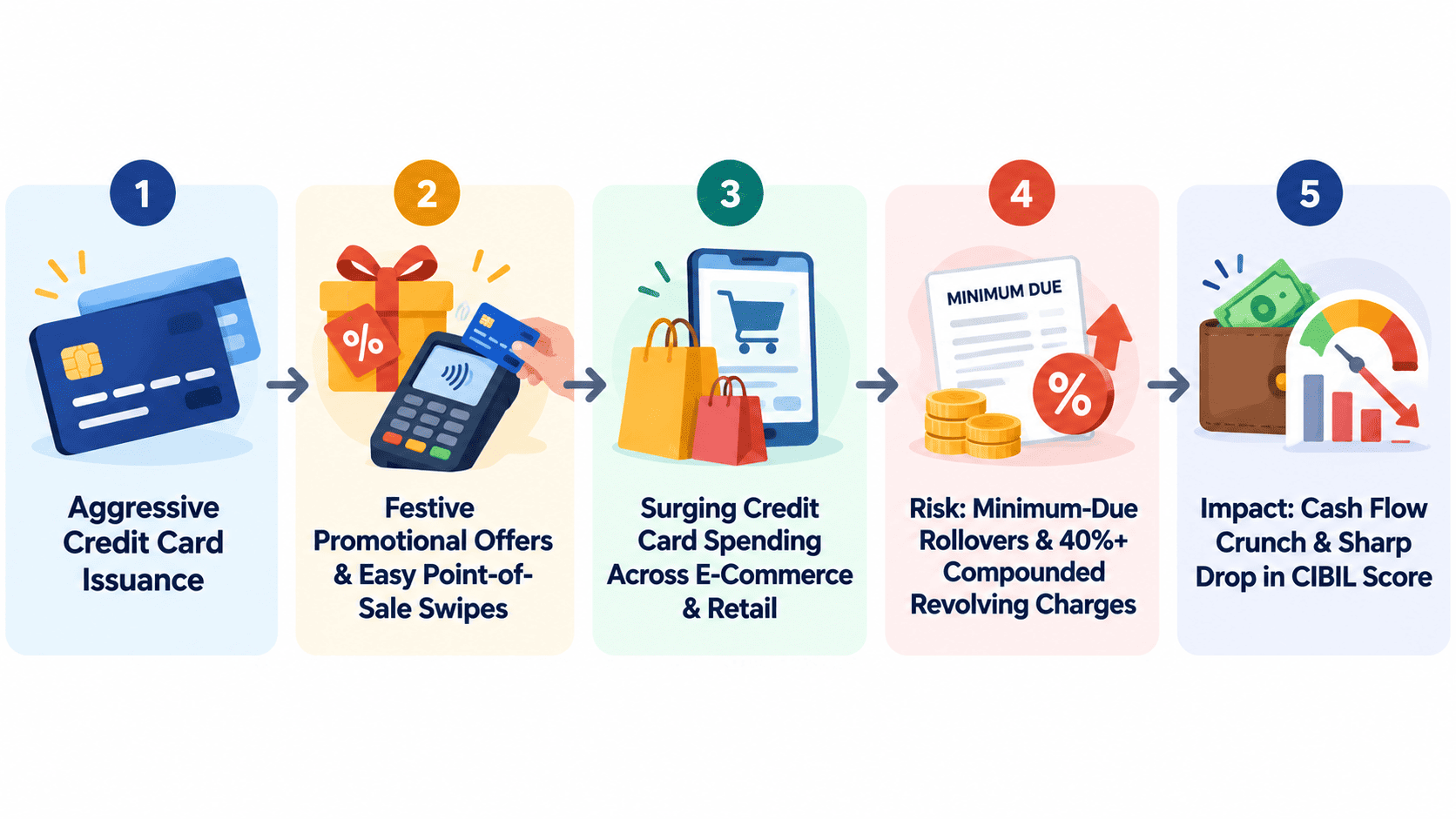
While festive reward points and no-cost EMI schemes appear lucrative, rolling over unpaid balances on HDFC Bank credit cards or Axis Bank credit cards can trigger annual finance charges ranging from 36% to 49.36% per annum. For young professionals, students, and gig workers, managing revolving debt on high-interest cards can quickly derail long-term financial stability.
Institutional Comparison: Earlier Market vs Current Reality
|
Functional Parameter |
Mid-2024 to Early 2025 Setup |
Current September 2026 Reality |
Impact on Indian Borrowers |
|
Monthly Card Originations |
0.8 million – 1.0 million cards |
1.26 million cards added |
Pre-approved credit cards are readily pitched via banking apps. |
|
Total Card Base |
~105 - 113 million active cards |
125.32 million active cards |
Broader accessibility across Tier-2 and Tier-3 urban markets. |
|
Regulatory Risk Weights |
RBI increased risk weights by 25% |
Lenders absorbed capital charges |
Underwriting relies heavily on bureau history and strict income verification. |
|
Fintech & SFB Presence |
Unsecured card issuance paused |
SFBs (like Slice) issuing natively |
More entry-level options for first-jobbers and freelancers. |
|
Credit Alternative Channels |
High dependence on revolving plastic |
Transparent digital micro-credit |
Digital credit lines provide clear repayment schedules over revolving debt. |
What This Means for Borrowers
The surge in credit card additions directly impacts how retail borrowers navigate credit access, borrowing costs, and portfolio risk:
-
Credit Card Limits and Eligibility: Banks are easing card approval criteria for existing salaried account holders to capture holiday spending, though strict income verification remains non-negotiable for new-to-credit profiles.
-
The Revolving Credit Trap: A high card limit is not free capital. Defaulting or carrying forward balances attracts steep finance charges, taxes, and severe credit score downgrades.
-
Impact on Future Personal Loan Approvals: Maxing out credit card limits elevates your Credit Utilization Ratio (CUR) above 30%, which immediately drags down your credit score and hinders your eligibility when applying for long-term personal credit.
-
Transparent Credit Over Revolving Plastic: Savvy consumers increasingly bypass high-APR card balances by leveraging short-tenure digital loans that specify transparent repayment schedules upfront.
Managing Cash Flow and Personal Budgeting
Before accepting every pre-approved card invitation, young earners and salaried employees should benchmark their balance sheets against fundamental budgeting rules:
-
Track Debt Obligations: Use a FOIR Calculator to ensure that your total monthly loan repayments, card EMIs, and essential commitments do not exceed 40% to 50% of your take-home pay.
-
Maintain Monthly Discipline: Follow a balanced household framework using the 50 30 20 Rule Calculator to distribute monthly income methodically across necessities, personal goals, and liquid emergency reserves.
-
Prevent Uncontrolled Spending: Read our practical guide on Lifestyle Inflation: Why Higher Income Does Not Always Mean More Savings to avoid consumer debt traps during shopping seasons.
-
Understand Compounding Costs: Calculate how deferred card charges accumulate over time with our Compound Interest Calculator to see the actual cost of minimum-due payments.
Hypothetical Example: Resolving Festive Expenses
Suppose a salaried employee incurs an unexpected festival or emergency travel expense of ₹30,000.
-
Scenario A (Rolling Over on a Credit Card): The borrower pays only the "Minimum Amount Due" (typically 5%, or ₹1,500) on a card charging 42% APR. Because interest charges apply retroactively to the entire outstanding sum from the date of the swipe, interest and GST pile up rapidly. It can take over 24 months to fully retire the debt, costing thousands of rupees in pure interest penalties.
-
Scenario B (Disciplined Fixed Loan): The borrower secures a fixed-tenure digital micro-loan of ₹30,000. Using a transparent Personal Loan EMI Calculator, they lock in equal, predictable monthly EMIs over 3 to 6 months. Every single installment pays down both principal and interest, keeping credit utilization healthy and completely removing the threat of open-ended interest accumulation.
What Borrowers Should Check Before Taking a Loan
If you need immediate credit without getting entangled in the high-interest revolving cycle of credit cards, evaluate your lending partners thoroughly:
-
Mandatory Key Fact Statement (KFS): Verify that the lender provides a full breakdown of the Annual Percentage Rate (APR), processing fees, and net disbursal amounts upfront, as mandated by the RBI Master Direction on Digital Lending.
-
Repayment Predictability: Calculate your exact monthly outgo using a Loan EMI Calculator before executing the loan agreement.
-
Regulated Underwriting: Borrow exclusively from RBI-registered Non-Banking Financial Companies (NBFCs) committed to the Responsible Lending code and transparent collections.
-
Repayment Flexibility: Review early settlement terms using our Loan Foreclosure Calculator to ensure you can clear debts ahead of schedule without penalties.
When managing short-term cash gaps, medical bills, or festival purchases, Pocketly delivers a responsible and 100% digital personal borrowing experience. Whether you require a Personal Loan for Salaried professionals to bridge month-end expenses, a tailored Personal Loan for Self Employed individuals managing operating cash flow, or a convenient Loan for Non Salaried workers, Pocketly provides seamless credit lines from ₹1,000 up to ₹50,000 disbursed directly into your bank account with complete disclosure of terms.
10. Key Takeaways
-
1.26 Million Net Additions: Indian lenders added 1.26 million net credit cards in September 2026, marking the second-highest monthly volume this calendar year.
-
Private Lenders Drive 43%: HDFC Bank credit cards (280,353) and Axis Bank credit cards (259,525) accounted for nearly 43% of total net issuance.
-
Active Base Tops 125M: India's total outstanding credit cards reached 125.32 million, up 10.4% year-on-year from 113.51 million in September 2025.
-
Surging Quarterly Growth: Banks added 3.72 million cards in the July–September quarter, jumping nearly 47% compared to the same period in 2025.
-
Revolving Risk Warning: Cardholders should avoid revolving unpaid balances at 36%–49% APR, relying instead on structured, short-term personal credit lines with fixed EMIs.
Take Control of Your Credit Without Falling Into the Card Debt Trap
Don't let high revolving interest rates wipe out your monthly savings this festive season. If you need immediate funds to cover urgent expenses or bridge cash flow gaps, get access to quick, reliable, and transparent digital credit up to ₹50,000 on Pocketly. Complete your 100% paperless KYC in minutes and manage your repayments with flexible, easy EMIs.
Download the Pocketly App on Play Store & App Store and apply today.
Sources
-
Reserve Bank of India (RBI): Monthly Bank-Wise ATM, POS, and Card Statistics (Reported September 2026 / October 2026).
Direct Portal Reference: https://www.rbi.org.in -
The Economic Times: Banking News Bureau, "Credit card additions hit second-highest monthly level in 2026 as banks gear up for festive season" (Published October 27–28, 2026).
Reference: https://economictimes.indiatimes.com -
Reserve Bank of India (RBI): Master Direction – Reserve Bank of India (Digital Lending) Directions, 2022 / Fair Practices Code for Lenders.
Reference: https://www.rbi.org.in
Frequently Asked Questions (FAQs)
1. What caused the surge in credit card additions in September 2026?
According to the latest RBI credit card data 2026, banks aggressively expanded their card portfolios ahead of the peak festive shopping season to capture high merchant volumes, festive e-commerce sales, and customer EMI transactions.
2. Which banks led credit card additions in September 2026?
HDFC Bank and Axis Bank led the market, adding 280,353 and 259,525 net cards respectively. Together, they accounted for nearly 43% of all net credit cards added across the Indian banking sector during the month.
3. How many credit cards are active in India right now?
As of September 30, 2026, the Reserve Bank of India reports that total outstanding credit cards in circulation reached 125.32 million, reflecting a 10.4% annual increase compared to 113.51 million active cards in September 2025.
4. Does high credit card spending in India affect credit scores?
Yes. If your card spending pushes your credit utilization ratio above 30% of your total credit limit, or if you roll over balances by paying only the minimum due, credit rating agencies will reduce your score, making future loan approvals difficult.
5. How do credit cards differ from digital micro-loans like Pocketly?
Credit cards provide an open-ended revolving credit line where unpaid balances attract high compounding interest of 36% to 49% per annum. In contrast, digital micro-loans from Pocketly offer structured, fixed-tenure credit from ₹1,000 to ₹50,000 with transparent APR and fixed monthly EMIs.
6. What should I check before applying for an instant personal loan?
Before applying, review the mandatory Key Fact Statement (KFS), verify that the lender is partnered with an RBI-registered NBFC, calculate your monthly installment using a Personal Loan EMI Calculator, and ensure there are no hidden processing fees.