

Low CIBIL Score can make it difficult for you to take out loans, particularly when you require money in a hurry. You may have had a slip-up with a credit card payment last year. Next, there's a call for your laptop for repair or a medical bill just before payday.
While searching for other loan options to traditional bank loans, you might find yourself encountering P2P loans. But, can you really obtain 1 with bad credit? But how secure are these platforms?
The RBI guidelines for P2P lending impose certain obligations on P2P lending platforms in India. Knowing them will help you to avoid being misled by loan offers and costly borrowing.
Quick Answer: Can You Get P2P Loans With Bad Credit in India?
Yes, applicants with low credit ratings can apply for P2P loans in India. Approval may not be guaranteed, however. P2P firms regulated by RBI are required to evaluate the creditworthiness of borrowers and make their risks known to prospective lenders. Payment history, income, other loans and lender willingness will impact results.
Also Read: 15 Days Loan App: Can You Get ₹5,000 with Pocketly?
What Are P2P Loans and How Do They Work?
Peer-to-peer loans (P2P) are loans that you can get from another person or another person who meets the requirements of the lending platform using the Internet.
Explanation: A P2P lending platform is a web-based opportunity that enables borrowers and lenders to link up, draft a loan contract and oversee repayments. The platform does not make its own loans.
Here is how a typical P2P personal loan works:
-
The borrower registers on a P2P loan app or website.
-
The platform verifies the applicant's identity and assesses credit risk.
-
Eligible lenders review relevant borrower information.
-
Individual lenders agree to fund the loan.
-
The borrower signs the agreement.
-
Funds are transferred through the prescribed banking and escrow arrangements.
-
The borrower repays according to the agreed schedule.
Unlike a conventional bank loan, funding depends on participating lenders.
Can You Get a P2P Loan With a Low CIBIL Score?
Having a bad credit score doesn't mean that a person can't apply. But, P2P loans are not guaranteed loans for borrowers with bad credit.
Consider two situations:
-
You are a first time jobber and are receiving a monthly income of ₹25,000 and have never used a credit card. May have little to no credit history.
-
Salaried borrower: Your monthly income is ₹40,000, but you have been regularly defaulting on your EMIs. You have a history of credit problems.
The first applicant might not be able to qualify for traditional credit, while the second one may have problems.
P2P platforms verify borrower information before showing the applications to lenders. If you have a track record of defaulting on loan payments, have a tremendous amount of debt or an irregular income, it may be harder to get the money you need.
Practical insight: It doesn't mean something is low, if you don't have one at all, especially if your score is due to non-payment. Before applying, review your credit report to determine which of the following situations is the case.
RBI Rules for P2P Loans in India: What Changed?
The Reserve Bank of India issued updated NBFC-P2P Directions on 28 November 2025, which form the current framework discussed here.
|
RBI requirement |
What it means |
|
Registration |
P2P platforms must hold RBI registration as an NBFC-P2P |
|
Borrowing limit |
Total outstanding P2P borrowing across platforms cannot exceed ₹10 lakh |
|
Single lender exposure |
One lender cannot have more than ₹50,000 exposure to the same borrower across P2P platforms |
|
Maximum tenure |
P2P loans cannot exceed 36 months |
|
Loan security |
Platforms may facilitate only unsecured loans |
|
Credit assessment |
Platforms must assess borrower risk |
|
Fund transfers |
Prescribed bank-operated escrow arrangements must be used |
These are regulatory limits, not amounts or tenures that every borrower will receive.
The RBI also requires platforms to display interest rates in annualised percentage rate (APR) format and disclose applicable fees.
A registered P2P platform cannot promise lenders guaranteed returns or protect them from every borrower default. Borrowers remain responsible for repaying their loans.
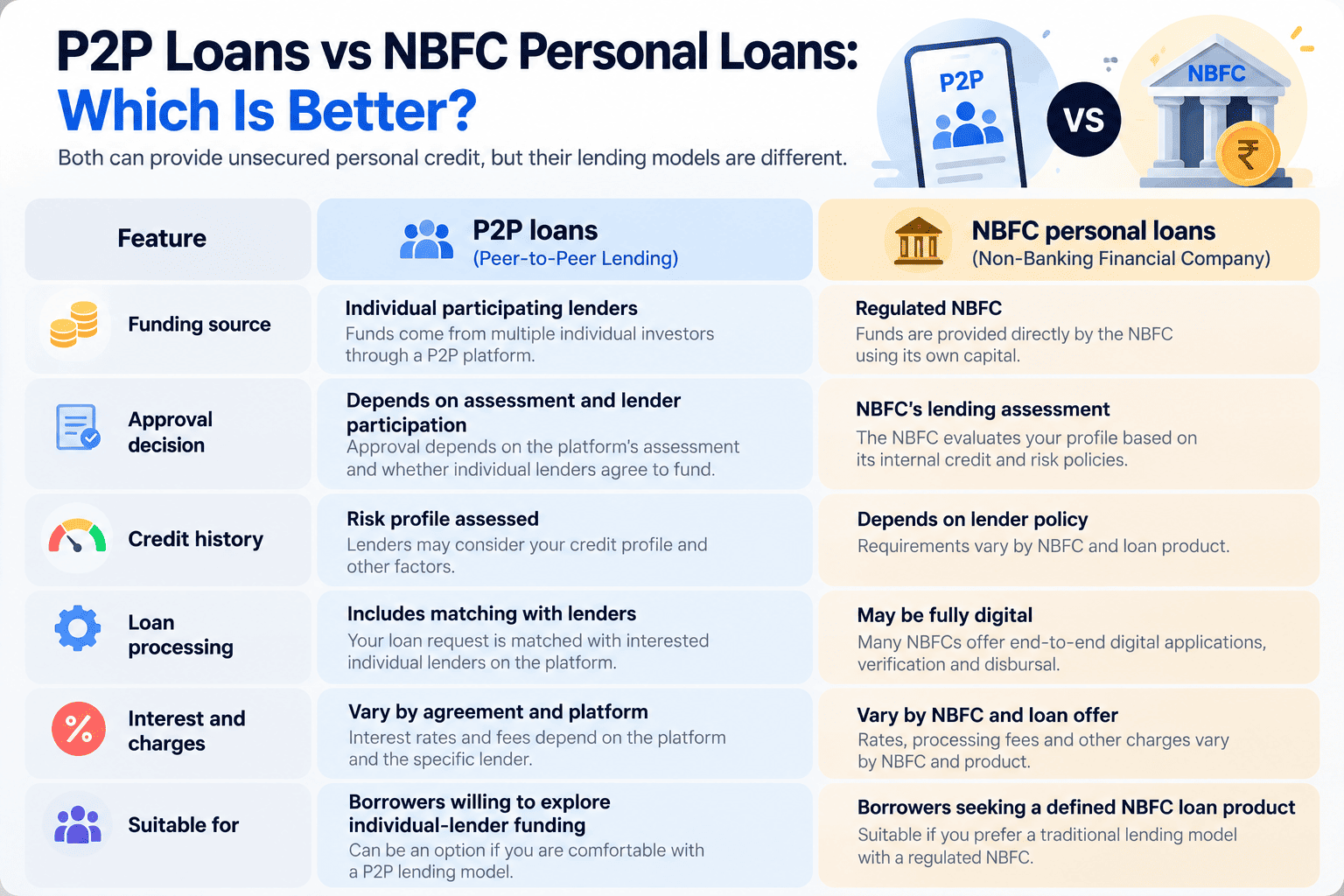
P2P Loans vs NBFC Personal Loans: Which Is Better?
Both can provide unsecured personal credit, but their lending models are different.
|
Feature |
P2P loans |
NBFC personal loans |
|
Funding source |
Individual participating lenders |
Regulated NBFC |
|
Approval decision |
Depends on assessment and lender participation |
NBFC's lending assessment |
|
Credit history |
Risk profile assessed |
Depends on lender policy |
|
Loan processing |
Includes matching with lenders |
May be fully digital |
|
Interest and charges |
Vary by agreement and platform |
Vary by NBFC and loan offer |
|
Suitable for |
Borrowers willing to explore individual-lender funding |
Borrowers seeking a defined NBFC loan product |
Neither category automatically offers cheaper borrowing or easier approval.
The useful comparison is the amount you receive, the total repayment obligation and whether you can meet each due date.
The Loan Cost Many Borrowers Overlook
Suppose you need ₹5,000 for an urgent repair.
Pocketly's published representative example shows how deductions can affect the actual amount received.
|
Loan detail |
Illustrative Pocketly example |
|
Sanctioned loan |
₹5,000 |
|
Processing fee including GST |
₹425 |
|
Net amount received |
₹4,575 |
|
Total interest |
₹302.96 |
|
Total repayment |
₹5,302.96 |
|
Total credit cost |
₹727.96 |
|
Disclosed APR |
93.15% |
This is Pocketly's published illustration for a three-month loan, not a P2P market rate or a guaranteed offer.
If you need ₹5,000 in your account, receiving ₹4,575 may not cover your expense. Check the net disbursal and total borrowing cost before accepting any loan.
Alternatives to P2P Loans for Bad Credit
If a P2P platform cannot match your application with lenders, consider these options.
1. NBFC personal loans
Some NBFCs assess borrowers using income, existing obligations and other eligibility information rather than relying solely on an established CIBIL score.
Read more: NBFC Personal Loan for Bad Credit.
2. Secured loans
A loan against eligible gold or a fixed deposit may be an option when unsecured borrowing is difficult. However, failing to repay can put the pledged asset at risk.
3. Salary advance
If your employer offers a salary advance, check the repayment deduction and whether fees apply. This may suit a temporary cash-flow gap.
4. Restructuring existing debt
If you already struggle with several EMIs, discuss available repayment arrangements with your lender before adding another loan.
Avoid taking a new loan to recover stock-market or F&O trading losses. Borrowing for speculative trading can increase losses and leave you with repayment obligations even when the trade fails.
Pocketly: An Alternative to P2P Loans for Small Expenses
For borrowers seeking a digital personal loan, Pocketly offers another option.
Pocketly operates through Speel Finance Company Private Limited, an RBI-registered NBFC. It is an NBFC-based personal lending service, not a P2P lending platform.
According to Pocketly's published information:
-
Loan amount: ₹1,000 to ₹50,000
-
Application: 100% digital
-
Repayment period: 61 days to 9 months
-
CIBIL requirement: An established CIBIL score is not mandatory to apply
-
Processing: Pocketly advertises a process that can take as little as seven minutes for eligible applicants
-
Security: Unsecured personal loans without collateral
Pocketly describes its service as trusted by millions of users. Its digital process may suit eligible salaried borrowers, first-jobbers and self-employed individuals who need smaller loan amounts.
However, not requiring a CIBIL score to apply does not mean there are no checks. Approval, available amount, interest rate and disbursal time depend on eligibility, verification and lender assessment.
Need to check your eligibility? Visit Pocketly – Apply for an Instant Personal Loan and review the Key Facts Statement before accepting any offer.
How to Choose a Safe P2P Loan App
Before sharing PAN, Aadhaar or bank information, follow these checks:
-
Verify that the P2P operator holds the appropriate RBI registration.
-
Read the platform's credit assessment and eligibility criteria.
-
Check the APR, fees and total repayment amount.
-
Confirm the lender details and loan agreement.
-
Never send an advance fee to an unknown personal account.
-
Avoid apps demanding unnecessary access to contacts, call logs or photos.
-
Keep the repayment schedule and complaint contact details.
For more help, read Pocketly's guide to identifying fake loan apps.
Final Thoughts
If you are looking for a p2p loan for bad credit in India, you might want to look into it, but having a poor credit score doesn't mean you won't be able to get loans. RPs are required to evaluate borrower risk and lenders determine their participation.
Pre-check your credit report, work out your total repayments and see if there's another EMI that fits in with your monthly budget.
In case you're looking for a smaller personal loan, then you can try Pocketly's digital application for loans up to ₹50,000, depending on your eligibility.
Disclaimer: This article is for educational purposes. Loan approval, fees and repayment terms depend on the applicable lender and agreement. Always review the Key Facts Statement before borrowing.
Frequently Asked Questions
1. Are P2P loans available for bad credit in India?
Yes. Borrowers with low credit scores may apply, but eligibility assessment and lender participation determine whether funding is available.
2. Are P2P loans legal in India?
Yes. P2P lending is permitted through platforms registered with the RBI as NBFC-P2Ps and operating under applicable regulations.
3. Can I get a P2P loan without a CIBIL score?
You may apply with a limited credit history, depending on platform eligibility. Creditworthiness checks are still required.
4. Are P2P personal loans approved instantly?
Not necessarily. The platform must complete its assessment and match participating lenders with borrowers before disbursal.
5. What is the maximum P2P loan limit in India?
RBI rules cap a borrower's aggregate outstanding P2P loans across platforms at ₹10 lakh. This is not a guaranteed borrowing entitlement.
6. Is a P2P loan app safer than a personal loan app?
Safety depends on the operator, regulatory compliance, disclosures and data-handling practices. Verify the relevant regulated entity before applying.
7. Can students apply for P2P loans?
Eligible students may apply where platform criteria permit. They must still satisfy credit assessment and repayment requirements.
8. What happens if I miss a P2P loan EMI?
Missed payments may attract disclosed charges, recovery follow-up and adverse credit reporting. Contact the lender or platform promptly if repayment becomes difficult.
9. Is Pocketly a P2P loan app?
No. Pocketly provides a digital personal loan service through Speel Finance Company Private Limited, an RBI-registered NBFC.
10. Can I apply for a Pocketly loan without a CIBIL score?
Yes. Pocketly states that a CIBIL score is not mandatory to apply. Loan approval depends on its eligibility and verification criteria.