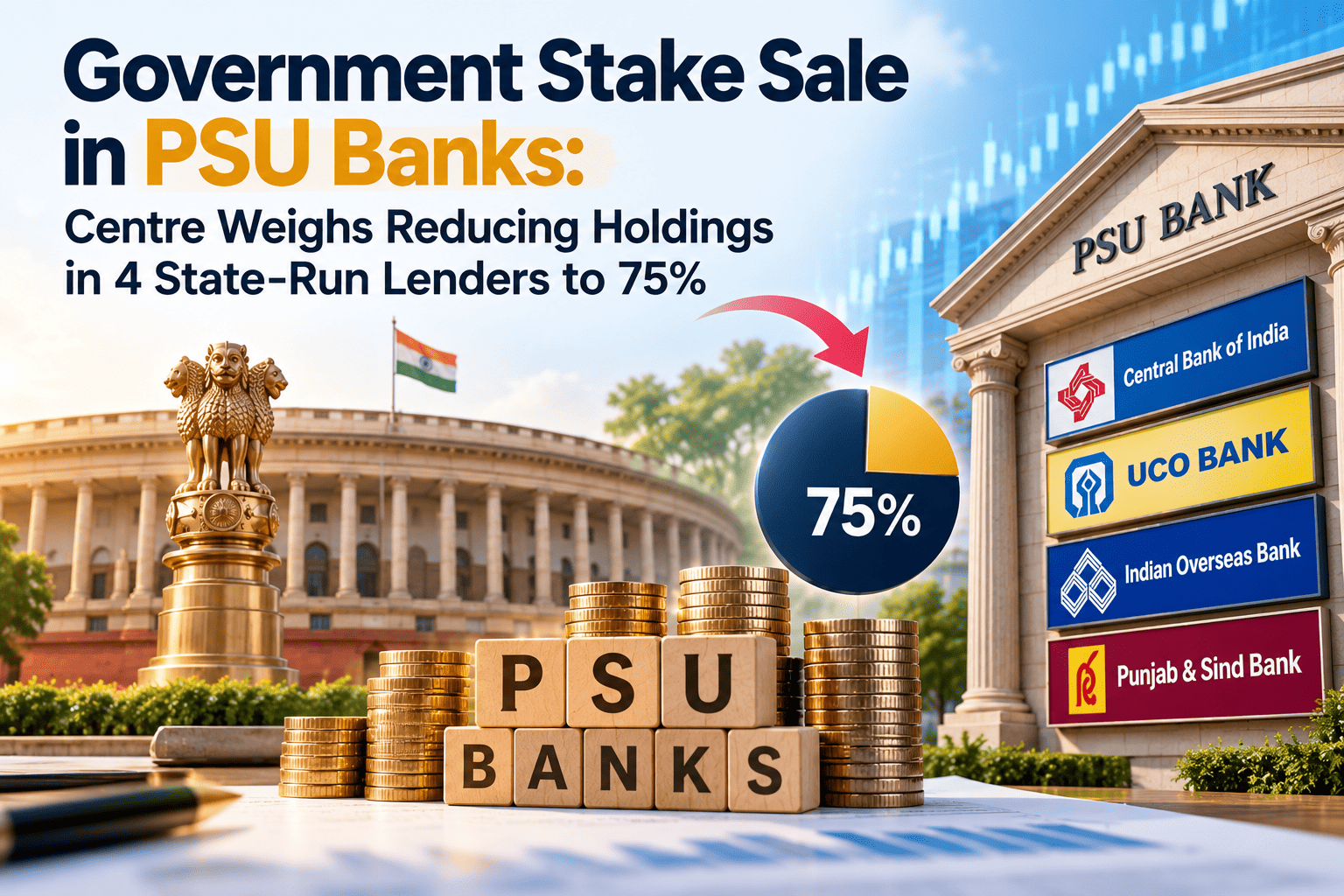


The Government of India is actively preparing to reduce its equity ownership to 75% across four state-owned lenders Central Bank of India, Indian Overseas Bank (IOB), UCO Bank, and Punjab & Sind Bank to comply with statutory Minimum Public Shareholding (MPS) rules established by capital markets regulator Securities and Exchange Board of India (SEBI).
The development, reported on October 23, 2026, follows the landmark divestment of IDBI Bank to Fairfax Financial Holdings. The primary objective is to widen the public trading float and meet regulatory requirements over the coming fiscal year through Offer for Sale (OFS) tranches and organic balance-sheet equity raises. Crucially for retail consumers, this proposed equity dilution is not an immediate change in state control, and day-to-day operations, deposit safety, and existing loan agreements remain fully protected under Reserve Bank of India (RBI) supervisory frameworks.
What Happened?
The Ministry of Finance is evaluating a phased government stake sale in PSU banks to lower sovereign holding to the mandated 75% threshold in Central Bank of India, Indian Overseas Bank, UCO Bank, and Punjab & Sind Bank. The divestment will occur via Offer for Sale (OFS) mechanisms or fresh market capital issuances without relinquishing majority government control.
The Regulatory Trigger: SEBI Minimum Public Shareholding (MPS) Rules
Under Rule 19A of the Securities Contracts (Regulation) Rules (SCRR), every listed company in India must ensure a minimum public float of 25%, capping promoter ownership at 75%.
While the Centre previously extended compliance exemptions for public sector entities, financial institutions, and public sector undertakings until August 2026, the Ministry of Finance is now prioritizing long-term market float expansion to normalize these lenders on the BSE and National Stock Exchange of India (NSE).
Current Government Ownership in the 4 PSU Banks
|
Public Sector Bank |
Current Government Holding (%) |
Required Dilution to Hit 75% Cap |
Primary Divestment Mechanism Considered |
|
Indian Overseas Bank (IOB) |
92.44% |
17.44% |
Offer for Sale (OFS) / QIP / Rights Issue |
|
Punjab & Sind Bank |
93.85% |
18.85% |
Offer for Sale (OFS) / Tier-1 Capital Dilution |
|
UCO Bank |
90.95% |
15.95% |
Phased Market Placement / OFS Tranches |
|
Central Bank of India |
81.19% |
6.19% |
Offer for Sale (OFS) / Qualified Institutional Placement |
As shown above, Central Bank of India requires the smallest adjustment (6.19%), whereas Punjab & Sind Bank, Indian Overseas Bank, and UCO Bank require substantial sell-downs exceeding 15% to 18% of their aggregate equity base.
Stake Sale vs. Bank Privatisation: What is the Difference?
A common point of confusion among depositors and credit seekers is whether a stake reduction equals full Bank Privatisation. They are separate financial processes:
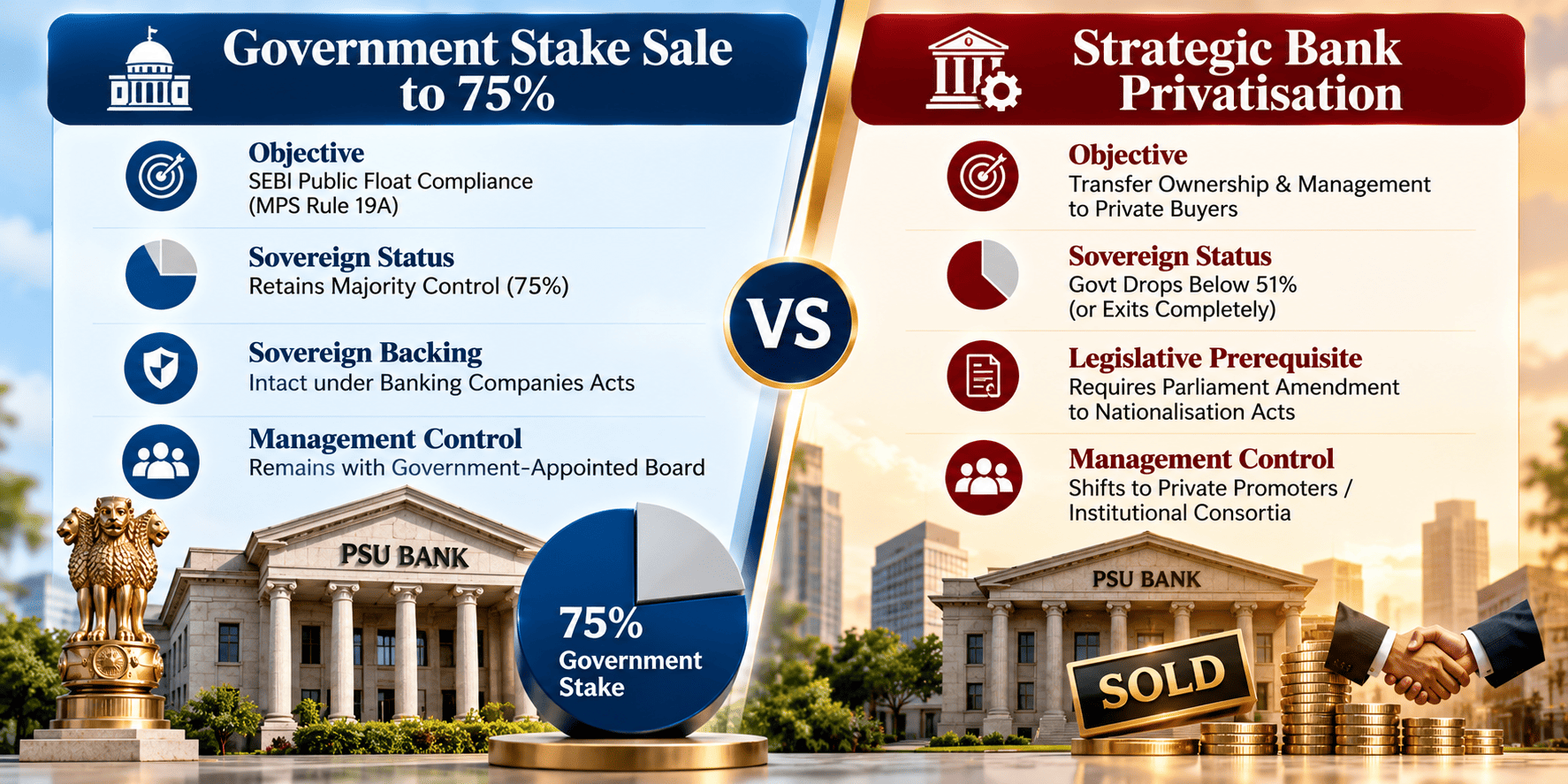
While the broader public sector bank privatisation plan india first outlined in Union Budget 2021-22 to privatise two state lenders alongside one general insurer remains an active policy consideration, NITI Aayog's shortlisted candidates (Central Bank of India and Indian Overseas Bank) cannot be privatised without statutory legislative changes.
Amending the Banking Companies (Acquisition and Transfer of Undertakings) Act, 1970/1980 requires formal parliamentary clearance. Therefore, the immediate move across these four public sector banks in india represents a float-widening exercise rather than an overnight handover to private buyers.
How Will the Government Offload Its Stakes?
The Department of Investment and Public Asset Management (DIPAM) and bank boards are evaluating two primary routes:
-
Offer for Sale (OFS) via Stock Exchanges: The central government sells existing shares directly to institutional and retail investors through dedicated exchange bidding windows. Proceeds flow directly to the national exchequer.
-
Bank-Level Fresh Capital Raising: The respective PSU Banks issue new equity shares via Qualified Institutional Placements (QIP), rights issues, or follow-on public offers (FPOs). This expands the total share base, organically diluting the government’s percentage while injecting fresh Tier-1 regulatory capital directly into the bank's balance sheet.
What This Means for Borrowers and Everyday Consumers
For salaried professionals, gig workers, small business proprietors, and students seeking credit, changes in sovereign equity stakes raise natural questions regarding personal loans, interest rates, and loan servicing.
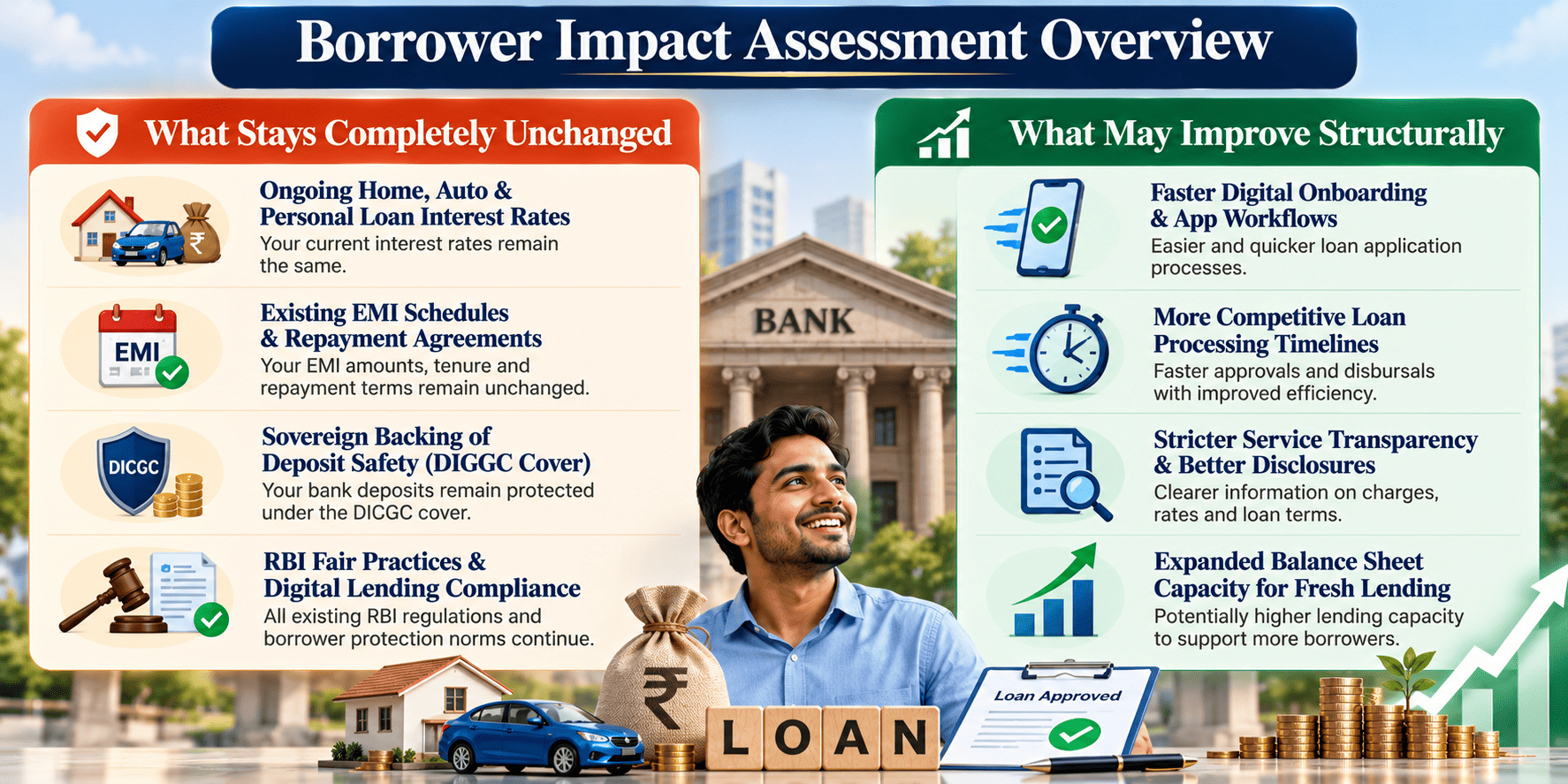
1. Will Personal Loan Interest Rates or EMIs Change?
No. Personal loan and retail credit interest rates are tied directly to the RBI Repo Rate via the External Benchmark Lending Rate (EBLR) or the Marginal Cost of Funds Based Lending Rate (MCLR). A reduction in government shareholding from 92% to 75% does not alter the underlying benchmark or increase loan EMIs.
2. Are Customer Deposits Safe?
Yes. All deposits across public sector banks in india continue to enjoy statutory backing, alongside standard coverage of up to ₹5,00,000 per depositor under the Deposit Insurance and Credit Guarantee Corporation (DICGC), a wholly owned subsidiary of the Reserve Bank of India.
3. What Changes for Loan Processing and Digital Services?
As public shareholding expands, public-market institutional scrutiny generally drives PSU lenders to accelerate digitization. Borrowers can expect streamlined net banking portals, automated mobile application journeys, and improved turnaround times for retail credit processing.
Institutional Comparison: Before vs. After the Proposed Stake Cuts
|
Functional Area |
Current Situation (Pre-Stake Sale) |
Proposed Situation (Post-75% Rebalancing) |
Practical Impact on Indian Borrowers |
|
Government Equity |
81.19% to 93.85% across the 4 banks |
Capped at 75.00% across all 4 lenders |
Majority state ownership and sovereign identity remain fully intact. |
|
Public Float & Liquidity |
Restricted (6.15% to 18.81% free float) |
Expanded to at least 25.00% public float |
Deeper stock liquidity; institutional investor oversight improves corporate transparency. |
|
Lending Capital Base |
Constrained by sovereign budgetary allocations |
Expanded via public QIP / Tier-1 share issuances |
Banks gain higher balance sheet headroom to issue consumer and corporate credit. |
|
Digital Lending Experience |
Moderate; traditional branch-heavy processing |
Accelerated deployment of digital journeys |
Faster loan approvals and automated KYC checks for everyday retail applicants. |
|
Loan Pricing & Margins |
Benchmarked to RBI EBLR / MCLR |
Benchmarked to RBI EBLR / MCLR |
Zero disruption; borrowing charges remain tied strictly to monetary policy. |
Managing Day-to-Day Cash Flows During Banking Transitions
Even as large PSU Banks upgrade their infrastructure, retail loan disbursement through traditional branch networks can still require multiple days for verification, physical document collection, and field checks.
For young professionals, students, freelancers, and self-employed individuals who face immediate, short-term liquidity bottlenecks such as unexpected utility bills, medical prescriptions, or monthly rent dues waiting on traditional processing is not always practical.
What Borrowers Should Check Before Taking a Personal Loan
Before committing to any personal loan or credit facility, ensure you evaluate the following essential factors:
-
Regulated Lender Verification: Always verify that the lending platform partners with an RBI-registered Non-Banking Financial Company (NBFC) or a Scheduled Commercial Bank. Pocketly facilitates loans exclusively through its partner RBI-registered NBFC, Speel Finance Company Private Limited.
-
Total Annual Percentage Rate (APR): Examine the complete borrowing cost, including processing fees, administrative charges, and applicable taxes, clearly itemized in a standardized Key Fact Statement (KFS).
-
Repayment Affordability: Budget your outgo carefully. Never borrow without a sustainable plan for monthly instalments.
-
Credit Score Discipline: Regular, on-time repayments build your credit history across bureaus like CIBIL and Experian, while late payments damage your score and attract penalty charges.
How Pocketly Bridges Short-Term Credit Gaps Responsibly
If you experience temporary cash flow shortfalls while navigating routine banking hurdles, Pocketly is India's Most Trusted Financial App used by 20M+ of Happy Users.
Eligible borrowers can apply for instant personal loans, no CIBIL score needed at Pocketly, accessing hassle-free, short-term digital credit designed to manage immediate cash needs without complex branch visits:
-
Instant Digital Underwriting: Eligible borrowers can secure digital short-term credit ranging from ₹1,000 to ₹50,000 with a 100% digital, paperless application and swift bank transfer.
-
For Salaried Earners: Bridge month-end salary delays smoothly with a targeted personal loan for salaried applicants.
-
For Business Owners & Traders: Manage operational inventory cycles and utility bills using a flexible personal loan for self employed profile.
-
For Freelancers & Students: Access micro-credit lines without corporate pay slips via the dedicated loan for non salaried category.
-
Budget Repayments Accurately: Plan your finances beforehand using Pocketly’s free personal loan EMI calculator to maintain total debt transparency.
All loans facilitated through the Pocketly platform are issued by our regulated NBFC partner, Speel Finance Company Private Limited, in strict conformity with Reserve Bank of India (RBI) digital lending guidelines and published responsible lending norms.
Hypothetical Personal Loan Repayment Example
To understand how short-term digital credit is calculated, review this illustrative borrowing scenario:
-
Loan Amount Borrowed: ₹10,000
-
Repayment Tenure: 3 Months
-
Illustrative Interest Rate: 2% per month (reducing balance)
-
Processing Fee (Example): ₹300 + 18% GST (₹54) = ₹354
-
Estimated Monthly EMI: ₹3,467
-
Total Repayment Amount: ₹10,401
-
Net Disbursed Amount: ₹9,646 (after upfront processing deduction)
(Note: The above calculation is a hypothetical example provided purely for educational purposes. Final applicable rates, fees, and credit limits are determined based on individual borrower underwriting and are detailed in the lender's Key Fact Statement.)
The Road Ahead for State-Owned Banking
The Centre's plan to lower sovereign ownership to 75% marks a significant step toward structural modernization across Central Bank of India, Indian Overseas Bank, UCO Bank, and Punjab & Sind Bank.
By aligning these institutions with SEBI's minimum public float mandates, the government aims to enhance capital-market transparency and institutional governance while retaining its majority controlling position. For Indian borrowers and savers, the core foundation of public sector banking regulatory oversight, sovereign trust, and deposit protection remains firmly intact.
Key Takeaways
-
Targeted Lenders: The government is considering paring its equity holdings down to 75% in four lenders: Central Bank of India, Indian Overseas Bank, UCO Bank, and Punjab & Sind Bank.
-
Regulatory Compliance: The primary driver is compliance with SEBI's Rule 19A Minimum Public Shareholding (MPS) mandate requiring a 25% public float.
-
Not Full Privatisation: Selling down to 75% keeps the government as the dominant majority owner with complete administrative control. Full privatisation would require parliamentary amendments to the Banking Nationalisation Acts.
-
Divestment Route: The sell-down is expected to occur via stock exchange Offers for Sale (OFS) and bank-level fresh equity placements (QIPs).
-
Borrower Security: Personal loan interest rates, ongoing EMIs, deposit safety (up to ₹5 lakh under DICGC), and RBI consumer protections remain completely unaffected.
-
Responsible Borrowing Alternative: When traditional bank processing timelines cause short-term cash flow gaps, regulated digital platforms like Pocketly offer transparent credit from ₹1,000 to ₹50,000 via Speel Finance Company Private Limited.
Need Instant Cash for Urgent Expenses? Borrow Responsibly with Pocketly.
Don't let unexpected medical bills, tuition payments, or mid-month expenses disrupt your financial balance. Pocketly is India's Most Trusted Financial App used by 20M+ of Happy Users. Eligible borrowers can apply for instant personal loans, no CIBIL score needed at Pocketly, and receive funds from ₹1,000 to ₹50,000 directly into their bank account via our RBI-registered NBFC partner, Speel Finance Company Private Limited.
Download the Pocketly App on Google Play or App Store
Calculate Your Monthly EMI in Seconds
Also Read: Paras Healthcare IPO GMP 2026: Date, Share Price & Latest Updates
Also Read: Jio Platforms IPO GMP : Today, Expected Share Price and What Indian Investors Should Know
Also Read: SFC Environmental Technologies IPO GMP Steady at ₹31: Should You Bid for a 9.39% Listing Pop?
Also Read: Before Bidding ₹15,000: 4 Key Things BLS Polymers IPO Financials & ₹35 GMP Reveal
Also Read: MK Jewels IPO Opens Oct 28: ₹330 Cr Issue, ₹0 Initial GMP & What 19,000+ SKUs Mean for Debut
Frequently Asked Questions (FAQs)
What is the government stake sale in PSU banks?
The government stake sale in PSU banks refers to the Centre's plan to reduce its equity holding to 75% in Central Bank of India, UCO Bank, Indian Overseas Bank, and Punjab & Sind Bank. This sell-down aims to meet SEBI's 25% minimum public shareholding rule while keeping the government as the majority owner.
Will Central Bank of India, UCO Bank, IOB, or Punjab & Sind Bank be privatised immediately?
No. Reducing equity holding to 75% does not constitute bank privatisation. Complete privatisation involves relinquishing majority control below 51% to private promoters, which legally requires amending the Banking Companies (Acquisition and Transfer of Undertakings) Act in Parliament. The current move is strictly a public-float compliance measure.
Will personal loan interest rates or existing EMIs change due to this stake cut?
No. Retail borrowing costs and loan EMIs are determined by the Reserve Bank of India’s policy repo rate, benchmark EBLR, and internal MCLR formulas. A change in the government’s equity percentage on stock exchanges does not alter a borrower’s existing contract terms or lending rates.
Are savings deposits safe during this government stake sale?
Yes. All customer deposits in these four state-owned banks remain backed by standard banking reserves and are insured up to ₹5,00,000 per depositor under the Deposit Insurance and Credit Guarantee Corporation (DICGC), an RBI subsidiary.
How will the government sell its shares in these four PSU banks?
The government is evaluating Offer for Sale (OFS) tranches through stock exchanges and enabling banks to issue fresh equity to institutional investors via Qualified Institutional Placements (QIP). The exact timing and sizing will depend on market appetite and equity conditions.
What should I do if I need urgent cash while waiting for bank loan approval?
If you face temporary cash flow shortages while awaiting traditional bank processing, consider regulated digital credit solutions. Pocketly provides eligible users with personal loans from ₹1,000 to ₹50,000 through its partner RBI-registered NBFC, Speel Finance Company Private Limited, featuring paperless KYC and transparent terms.
Sources
-
The Economic Times / Livemint (October 23, 2026): "After IDBI Bank sale, Centre looks at Central Bank, UCO Bank, 2 other PSU banks for stake cuts."
[https://www.livemint.com/industry/banking/after-idbi-bank-sale-centre-looks-at-central-bank-uco-bank-2-other-psu-banks-for-stake-cuts-check-terms-here-11792736691027.html](https://www.livemint.com/industry/banking/after-idbi-bank-sale-centre-looks-at-central-bank-uco-bank-2-other-psu-banks-for-stake-cuts-check-terms-here-11792736691027.html) -
India Today Business Desk (October 23, 2026): "PSU bank stake sale: Centre plans to reduce holdings in four lenders to 75%."
[https://www.indiatoday.in/business/story/psu-bank-stake-sale-centre-cut-holdings-four-lenders-75-percent-privatisation-3023190-2026-10-23](https://www.indiatoday.in/business/story/psu-bank-stake-sale-centre-cut-holdings-four-lenders-75-percent-privatisation-3023190-2026-10-23) -
Securities and Exchange Board of India (SEBI): Securities Contracts (Regulation) Rules, 1957 - Rule 19A (Minimum Public Shareholding Requirements).
-
Reserve Bank of India (RBI): Master Direction on Digital Lending (Guidelines on Upfront KFS Disclosures and Regulated Entities).
-
Deposit Insurance and Credit Guarantee Corporation (DICGC): Deposit Insurance Coverage Guidelines for Commercial and Public Sector Banks.